

 Spotify

 Apple Podcasts

 Goodpods

 Audacy

 iHeartRadio

 Youtube Music

 Amazon Music

 Audible

 Podchaser

 YouTube

 Castbox
 RSS Feed
Ep. 153 - Faith, Intuition, and the Mystical Side of Grief

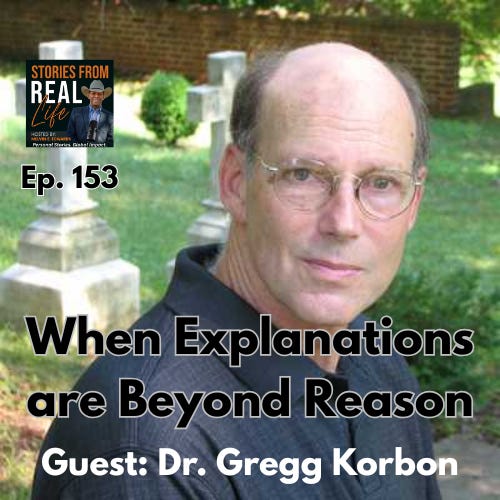
Dr. Gregg Korbon’s life was rooted in science, discipline, and achievement—through medicine, military service, martial arts, and teaching. But when his son, Brian, a deeply intuitive and gifted child, died just before his tenth birthday - just as he had predicted to his parents - everything changed. Out of unimaginable loss came dreams, synchronicities, and spiritual encounters that challenged the limits of reason. In this episode, we explore the themes of his book Beyond Reason: the transformative power of grief, the role of faith and intuition, and how loss can open us to a deeper consciousness of love and connection. Dr. Korbon also shares insights for those navigating grief, bridging the worlds of science and spirituality, and carrying forward the legacies of those we love.
Want to be a guest on Stories from Real Life? Send Melvin Edwards a message on PodMatch, here: https://www.podmatch.com/hostdetailpreview/storiesfromreallife.
storiesfromreallife.substack.com
Get full access to Melvin E. Edwards at storiesfromreallife.substack.com/subscribe
If you would like to support this podcast, please click on the PayPal link to make a donation today. Any amount is the perfect amount!
Thanks!
0:00 Today on Stories from Real Life with Melvin E. Edwards, we meet Dr. Greg Corbin, whose son Brian accurately predicted his own death at age 9. After the loss of his gifted son, Dr. Corbin found himself thrust into a world of grief, dreams, and mystical signs that challenged everything he knew as a physician and scientist. In this conversation, he shares the profound lessons beyond reason. How grief can open us to intuition, spiritual transformation, and a deeper understanding of love. In that two weeks before he died, he was tying up all his loose ends.
0:41 He died the day before Mother's Day. He'd never planned in advance before, but he had me get Catherine's Mother's Day present and her... Mother's Day card, and he had insisted that Catherine get my Father's Day card even though it was another month away. He had all the things that he meant to do, contact the grandparents and do this and do that. He tied up all his loose ends, a lot of which we didn't realize until later. Pull up a chair, it's story time with Dr. Greg Corbin. You are listening to Stories from Real Life, a podcast by engaging storytellers for engaged story listeners.
1:25 Here's your host, author and journalist, Melvin E. Edwards. Hello again, and welcome to another episode of Stories from Real Life. I'm your host, Melvin E. Edwards. Thank you for joining me for the podcast where personal stories can have a global impact. As you heard in the intro, our guest today is physician and author, Dr. Greg Corbin. Dr. Corbin, thank you for joining me today. Thank you for having me. It's a great pleasure. So we're going to spend a lot of time today talking about your son, Brian's story.
2:05 From what I understand, Brian was a brilliant, intuitive child who predicted he would not live to be 10 years old. Tell me about the weeks leading up to May 8th, 1993. Well, it all started when it was time for his ninth birthday, which is six months before he died. And Brian said he did not want to celebrate his birthday because it would bring his death closer. And he would not live to double digits, which would be age 10. And then he got very depressed. Now, let me give you background. Brian was this brilliant, gifted, child that just loved to entertain people and wrote wonderful poetry and he could do all kinds of stuff I couldn't do.
2:48 I couldn't write poetry and, uh, he would come up with this great stuff. And we were at a summer camp once and he went up on stage for talent night and he said, uh, uh, that he'd been doing, uh, karate for a few months and he demonstrated a karate form and, uh, It was like mesmerizing. He created this beautiful dance that we had never seen before. My wife and I looked at each other and went, wow. And all the kids at the camp all started chanting, Brian, Brian, Brian. It was like a magic moment. So he was, I've always prided myself on being bright, but he was smarter than I was.
3:34 And also just a very special kid. So he was extremely happy and brought a lot of joy to the people around him. So it was unusual for him to get so depressed. So for months, he was afraid to go to sleep. He was afraid that sleep would, you know, bring his death closer. And we didn't know what to do. My wife's a minister and a pastoral counselor. And my specialty is anesthesia and pain management, which is mostly like psychology. so but we didn't have a clue as to what was going on we took him to a therapist and he looked brian loved going to the therapist because he learned he was learning therapy and the therapist said he loved brian because brian was showing him you know how his brain worked in ways he hadn't seen before so they couldn't come up with any issues but over the next several months uh he started coming out of his depression And then about six weeks before he died, he said it was time for his party.
4:37 But he didn't want it to be a birthday party. He wanted it to be a happy spring party with just three friends and no presents. So in that six weeks, now, let me tell you that I was a very level-headed person. physician did not believe in paranormal even though i'd had a lot of paranormal experiences as a kid and a lot of close calls that i were miraculous for me to be here then when i look back you know it's guardian angel sort of stuff but my rational mind would not accept that so i was very no nonsense but all of these things were so it wasn't just what was going on um intellectually The universe was like orchestrating this event.
5:26 And I could feel it, but I couldn't understand it. It's like Brian and Lynn would be talking, you know, drawing butterflies all the time. When he started coming out of his depression, you know, they were doing that. And let's see, I think it was about three, four weeks before he died that a luna moth showed up on his window, his glass door. And I've never seen one before or since. And they're big 10 inch moths. They only live for 10 days and they don't have a mouth. They don't eat. And they're just like mayflies. And they exist to fly around, find them, lay eggs and then die.
6:11 This huge moth was on Brian's door for about 10 days. at nights, tapping on his door. Tap, tap, tap, tap all night. And the full moon would come and shine and cast its shadow on the floor right next to his bed. Things like that. It was like the Poe story. Tap, tap, tap, tapping on my chamber door. Nevermore. The Raven. I mean, all this stuff was happening. Brian was saying it was time for him to go on his trip. He'd hop in and he'd jump into a crate. We'd have a cardboard box. He said, it's time for me to go to Australia or Wisconsin.
6:53 And he'd hop in and he'd pretend he was mailing himself. So this theme of this trip was getting strong. I mean, which of course totally went over my head. I could feel the stuff, but I couldn't understand it. And then two days before Brian died, Catherine was driving home and she found him halfway down the driveway with his little red wagon, with his teddy bears and his camping gear. So it was time for him to go on his trip. And she said, well, you can't go on your trip. You got your birthday, your party, saying you have to spring party. So they sat on the side of the driveway and talked about it. And Catherine said, well, you've always been afraid to camp out.
7:36 in our tent so why don't we pitch the tent and that'll be your trip for tonight and then um and then you'll be here for your party the next day so he thought it was great you'd always been afraid to sleep out but uh we pitched the tent and you slept out with our dog sasha and i could tell you stories about sasha she was an alpha female and she was the most courageous dog i really could tell you some great stories about her i've had some amazing dogs and she um so she camped out with brian and one thing i think she was doing was giving brian her courage because you know that was she was you know really amazing one little story about sasha i went for a run in uh in the neighborhood into an area we hadn't been before and she was 40 pounds an Eskimo dog, mostly fur.
8:28 And we went to Snibbert, and three really big dogs, each of them were at least twice as big, really mean-looking dogs, came up over this hill to attack us. And Sasha looked at them, and I had never seen such fury. The closest dog she tore into, and the fight was over in about one second. Just pure fury. It's not how big the dog in the fight, but the fight and the dog. Okay, so that's just one example. So they spent the night and then Brian had his party. It was a most beautiful spring day. The party was over. And then he went to his room for a couple hours to finish things up before going to his little league baseball game.
9:15 And in that time, he put a sign on his door that I didn't see for a couple days. Brian's on a trip. Don't worry about me. He wrote goodbye letters. He wrote letters to, turns out, he invited his girlfriend to the party, but there was another girlfriend on the side he wrote this letter to. And something else. And in that two weeks before he died, he was tying up all his loose ends. He died the day before Mother's Day. He'd never planned in advance before, but he had me get Catherine's Mother's Day present and her Mother's Day card.
9:56 And he had insisted that Catherine get my Father's Day card, even though it was another month away. He had all the things that he meant to do, contact the grandparents and do this and do that. He tied up all his loose ends, a lot of which we didn't realize until later. Okay. So then it was time for me to take him to his Little League baseball game. And we went by the mailbox and he said, here, we need to mail these letters. And I said, Brian, they won't get there. They don't have stamps. He said, you don't understand. They will get there. He was insistent. So we put the letters in the mailbox, went to the baseball game. Now, this was his second Little League baseball game. He was a little good on the team.
10:39 Wasn't very good at baseball. And it wasn't really his thing. But I thought it'd be good for him. He was so intellectual. I thought it'd be good for him to be in a team sport. So he was a good sport. He went about it. But he'd always been afraid of the baseball. And, you know, he had trouble throwing the ball all the way from the outfield and stuff like that. It was a real stretch for him. But he was, as we went to the baseball field, he was like different. He was really enthusiastic. And he couldn't wait to get there. He said he wanted to score a run more than anything. And we got there. The coach, he said, Coach, you know, I want to be the pitcher. And he was chasing, you know, charging the ground balls and just totally different.
11:23 He was having the best time. And then it was his first time up at bat. And he was so little, he got walked. Next little boy, he had a triple. Ryan ran around the bases. You know, that's what he wanted to do more than anything. And he did it. And he ran home. We were cheering him. He gave high fives to everybody in his team. And in the dugout, fell over and collapsed. And so I'm an anesthesiologist. And that's what we do. We invented resuscitation. We invented ICUs. But we do it every day. So I went over and I said he should have an arrhythmia. We should be able to get him back. Rescue squad was right across the street.
12:04 He showed up in about a minute, and I thought, you know, we should be able to get him back. But I looked at him, and I knew he wasn't coming back. And we took him to the emergency room and then pronounced him there. And then I went to the Little League baseball field to get my car off. because it felt important for me not to leave it there. And I started having all these strange experiences that day. The winter of the baseball field was, it was the most beautiful spring day I had ever seen. It was absolutely perfect weather, blue sky. It was honeysuckle in the air, which is unusual for that time of year.
12:48 Usually that's much later. So the air was sweet. And I went to the area of the baseball field, and there were all these picnics, other baseball games going on, picnics, kids laughing, sound of music, and I smelled the food, the barbecue, and the honeysuckle, and I reached up to wipe and tear from my eye, and the vomit from Brian's, you know, on my hands, the sour smell, blended with the sweet honeysuckle. And all of a sudden, everything got clear. And I'd never experienced colors that bright or sounds that clear.
13:36 And it was like I was in a different state of consciousness. And I think it was a consciousness similar to what Brian was in after he died. and i knew that brian had finished his work he'd you know done everything he was supposed to and the only unfinished jobs was mine and that he was at peace and i didn't need to worry about him so that was one thing that happened that day and then went home and all these people came to So as we were in shock, and then I had to tuck my daughter in.
14:18 Brian was nine, and we had a daughter. She was seven, and she was in the first wave of autistic kids. Nobody knew what she was for years later. They told her she had cerebral palsy, but it was autism. And for an autistic kid, it was really sweet. So we've been blessed in that. So I went down to tell her and tuck her into bed and tell her that Brian had died and wouldn't be coming home. And I was not a religious person and I wasn't used to speaking in these things. Turns out physicians are the most uncomfortable people with death. I didn't realize until later, but I had been too.
15:01 One reason you go into it. The other people are ministers and therapists. They're the most uncomfortable with death. So I got in bed with her and I said, you know, Brian isn't here anymore. He's up in heaven. Didn't really know what that meant, but it seemed like a good thing to say. And she said, you know, Brian, no coming home? He said, oh, I said that dark. And then she looked up at the ceiling and her eyes focused. She got this wonderful smile on her face and she could see something. And I thought, what could she see?
15:41 And all of a sudden, I felt the bed vibrating. And I looked, and we were being carried along by a rippling river of energy waves. And I could tell that it had always been there, but I just could never see it before, and that Brian was now part of it. And I could feel it. So the mystery of what that river was, as well as the whole The whole thing. And things kept happening. It wasn't just, you know, it didn't end. Brian would be in his face now. Yeah, he'd be about 41.
16:22 So what do you think he would have done with his life if he had gotten the chance? Yeah, I can't answer that. This was not, you know, this was not a question that he didn't have multiple paths. The universe orchestrated this path. So it's like the dreams that come. So I can tell you about that. So we went to a support group for parents who lost children, compassionate friends. And over the next year, I'd listen while the other people... The other parents talked about it. And there were three kinds of dreams that came up. And I never saw, I've never seen anybody describe it, but I've, you know, I saw it over and again.
17:06 And the first were the pain dreams. And that's when, and I'm getting to your question in a roundabout way. So the first were the pain dreams. And when I resuscitated Brian, I shut down my emotions. But in my pain dreams that came for the next week, every night, I went back to this resuscitation scene. And I, you know, felt all of my helplessness, my pain, all my sadness that I had denied that day. And that's because that's part of the healing. In order to heal, you have to feel the pain. And the amount of people that told me that I needed to take sedatives to numb the pain was like, you know, everybody was saying that. I said, no, you know.
17:48 Even at the funeral, with all of the pain, I could feel that something wonderful was happening at the same time. And the idea that I would numb that and shut myself off of that, I could tell was wrong. So anyhow, the pain dreams, pain reveals and love heals. To feel to be on the healing path, you need to feel the pain. And the next one. that most people get are the I'm okay dreams. And those are usually months later. And you see them. They're a little bit older. They're like in heaven. And they're fine. And they're telling you they're okay. The problems are yours.
18:29 All of the pain and everything like that. Okay. And the last one is the goodbye dream. And I'm getting to your answer. Okay. Not everybody gets those, but I had a couple in different situations. And you go into the dream world and you call him back because you want to see him. And he shows up, although he's evolved. And he was a Christ figure. So I called him back, got in the backseat of my car. We visited for a while. And then he tried to lose his human shape. And I could tell he was confined by my car, my ego, my life.
19:10 It was too confining for him. And it was time for us to say goodbye, for us to go on our separate paths. He was no longer Brian. And I needed to let go of that for me to continue my evolution too. So he was supposed to be Brian for those nine years. And he came. He's a teacher. He taught his lesson. And so people have said, well, you know, do you think you'll see him again? Well, there was another goodbye dream I can tell you about if you want. And the answer is, you know, I don't want to see him again because he already told me that he's moved on.
20:00 He's no longer, you know, no longer just Brian. So the other goodbye dream, sort of, was, have you ever heard of the Monroe Institute? No. Yeah, okay. Let's see. After he died, all of these, you know, just amazing things happened to me. Teachers kept appearing. You know, the guy who wrote the book Magical Child, Joseph Chilton Pierce, who travels all around the world he used to spend a summer he's dead now but uh he wrote uh cracking the cosmic egg magical child and he uh only lives a half an hour from me and it turns out he and he became my mentor he had the most amazing experiences he used to spend summers in an ashram i mean i'd read about all the paranormal stuff his stories were way beyond you know anything i'd read And he traveled all around the world and met the most amazing, magical children.
21:07 Children that remembered all their lives, had magical powers, you know, and he would come back. So there's one human being on the entire planet. To help me understand a child like Brian, it was Joe Pierce, and he shows up right in my backyard. So then he lived off the grid. down south of charlottesville turns out charlottesville where i live is this little college town but and i didn't know it until i you know when the teacher is ready the student will appear so it turns out that charlottesville is like a spiritual center for the western world europe the americas australia new zealand the first books on um out of body experiences was bob monroe charlottesville First books on after-death experiences, Raymond Moody, Charlottesville.
22:05 First books on scientific verification of reincarnation, Ian Stevenson, Charlottesville. First books on remote viewing, military intelligence remote viewer 001, John McMonagle, who's a friend of mine, Charlottesville. Declaration of Independence, highest level of of consciousness ever written into a country and also fulfilled okay declaration of independence time of thomas jefferson that's the constitution bill of rights monroe and madison madison and monroe charlottesville all right so don't ask me why but every time you know something would happen i went to race car driving school afterwards and i had um Finished the last thing, adrenaline sport that I had wanted to do when I was talking to a nurse in the hospital.
23:03 And I said, gee, I've finished everything I want to do as a kid. I wonder what's in store for me next. She started talking about this guy she used to work for named Bob Monroe. And he was involved in a lot of spooky stuff. He worked with military intelligence, body experiences at this institute where they use sound waves. to get people to have higher levels of consciousness. So the next day I went to my first, I decided to bike commute. I'd always been afraid because bike commuting is dangerous.
23:44 People get hit every year here, you know. But one thing I discovered from the other parents of dead children was that we had all somehow lost our fear of death. So I decided I would bike commute. So I went to a bike class to learn how to fix the bike because I figured if I'm going to... And I've since biked over 40,000 miles. Wow. In the snow, in the rain, you know, before dawn, stuff like that. So the guy said, would you like to come riding, bicycle riding with me this weekend? We have a bunch of kids that we ride. And I said, sure. He said, he gave me directions. Okay, go out here in the middle of nowhere.
24:25 Turn left, turn right at the sign that says Monroe Institute. Two days in a row, you know, this nurse talks about it and then this guy. So I go and his father-in-law, who lives next door, is Joe Pierce. Okay, the guru. And because of Joe Pierce, Bob Monroe bought the land next to him and created his Monroe Institute. So I started going to Monroe Institute, which for me, it was an amazing experience and all kinds of stuff happened. And usually on the last full night, I would have usually all these questions and things that raise questions. And I had this blow up experience of consciousness that would like answer everything.
25:09 And this one. So I created a dream garden and a place to bring the call Brian back. And at that time, I hadn't had that goodbye dream that I told you. And I put all the stuff he liked, hummingbirds and all the stuff that we enjoyed together. And I created it and I put all my love in there and I called him to come. And sure enough, he came floating down like an angel. And I was so glad to see him. I put my arms around him. Brian, I'm so glad to see you. But he started turning into stone, turned into a stone statue. And I thought, okay, all right. I can begin to understand.
25:52 It's all right, Brian. I can understand, you know, you can't be here the way I remembered you. And then this light that had been in his body kind of floated up and out and up into the void. And I just, I tried with all my will. You know, I had spent my life making things happen by force of will. And I couldn't do it. So I was exhausted. So I gave up and I just floated up. And I saw a stone vortex in the emptiness rotating. And I thought that looks like a good place to rest. I was so tired. And I sat down there and spun in space with a clear light shining on it.
26:36 And all of a sudden, this presence showed up next to me. And it was a chipmunk, Brian's favorite animal. And I looked at him, and he looked me in the eye, and I could tell it was Brian. And then all of a sudden, everything went white. And this overwhelming, pure love, unconditional love that I'd never felt anything like it. just melted me down, melted away a lot of my ego. And in my book, Beyond Reason, I give that one sentence that it was actually one of the most life-changing things. After that, even more paranormal stuff started happening to me.
27:17 That was the goodbye dream in his way, but it changed me. So you describe grief as not just pain, but as a portal to insight. How did mystical experiences manifest for you during the time of understanding and putting together this book? When Brian died, I started losing. It's been a 30-year process, but I started losing my belief in physical reality. and gaining more belief into the dream world or the formless world. So it's like, and all of these mystical experiences, I just kept reinforcing that, that our physical reality, things would just appear, you know, and people would show up or, you know, you could manifest things or whatever.
28:08 So tons. You know, just about every paranormal experience you can have, I've had. And what they've been teaching me is that they're really not that important. Just signs, you know, that there's more going on than physical reality. And they're not to be used, they can be used for healing, but not for power. And if you want, I can give you a couple examples of that. Okay. Yes. Let's see. Telepathy. So you're familiar with telepathy? projecting your thoughts. You know, we've all had times like where you think about something, you know, and the phone rings and it's them, that kind of stuff like that.
28:52 But my first example of telepathy at the Monroe Institute, again, And I was coming out, and this was fairly early when we'd go astral travel to different worlds. But I, you know, they were never inhabited by very intelligent beings at the time. So you go see these beautiful, but you were the smartest person there, smartest person in the room. I was still limiting it to that. And I just finished and we were coming out of it. I had wonderful experiences. It was beautiful. And then all of a sudden, I felt like a ripping in my reality, like ripped open. And then this big silver platter with this brown loaf on it appeared.
29:35 But it felt like mental rape. It felt like it was very wrong. So then afterwards, we went for the debrief into the gathering area. And the facilitator, who was a very talented psychic, said, anybody get my message of chocolate? And I said, oh, that's what that was. He'd been drinking hot chocolate. When he was finishing up the tape and saying, okay, now it's time to come back and meet in the, you know, like that. So he had done that, but he'd sent that. And I said, oh, that's what that was. But I knew it was wrong. You know, I could just tell. Yes, you can do that. And people do that all the time. This MKUltra, mind alteration stuff, propaganda, it's wrong.
30:19 You're violating the sovereignty of your individuality, you know, and your free will. And that was the first time. And another time I had read about this friend, this guy who later became a friend, who was the manager of clinic. I forget what his name was. Psychiatrist. He wrote a lot of books on paranormal stuff. And he'd done something called the Copper Wall Experiment, where he took the most gifted psychics in the world, healers, put them in front of a copper wall, which shows up in ancient Egypt. You sit on a chair with glass underneath it. and project it against the copper wall and there's something above your head that's suspended.
31:00 So he recreated that. He brought in the most gifted healers from around the world and rigged them up to see if they could generate power. I never saw the data on that, although a friend of mine is recreating that at the Monroe Institute. I'd like to see what his data shows. Because I had a heart, I'm a scientist and I'm very critical for this sort of stuff. Apparently, I had heard that the only person who had generated a positive energy was this healer called Miatech Werkus, who it turns out was Polish. And he was famous for doing healing on stage and the lights would change. The lights would start going up and down, you know.
31:42 And so... Sure enough, just about every time I look for a healer, they're within about an hour or two. So he was up in DC. So I went and did a workshop with him. And we were working on telepathy. And the first day, we paired up in groups. You're supposed to let all your defenses down and receive the telepathic message. And the first day, I was the star. Actually, the message that I was supposed to get came to me before we even started. And instead of a short little phrase, it was a long one. And I said, how did you know that? So the next day we were supposed to do it again. And I paired up with somebody and we let our defenses down.
32:23 And all of a sudden I never felt anything quite like that. I went completely numb, shut down, couldn't feel a thing. Went back to my hotel room. I couldn't meditate. I'd never felt that numb before. Next morning, our final morning, We get back together and the guy that I paired up with, we were kind of telling our stories and saying goodbye. And he said, you know, this was my last hope. I've been on the verge of killing myself and I've tried everything and nothing worked. And I told myself, I'll try this. And if this doesn't work, I'm going to go home and blow my brains out. So my guardian angel, and I can tell you some stories from my childhood.
33:08 It kept me alive, protected me. So the idea of telepathy, those were my two lessons of telepathy, is that yes, you can do it, and no, you don't want to. So mystical or paranormal signs often follow laws. How do you differentiate between symbolic meaning and subjective interpretation of those experiences? Let's see. I'm not sure I do. I think, you know, when you're accepting these things, the intelligence is way beyond yours so you can categorize it in lots of ways like you just said but the best thing to do is just accept it and try and learn from it so since I've been aware of this incredible intelligence it's like you know it's so obvious I'm a beekeeper you see from the stuff behind me bees go out and they collect, you know, nectar from like average flight for each be 150 flowers.
34:13 And they have to minimize the amount of effort to go to 150 different flowers. So in information science and computer science, the hardest problem there is, is called the traveling salesman problem, which is exactly that. How to go to all these different places with the least amount of distance. And, uh, A difficult problem is maybe 30 places when they give computer science. So they use teams of math geniuses with supercomputers to solve this. And a honeybee does better. The honeybees would do better at solving it with a brain the size of the grain of sand than these supercomputers with these math geniuses.
35:00 So they took some of the bee behavior and they modeled their algorithms after that to get better results. So somehow this bee is operating at a higher intelligence than you and I could do every day, all right? Now you have the flowers that the bees go to, and their goal is to optimize the number of trips that the bees come to pollinate them with the least amount of nectar, because nectar is hard to make. So they want the bees to rub the pollen with the least amount of nectar. So what they do is they move the nectar around flowers of each plant randomly, okay?
35:41 But all the fields, flowers in the field coordinate, and they rotate the flowers that have nectar amongst themselves. And if you look at the mathematics that they're using, once again, it's way beyond, it's like math geniuses with supercomputers to optimize the amount of and the flowers do it all right and then you have the then you have the spiders that try and capture the honeybees and eat them so not to mention the fact that spiders don't have a brain just a spinal cord and they still lose wonderful marvel of a spider web but some bees will decorate the spider web with a landing pattern that mimics the landing pattern in infrared.
36:31 No, ultraviolet. The flowers have a landing pattern that guide the bees into the nectar. All right? So somehow these spiders that have never been in this flower, okay, will recreate the same landing pattern and put it on their web. But the flowers around them change every couple weeks. And the spider will change the landing pattern to mimic whatever is in bloom at the time. How does the spider know? Okay? So you don't have to go very far to be aware of the fact that we are surrounded by an intelligence far beyond ours.
37:16 And if they taught science correctly, everybody would believe in God, you know? They wouldn't have to know what God is, but everybody would go, you know, not to mention if we share all the stories like with Brian. So you referred to grief as a catalyst for a spiritual awakening. What shifts in belief or consciousness did you experience along? Yes. Well, the grief is this huge emptiness. And I had grown up. with lots of emptiness. I did not have a happy family.
37:58 And I, as a result, became an overachiever and an adrenaline junkie looking for a high because there was no home for me to rest in where, you know, that was my comfort zone was being away because being at home was, you know, had always been pretty bad. So I had always covered up The emptiness, it's like I went to race car driving school. I talk about it in the book. And I was just about to go on my spiritual journey. It was after Brian died. And I looked at it. We had all these talented men. Some flew in on their private jets.
38:40 One playboy came and he crashed. Over a week, he crashed five cars and just paid for them. I mean, these were super rich. My friend Chris and I as doctors felt like the working poor. And they were just using up and they were, but they were distant. They were distant. You know, there weren't a lot of fun to talk to. They didn't get together. And even the ones that brought their girlfriends, they were still quiet. And they were out there on the racetrack, you know, going round and round, using up all their energy, creating all this adrenaline and always pulling back into the same place, the pit of their emptiness.
39:21 And then what I learned through my grief as well as the grief of the other parents was that the emptiness was a portal. And so it's a two-way street and it's mystical. But if you let the love for your loved one be your guide, you follow the pain of the separation and the healing. I have somebody here who's trying to... So instead of numbing the pain or distracting from the pain, which is really what we do in our society, actually encourages it, is that if you have love, people will talk about going back to a painful experience, PTSD, all that.
40:11 Well, you can do that, but you have to have love. You have to have more love than when you were there. If you have love, you can heal. So if you have love, you can go back to that and recreate that pain. And it will transform you. So it's like going into the flame. And you'll come out different. But we need to. We are so limited. And when we first opened our eyes, we're awareness, bubble of limited awareness. And you have to outgrow it if you want to be happy. So how can health care professionals better support grieving individuals who report intuitive experiences that fall outside of conventional medicine.
40:55 Yeah. I just had my 50th medical school reunion on Zoom. And all these docs and death came up a lot because we lost 15 of our 112. And some are in poor health. So they're on their way. And so it seemed, you know, death kept coming up. So I said, you know, I had a son that taught me that you don't have to be afraid of death. And here's, you know, our website for anybody who's interested. So out of the, like, 80 docs, two answered and said that, you know, the rest wouldn't have anything to do with it.
41:36 Once again, doctors are some of the most afraid. And they would tell their stories of their life. I won this award. I taught at Harvard. I taught at Duke. I taught at Hopkins. They were so boring. Now, it's true. If you want to say they had happy lives, you know, compared to mine, mine was very, lots of adventures, lots of trauma. You know, I can't say that, you know, that one's better than the other, but they were the same, you know, and they didn't want to talk about death. So, all I can say is keep an open mind and an open heart. So, If you're a doctor, this stuff will show up and it will teach you.
42:20 But anyhow, that's a continuing problem. Are there any practices like dream journaling or mindfulness or anything else that you would recommend for those navigating loss and seeking spiritual understanding? Yes, of course. I had tried over, let's see, about the 31 years. Since Brian died, I'd done all kinds of spiritual practices, and they were all helpful. So I think when you first wake up and you're about to go to sleep, Einstein would work on those, you know, creating that right on the verge of sleep to get his ideas.
43:09 I mean, all the great scientists acknowledge that. Tesla, Einstein, Planck. You know, they had this problem, but they didn't solve it with their brain. It showed up at this kind of half-awake, half-sleep edge of regular consciousness. So they cultivated that. And that's where, you know, it doesn't have to be much. But I think that if you do some dream work, journaling, are open to anything that happens, especially when teachers show up, you know, if you're ready, then something will show up for sure. That's just the way it works. And trust, there's a duality, trust and responsibility.
43:53 If you trust, which is a learned thing, as you learn to trust the universe, it will respond more and more. So, but I would recommend that you do, it only has to be like five minutes of meditation a day, five minutes in the morning as you're just waking up and just going off to sleep. That's percentiveness. where you're no longer at the mercy of physical reality, is that you can now move into the dream world and into the oneness, where there's no form. You know, the Garden of Eden, when we started there, that story, so it was two things.
44:34 It was the intention to be separate. Eve wanted to disobey God. and be your own person, much like today's feminist. And then she took a bite of the apple. The snake eats the apple whole. So limited awareness. She took that and she chewed it up smaller, smaller, smaller, smaller. And that's what she swallowed. It's a tiny little bit of reality, which creates duality. Duality, duality, layers and layers, octaves, octaves. And you go into, you need a place to put that. So you need space. You're creating space. Because you need a place to put the parts. And then to tell the story, then you need time.
45:16 That's another way. So you're creating space and time. So what are you doing? You're creating all the world's stage. So what do you need for stage to tell the story? You need a place. You need limited awareness. Because the hero at the beginning always has stuff wrong with him. He's incomplete. And he goes through all these traumas, and then he becomes healed, you know, at the end. But he can't know the ending. He has to, you know, that's just how you tell the story. So when she takes that bite and wants to be separate, she's starting the process. So the healing process is going back, giving up the duality, giving up your desire to be separate, you know, giving up your...
46:06 desire to create a limited world. Moving forward, how do you envision continuing to guide others through grief and wonder? Okay, so I'm trying to let people know about Brian's story. And it's a great pleasure for me when I go through the Amazon comments to see that it's been a great help for people, grieving parents. So I get that. It brings a tear to my eye. You know, knowing that Brian still is helping to heal people. And then I'm finishing its launch. And then I'm trying to write another book.
46:48 I'm not trying. I'm going to start in another month writing the next book, which is everything I learned since I wrote the first book, which kind of ties it together to stuff that we were just talking about. Okay. And as a final question today, it's a question I ask all of my guests. what one piece of advice would you like to leave with the listeners on, on any topic? Piece of advice. Yeah. I don't like to give advice. So, uh, like, uh, uh, you are very courageous to be here, uh, to take on this, uh, journey, all the pain and suffering and the sorrow in the world. So I commend you.
47:28 Uh, and then, uh, as you, increase your awareness and heal your way back home. I wish you a safe journey. That's a great way to end this episode today. So our guest today has been Dr. Greg Corbin. Dr. Corbin, thank you so much for being here today. I appreciate it. My pleasure. Please go to my website at podcastreallife.com for more information about my guest and the things we discussed today, including a link to his website and his book. That's it for today's episode of Stories from Real Life. Join us again next time for another chance to learn from each other. Until then, don't forget to shine your light wherever you go. Don't forget to subscribe and share.
48:09 Let's meet right here every Tuesday and Friday. See you then.


