

 Spotify

 Apple Podcasts

 Goodpods

 Audacy

 iHeartRadio

 Youtube Music

 Amazon Music

 Audible

 Podchaser

 YouTube

 Castbox
 RSS Feed
Ep. 229 - David Deane Haskell: From Childhood Trauma to the Freedom of Recovery
What happens when a childhood tragedy shapes the way you see yourself for nearly half a century? And what does it take to finally believe you’re worthy of love, friendship, and happiness?
David Deane Haskell traveled halfway around the world to perform as a professional drummer at Tokyo Disneyland. It was an extraordinary opportunity, but behind the music and excitement was a man struggling with the lasting effects of childhood trauma, addiction, and profound feelings of shame.
David lost his mother when he was just four years old. Five years later, learning the circumstances of her death changed how he understood himself and his place in the world. For decades, he sought acceptance through music, writing, and relationships while battling the belief that he was fundamentally unworthy.
In this deeply personal conversation, David joins Melvin from Japan to discuss his memoir, Wounded Angels, and the difficult journey toward sobriety, forgiveness, and self-acceptance.
Together, they explore the difference between guilt and shame, how childhood experiences influence adult relationships, the challenges of repairing the damage caused by addiction, and the healing power of writing. David also reflects on rebuilding his relationship with his daughter, rediscovering his love of drumming, and embracing the possibility that his most meaningful years may still lie ahead.
When asked to complete the sentence, “The greatest freedom I’ve ever experienced is...” David offers a single-word answer that captures the meaning of his remarkable journey.
In this episode:
* How a childhood loss affected David’s identity and relationships.
* Why professional success couldn’t overcome his feelings of inadequacy.
* The difference between feeling guilty about something you’ve done and feeling ashamed of who you are.
* His journey through addiction, isolation, and recovery.
* How he rebuilt his relationship with his daughter.
* Why writing became an important part of his survival and healing.
* What living in Japan has taught him about himself.
* Why he believes his creative life is only beginning.
About the Guest
David Deane Haskell is an American author and professional drummer living in Japan. A former Tokyo Disneyland performer and member of the Blue Devils drum corps, he writes both memoir and science fiction. His memoir, Wounded Angels, explores childhood trauma, addiction, shame, and the process of emotional recovery.
Connect with David Deane Haskell
Website: https://daviddeanehaskell.com/
Wounded Angels: https://books2read.com/woundedangels
About Stories from Real Life
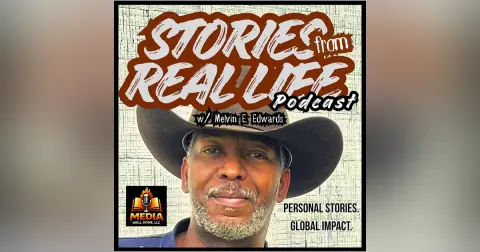
Hosted by award-winning journalist and author Melvin E. Edwards, Stories from Real Life explores the extraordinary experiences, unexpected journeys, and defining moments that shape ordinary people. Produced by Media Well Done.
Real People. Real Stories. Personal Stories. Global Impact.
Pull Up a Chair. It’s Story Time.
#StoriesFromRealLife #DavidDeaneHaskell #WoundedAngels #AddictionRecovery #ChildhoodTrauma #Healing #Memoir #MentalHealth #PersonalGrowth
Get full access to Melvin E. Edwards at storiesfromreallife.substack.com/subscribe
If you would like to support this podcast, please click on the PayPal link to make a donation today. Any amount is the perfect amount!
Thanks!
0:03 That's November 11th at 6 p.m. Central Time. See you there. [music] Stories from Real Life is a production of Media Well Done, LLC. You [music] are listening to Stories from Real Life, a podcast by engaging storytellers for engaged story listeners.
0:53 Here's your host, author [music] Hello, welcome to Stories from Real Life. I'm your host, Melvin E. Edwards. Thank you for spending some time with us. My guest today, David Dean Haskell, went all the way to Tokyo Disneyland to play drums. But the story that followed was far more complicated than anything he could have imagined. Behind the music, the excitement, and a new life in Japan were wounds that had followed him since childhood. David is an author whose memoir, Wounded Angels, examines what it means to confront parts of ourselves we'd rather forget.
1:35 Joining me today from Japan, David Dean Haskell has a remarkable story about loss, survival, forgiveness, and learning to live again. So David, welcome to Stories from Real Life. Thanks, Mel. I'm really grateful to be here. It's really awesome to be connecting with you from the future, as we were saying before we started recording. It's tomorrow. Yes, time travel. This is pretty cool, time travel. What's the future like? Is it better than the current time table here? I wish. I wish I had good things to report. Things are pretty dark these days, but I write sci-fi too, so I'm trying to be hopeful. Of all the ways a person might end up living in Japan, playing drums on trash cans at Tokyo Disneyland has to be among the most unusual.
2:15 How does that happen? Yeah, yeah, I would agree. Well, it happened. I mean, in your introduction, you talked about some of the difficulties that I've had in life. Childhood was rough because I lost my mom at an early age. And what I ended up turning to for my enjoyment and for my sense of pride and these kinds of things was drumming. And I just took I went to the drums like a duck to water. I ended up going out to the West Coast to Concord, California to join the best marching group in the world. It's called the Blue Devils. I was a member of the Blue Devils, played snare drum. And then a lot of these marching drummers, there aren't a lot of gigs. We're not like jazz guys who can get up on stage and play.
2:56 So the best place to go is theme parks. So we put together these trios playing on trash cans or playing in like little marching groups around Disneyland or Epcot, whatever. And I was doing that in Florida. And I heard, oh, hey, you know, one of the guys that you know from Blue Devils, he's out in California, in Tokyo, playing at Tokyo Disneyland. I went, well, how do you do that? How does that work? And then I heard that there was an audition tour coming around. I auditioned. They put me on a plane and paid me to play drums on trash cans in Tokyo, which was amazing. And I did that for about 10 years back and forth. And then I ended up settling here in 2001 and just never really left. All right, cool. That is cool.
3:37 So what was the first moment in Japan when you realized that your life had taken a turn you never could have predicted? Oh, I don't know. It's not like I thought, oh, wow, this is way different than I thought it would be a year ago. One thing led to another. I was sort of just in survival mode until, honestly, the last five years or so. And I'm 55 years old. So the first 50 years of my life, I was just trying to pay the bills, get by, and just try to survive the month, survive the year. I struggled with interpersonal relationships, couldn't maintain and keep friendships, felt like I was very unlikable.
4:22 I was a lot heavier doing drugs and alcohol and all these kinds of things to numb out. And I was just very, very unwell. Fortunately, about eight years ago, I got off drugs and alcohol. About five years ago, I started to deepen the healing thing and get into spirituality and wellness. Slowly but surely, I started to Build the life that I wanted. And this is part of it. Appearing on this podcast, I didn't want to do this even six months ago. I was like, what are you kidding? I don't want to be vulnerable. I don't want to put myself out there. I wish people would just read my book without me having to talk about it or without me having to have connections and these kinds of things. But the more I dream about putting together a life, even at this relatively late stage, The more I'm willing to take chances and do things.
5:09 So I think maybe around now is the time when I'm saying, hmm, my life is kind of going in a way that I didn't expect and I'm pretty okay with it, but it's not easy. You said relatively late stage in your life. Would you consider this your prime time? Well, I don't want to say that I regret, but I wasted a lot of time in my 20s and 30s and 40s because I was very unwell. So if I had a time machine, then I could go back and sort of take care of that guy. It all comes together. In my case, I don't speak for anybody else, but in my case, it's come together in a really beautiful way. I wouldn't change anything as painful as a lot of it was.
5:50 But I've had a lot of good fortune too. I'm grateful for a lot of things. I've had a lot of lucky breaks. So it's not like I'm sitting here going, oh, my life was horrible and now it's okay. It's not like that. But I was very unwell. I was very unwell. And a lot of people are when they get bogged down in trauma and addiction. And so I wasn't super grateful for it. And I kind of feel like I missed a lot of those opportunities. But I'll tell you one thing, the Disney thing, right? Who wouldn't enjoy banging on drums on trash cans and getting paid for it, right? But I was very unwell on the inside. I was dying on the inside. I was just really struggling. And so I was going, oh, yeah, whatever. It's a gig.
6:30 And I didn't really appreciate, wow, this is something that not a lot of people get to do. But last year, in the middle of the healing, I had a bunch of synchronicities went down. I was in Indonesia, of all places, traveling around. People heard about me. They heard about my background. They wanted me to go around and do a bunch of coaching clinics, basically a tour of Indonesia. And I just enjoyed every single moment of it. I was grateful. I was just appreciating the fact that people were vibing with what I was doing. I was appreciating listening to the kids play drums and these kinds of things, taking pictures. It was amazing.
7:10 And it was like I got the wonderful opportunity To have a second chance at this kind of thing and really, really be grateful for it. So I'm super pleased that that happened and lucky. Yeah, I consider myself lucky. That's great. You didn't have a very lucky break to start out your life, a very young age. You've spoken about losing your mother when you were just four years old. What do you actually remember about her and what did you have to piece together from other people's memories? I don't remember anything about my mother, sadly. I do have memories of times when she was still alive. I had just turned four. But I mean, I think I have some clear memories of some things that happened when I was three.
7:54 I have clear memories of that family because my mother's side of the family basically disintegrated when she died because she died under tragic circumstances. My grandparents divorced and literally five or six key people in my life vanished. So not only my mother. I hadn't really thought about that at the time. Yeah, no, my grandfather, I never saw him again. My stepfather, who my mother had married, he gave me a kiss and said goodbye and said, see you soon and disappeared. And a couple of cousin playmates I didn't reconnect with until adulthood. Yeah, yeah, yeah. I hadn't even really given that a lot of thought. It was just, oh, David's mother died.
8:35 No, it was a real explosion. It was real shock and trauma at age four. Then at age nine, I learned even more about the circumstances around her death, which were, again, tragic and caused me a great deal of PTSD shock, like shame and dread. And a sense that, you know, I was really broken. Like, this is why I can't make friends. This is why I can't get along. You know, it's hopeless. I won't be able to fix this. You know, there's just no way to fix this. And that's the way trauma works, sadly. And it is. The hopeful message I have for people is, at least in my case, it was fixable. It wasn't easy. It was painful and it took a long time, but it was fixable.
9:15 And so the self-loathing and self-hatred and that kind of stuff was very trauma-related. And believing that I wasn't likable and wasn't lovable and these kinds of things was trauma-related. And I no longer feel that way. So when I talk to people who have similar stories, I kind of think I have a message of hope in those lines because, yeah, we can't overcome things. At what point did you start to feel likable? A couple of years ago, not that long ago. I've really only been on the healing path, as I say. Well, eight years really since I hit really rock bottom and was able to get away from the substance abuse, which there was no hope at that.
9:56 If you're doing drinking and drugs and numbing out like that or other severe addictions, it's very difficult. You got to get off that first, first and foremost. But even after that, I was still struggling with relationships. I was struggling with codependency. I hadn't started doing the inner child work, which is what became very transformational in the last five years or so. So I'll tell you, I did these Affirmations, because I was trying to do a lot of work on it, you know, and like to say I'm likable and to sort of want to throw up, you know, and think, oh, that's disgusting. That's not true. You know, I was doing these affirmations. One was I'm likable. I'm valuable.
10:36 I'm, and a couple others I can't remember at the moment, but the one that really made me cringe the most was I'm valuable because I had this real belief that I was worthless. And that I had to earn my plate. Like I had to be a good drummer or a good writer or a good whatever to make you like me. So that then maybe I could have a friend or an ally for that matter. Because the world's a scary place, man. We need friends. We need support. We need people who understand us. And I was very alone for a long time. And that was rough. Wow. That's hard. That's hard to hear. You were nine years old when you learned the circumstances of your mother's death, as you mentioned. And without being graphic, she took her own life.
11:18 When... When you look back, if you have photographs of yourself when you were a child, can you see the pain in yourself in those photographs? Yeah, I can. And not only that, when I look at photographs from like five to 10, I think I see more innocence there and more like I was not okay. I was never really okay because I always, you know, my mom had died and my dad was alcoholic as well. He passed away just last year and I had a difficult... Relationship with him. I loved him. I realized that when he passed away is I loved him, but I feared him. And so it was a lot of instability there. But from five to 10, I didn't know the circumstances.
12:01 And I tend to think I was kind of hopeful, like maybe I'll overcome this. But once I learned that she had taken her own life, that just really devastated me. There was this Flood of shock and shame, which I write about. That's the key of the whole thing that I write. The book is about that shock and what it did to me, this trauma. The thing is, I didn't know what it was at the time, but now I look back and I see that was what I call a shame attack. A lot of people don't know shame as well as they know things like panic and So people can relate to a panic attack. Even if you don't have panic attacks, you can understand the idea of it because if a tiger approached, you would know what a panic attack feels like.
12:46 We can imagine it. But shame is different. We don't talk about shame. We don't explain it. And so this toxic shame thing that happened to me, I didn't know what it was. I just knew I felt gross and horrible and wrong and hopeless. And I didn't think there was any way I could fix it. And I just sort of shrank inward. Yeah. And it was very, very difficult to deal with. Wow. So the name of your memoir, as I mentioned at the top, is Wounded Angel. I'm curious, was the wounded angel, the angel, you as a child or you as a grownup? Yeah. So it's Wounded Angels, actually. And that's the various inner child facets. And the thing is, I've gotten some flack for the title. Like a stranger told me, well, that title is no good.
13:28 You'll never sell any books. You need to make a title about them, not you, something. And I did think about it when I titled it. I thought, I'm no angel. You know what I mean? I've done plenty in my life that I'm not proud of. But I didn't title the book. The inner child did. And that was the thing. Wounded Angels definitely refers to that nine-year-old. And any nine-year-old, any child that goes through trauma, I used to look back at myself and think he's pathetic or he should have got his act together. He should have figured out how to make friends. But now I look back on that and I think if I was looking at any other nine-year-old, And I often say when people talk about I don't like myself or I was a bad kid, these kinds of things, that's trauma talking, I think.
14:13 Because when you think about it logically, If you met some other kid, would you think such horrible things about a kid who was nine or seven or whatever? So yeah, that's the wounded angels and they're the angels within me. And as I said earlier, I don't have any memory of my mother, but people sort of talked her up like she was some kind of angelic figure. Oh, she was so lovely. She was so wonderful. And that was before I learned how she had died. So that kind of got built up in me that she was some sort of angelic figure. So in my mind, in childhood, there was a lot of kind of angel imagery and also a lot of pain.
14:59 So that's where the book title came from. Okay. So you became a performer, a father, and a writer. How much of that do you think was driven by the need to prove something about yourself? Yeah. A lot of it, a lot of it. I started with piano and I was third grade or so and I was being bullied and I was defiant. I was picking fights too. I'm not saying I was sitting around innocent. It wasn't like that, but I was struggling with relationships. But when I got up and played the piano, all of a sudden, oh, look at Haskell. Oh, he can play. Wow, that's pretty cool. Play something else. And I sort of became safe. I was like, to entertain people when you get up on stage, it's kind of a safety thing. Weirdly enough, I think when I've seen some Michael Jackson interviews, I felt that sense from him that he was like really troubled, but then he could get up on stage and that was a place where he was untouchable.
15:49 And I think, you know, that's a thing. And a lot of, you know, you see Hollywood people like that, that are struggling and like when they're When the camera's on or they're under the lights, then you can't really criticize. That's the thing. Another thing was my dad was critical. I'm not sure why. When I look back, I wonder if it was even competitive or something. He used to criticize my drumming, and he knew nothing about drumming. And I was a world-class drummer. I'll tell you, I have the proof. I was in the best marching group in the world. And then I got hired by Disney, professional level, world-class level. And he used to watch me play and he would comment.
16:30 He'd say, oh, you made a mistake. Oh, you didn't do it right. And it would cause me shame and to feel inadequate because I think I was trying to prove something to him. Like, look, I'm not a burden. I'm not unimportant. I can do these things. Be proud of me. Then I did the same thing with writing because the drumming involves interpersonal relationships and you have to be able to gig with people and vibe with people. I was getting worse and worse, so I wasn't able to do that. What else can I do? I can write. I can reach out. Then, well, I have to get good at it because otherwise nobody's going to pay attention to me. I became really good at writing. Nice. So do you feel totally confident about your writing or is that something you also sometimes struggle with?
17:14 No. No, I have total imposter syndrome all the time. When I say that I'm good at writing, that's me looking at it intellectually and looking at the responses and those kinds of things. I go back and forth. I think the nonfiction, I actually did the second edition recently and I also did the audio book. So I was literally going line by line. And I realized that this is a really powerful, important story. I think people can really benefit from it. And I didn't do a lot of edits. It sort of wrote itself because it's nonfiction, right? You can't have a plot hole in nonfiction. It is what it is. You might not agree with my interpretation, but so I'm more confident with my nonfiction writing. The fiction, it's like, someday maybe I'll write something good.
17:55 But then on a better self-esteem day, I'll read what I write and I think, wow, that's pretty good stuff. Maybe somebody can vibe from it. When people read it and they tell me that they liked this or that, I really feel gratified because then I feel like, okay, I'm judging myself from a very harsh lens. Even with the drumming, not that I would criticize the performing itself because I knew it was high level, but I criticized my soloing. Or I thought like, oh, that's kind of lame. Or that's kind of a dumb idea. But again, that's trauma talking. You know what I mean? It's like, it's a music solo. You can play whatever you want.
18:36 Why would you be so down on yourself? So yeah, that's a great question because the imposter syndrome is something I have been working on a lot for years. You talk about fiction versus nonfiction. Could you have written the story as fiction and sort of protected, giving yourself more cover? Or did you feel like you were going to just rip the bandaid off and just expose yourself totally? I've thought about fictionalizing the inner child because there's so many, I feel, I don't want to sound like I'm completely insane because like, you know, but there's all these different parts of me, personality parts and whatnot. There's a defiant teenager. There's a, you know, scared little kid and, you know, and there's a lot of different ones.
19:17 And I thought about fictionalizing that. And I think I do. I actually, my newest book, which is coming up in a few months, there's three main characters, the three guys, very creative and very different. And I was like, oh, that's me, myself and I. It's like three different, like, Elements of myself. One of them is really cocky and thinks he's kind of, you know, he's got his, you know, he can do anything and he's better. Another one is really imposter syndrome and feels completely inadequate. It's like, yeah, I felt both of those things, you know, from time to time. And then And another one is he's kind of like had a lot of breaks and feels like he has something to prove because he's had lucky breaks. And I felt like that too, because I felt I've had bad breaks for sure.
19:58 And I've also felt that I've had lucky breaks. I mean, ending up in Japan, I beat out dozens of guys in the audition and a lot of good players, you know, as I didn't think I was particularly, I could have won, I could have lost, but I got lucky, you know, and I got a lot of good fortune from that. So I'm grateful for that stuff. How did you separate the shame you felt about your past from the responsibility that you still needed in order to take responsibility for your actions? There's a difference between shame and guilt. This is one thing that it's important for people to understand. As in active addiction, I did real harm, especially to my ex-wife and even more especially to my daughter, who I love very much.
20:40 She's 22 years old now. We have a wonderful relationship, thankfully, at least 50% thanks to her efforts or more because it was a very mutual relationship. Healing. But at age 13, 14, she said, you were horrible last night. I don't even want to see your face. She didn't want to. And I understand because I grew up the son of an alcoholic. I did real harm and I felt guilty about it and I did my best to repair it. I don't feel guilt anymore. I don't think you have to carry guilt forever. If you're walking down the street with your face in your cell phone and you knock over a little kid, you should feel guilty.
21:21 You've done harm. Then you pick up the kid, you apologize, you do your best. It might not be intentional, but still, we should feel guilt. Shame is a whole different thing. Shame is there's something wrong with me. It's very primitive emotion. By the way, I'm not a doctor. I don't have any training in this. This is all my experience. But shame, in my experience, it's a very primal, tribal thing where we feel shame when we think we've done something that's going to get us cast out, that's going to get us rejected by the group. Because back thousands, hundreds of thousands of years ago, if you got cast out by the group, you died.
22:03 It's very, very powerful and similar to panic. Panic is a very powerful thing too. It's going to save your life. Shame could save your life too because if you're doing shameful things or you perceive that you might be doing shameful things or others, here's the thing for me, others were telling me or I was believing what people were saying and getting scapegoated into thinking that I should feel shame. You know, that goes way, way deep into survival. And so, you know, for me, shame, it still comes from time to time. I can feel it. I'm very aware of it. It feels gross. I hate it. But I can also separate it from like, I didn't do anything shameful. Sometimes somebody else's bad behavior will make me feel shame because I'm associated with them or something.
22:49 Somebody I respect, if they mistreat a convenience store employee or something like that, suddenly I'll feel a flood of shame. It's weird. And I used to say, I have a broken shame valve, but I think- I mean, that's just something I'm learning to sit with these emotions as they flood through me. That's kind of all I can do. You can't really make them go away. But with the mindfulness, it gets easier and it also gets quicker to do the self-care and get done with it. So I might feel those floods of emotions, but I'm not spun out for a week anymore. I can get away from the situation, sit calmly, prayer, meditation, that kind of thing, and get myself right pretty quickly within an hour or two or maybe a day.
23:33 If it's an upsetting, because sometimes there's upsetting situations and we get triggered and whatnot. But yeah, that's what I would say about shame and guilt. All right. I want to go one question deeper on that. Hopefully it's not too personal. You define shame as... Yeah. Well, I had family. That was part of it. So I mean, that was exactly it. So when I felt that shame attack, shame shock when I was nine years old, I had, as I said, my whole family had already disintegrated when I was four.
24:17 And so to learn the circumstances, There's age-appropriate ways to talk to kids. He used to say things like, I'm glad that your mother didn't decide to kill you when she died because a lot of people who commit suicide kill their kids. Now, I think he was sincere. Dumb about the way he just, whatever. But it was harmful. I don't know what went through my head, but that caused shame. That caused floods of shame in the sense of like, why would she hate me? Why would she want me dead? Was my mother a monster? So that certainly added to the shame.
24:59 And also in terms of the peers, the sense that I was hopeful to somehow, someday make a friend when I was nine. But then feeling that shame, I felt like, oh, this is really hopeless. I'll never be able to get over this. What if they hear about it? What will they say about me when they hear how my mother died? All those kinds of things. And again, it's child brain. It's not rational stuff. Okay, let's take that. Same line of thinking, the child brain, into adulthood. After you became sober, you were unable to write for a few years. Was that shame-based, do you think? No. The writer's block was five full years.
25:40 And what it really came down to was I was doing emotional and spiritual healing, and I didn't have any more creative bandwidth to write. I was trying to write, but I was journaling. I was doing, again, the affirmations, the inner child work, the gratitude lists, these kinds of things, sort of rebuilding a personality that didn't feel those kinds of toxic shame and toxic emotions. So yeah, no, I don't think that was particularly shame-based. I don't really take a lot of actions based on shame these days. When I was in active addiction, I did. Because it was like, okay, well, if I just isolate myself.
26:23 I was a hermit for about 11 years. I was 100 pounds heavier. I had lost all the music jobs. I hadn't been working for Disney for 10 years. And I was just in the room, shades closed, never went outside, never exercised, ate McDonald's every other day or every day, drinking and just trying to survive. And I was working, teaching English, making just enough money to get by. And that's when I started writing, actually. So it was like, what I'm going to try to do, I'm just going to try to do something, anything to, you know, keep some little spark of hope alive. And so that's when the first four fiction books came out, was from 2013 to 2019.
27:03 And I'm very proud of them now. I used to think, oh, they were garbage. Nobody's going to want to read them. But I went and did second editions on three of them recently, this year, and, you know, fixed up You know, the rookie issues, but, you know, man, I was, what was I doing? I was trying to overcome this. I was trying to, like, actually, you know, not give up on life entirely because, I mean, this stuff can really kill you. You know, some people do die from this. You can get lower and lower, and not everybody, you know, has this, you know, remarkable turnaround. But I am kind of a case study where, like, yes, it is possible. You know, and I can't speak for anybody else, but I can certainly say I'm better now than I was five, 10 years ago, for sure.
27:48 Like, no doubt. That's great to hear. So your science fiction explores humanity, technology, and futuristic stories. What does the future look like in your story? My personal story? Your personal story. I'm very hopeful. I'm very hopeful. I don't know what the future holds. Future tripping is a big problem for me. If things were okay today and probably look good next week and next month, I'm going to start worrying about next year. I'm going to say, well, next year, I'm going to have to move. I'm going to have to find a new house. I'm going to need to make more money. I'm going to need this or that. What if the publishing doesn't work out? What if nobody ever buys my books?
28:30 Then what? Well, I can't say, but I am putting a lot of effort into my creative self and I'm putting a lot of effort into the business as well. This is part of it. Doing outreaches to appear on podcasts to connect with podcasters and potential readers is a huge shift for me in the last four months. I wouldn't have done this. I did a couple of podcasts last year. But I wasn't putting a lot of effort into it because I didn't want people to hear from me. The imposter syndrome, nobody's going to want to hear it. But secondly, I don't believe in gurus. I'm not a guru. I don't like the idea that I have something to teach somebody necessarily.
29:10 I think I'm here to share my experience and mainly through the book. And then if you can see what my experience was, I think maybe that can inspire people to pursue their own healing. But that's pretty much it when it comes to the nonfiction and the sci-fi stuff. I just want to I just want to rock the world with that stuff. I have a lot of interesting... The future is a very incredible, limitless thing. And I've always been the optimistic future guy, even as dark as things are these days. That's great to hear because we can always use more optimism. So what does your daughter think of your books? She hasn't read them, I'll tell you. She hasn't read them and one of them is dedicated to her and she hasn't read it.
29:53 She hasn't watched any of my podcasts either. And it's funny because I said, I have some family members that I fear talking about everything openly because I think, well, what if they hear this or that and they feel insulted or they feel angry with me? It's very difficult when you're a memoir writer. What are you going to do? Either you tell the truth or you don't, right? But I always have incredible, loving, optimistic praise and nice things to say about my daughter. And yet she doesn't watch the podcast. So I keep telling her, like, you ought to watch the podcast. You know, I said all these nice things about you. And she laughs about it. We have an amazing relationship. She's the love of my life, like my heart. She's 22 years old.
30:35 She's an amazing young woman. She knows she can come to me for guidance, but she also knows that I will respect her boundaries as an adult. If she doesn't want my advice, she can just tell me what's going on. She's very wise. I know she's been through the ringer because she grew up with an alcoholic dad and that's trauma. And again, we've worked for, so since she was 14 is when I quit the drugs and alcohol. Since she's 22 now, eight years, it has just become absolutely the most important and beautiful relationship of my life. I'm divorced, I'm single now, so I don't have a partner. My family means a lot to me. Friendships mean a lot to me, but my daughter is the ultimate person.
31:16 Symbol of healing, I think. And I think she would say that too. And one of these days, maybe she was invited to appear on a podcast. There was a podcaster who was out here and he was like, oh, why don't you bring your daughter in? And she thought about it and thought about it and she's not going to do it. So that's all right. That's fine. But she's on her own journey and I'm proud of her and I love her so much. What kind of legacy do you want to leave for Lisa? I don't think I'm quite ready to start with the legacy stuff because again, 55 years old, but there was a lot of arrested development. I don't say that I regret my 20s or 30s or 40s. I did a lot and I was building something, but I was always kind of Two steps forward, three steps back because of the unwellness, the addiction and whatnot.
31:59 So I kind of feel in a way that I'm just getting started. As I say, the last 18 months or so, I've been really building up the publishing business, taking the writing very, very seriously. I intend to sell a lot of books and connect with a lot of readers because I have something to say. And do you know Shohei Otani, the baseball player? Are you familiar with that? Oh, yeah. Yeah. I don't know anybody who doesn't know him. Well, a few people don't, but I have a dream, which is to be the Shohei Otani of the writing world. I want to be equally well-known for nonfiction and fiction. And I don't know if anybody's ever really done that. I don't know if recently. Right here. I released my first novel this year.
32:41 Awesome. This is my nonfiction. Sweet. Eight generations of my family. All right. Well, we can get right up there on the charts, you and I, and we'll be having a lot of conversations like this. You can be Shohei and I'll be Babe Ruth. How's that? That sounds fine. Off pitching and hitting. Yeah. Awesome. All right. You spend much of your life trying to become someone else. So who is David Dean Haskell when he no longer feels the need to prove anything? Hmm. That's still a question I can't really answer. Learning about myself has been huge and it's time consuming. The more I get to know myself and my integrity, my sense of faith and spirituality, my sense of right and wrong, the more I realize how much conditioning there was, how much I was listening to the adults around me, the influential people around me, and also treating them like they couldn't be wrong.
33:37 And the thing is, there was a lot of unwell people around me. And I was very unwell for a long time. I'm still, I have my ups and downs, but I'm on the path to getting healthier, hopefully. And so when I reflect and meditate and pray about a situation, I come up with pretty good answers that I'm pretty okay with. Like how to handle... A conflict with somebody or how to handle a business decision or how to be helpful or to step back if somebody's not asking me for help. I'm getting much, much better at that. But at the same time, still, I don't know what I want entirely. Because even the publishing and that kind of thing, do I really want huge success?
34:19 What would that look like? What would my responsibilities be? I'm opening myself up for attack, right? The internet is a cesspool. With people who are more than willing to say hateful, vitriolic things. And I see people go through it all the time. Do I really want that? And so I'm putting all that together with what the dreams mean to me. And so, yeah, if you ask me this in 10 or 20 years, I'll probably have a better answer. Okay. Well, meet me back here in 10 or 20 years and we'll talk about it. I hope so, yeah. All right. So as we start to wind down the conversation, I've got some rapid fire questions I have for you. So I'll just give you the question. You give me a quick answer.
34:59 What's one thing about Japan that Americans consistently misunderstand? They're not as polite as you might think. Okay. If you could play drums with any musician in history, who would it be? Stevie Wonder. Didn't expect that answer. I thought for sure you'd say Ringo because that's what I would have said. No, Stevie. Do you know Stevie's a drummer? He did, yes. Some of his best tracks is Stevie himself playing drums. I was so disappointed. I know this is rapid fire, but I went to see Stevie in Tokyo and he didn't play a drum solo and I was so disappointed. And then I read in a review like a month or two later, he was in America and he was playing drum solos every night. Man. Yeah. Yeah. The two most surprising drummers that I discovered much later after the peak of their career was Stevie Wonder and Karen Carpenter.
35:44 Yeah. Oh, Karen. Oh my God. Yeah. For sure. She's really good. Brilliant. Okay. What's the strangest thing that ever happened to you while you were performing at Tokyo Disneyland? I dropped a trash can on the ground and it made a huge noise. And then all of a sudden the whole audience went silent and they were just staring at me like I'd done something really offensive. And I just wanted to run away and hide. It was like the bizarrest thing. If you had been Oscar from Sesame Street, you could have just crawled into the garbage can. Totally. Put the lid down. All right. So what has taught you more about yourself, music or writing? Writing. All right. Last question of the day. It's not even really a question. So complete this sentence.
36:25 The greatest freedom I've ever experienced is? Recovery. That's a good, good way to end this conversation. So thank you for your honesty, your vulnerability, and reminding us that it's never too late to write a different chapter in your own story. So David, thank you so much for being here today. I really, really appreciate it. Thank you too, Mel. I really appreciate what you do. Thank you. So the links to the things we discussed in this episode are available below in the show notes. That's it for this week's episode of Stories from Real Life. Until next time, don't forget to shine your light wherever you go. [music] That was Stories from Real Life.
37:06 Join us again next week for another great storytelling journey. See you next time. [music] Stories from Real Life is a production of Media Well Done, LLC.


