

 Spotify

 Apple Podcasts

 Goodpods

 Audacy

 iHeartRadio

 Youtube Music

 Amazon Music

 Audible

 Podchaser

 YouTube

 Castbox
 RSS Feed
Ep. 142 - Free Black Virginians in a Slave Society
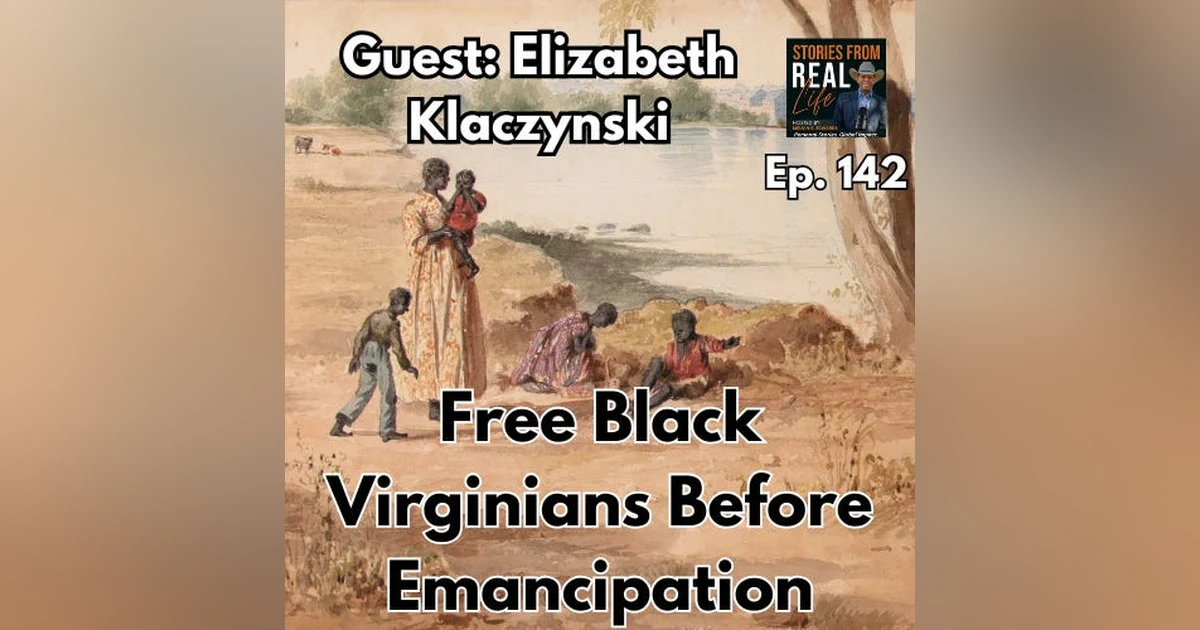

In this episode of "Stories from Real Life," host Melvin E. Edwards sits down with Elizabeth Klaczynski, curator at the Virginia Museum of History and Culture. They delve into the fascinating history of free Black Virginians from 1619 to 1865, exploring themes of freedom, identity, and resilience.
Elizabeth shares insights from her exhibition "Un/Bound," highlighting the untold stories of individuals who navigated systemic oppression with creativity and determination. Tune in for a thought-provoking discussion that challenges our understanding of American history and identity.
https://virginiahistory.org/exhibitions/unbound-free-black-virginians-1619-1865
https://www.linkedin.com/in/elizabeth-klaczynski-05ba0824/
https://virginiahistory.org/unbound-free-black-virginians-1619-1865-traveling-exhibition
Want to be a guest on Stories from Real Life? Send Melvin Edwards a message on PodMatch, here: https://www.podmatch.com/hostdetailpreview/storiesfromreallife. www.podcastreallife.com
storiesfromreallife.substack.com
Get full access to Melvin E. Edwards at storiesfromreallife.substack.com/subscribe
If you would like to support this podcast, please click on the PayPal link to make a donation today. Any amount is the perfect amount!
Thanks!
0:02 In this episode of Stories from Real Life with Melvin E. Edwards, we dive into the powerful truths behind the exhibit, Unbound Free Black Virginians, 1619 to 1865. Our guest is Elizabeth Klesinski, the exhibit's curator at the Virginia Museum of History and Culture. She's here to share stories of struggle, survival, and strength in a world built to deny freedom. We take a powerful journey into the lives of free Black Virginians before emancipation. People who walked a tightrope between liberty and oppression, resilience and risk. First, I just think that most people have no idea that these people existed.
0:45 Here in Virginia in 1860, there were 60,000 free Black Virginians. Right? Like, that's a huge number. There were... I think there were... I can't remember how many were enslaved. I want to say close to half a million in 1860. But 60,000 is a significant number, you know? So I think just acknowledging that these people were here, I think is really important and a big takeaway to take home from this show. Pull up a chair for this episode with guest Elizabeth Klesinski. You are listening to Stories from Real Life, a podcast by engaging storytellers for engaged story listeners.
1:28 Here's your host, author and journalist, Melvin E. Edwards. Hello again, and welcome to another episode of Stories from Real Life. I'm your host, Melvin E. Edwards. Thank you for joining me for the podcast where personal stories can have a global impact. Before I begin today, I want to say thank you to Noe Banda, who recently sent a donation to the show. Noe, I appreciate you. If any of the listeners are interested in contributing, you can do so on my website or Substack. Look for links in the show notes. Now let's get to today's show.
2:09 As you heard in the intro, our guest today is Elizabeth Klesinski, a curator at the Virginia Museum of History and Culture. Elizabeth, thank you for joining me today. Oh, thank you for having me. This is a pleasure. Yes, I'm looking forward to this topic today. So I read during my research preparing for this that you once described wanting to be an historian as early as a fourth grade. Yes, that is true. And you later studied early American and Southern history at Rice University in my hometown of Houston, Texas, before you went on to Harvard and the University of Virginia, where my daughter-in-law went to school. Oh, nice. I actually did not go to Harvard. I went to Oxford.
2:50 Well, sorry. I've got Oxford right here, and I said Harvard. I don't know why I said it. It's all good. Oxford. That's way better than Harvard. That's way better. You went to Oxford. How did you go from Rice to Oxford? I actually did a year abroad, my junior year abroad at Oxford, and I just loved it so much. And I went to study American history in the UK, which was a little unconventional. But as you sort of mentioned, I specialize more in early American. So it made some sense. The perspective was just really interesting, too. So how did that trajectory shape the kinds of questions you bring to African-American history?
3:33 Oh, that's a great question. So I'm really interested in questions of the American experience, right? And these values that we espouse and also just... American identity. And I think, you know, viewing those questions through the lens of Black history is incredibly important and incredibly fulfilling, but also tells a really complicated story, right? And it's just been a fascination of mine from a really young age. One of the motivating... factors sort of in me studying Black history and specializing it is what, how did this all happen and why, right?
4:20 So I did really bring, I think, that perspective also to the exhibition I worked on, which we'll talk about. It was called Unbound Free Black Virginians, 1619 to 1865. really, really fascinating stories that we unearthed that ask really, really hard and enduring questions about freedom and American identity and who is free and on what terms and what it all means. Well, this is a topic that's very personal for me, probably, obviously, but also because I've studied this subject from my own family's perspective here in Texas. Oh, wow. And we can talk about that as we go through this discussion, if you'd like.
5:02 But I'd like to focus on you and the exhibition right now. So was there a specific moment during your time at Rice, Oxford or UVA when African-American history moved from being sort of part of the background to a central focus for you? That's another great question. I would really say when I worked on my master's thesis, which was a sort of a micro history of a court case in 17th century Virginia involving a man named Andrew James, who was enslaved. from a very young age, and it was essentially a lawsuit and a court petition to prove that he had earned his freedom.
5:44 So I think that was sort of really the turning point. I wondered, again, I was saying... what did this feel like? How was this world possible? What were these people thinking and feeling? And I've always been really motivated by stories. I call myself a very bad historian because I don't remember dates. I'm horrible with names. I don't care about theories as much as I care about the experiences of of real people and kind of getting into their, their heads, you know, history is just a collection of stories that happen to be written down or recorded or remembered.
6:28 So that's always, it's been a really fascinating topic to me. Okay. So when you curated Unbound, Free Virginians, Free Black Virginians, 1619 to 1865, what was your starting point in thinking about how to tell a story that's often overlooked in the dominant narrative? Yeah. Oh, you have, you're asking great questions. I love this. This is awesome. Well, my first thing that I had to kind of get my head around is this is a lot of history, right? This is a pretty long span. One of the, I think, unique things about this exhibition actually is sort of the magnitude of it. To our knowledge, there hasn't been an institution that's explored this history from a, like an exhibition perspective.
7:14 Yeah. spanning that amount of time. So I knew this story would have to have some chronological beats, like figuring out how to break that up. But I was really focused on mostly the themes and the people that we wanted to discuss. We were really lucky. We had a panel of advisors, so professors and graduate students who at universities here in Virginia that they specialize in this topic. So they kind of formed an advisory group that helped us shape the ideas of the exhibition. I also worked really closely with descendants of free Black Virginians to get their perspective and their buy-in and to really shape the content of the show.
8:03 But I started with a book. It's called Israel on the Appomattox by Melvin Ely. It's a really beautiful book. And it's about a free black community in Prince Edward County in the sort of early 19th century. And it just, that book gave me so many ideas and so many topics that I think were worth exploring. And we were really lucky that he was one of our advisors too. So that was great. And he's got a great name too. He does. Welcome everywhere. Not many in the whole world, but they're all involved in this project. There we go. So how did Virginia's law shape the lives of free black people between 1619 and 1860?
8:48 Oh my gosh. A huge part of this story is the legal system, to be honest. It's sort of the one thing, well, there are several themes that sort of drive through the whole show, but the legal system was kind of the framework upon which I, I based it just because I, it, it, it defined so much of what was possible in, in free black Virginians lives and the restrictions they faced because of their race. Um, it, it's really the scaffolding, like I said, on which all of this, this rests, um, our sections in the show are actually not exclusively, but they are.
9:30 So, uh, it's divided up chronologically. So we have 1619 to 1705, um, 1705 to 1782, 1782 to 1806, 1806 to 1861, and then 1861 and beyond. So there's a lot going on. But for the most part, the timelines are defined by specific pieces of legislation that were sort of a sea change in the history of free Black Virginians. So, for example, 1782, there was a law that allowed private manumissions, which beginning in 1723, if anyone wanted to be legally manumitted in the colony of Virginia, they had to get the consent of the governor and the governor's council, which was incredibly challenging because between 1723 and the beginning of the American Revolution, fewer than 25 people were legally manumitted in the colony of Virginia.
10:28 That's wild to think about that. There were free black people, of course. Most of them had been born free or they purchased their own freedom earlier on. And a lot of people were self-emancipating in this time period in the 18th century. But yeah, that's just one example of a law that changed the lives radically of thousands of people. Wow. Yeah. I noticed the first cutoff you had on the sectioning of this timeline was 1705. I wonder why that date. The reason I ask that is because two of my favorite historical figures were born around that time. Interesting. Jonathan Edwards, 1703, and Benjamin Franklin in 1706, I believe.
11:13 I'm sure there's no connection, but maybe there was something going on during that. So in Virginia, 1705, the General Assembly, which is our state legislature, instituted what is sort of colloquially, words, I can say them, known as the Slave Codes. So it was a massive law. I think there was something like 46 articles in it that really codified what life was like for enslaved and free black people in Virginia. So it was a sort of a landmark moment. In so many ways, it represents kind of like a hammer coming down on these people because the laws are truly atrocious and really hard to read.
12:03 But it really was kind of a turning point in this history. Okay, I've got a couple questions that I'm really curious about. One of them you sort of answered already. But were these people always free or were they indentured servants? Or the second question part of that is, did they maintain their African names? Ooh. So the first question, were they free or indentured servants or enslaved? Historians have been fighting that question for generations now, specifically the first enslaved. I say, I would argue... They were enslaved, if not legally, but de facto.
12:43 But legally, it's a bit murky in that 17th century period. Beginning mostly in the 1660s, the General Assembly starts passing laws that are explicitly sort of defining the terms of enslavement and freedom on a racial basis. So that's really the first time you start to see the legal culture shaping the shaping this history. So the short sort of answer is historians will fight over this until the end of time for the 17th century. And until we find some magical records or documents that tell us definitively, it's a bit unclear.
13:24 But definitely into the 18th century, the laws were just a lot more harsh. They were a lot more clear. It was much more difficult to escape slavery. But there were people who were born free and were always free. And there were people early in that 17th century time period that purchased their own freedom or were emancipated. And because someone's status followed that of their mother, if their mother was free, they would be free as well. And in terms of keeping African names, not so... I would say...
14:06 Not really. Sort of the earliest examples, that 17th century period, a lot of people took on anglicized names or Spanish sort of tinge names as well. Of course, in the 18th century when Virginians were bringing like thousands and thousands and thousands of people from Africa, part of the sort of dehumanization process was renaming them. So it's not clear if they, those people accepted those names, but for the record, they're known by their sort of anglicized names. Okay. So how did free black Virginians navigate the constant threat of re-enslavement or displacement?
14:50 Um, incredibly creatively, I would say, um, uh, there were laws of course that allowed for, for re-enslavement. There, uh, were laws, uh, that basically required, uh, free black Virginians starting in 1806 to leave the state within the year. If they were not approved to stay, they would have to petition their local government for permission to stay. I would say people were extraordinarily careful. Many of the people I found in this research were incredibly adept and aware of the legal system. They would use it to their advantage. So it was really clear that these people...
15:33 knew what was happening. My favorite story, it's tangentially sort of related to your question in some ways, but it's a great story and I love to tell it. So there was this woman in Petersburg, I believe her name was Sarah And she was free. Her husband was enslaved, which was very, very common. There were many family relationships, children, spouses of mixed status, I would say, where one was enslaved and one was free. So her husband was enslaved. She was actually his enslaver, which was also sort of a, it's called fictive ownership. And it was a way to keep families together.
16:14 But apparently this guy was a real jerk. Yeah. And she freed him so that he had to leave the state of Virginia. So in 1806, the General Assembly passed the law that says, you know, private man, you can free anyone you want, but they have to petition the local government to stay in Virginia. And if the local government decided they couldn't stay, they had to leave. So she kicked him out, essentially. Right. Which is amazing. And it does kind of speak to your question about, you know, some people did not avoid displacement, but other people, again, were using the legal system in creative ways that were quite sophisticated in many circumstances.
17:03 Even if like maybe... I guess he was a jerk. Exactly. And their marriage wasn't legally recognized anyway, because of course, enslaved people couldn't legally marry. So again, you have sort of these mixed status families, what I refer to as fictive ownership, where because of that 1806 law, people didn't want to risk that. the chance of their loved one having to leave the state. So they would legally enslave them in name only just to keep families and communities together. Which there's just so many of these types of examples of things like that, where it's just, it's so...
17:49 Researching this just kind of hit me in the gut a lot of times with these things because it's what a decision to make, right? Like how, what was that like? I cannot even imagine. And it's so wild to me that so many people had to think through this. These questions, these processes, these complications, it's really remarkable and a real testament to the resilience and creativity of these people. So it's quite remarkable. Wow. When we're done with this interview, I have a couple of stories I want to tell you. Oh, yes, please.
18:30 But my next question was going to be about free black women. And you sort of just segued right into that. What role generally do free black women play in these communities and how are their stories represented in this exhibition? That's a great question. In so many ways, free black women in ways were sort of leaders in the community. They were leaders in family life. Many of them, interestingly, if they could, if they could afford it, they would not work in the homes of white people. They would work for their own family or they would have their own businesses or things like that. Just, I think, as a sort of form of autonomy and pride.
19:13 um and so we we definitely tried to represent those stories especially to um during like the american revolution in the civil war uh free black women were really crucial to war efforts supporting particularly the union army um and sort of uh keeping keeping families together so we we really strove to have a mix of genders in this exhibition. Of course, it's challenging because men are usually overrepresented in the historical record and women are underrepresented. But they did do quite a lot. Elizabeth Keckley is a great example of a free Black Virginian.
19:55 She became Mary Todd Lincoln's dressmaker as well as the dressmaker for many of the other elite ladies of Washington. And So like I said, they owned their own businesses. They raised families. They really drove church life. They were really involved in community life in general, mutual aid societies, and education, I would say. Many people, many women were covert educators. So it was illegal up until the Civil War, obviously, for Black people to gather to learn to read and write. Yeah. So any sort of educational activities were sort of conducted underground.
20:37 And it was mostly women who were driving those efforts. Okay. That sounds good. So what were some of the most surprising or moving discoveries you made during your research? My favorite thing in this exhibition is a old brown raggedy looking piece of paper. Yeah. Um, you know, uh, which there are a lot of them in this exhibition, which is something I actually wanted to talk about too, how little humble objects can tell big, big stories. Um, and that's the case with, with this. Um, so there was a man named Benjamin Short and he was born enslaved and he was freed, um, by Richard Randolph.
21:23 Uh, this is the book I was referencing, uh, by Mel Ely, um, He was part of a settlement of people Richard Randolph emancipated and then willed them land of his own. And they set up a thriving, complicated community there. And like I said, Ben Short was one of these individuals. And so this raggedy little piece of paper is a bond that he entered into with a white man for two hundred dollars. And what's so special about it is he wrote his name on the bond and it looks like the handwriting of, of someone just learning how to read and write. So if you're familiar with like elementary school children, they have kind of that blocky handwriting where they're a little shaky.
22:07 Um, but that's what his signature looks like. And he could have signed an X that was totally legal. So many people did, but, but that is, that signature just to me is such an assertion of personhood, right? He's like, I'm going to write my name. I am here, I'm writing it. And it just embodies so much, I think, of what's so powerful about this exhibition. Just these little humble objects being so much more than they actually are and what they represent. And just again, the, the challenges these free black people faced and, and what they did to overcome them and assert sort of their, like I said, their personhood.
22:52 I think it's, that's really powerful. I cried actually a little bit when I saw it, I kind of teared up. Cause it's, I probably would too. Cause that I would recognize the significance of that. Also, a lot of people would see that not realize how powerful of a statement that would Yeah, exactly. And there were these there we found these these beautiful love letters between a couple, you know, and it's it's just those those type of things really move me. You just see the contours of people's lives. Yeah. You know, something that also just kind of hit me in the gut is there are these documents called free Negro registers.
23:32 And, you know, some of this language is really offensive. It's just, yeah. But if your listeners aren't familiar, so free people were required to register with their local court. So your city or county. You would literally walk up with your free papers or how you were emancipated, and you would stand in front of the county clerk, and the county clerk would write your name in a book and said, so-and-so is free. But there was a detailed physical description. People talked about complexion, hair texture, if you had any scars. Yeah.
24:13 You know, if you were a seamstress, if you were a farmer, all sorts of things. And in so many ways, it's just it's pre-photography. It's a method of surveillance. These records were ways to keep track of all the free black people in the locality. So we so you would know who was free if someone was trying to feign being free, all sorts of things. And then they would get a copy of the same exact thing. And that was, that was the badge of their freedom. It's their free papers. So in so many ways, these things are a method of surveillance, but they're also like an embodiment of freedom. So there's this, this tension that's going on, you know, cause your free papers were one of the most valuable, if not the most valuable things you owned.
25:00 Right. Yeah. So I don't know, just like, as I said, I'm rambling a little bit just because there's so much. But just the idea, yeah, the stories that these objects and these documents tell are so powerful. I think about stories like that when somebody intentionally or unintentionally tries to minimize slavery in this country by comparing it to indentured servitude, especially by the Irish. Sure, yeah. An Irish person who didn't serve their full term or we'll call it and decided to just leave. They didn't need papers.
25:41 They didn't need to show a document to the deputy or they weren't risking having that paper shredded up by somebody who was just. Which happened often, you know, right. It's it's. It's an entirely different situation. There's a level of free will and there's so much layering, again, of all the restrictions and the complications these people had to deal with just because they were Black. Literally, that's the only reason. Yeah. It's very heavy to think about, but I think it's really important to think about that and just the ways that there are different tiers of justice or freedom for different people and why.
26:28 We could really dig down deep on this, but I want to make it wide. We could. It'll be narrow and wide on this episode. We can come back another time and dig a little bit deeper if we choose to. Your museum is in Richmond. I found it interesting that it's on Arthur Ashe Boulevard. Yeah. But Richmond isn't just the capital of Virginia. It was also the capital of the Confederacy. So were there any blacks, free blacks in Richmond before the end of the Civil War? Oh, yes. Yes. Richmond had a huge free black population and so did Petersburg. I don't have the exact numbers off the top of my head again.
27:09 I'm really bad with numbers. I'm terrible. But Richmond and Petersburg were really like a sort of central nexus for free black Virginians and from all over the state. A lot of free black people did live in cities. They're just better economic opportunities. Yeah. more chances to, to socialize with other free black people. But yeah, Richmond actually had a very, very high population of free black people in, in Antebellum, Virginia. Okay. You talked about this a little bit earlier, but are there any specific documents or artifacts in the exhibit that you think every visitor has to see?
27:49 Besides Ben Short's bond? Yeah. That is my favorite, but there are so many others that are great. One of my other favorite things is there are three little tiny clay marbles from the Bray School, which is a school in Williamsburg that was dedicated to educating free and enslaved black children and also indigenous children. And this was pre-American revolution. So the laws basically outlawing literacy had not yet been established. There are these three tiny little marbles that were excavated in the archaeological dig.
28:30 And they're just to me, they're so poignant because these were children, right? These were children and they were playing with toys, you know, and that just... I don't know. That to me is really powerful. And the other thing that I love in the exhibition is this heat, this big trunk that is covered in 19th century deer hide, which our conservator almost had a heart attack when I was like, I want to show this. Yeah. But it belonged to the Madden family. And the Madden family were always free.
29:13 So the Maddens were established in 1758, I want to say. A white Irish servant had a daughter by a black man. We don't know if he was free, enslaved. We don't know anything about him. But all of her children then, of course, were free. And they lived in Culpeper County. They still live in Culpeper County. But they had this trunk. that the sort of patriarch of the family and the matriarch, his mother, bought at some time in the 19th century. And they kept all of their family documents in it. So all of their free papers, their accounts, they ran a very successful tavern. They had several businesses. They were farmers.
29:53 So all of their, it's kind of like the lockbox, I guess, right? Like your safe deposit box at the bank or whatever. Yeah. So we managed to get that on loan from Evelyn Madden, who is still here, right? She was one of the descendants we worked with to really shape this exhibition. And we're really grateful that she loaned us her family heirloom in so many ways. That's really cool. One of the lessons I learned in researching my own family's history is how short time periods are. Living to be 100 years old is generally considered a long time, but it's really a short period in history.
30:36 And so even something, a recent news story about the grandson of President Tyler, right there in Virginia where you are. Two generations from 1700s to 2025. It's crazy. It's pretty amazing. So what are some lessons from the Black History exhibit resonate with you the most? That's a great question. I would just say... One, the ingenuity and perseverance of some of these people that I found out about and just the need.
31:19 for us now today, one, to recognize this history, but also to just recognize the humanity of these people that we have in the exhibition, a book. It's a little tiny book, very humble. Again, it's called The Narrative of the Life of a Colored Man, I believe is the title. And it's by Noah Davis. And you open the book and the frontispiece is basically saying, You know, I was freed at this time. I've spent the last 12 years and $4,000 to try to purchase my wife and children. And I'm writing this book to raise the money to purchase the rest of my children.
32:00 And I just, like, can you – I just can't – I cannot imagine that. But it happened every single day. You had to purchase your children, right? So just – sitting with that, like reflecting on that and just thinking again, back to that question of why, like, why, why did we do this? Right? Like why, like what motivates this? And then how do people live within this system? You know? How do people live with themselves within the system? Yeah. That too. Yeah. And just, you know, I think it's, the story's really complicated and I think good history, you know, isn't, isn't one dimensional.
32:46 It asks all of these complicated questions. You get complicated answers. You know, I think we tried to do that with, with this exhibit as well, but just Yeah. And Matt, I just, I told that story to sort of my friend group who are not historians, but they're like interested in history and most of them have children. And one of my friends responded, it's just like, I cannot even imagine like being in that. I just like, it is unfathomable to like have to raise money to buy my children, right? Like your most precious thing in your life. Yeah.
33:27 So yeah, and the fact that he had the problem and he tried to figure out a solution. It's pretty amazing. I said I was going to try to keep my own stories out. No, please. I got one I got to share. Please. You prompted me. You see here over my right shoulder. This is the audio book of my first book called The Eyes of Texas. Oh, cool. And I wrote about it covers eight generations of my family. Oh, wow. My great, great, great. My great, great, great grandfather was born in Maryland, just outside of D.C. I lived in Maryland for almost 20 years.
34:08 Nice. And his future wife was born in Virginia. They were both sold to a man in Texas. And those are my first Texas ancestors. Great, great, great grandparents. Well, they had children here in Texas who were also enslaved. Their oldest daughter was sold away to a plantation in Louisiana. And usually when that happened, it was like a death. You would never see a person again. And there was nothing they could do about it at that point. He had to wait until emancipation in 1865. Mm-hmm.
34:49 And he found her. Wow. He figured out a plan. Wow. Louisiana found her and brought her back to Texas. And she lived the rest of her life in Texas. And she married a man who's both of his parents were from were born in Virginia. They were brought to Texas, which was interesting. They ended up in the same tiny little county. Yeah. Texas. But they went after emancipation. They went back to Virginia. I don't know that much about the Virginia part of their lives. So my next objective is to research. But my great, great grandmother, who was sold away and then eventually brought back, lived to be 99 years old.
35:30 Wow. So she was born about 18 years before the Civil War. And she died a few months after the end of the Second World War. That's crazy. Wow. And so my book covers those. Yeah. Imagine what she saw. I mean, that, that's unbelievable. But again, to your point, like, you know, it's a relatively short amount of time, I guess, but to us, you know, it's just the amount of change she saw. I can't even imagine that. Absolutely. Okay. Let's get back to the story. Okay. So how do you as a curator balance honoring painful histories while also highlighting resilience and hope?
36:14 Hmm. Um, that's a great question. And that's something I thought a lot about in this exhibition. Um, it would have been incredibly easy to make this just bleak, you know, like, um, it, it, but I don't, I think that would have been a disservice to the story. Um, because not all of this was bleak. Um, people did incredible things. Um, people did, I would just argue to people, just the virtue of living their lives, you know, creating family and creating communities. Um, within this context, I think had, had to really come out, you know it, it is overall, it's a really tough topic.
36:56 It's hard to, to handle it. It's hard to, one of the challenges I think too, is just describing a world that in so many ways is so foreign to us, but then there are ways in which like the themes are still present and questions we have yet to answer. But just being very cognizant, I think, of going through the exhibition as a visitor would. My brain is full of all of this stuff. But the person who comes and sees this exhibition probably doesn't know much about it. So just really expressing the full range of these people's experiences, I think, was really important.
37:38 On a cultural level, in what ways do you hope this exhibit, I'm having a hard time saying the word exhibit today. How does this exhibit change public conversations about race and American identity? That's a great question. You said that on every question. I appreciate that. You are asking wonderful questions. These are like super in-depth and like really powerful. I appreciate it. Yeah. First, I just think that most people have no idea that these people existed. Here in Virginia in 1860, there were 60,000 free black Virginians. Wow. Right? Like, that's a huge number.
38:18 There were... I think there were, uh, I can't remember how many were enslaved. I want to say close to half a million in 1860, but, um, 60,000 is a significant number, you know? So I think just acknowledging that these people were here, uh, I think is really important and at a big takeaway to take home from this show. Um, but I also just think, um, the, the enduring question that I kept kind of coming back to is what is freedom? What does it mean? Who is free and why? And I think those questions are applicable in our context today on many levels.
39:03 And in particular with discussions of race, um, you know, people aren't legally enslaved of course anymore, but there are other ways that people are unfree. Right. Um, And I hope that this exhibition brings up those questions and gets people thinking about that and how it's applicable to people today and in the future. Okay. So in this exhibition, how did you balance the desire to surface empowering stories about free Black Virginians with the broader context of systemic oppression and the institution of slavery? My guiding principle, one of my guiding principles in this exhibition was it is impossible to appreciate what these people managed to achieve without understanding the challenges they were up against.
39:57 Um, So that was something that I just kept coming back to because you do want to have like inspirational stories. You do want to show how people triumphed over this system, but you also have to accurately describe the system in order for people to understand that. the magnitude of what they actually achieved. So I just always tried to keep the background of just this. This is the legal reality. This was the social reality. This was economic reality. This is the context in which in which people lived and just always have that those things up against each other. I would say without context, details really have no meaning. They don't have any meaning, right?
40:38 Yeah. You can say people did this and this and this, but unless you knew, you know, how hard it is to climb up that mountain, like, you know, what is that? The big famous Kilimanjaro, you know, it doesn't mean anything. You feel like I scaled this giant mountain, you know. Yeah, you were in a helicopter and dropped you off at the top. Right, right. Or you had a leg amputated and you still managed to climb up. And you walked. Two different experiences. Exactly. Exactly. So you once did a talk on the emotional history of slavery in Virginia. And you framed slavery through emotion and power. So what prompted you to explore emotion as a lens? And what does that add that traditional political economic narratives might miss?
41:23 Another great question, Melvin. You're killing me. I love it. Yeah. Like I said, I'm a semi-bad historian. I am much more interested in people's lived experiences than who voted for what, although those things are very important because they have ramifications for how people live their lives. And not dissing political, economic, the more traditional narratives, there's definitely a place for that. But sometimes I just felt like, and especially in graduate school, it sort of lacked a heartbeat. in many ways.
42:05 And I wanted to explore that heartbeat and I wanted to get at what people really experienced and how they felt about it and how they thought about it. It's harder to quantify, of course. It's a lot easier to go through voting records and spreadsheets and all of that stuff. But I think that's kind of where people live their real lives. And I wanted to explore that. Okay. So did the negative reactions to the 1619 project or diversity programs in general impact the way this exhibition was curated? Um, I would honestly say not necessarily what we, what we do here.
42:49 Um, Everything that we write, everything that we present, everything that we make public is heavily researched. It's all based in fact. If people want to see the documents we used, we can bring them out and show you exactly what they said. And so that, I think, is one of my approaches to history. It's you can't hide these things. We don't politicize. We... raise questions. We don't necessarily answer them. But I think the VMHC, and I pride this institution on that, is committed to responsible scholarship, real scholarship, you know, and it's hard to dispute facts.
43:34 People will try. When you pass them that piece of paper and it's like, this is literally what's written on it. So, you know, deal with it. Yeah. How do you tailor complex historical subjects for different audiences? Let's say for instance, high school age students or somebody like me, who's a genealogy researcher, or especially when those subjects intersect with identity and trauma and might be really personal. We, so as a curator, I wrote the scripts. I made the selections for the images, the objects, things like that. But we ran the script and everything through internal and external committees.
44:20 So our internal team involved our education people, involved our community outreach people. So, and then again, we had an outside academic committee and we also vetted content through descendants. So there are just multiple levels of checking things. You know, like our education people are great at saying, this will not make sense to a fourth grader. You need to rewrite it so that it does. But again, not to lose someone with a little bit more sophisticated knowledge. So it was just really getting a lot of buy-in from different team members with different perspectives. There is a lot of editing.
45:01 There's always a lot of editing. Yeah. There are many, many versions of this exhibition floating around in the ether. But, you know, I think the end result is really powerful. We've had really great feedback from, you know, educators of elementary school students all the way down to the former state librarian of Virginia. So I think we as a team did a really nice job of kind of keeping all of that in mind. Okay, that sounds great. So I just have one more question as a part of this interview, but I do have a couple other questions I want to ask you after. Of course. So the last question I have for you today, where can people view Unbound and are there digital ways to engage with it?
45:46 So there is a page on our website. We also have a traveling version of the exhibition that's coming out. That comes out in October. So we will ship the traveling show literally anywhere in the country for free. So if you are a school in Texas and you want it, there's a place on our website that you can request it and you will have giant crates show up in the mail. like at a certain time. Um, we also have a book that's associated with the exhibition. Um, it launches officially on August 20th. It will be on our website.
46:26 Um, so people can purchase it there. Of course, we love people to come to Richmond and what we realized that's, that's not always possible for people. Um, so definitely check out the website, um, check out the traveling exhibitions and the book if you're interested. That sounds awesome. Thanks. So our guest today has been Virginia Museum of History and Culture curator, Elizabeth Klusinski. That's a mouthful. Elizabeth, thank you for being here today. Thank you. You asked amazing questions. This was delightful. I really appreciate it. Thank you. Thank you. So please go to my website at podcastreallife.com for more information about my guest and the things that we discussed today.
47:07 That's it for today's episode of Stories from Real Life. Join us again next time for another chance to learn from each other. Until then, don't forget to shine your light wherever you go. Thank you for tuning in to this episode of Stories from Real Life. Don't forget to subscribe and share. Let's meet right here every Tuesday and Friday. See you then.


