
 Spotify

 Apple Podcasts

 Goodpods

 Audacy

 iHeartRadio

 Youtube Music

 Amazon Music

 Audible

 Podchaser

 YouTube

 Castbox
 RSS Feed
Ep. 158 - How Dads Can Build Legacy and Live with Purpose

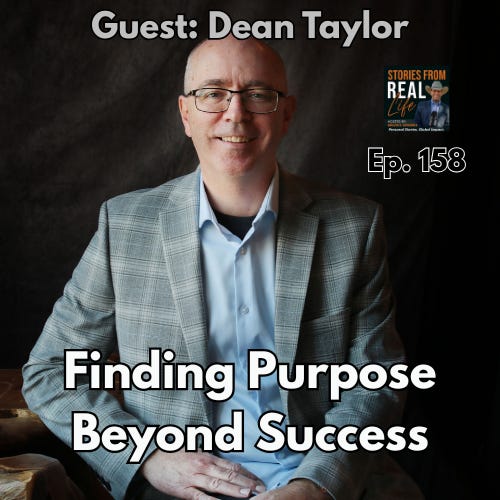
Today I’m joined by Dean Taylor — speaker, mentor, and author — who helps fathers move from feeling stuck to living with clarity, courage, and purpose. After nearly three decades in healthcare leadership, Dean realized outward success didn’t match the life he truly wanted. Now, he equips dads to define their values, strengthen their faith, and leave a lasting legacy. In this conversation, we dig into his personal journey, practical tools, and the heart of what it means to live intentionally.
Books mentioned in this episode:
Want to be a guest on Stories from Real Life? Send Melvin Edwards a message on PodMatch, here: https://www.podmatch.com/hostdetailpreview/storiesfromreallife.
storiesfromreallife.substack.com
Get full access to Melvin E. Edwards at storiesfromreallife.substack.com/subscribe
If you would like to support this podcast, please click on the PayPal link to make a donation today. Any amount is the perfect amount!
Thanks!
0:00 On today's episode of Stories from Real Life with Melvin E. Edwards. We're joined now by Dean Taylor, speaker, mentor, and author, who helps fathers move from feeling stuck to living with clarity, courage, and purpose. After nearly three decades in healthcare leadership, Dean realized outward success didn't match the life he truly wanted. Now he equips dads to define their values, strengthen their faith, and leave a lasting legacy. We all carry these things called phones around. And they have a wonderful functionality, a piece of an application called a GPS.
0:46 But they're not very useful if we don't put in an address. And so to me, having a purpose is like having an address and a GPS. When I have that, when I put the address in, then I know the path and the path becomes more clear. Pull up a chair? It's story time with Dean Taylor. You are listening to Stories from Real Life, a podcast by engaging storytellers for engaged story listeners. Here's your host, author and journalist Melvin E. Edwards.
1:32 Hello again, and welcome to another episode of Stories from Real Life. I'm your host, Melvin E. Edwards. Thanks for joining me for the podcast where personal stories can have a global impact. As you heard in the intro, our guest today is mentor and coach, Dean Taylor. Dean, welcome to the show. Thank you, Melvin. It's super nice to be with you today. Appreciate you having me today. So you help fathers find their purpose. How do you define purpose, and how is that distinct from goals and ambition? Great question. For me, purpose is... People often will say, is it something, you will often hear it said, well, my why. And for a while in my life, I thought why was something that could change over time.
2:13 And my own experience, what I've learned is that my purpose and my why really is who I am at my core. It's the thing that I am, like, I don't change really who I am. That's just, that's kind of central to me. To me, purpose is really understanding who you are as a person, as an individual, and what is that really is the thing that you just... Best way I can describe that thing kind of in your chest that just kind of pulls out you and says, this is what I was meant to do and what I want to become and what I'm after in life. Okay, that makes total sense.
2:54 So how did investing in real estate lead you to discover your purpose and develop your vision? Well, great. Yes, I... I think when I was first doing real estate, it was something that I was looking for, working a full-time job, something that I was I've loved doing, but I just didn't feel in my heart I was completely fulfilled. So I began looking at things that I could do that seemed to sort of speak to me a little bit. And so it was something I had some interest in earlier in life.
3:36 And so I thought, well, I've never really tried that, so I'll do that. I flipped a few houses. I had an Airbnb that I ran for a little while. I made some money, lost some money. But along that path of that journey, what that helped me realize is it led me on a path of discovery in terms of... I think always part of my vision was I wanted to share and I love learning. I love learning new things. I want to share and inspire other people. And I would go to conferences. I'd go to meetups. I'd go to things. I always had the question in my mind, well, how can I be the person on the stage? And I always felt like I didn't have enough experience.
4:16 I didn't have enough this, that education, whatever it was. But through that process of reflecting and just doing things, I really thought, wow. why am I selling myself short? This is the thing that's really pulling at my heart. So I thought, I am just going to do this thing. I'm not, I'm going to just keep walking. I'm going to walk in the direction where I feel led to go. And so the real estate was just, I think, a path that, that sort of helped me discover. It was just the thing that I thought, I want to share, I want to teach, and I want to inspire. And it made it sound kind of a little bit strange. Like, well, how did that really help you do that?
4:57 And I think it was through the process of As I mentioned, I made some money, I lost some money. And when you lose money, you kind of go, wow, this isn't very fun. And there's some soul searching that you do. And so I think that was the trigger that got me thinking about, well, what is it that I really am passionate about? I enjoy doing this. It is a lot of work. I felt like I was... just sort of led on a path of discovery. It was just kind of that thing that just, well, I look back now, it was just one of those, you don't really connect all the dots always looking forward. But looking back, I say that was the thing that helped lead me to what I'm doing today.
5:41 Okay. So what do you think holds most men back from having the kind of career they feel passionate about? Well, I can speak from my experience probably first and foremost is that going through... What I got my education in isn't necessarily the thing I ended up doing. For example, I became a nurse in the newborn intensive care unit. I got my degree as a nurse initially. And I love taking care of the babies. There was some conflicts in terms of my home life and my schedule that made that difficult, working long days, 12-hour shifts, trying to raise a family.
6:29 And I thought, there's got to be something more. And I got into IT, of all things. You think, well, how does that happen? And so it provided a more stable relationship. work schedule for me. I went to school and I got a master's degree in nursing. It's called nursing informatics that allowed me to bridge that gap from the bedside, doing bedside care into healthcare IT, which is what I have done for a long time. But to your question about, well, what maybe leads people to feel like they're being unfulfilled? And for me, what it was is I just, I felt like I was without having the clarity of my purpose, without having the clarity of what, and having some limiting beliefs about that, feeling like I didn't have enough experience in this thing to go do the thing that was really pulling at my heart.
7:23 I feel like I didn't. I needed some other experience or education or something about that. And that was always my mindset. And so I think for a lot of people, other men that I've spoken with, friends that I've talked to as well, I think it's just sometimes just doing the thing you just do the thing you feel like you got to do to survive. and the thing that's going to pay the bills, the thing that's going to get you. And you sort of just start putting those dreams and that passion to the side, because I like what your, your podcast name is real life sort of has happens and things sort of take over and you start just doing the thing just to get the, to pay the bills, to get to the next thing.
8:05 And so we just sort of let those things that, and we tell ourselves we have to be realistic and we tell ourselves we got to stop dreaming and we got to just do that. And so I think for me, that's how it, I think that's a lot what happens with men and losing that feeling a little bit unfulfilled. Okay. So what was the hardest part of the transition for you going from healthcare IT and leadership into doing the full-time work that you're doing now, helping dads live with clarity, purpose, and legacy? Belief. Belief in myself was, I think, the biggest thing. Again, going back to the experience, the limiting belief of I had to have or I didn't have enough or I wasn't enough.
8:48 I think the belief that I was somehow lacking. I guess the best way I can sum it up is I didn't feel like I was enough. But I think now looking back at life and what I began to realize is that is I have a life of experience. I have a lifetime of learning and growth. Raising a family and working in a career and doing all these things that I've done in my life, I discounted it. And again, I would say for me that the biggest transition was just overcoming that limiting belief that I felt like I wasn't enough. Was there a book or something that helped you get past those limiting beliefs?
9:30 Love your question, and thank you for bringing that up. Yes. I read a book, maybe you've heard of it before. It's called The Miracle Morning by Hal Elrod. I have not heard of it. Yeah, Hal talks about in the book, well, Hal has an interesting experience where he went through a life transition. We had a major car accident, and then he... developed this, calls it the savers routine. S is standing for silence, A for affirmation, V for visualization, E for exercise, R is reading and S is for scribing. And that's why I was intrigued by this book. I thought, wow, this sounds kind of interesting.
10:12 And I read this book and I thought, well, I could probably implement two of the six things he talks about here. So I began to do that. I began to scribing or journaling. So I began to write in a journal every day. And I would also visualize. I just thought as I'm writing, it helped me to visualize. And so I would think about things. I would be writing them. And after about a week and a half, two weeks of doing that, I began to notice a shift inside of me and just how I felt about myself when I would wake up in the morning and I would do these two things. And I thought, well, if I'm experiencing this kind of change and transformation inside of me, just doing these two things, what if I did all the other four?
10:57 What would change? And so I began doing that. And I began doing, I guess, all six savers. And I'm not 100% perfect. There's a day where I haven't done all six, but I haven't missed a day of doing the routine in almost three years. And that was really the beginning for me. So that book for me was the beginning of a real transformation inside of me. I began to notice, as I said, a change in my confidence level, a change because I began to see myself different. I began to see a different reality than what I was experiencing before.
11:37 It was a change. And it was small. It was a little bit at a time. I began to make that shift inside and experience that inside myself as I consistently practice the routine of changing how I started my day every day. Just a simple thing. Okay, well, I'll look up that book and I'll include a link to it in the show notes for this episode. So I've got sort of an unusual question for you here. Yeah, sure. If you could trade places with one of your kids for a day, what part of their life would you want to experience the most? Oh my gosh. One of my kids. I have five kids, so I'm going to think about this for a second.
12:18 What part of their life would I want to experience the most? Is that your question? Yeah. Yes. Wow. I think... Well, our youngest son, he's been doing a lot of working out recently, and he's transformed his body. He looks really good. And so I've been thinking about that. I thought, I'd change. I would maybe trade that and feel a little younger and a little more muscular. Trade some wisdom for his physical strength. Yeah, exactly. Yeah.
12:58 So when somebody feels, they say they feel stuck, what do you believe are the internal roadblocks? Is it usually mindset, fear of being wrong or fear of losing? What is it? What is it keeps people in a stuck position? Yeah, I think it could be a combination of all those. I think a lot of times it's the feeling of, one, that I'm not enough, or I don't have enough experience, or I think the feeling of... Lack of clarity. I was just talking with a friend. It's funny you asked this question.
13:40 I was just talking with a friend yesterday. He's sort of in a similar position about this. He was asking, what can I do? Where should I go? I'm feeling this... I have this thing I want to do, but I'm feeling all the realities of life where I have a job and I have family and I have church responsibilities and I've got all these other things in my life that I feel like are taking my time, but this thing that's in my heart I'm trying to, that I really want to pursue and whatever is something that I can do. And so one of the things that I think definitely helps to beyond that is first just becoming really clear on what are the things you really value?
14:24 What are those things that are really important to you? And so I think because, and I say that because I've learned that if I'm trying to do something that's not in alignment with my values, eventually my values are always going to win out. And so becoming clear on what the value, what you truly value is, And then making sure that those values are aligned with your strengths and your desires. Once you get your strengths, your desires, and values in alignment and working and rowing in the same direction, then you can begin to experience transformation in life in a whole different way and not always feeling like there's this constant in between what I'm trying to do and what I truly value and what are the things that are core values in my heart.
15:15 So talk about values. What role does faith play in helping someone overcome the feeling of being stuck, especially when it comes to big life transitions? That is a fabulous question. For me, faith is a core part of who I am. It's a core part of my life and my belief system. So I think faith can have... I think faith can mean a lot of things to people. It can be a religious belief, and that's definitely part of my life. But I think faith also... is a word of action. And so I think faith plays an important role in moving beyond stuck because it's not just a belief.
16:02 I think belief, faith is also incorporated in that is an expectation of something happening. And it ties into visualization and being able to see the thing as being done. And having that expectation that what you're wanting has actually happened or happened. And so when you walk into it with that kind of faith and belief, you become... almost unstoppable in a way because you know that the thing that you're you're doing is there it's already it's as if in your mind it's already happened and so that that's to me that's how faith is such a powerful force in going after the thing that you you want and you know that you're what you're going to accomplish is what will be done On your website, you have a free guide and you mentioned journal prompts and actionable steps.
17:03 Can you share one of those exercises that's particularly useful for somebody going through this? Yeah, absolutely. I think one of the things for mentioning that, as I talked a little bit about just a minute ago, being able to get clear on the values. And one of the steps, one of the things that I talk about and recommend in there, and there's another book that I reference in the guide, is a book by Simon Sinek called Starting With Why. And there's a powerful exercise in thinking about the stories, the stories from your life that were most impactful to you, the things that have helped shape you. And then once you kind of have a collection of stories, working with someone who doesn't really, they know you, that you trust you can share those stories with.
17:50 And I follow this exercise and I would recommend this to anyone seeking to find a purpose in life is, And I think that the value of having a friend that knows you but doesn't know all the details of the story, they can help you pull out themes from those stories that you may not see because you're too close to the story, if that makes sense. Sometimes those stories are impactful, but you may not be able to see all the different themes or meanings that can come from that maybe are underlying or inside those stories. So that's an exercise that I did. And it was one of those things I did early on in my discovery of purpose and the things that I was feeling really drawn to and passionate about.
18:35 And it was a great exercise. So that's something I would highly recommend. Okay. So how do you personally help someone clarify their purpose statement if they come to you asking for some advice on that subject? Okay. Yeah. Again, I would start with understanding getting clear on the values and writing out the list of what and spending some time writing what the values that you feel are important to you. And that you are there kind of those things that that you're just not willing to negotiate on. What's the values that you have, for example, integrity could be one. And so once you have this kind of this fine core set of values and then just the exercise that I went that I just talked about, when you look at your stories, the things that are the really most impactful in your life and trying out and writing.
19:29 Once you kind of identify what those core things are about that came from those impactful stories of your life, then just taking some time and writing out a statement, just a draft of a statement and just let it sit for a minute. And you don't have to do it all at once. You can do it. over a period of time just let it let it kind of sit and think about it for a minute and then come back and and then draft it and um and kind of work on it and massage it a little bit um that's something that i did that as i i have if i were to pull out my my old journal i have several pages where i would as i would just reflect upon those stories and those themes and my values and the things that were important to me i would I would kind of cross them out and rewrite them until it felt like that was something that, okay, now I feel really connected emotionally to that purpose statement.
20:23 Okay. How can a father model courage, clarity, and purpose for his children in everyday life, especially when he doesn't necessarily feel like he's got it all together? That is a fantastic question. Question. I have a good friend of mine that I talked to several months ago and interesting story. He and I had gone out for lunch and he had, he was talking, he told me the story about having a conversation with his, one of his sons who's mid teen years. And, uh, he was encouraging him. He said, Hey, you, you go follow your dream, go do the thing that you, you want to do. And, uh, his son asked him a question that he said, it just stopped him in his tracks.
21:06 His son asked him, he said, well, dad, are you, are you living your dream? And he said, just stop me in my tracks. And I realized I'm telling my kids this all the time. And yet I'm not living and doing that. And so I think to your question about how do you model that courage, I think it's kind of what we've been talking about. When you step into the and doing the thing that you feel drawn to do and modeling that. Because we can talk about it and we can... And it's so funny, I was driving by a billboard. I was driving home the other day and I saw a billboard. And I don't disagree with the message on the billboard.
21:48 It just said, kids have potential. But it made me think a second. I thought, how often do we say and we think about younger people having potential, but then we reach a certain point in life where we think we no longer have that same potential. We call it wasted at that point. Yeah, the time that life has passed us by. Oh, I'm too old. I'm too... far in my career. I'm too whatever it is. And what are people going to think about me if I actually voice this thing that's inside of my heart? And so I think having the courage to, it kind of goes a little bit of all what we've been talking about, having belief, faith, having clarity of purpose and what you want to do.
22:32 And then sometimes you just have to step into it and do it. And There's another great book that I love and recommend to anyone. It's The 15 Invaluable Laws of Growth by John Maxwell. In one of those chapters, he talks about the law of the rubber band, and he talks about how... A rubber band is only really useful when it's being stretched. If a rubber band is just laying on a table, it's not really doing anything. That's when it has its less usefulness. And so when we're stretching, that's when we become most useful. And when we're trying to...
23:13 And I think our brains are wired in a way that we... They want to keep us safe. They want to... It wants to protect us. And we're kind of in this little bit of... Sometimes in a survival mode. Our brain wants us. And so when we step outside of something that feels... unfamiliar to us it feels scary and so when we and then we get back into our area of familiarity we say oh that that thing that i was about to do was was not right because it it felt unfamiliar it felt scary and what i've learned in life is that if i'm always falling back into that area of familiarity and not moving beyond that into areas that are And stretching myself like this rubber band, when I stretch myself, then I learned, I just kind of broadened my circle.
23:59 And now that what was used to be unfamiliar now feels familiar. And as I continue to stretch myself, then my area of familiarity keeps growing. And I'm no longer feeling that. Does that make sense? It does. So including kids in this, how can dads include their kids in the journey of purpose and legacy? Yeah. Well, what I've done with my own, I have older children. I have children who, my children are 20 up to 30 now. But I've shared with them. I've shared with them my journey. I've tried to include them in my own growth.
24:39 I think if you have younger children, and I love this question because I think fathers play such an important role in modeling things. It's being a model for their children. And so I think that just I would say sharing with them what you're what you're being open about, what your purpose is, what you're what you're what you're going after, including in those those things. I like I was mentioning to you, I. I've had a mastermind. I think I mentioned this before we started the program that I had started a mastermind.
25:19 And I've included my kids in that. And they've been able to see me as I've continued my growth. And I've included them as part of that. And I was grateful that they would even want to be a part of it. I felt honored that they would say, hey, dad, I want to be part of this with you. And so I've made them a part of my own life and journey. That's pretty cool. So we're talking about legacy here. So how do you define legacy and how can and how do you help people shape a legacy that's both meaningful and realistic at the same time? Fabulous question. To me, I define my definition of legacy is what am I helping my kids to grow into?
26:01 And I say that because I know my own children have things that they desire, things that they want to achieve in life. And part of the legacy that I'm wanting to leave with them is helping them to achieve that. And also to show, we just talked about being a model and showing them that I can do it. And I'm not just telling that you can do it, but I'm actually living that as well. So I think a model of legacy would, for me, would be to defining legacy is... not just what I'm accomplishing in my life, but what path am I providing my children to be able to accomplish the thing that their hearts desire as well.
26:47 And I think a realistic legacy, for me, that means a legacy that is based on on what I believe. And again, I'll go back to the values and the things that are my strengths. And because I think sometimes I... I wouldn't, I'm trying to figure out how the best way, the easiest way to say this, but with a legacy that, I mean, if I try to, if I were to go say that I was going to be a, an NBA star, I'm going to leave.
27:27 That's not, that's, I don't, that's not a strength that I, that I have. What I wouldn't be a realistic thing for me, but legacy that is aligned with my values and my strengths and That's a realistic legacy to me and something that I can pass on and I can help other people achieve that same thing. Okay. And tied with your faith, what are some spiritual disciplines or practices that you believe provide footing for someone trying to rediscover their purpose? Love this. So I mentioned the miracle morning. That was one of the things that how that really helped me having a more consistent routine. I love to read from Scripture, and that was not something that I was doing as consistently as I wanted to because I was always trying to do it later in the day, or it wasn't part of my...
28:20 I would just find things if I didn't do it, I was trying to do it at the end of the day. And so I was missing out on that opportunity at some time. So I made that part. That was my reading in the morning. I'll read other books, but I always start with that first. That's the first thing I pick up and I read. And then silence can be meditation. For me, it's prayer. That's the time that I spend in prayer in the morning time. So I've incorporated that and made that just part of my daily routine. And having that that that consistency has been really transformational and helping me to elevate my level of and desire for a greater personal spirituality in my life.
29:04 So what are some of the biggest myths or misconceptions you see out there about what it looks like to live with purpose? Hmm. I think sometimes it's a misconception that you hear purpose and it feels like it's a little bit of this, a fluffy word or a word that is, it lacks real, I'm trying to think of the right word here, or the word that's, but it's not really based in reality sometimes, that it's, that you, that... And what I really have discovered is that having a clear purpose, and I'll use this analogy. We all carry these things called phones around, and they have a wonderful functionality, a piece of an application called a GPS, but they're not very useful.
29:57 if we don't put in an address. And so to me, having a purpose is like having an address and a GPS. When I have that, when I put the address in, then I know the path, the path becomes more clear. And having that, so to me, address is like purpose and a GPS. That makes a lot of sense. All right. The next couple of questions, we're going to go backward and then we're going to go forward. Okay. Okay. Looking back on your life as a father and leader, what advice would you give yourself looking back at your life? Hmm. Looking back at my life, I would say it's never too early to start dreaming again, but it's always too early to stop.
30:50 What I mean by that is that when I was younger, I had this dream. I was going to be the next Glen Campbell, if you know who that is. Absolutely. I used to watch his show with my grandparents when I was in town. Yeah. So when I was younger, I thought, I'm the next Glen Campbell. And then I got told, well, you can't really carry a tuna in a bucket. And so that dream sort of just started to die a little bit. And so you start dreaming about it. And I think I would go back and I would tell myself, again, it's always too early. It's never too late to start dreaming again. You can always dream again.
31:31 But it's always too early to stop. I would definitely tell myself that. Okay. So now looking ahead. Okay. What do you hope fathers look like or have achieved five to 10 years from now through your work? My hope and my desire is that fathers would understand that, especially fathers, I think about fathers who have felt that they somehow have underachieved or they've failed in life because they, and we're so prone to doing this, comparing ourselves and comparison is such a thief of joy. My hope is that fathers would, one, stop fathers, making those comparisons and believing that, uh, their, uh, that they, that their, their value in life is, uh, they, that they under, they stop undervaluing themselves.
32:28 Honestly, that they, that they think, uh, they see that there still is potential. There still is, uh, time left in life to achieve the things that they desire, uh, and that they will, uh, have the courage and have the clarity of purpose and belief in themselves and overcome the limiting belief that I think holds so many back from stepping into the life that they've envisioned for themselves and they've envisioned for their families and that they all lead their families with clarity and purpose and faith. Okay. And as a final question today, it's a general question that I ask all my guests. What one piece of advice would you like to leave on any topic?
33:09 Hmm. piece of advice, I would say my advice would be to I mean, kind of what I just said a minute ago, the advice I gave to myself about dreaming. And sometimes when you say dream, again, it kind of feels like unrealistic. What I'm really talking about is the thing that is in your heart, the thing that you kind of have felt this has been pulling at you. I truly believe that those feelings are there for a purpose. And I don't believe... That those dreams come from a God who would say, I gave you that dream.
33:53 And I don't think he plays games with those kinds of things. I think he puts a dream and he puts those things in our hearts for a purpose. And so my advice would be don't ignore those intuitive feelings that you feel and embrace them and have courage to walk towards it and to make it happen. Okay. That's great advice. And that's a good way to wind up this conversation today. So our guest today has been mentor and coach Dean Taylor. Dean, thanks so much for being here today. I enjoyed the conversation. Well, Melvin, it's been a pleasure. Thank you so much. I appreciate the time today. Yes. Please go to my website at podcastreallife.com for more information about my guests and the things we discussed today, including a link to his website and the books that he discussed.
34:33 That's it for today's episode of Stories from Real Life. Join us again next time for another chance to learn from each other. Until then, don't forget to shine your light wherever you go. Thank you for tuning in to this episode of Stories from Real Life. Don't forget to subscribe and share. Let's meet right here every Tuesday and Friday. See you then.


