

 Spotify

 Apple Podcasts

 Goodpods

 Audacy

 iHeartRadio

 Youtube Music

 Amazon Music

 Audible

 Podchaser

 YouTube

 Castbox
 RSS Feed
Ep. 130 - Keeping Promises in Freefall: Lyubim Kogan’s Journey from Olympian to Hero’s Wings
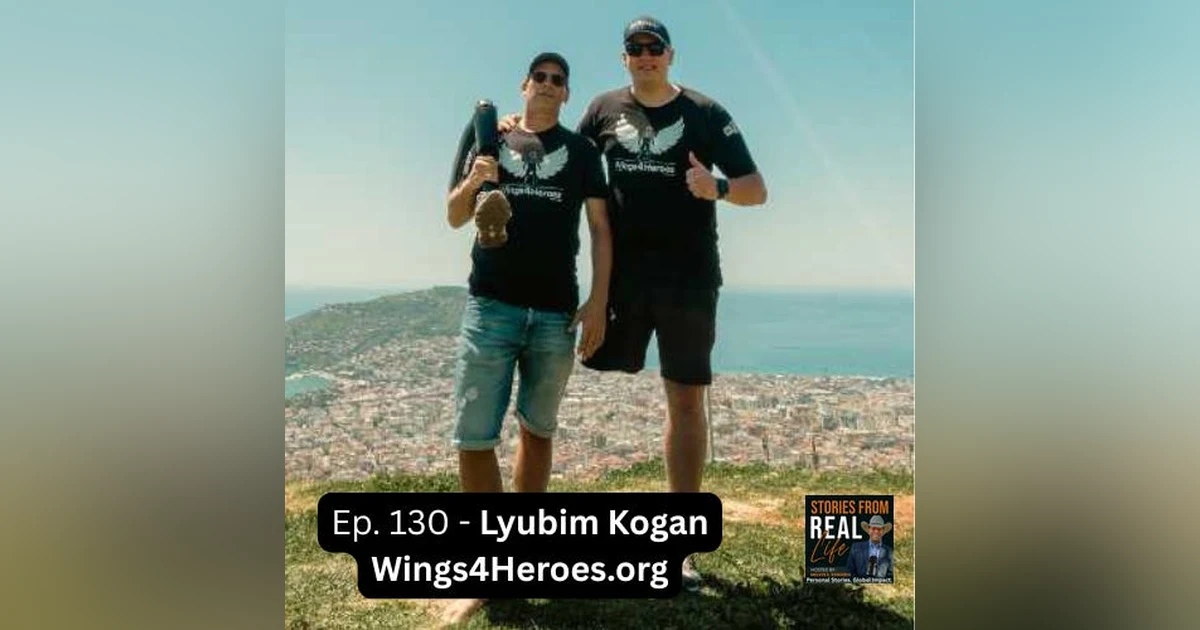

Today’s guest, Lyubim Kogan, is a five-time first-generation immigrant, Winter Olympian, NYU Stern grad, and 9/11 survivor. From Wall Street to war zones, Lyubim’s life has been anything but ordinary.
He’s the founder of Wings4Heroes.org, where he helps amputee veterans rediscover joy and purpose through paragliding adventures. A bestselling co-author with Steve Forbes and speaker at the UN alongside Brian Tracy, Lyubim shares powerful lessons on resilience, service, and what it truly means to keep a promise — especially when the path ahead is uncertain.
Want to be a guest on Stories from Real Life? Send Melvin Edwards a message on PodMatch, here: https://www.podmatch.com/hostdetailpreview/storiesfromreallife.
Takeaways
Lyubim Kogan's journey as a five-time immigrant showcases resilience.
The importance of community support for immigrants is crucial.
Pursuing dreams can lead to unexpected paths in life.
Wings for Heroes aims to support wounded veterans in need.
Apathy is a significant threat to societal compassion.
Personal stories can have a global impact.
The journey of an immigrant often involves cultural assimilation.
Kogan emphasizes the importance of keeping promises to veterans.
Volunteering and donating blood can make a difference.
Every individual can contribute to a greater cause.
Get full access to Melvin E. Edwards at storiesfromreallife.substack.com/subscribe
If you would like to support this podcast, please click on the PayPal link to make a donation today. Any amount is the perfect amount!
Thanks!
0:01 on today's edition of Stories from Real Life with Melvin E. Edwards. Our guest for this episode is Ukrainian-American Lou Beam Kogan. Bluebeam is a five-time first-generation immigrant, winter Olympian, NYU Stern graduate, 9-11 survivor, and founder of wings4heroes.org, a mission helping amputee veterans reclaim dignity, purpose, and joy through paragliding and adventure. Today, he's here to talk about what it means to keep a promise, especially when there's no script, no paycheck, and no clear path forward. Lifetime story, but I think the biggest threat that is facing the Western society is empathy.
0:46 If you can see somebody who is weaker than you, an old lady, you know, dropping a bag at the crosswalk or, you know, somebody struggling in our case, you know, could be a veteran without a lag. And if you can just turn away and look away, that apathy is the biggest threat because, um... We lose the humanity, and we've been so conditioned that the more we get away from our personal meetings, being behind the screen, it becomes easier and easier to look away. Let's join the conversation with Lou Beam Kogan.
1:31 You are listening to Stories from Real Life, a podcast by engaging storytellers for engaged story listeners. Here's your host, author and journalist, Melvin E. Edwards. Hello again, and welcome to another episode of Stories from Real Life. I'm your host, Melvin E. Edwards. Thanks for joining me for the podcast where personal stories can have a global impact. As you heard in the intro, our guest today is Ukrainian-born American Lubim Kogan. Lubim, thanks for joining me today.
2:11 Thank you for having me, Melvin. It's my pleasure to be here. I'm really interested in hearing your story. Lots of twists and turns. So you've been a five-time first-generation immigrant. Where do you live now? Right now, I am in Turkey. That's where I run Wings for Heroes mission. So home for now is Turkey. All right. Tell me about the five-time immigration story. Okay. So we go back to 1992. It's the year after former Soviet Union fell apart. and ukraine became an independent country i was 17 and uh we left it was the whole family my dad packed up i was the oldest out of three packed up our family and we moved to the united states it was basically done it wasn't even an overnight he came home one day and he said we're going i said when he said in about four hours i said where He said, we're going to the United States.
3:17 I said, for how long? He said, forever. So that was my first immigration. And, you know, I came to the East Coast. We were welcomed by my father's brother or my uncle. And I wanted to, you know, I was skiing. I was 17 years old and I really wanted to ski. It was a big dream to go to the Olympics. And, um, I grew up during the cold war. So the backdrop of my childhood, when I was five, the Afghanistan war started and it went on until I was 16 and, um, growing up in the seventies and eighties.
4:00 And basically I pictured America that, uh, president Reagan was sitting in his office and he had this big red button and he could go boom, push it at any time. And we would be all finished. But, excuse me, I also knew that Lake Lessen, New York, had two Olympic games. Excuse me. One in 1932 and one in 1980. And since I had a few hours to pack, so I packed my helmet, I packed my ski boots, and I packed my suit. I was wearing my track suit, and I remember that on the plane, I didn't even have socks. And we made it to New Jersey.
4:41 And I asked my uncle, I said, look, I want to go, I want to ski. And he wrote a letter to all different ski schools. And they got accepted to the National Sports Academy in Lake Placid. That was my real first home in the United States. And basically it was a boarding school. They gave me a scholarship. I could, you know, I could learn English. I could live there. They fed me and, you know, they also let me ski as much as I wanted to. They also gave me my first skis. So my first experience of being an immigrant for the first time it was coming to the United States in the early nineties. And it was the most awesome experience that I could have imagined because, you know, without knowing anything, especially the language, I found Americans being very generous, very welcoming and very open.
5:29 I was super lucky that I had a roommate who was wanted to become an English teacher. So we spent hours without a dictionary learning words and You know, he was my first teacher. And, um, since you asked me about five immigrations, then I spent 24 years in the United States and being first-generation immigrant, you don't really have much to fall back on. So you have to work super hard. You know, everybody works really hard, but I think first-generation immigrants have just that first, you know, I think 10 years or maybe a little more, you have to learn the language. you have to understand the culture and you have to assimilate.
6:10 And since I went into a boarding school and I had all, everyone was an American around me. We had one Japanese guy and I was the second non-American student, but basically I'm, you know, I was fortunate to, to blend in the culture and I did not live, you know, where communities, if you, if you look at the, around the United States, we have a lot of communities where immigrants come and they stay in one place together and, You can live 20, 30 years in one place that are surrounded by immigrants and not really know English. And for me, it wasn't the story. And, uh, you know, I worked super hard. And then I'd say, when I got to the top, when all my dreams came true in terms of financial, in terms of professional and financial, and, um, you know, I got to coauthor a book with Steve Forbes.
6:58 It came out in 2014. It became a bestseller. And the next year I was invited to speak at the United Nations headquarters in New York City with Brian Tracy, who was my, not only a mentor, I really admired how he presented himself, how he came across on stage and how he taught people. I was one of his students for more than 10 years. And then we shared the stage and it so happened that I I went briefly, you know, briefly, I went and first I moved to Slovakia and then I got, um, an offer to do an audit for a nationwide company in Ukraine. And they finished it in 2015 and they offered me to stay because what I found out is was clear that they needed to replace management, but they needed to find somebody who could do the job.
7:47 And, um, I saw, you know, the people were super scared. They were looking for somebody to lead. And since I came from the States, you know, there was, there were really high hopes. And, you know, one thing that we have in the United States, we have a clear way of doing business that everybody who is invited to be a part of the project, you assume that they know minimum, you know, they, they have a basic education and they understand how things work, but it wasn't the case when I started working in ukraine after not being there for 24 years you know i'm a foreigner i'm not i'm not i'm just i was just born in the place and i'm a guy from another country and actually you know i said yes before i really understood what i was getting myself into and if you think back that uh the war in ukraine started in 2014 with annexation of crimea and uh in 2022 it went full scale but at first I couldn't see it, but because our company was nationwide and once they started traveling East and Southeast and it became very real.
8:56 So, you know, going to the United States and I lived for about nine months in Slovakia, you going back to Ukraine, that's number three. Then after I finished the project, I wanted to learn how to fly paragliders. So I took a year off and I was, I lived, I lived in Austria and, uh, I think I would have stayed there for a little longer. But COVID kind of pushed everybody out of the countries that they were visiting or living in and back to their homeland. And, you know, actually, for six months, I spent in Ukraine another six months. And then I started the mission here in Turkey.
9:39 So right now we're in Turkey. from Soviet Union to the United States, from the US to Slovakia, from Slovakia to Ukraine, from Ukraine to Austria, and then from Austria to Turkey. Those are my five countries and, you know, living with five different nations, completely different, understanding that we're so different, you know, that we can be looking at one thing and seeing totally different things. That's the biggest thing that I could take away from, you know, so many places. All right, I want to start, go a little bit deeper on your first immigration story when you came from Soviet Ukraine to the United States with just a few hours of advance notice.
10:23 Tell me about the details and what you remember, like about the plane ride over, all those kind of details. So if you go back to the early 90s in Ukraine or all the republics that were part of the former Soviet Union, you had this superpower, that super control country that when it fell apart, you know, each independent, the Republic, each Republic became independent. And, um, one of the things that it was an extreme poverty all, all around let's talk specifically in Ukraine, you know, it's just basically, The big country fell apart like I was an athlete, right?
11:07 And as a national team athlete, we got notices that all our training camps were canceled for the next year. So basically, the budget that you had from one big country, it just disappeared overnight. And I know that the most people who were affected, like older people, for them, it was super hard to switch. You know, you have currencies changing. And the prices or the inflation, we had like, you know, 100% a day. You come every other day and things were like doubling in price. And I remember looking at my grandmother. She could not really handle it psychologically because when you're in your 70s and you have a fixed pension, you cannot really imagine how you're going to live through. But what happened was that the crime became really rampant.
11:49 Like having kidnappings, kidnappings became a normal thing. It was just such a, Such a widespread occurrence. And especially if you think about people who are living their country and they're moving somewhere to another country, what happens is that you sell everything. You basically have the most important thing that you can carry with you and you have all the cash that you can raise. So if somebody from outside your family finds out that you're immigrating, that family becomes a target. for kidnapping, ransom, or just coming in and taking everything they can get out of your house or your apartment. So the way my dad did this, he sent... I have two younger sisters.
12:35 At that time, they were... Let's see. I was 17. One was 12 and one was 7. And my father sent them with their... mom to, I think they went to Bulgaria. So they went outside of Ukraine for vacation that lasted the whole summer. We were leaving in October and they left early summer and they didn't come back. So when he came home in Ukraine, physically, it was just him and I and my sisters and my stepmom, they were outside of the country. So we packed up overnight, we packed up the same evening. loaded up our car and we drove, we actually had to drive to Moscow because all the international planes left from Moscow.
13:23 And we halfway was Belorussia, Minsk. That's when my dad got out and he said, I have meetings and you got to keep going towards Moscow. And he got out and I drove across, you know, Belorussia to Russia and they picked him up in the airport in Moscow. The next day we got on the plane and we flew to Czech Republic. And that's where there was a family reunion. My sisters came and my stepmom came. And my dad and I, we flew into Moscow and they came from wherever they were. We spent a day or two in Prague. And then with Delta Airlines, we went from Prague to Newark Liberty Airport.
14:06 So my first airport is the Liberty Airport in Newark. I actually had a little bit, you know, we were so stressful moving. And my stepmom, she had some kind of seizure in the plane. And after the plane landed, we actually, everybody, all the passengers got off the plane. And I was on the plane with my two younger sisters and my dad went with the ambulance and my stepmom, they went to the hospital directly. And he left me all the documents, everything that we had for the immigration. And immigration naturalization services officers, they came on board and we had actually, I remember it was so cool because Delta Airlines, they had those Mickey Mouse hats that they put on my sisters.
14:52 Yeah, they were entertaining them. They were super cool. And, you know, the guys with guns came in, they stamped our passports. And then I took my two little sisters and the stuff that we had and I walked out. And at that time, 92, you don't have cell phones, okay? You don't have a way communicating and My father's brother was waiting on the other side, and he was like, where are you guys? Like, everybody's out. They collected all the luggage, and you're nowhere to be found. So I told him that we had this issue with the seizure on the plane, and my dad went to the hospital. So he took the three of us, drove him to his home. And that was my first experience getting into the United States.
15:36 I told you that I got a scholarship to a ski school. So my experience was completely like the first year was totally different than your average immigrant because I was like, you know, really, it was the bubble environment that, you know, they really took care of me. And after finishing, you know, I spent one year in the national sports academy and then I went on to study. Like my goal was to learn English because I wanted to go to a really good school. But I still wanted to ski. So I stayed in upstate New York and I got into community college and they took every course they offered, like all of them on the list. And from there, I got accepted to New York University.
16:16 And actually, that's the really, you know how they say, be careful what you wish for. So I really, I want to ski, right? I'm training for the Olympics. I tell everybody I had two dreams. One was mine and one was my father's. So my father's dream is that I go to a really good business school. My dream, of course, I want to ski forever. I don't want to go to school. And once I got into NYU, actually, it's the school that I wanted to go. It's the one school that I wanted to go to. And I realized that if I wanted to ski, my commute is going to be 600 miles a week. So I structured all my classes and then I would finish on Thursday.
16:59 And then I would get, I would walk. I had off-campus housing across the Penn Station. So for people who are not familiar with New York City, New York University is on West 4th Street. And if you keep walking up north, the numbers are going up. On the 32nd was off-campus housing because NYU ran out of space and they put us up into Southgate Towers. It was the 4th. Star Hotel and we spent there one year, me and my roommate in a really nice suite. So I would walk almost 30 blocks. I would change and I would grab my stuff and I would go another 10, 15 blocks to 42nd Street for the central bus station in Manhattan.
17:44 And I would take the bus to Albany, New York. It's 150 miles. And there I would pick up my car and I would drive the other 350 miles. Then I would get in there late on Thursday, Thursday night, like, you know, midnight, maybe a little bit later. Then I would ski Friday, Saturday, Sunday. And if it wasn't the competition season on Sunday night, I would drive back to Albany, leave my car and take the bus into Manhattan. But if it was the competition season, you know, we skied, uh, Northwest. So it was New Hampshire, Vermont, Maine sometimes. So the commute got a lot longer and I could not leave right after the competition. So I normally came to New York, like with the very early bus, you know, like four o'clock in the morning, I would be on the bus going to Manhattan just to catch my first class.
18:34 And I did that 600 mile commute for two years. And yeah. Was it worth it? Was it worth it to get to the Olympics? Yes, of course. But I think, you know, it's like I'm thinking it's one of the things that stays with you forever. You know, if you make the Olympic team, you become an Olympian and you are an Olympian for the rest of your life. My goal was never, I knew that I would not get a medal because if we go back, you know, not just Ukraine, you take the whole Soviet Union, which produced a lot of, you know, gold, silver and bronze medals at the Olympic Games.
19:17 We had only won guy who won a gold medal and it was like in 1950s so I ski jumped and for my sport we were not competitive sports we were not dominant sports we were just that sport that is always like you know really we train hard and we do well at home but when we go to the international competitions it was a very different league you know if it's like somebody came to play football to the United States nobody can play football against American Football players, and it was the same kind of situation, you know, we were that country that we tried, but we were not that good. So again, for me, making the team was the goal.
19:58 It was not to win a medal. Actually, it was trying not to repeat the performance of somebody from Ukraine who before me took the last place. So that was the one, the biggest thing once you make the team. But to answer your question, yes, absolutely. You really, I think it's the first time I felt that like I'm a part of something bigger than me. Like when I got there and I looked around what was going on, then you get the picture because normally it's a lot of grinding and working away from, there's no spotlight when you're training for the Olympics. You know, it's like spotlight is just the few weeks when you're there, but You know, decades before you get there, it's your own way.
20:42 But yeah, absolutely. It's definitely worth it. So if you have any kids listening who are trying to go for the Olympics, it's a good goal to have. And hey, just in case you miss it, it's something you'll always remember, you know. There are only a few spots on the team and trying to be one of those guys or girls, it's a life-worthy goal for me, I think. Yes, absolutely. It's interesting. Last night, I, my wife and I watched the movie. I hadn't ever seen this movie. I can't believe I hadn't seen it called cool runnings about the Jamaican bobsled team. And that's such an inspirational movie about how these, these four guys who were runners, um, You can go watch the movie yourself for the details, but they want to be in the Olympics so bad they're willing to try any sport.
21:31 And they end up trying out to be a bobsled team from a place, an island, a tropical island like Jamaica. And they end up making it to the Olympics. Yes. Yeah. great movie you know i think well i think it's a great it's a good thing that you brought it up because you think about the olympics what they were last century and what they're now those are two different beasts when i went to the i went to the 1998 olympics in japan nagano japan so at that time um The rules about sponsorships were so strict that we even had to cover the name, the brand makers of helmets.
22:14 You could not show it because they had really strict. rules about brands that you could not display it. It was not commercialized. If you won the Olympics in 1998, yeah, you're a national hero and you're an international star, but you're not financially sad. And we're talking about the best guys in the world. And now it became so commercial that they don't even show the guys who are like, You know, if you're not, if you are in the Olympics, but you are somewhere towards the end, you may get zero TV coverage. Like you can go and they will not show you. Yeah. They'll find the story of somebody who's coming like pool runnings. They will do that.
22:54 But I think right now it became so commercialized that they're showing like, you know, those top five, top 10, top three to the audience and the audience is not getting the spirit of it. Like the spirit has been removed from the TV coverage and If you ever have a chance to go watch it live, that is a really cool goal to have too, just to experience of what it's like in there. Okay. So you talked about having two dreams, your dream and your dad's dream. You fulfilled your dream of making it to the Olympics, and then you fulfilled your dad's dream of becoming successful in the business world. So you built a career by specializing in financial planning and risk management.
23:39 And as you mentioned, you once wrote a bestselling book with businessman and former presidential candidate, Steve Forbes. Then you disappeared for a decade. I'm really interested. Where did you go and what did you do during the 10 years? So basically, you know, um, before writing the book, before getting all the big offers, like my claim to fame of my big breakthrough came in 2006, 2007. I was one of the people who like, I had one of my degrees is in accounting. And I had forensic accounting class where a former partner, Wernstein Young, was a professor.
24:19 And he showed us, you know, annual report. And he said, look, it was General Mills' annual report. And he says, look, this is General Mills. It's a big company. And they have a pretty picture on the front. But this is the last time I hope you guys are going to look at this report from the front because all the things that are interesting, you'll find them in the back. And we went into a place that is called Footnotes. And then footnotes, the companies disclose something that may happen, happened or very likely to happen, but it is not required by the rules to be shown on the financial statements. So it's sitting in the back of their annual report saying that I may show up or I will very likely show up with some period of time, you know, income statement, balance sheet, whatever.
25:07 And I was looking at Citibank's annual report and they just, I just owned in footnotes. They had more than $50 billion in losses and it was all related to subprime mortgages. And I remember sitting there and thinking, well, you know, if one of them is in a debt deep, they're all in the same thing. And once they start bailing and they, I'm talking about big financial institutions and banks because they pile up into a place that has the most opportunity. And when they're exiting, you know, it's whoever can exit first exits and everybody else, you know, left holding the bag. And I went to all my clients and I said, this is going to happen.
25:49 And when it hits the market, it will be too late to do anything. So, you know, at the end of the big bull run, like if you look at the market, it goes up, goes up, and then it just goes... So you know you'll be missing that, and it may be really painful for a period of time, but then, you know, it just gets to the end of the cliff in that case, and it falls over. So after I moved all my clients, I tell people I had nothing else to do, which wasn't exactly the truth, but you cannot tell the same people they already agreed with you, now we're waiting. So I started a radio show in Denver on KHOW, And it was, at first, it was super slow, but then I figured out that I hired the guy who did, he just cleaned up the sound, he made it work really nice, and it took off, Melvin.
26:40 It's, I think, let's say within a year, I had 11 different stations in seven different states. Yeah, so what I was doing, I was basically talking on the radio, saying, look, we all know that they're issuing this no income, no asset what they call the NENA loans, where you didn't need to verify your income, you didn't need to show assets, and they just were giving out mortgages. And at that time, some people couldn't make, at the end, like some people would make first, second, then they couldn't make a third payment. But then at the end, people couldn't even make the first payment. So there was this huge machine issuing new credit, and the consumer who was getting that credit, there's no way they could pay for it.
27:24 So that And then they were packaging, repackaging, and do creative things that the rating agencies would not really change their ratings. And that's how the game went on until it stopped. So, you know, when it stopped, we were ready. And that's how my clients lost. Like, I didn't have any clients' accounts that were net negative. It was either zero or they had some games. And that's where, you know, after that, the opportunity came to first speak at the In New York City, Steve Forbes had success in the New Economy Symposium. It was my first big speaking engagement. I remember being super stressed.
28:05 I don't remember anything except the stage. Everything went dark. I could see a few people in the front, and I could see the lights, and I could see the clock because you have the clock, and I saw the clock ticking, and I was so nervous that when I left, You know, you perspire on the upper body, but it looked like somebody dumped a bucket of water on me, like my trousers were completely wet. And I went from that stage, I didn't remember anything. And then I got a letter saying, like, you know, you did really well. And then after that, the opportunity to contribute to the book that Steve Forbes was putting together, it came my way.
28:46 The book came out, and a year later, I ended up By the way, it was the best seller, but all the money, you know, the way my contribution was structured is that they wanted to donate all the money to charities. And I agreed to that. So I don't even know how much they sold. I don't even know where it went, but I know that it was more than 200 charities that received help from that publication, from that specific book. And I, instead of cashing out, you know, just running my practice and drawing, In the United States, I felt like I'm standing on the street. There are no cars around me, all the green lights. And I'm the guy who has the car and I can go anywhere I want as fast as I want to.
29:32 But then I find myself in the place that, you know, the Ukraine 2015, that I thought I could make a difference. And I really saw that I was making a difference just by my presence. I said, there will be no politics. If you guys want to argue, there is the door going. When you're done, come back. When you're done, you know, we really need to concentrate and save this company. We need to work together. Otherwise, we have no chance. And in reality, if you look at the numbers, we had no chance because when the war started, you know, the U.S., they borrowed money in U.S. dollars to finance growth and they grew really well. You know, it was a really established company.
30:14 You know, when... a company borrowed money in the u.s dollars and when the war started the currency collapsed it went from like uh for one u.s dollars they had to pay nine ukrainian and few it was just a matter of few months it went up to like over 30. so the currency lost um say you lost uh 80 of its value in just a matter of few weeks so a company was not able to carried that debt and the volume was dropping significantly. In any case, I saw that the situation changed as fast as it did in the U S during the financial crisis and people didn't know what to do.
31:02 So I decided to stay. And, uh, I basically from going, you know, being like a public person, writing books and speaking on stages, I just went inside of, um, an office in the Western Ukraine at first. And I had to, you know, I had to build teams that had to teach people how to do things, what it means to, you know, get your job done and get a job, get it done right on time. And what do you do if you get stuck? And basically it's a lot of things that we take for granted because, you know, we grew up in the Western culture where we were taught that there are things that are called deadlines and standards and, You know, there are principles of running the business and there's loyalty and there's trust and all those things, they don't really, they didn't really exist and they still don't exist in Ukraine because, you know, it is still more than 10 years later at work.
32:01 But it was work, working with people one-on-one, working with teams and there was no publicity, there was nothing. I was just actually, I was really alone because When you are a foreigner running a company, not in your country, you just don't really, and you're the boss. You don't get to socialize with people who work for you. You just tell them what to do, and then you go home, and you carry all your issues home, and then you come back to work the next day, and you start over. So those 10 years is just, I did everything. I cleaned the floors. I showed people what it means to have a place that has a Western standard.
32:46 And I don't think there's anything that I haven't done in terms of working with the company and not just working on the floor with cleaning people and then working with the management in the boardroom. That's what I was doing, you know, for years. All right, so you were working behind the scenes, and you were also starting a charity called Wings for Heroes, which is a big part of the point of this conversation today. Tell me about Wings for Heroes, how it began, and what the purpose is. At the beginning, we are going to go back to 2016. I was at one of our guest stations.
33:27 It was a guest station by the highway. And I saw a double amputee veteran roll from our gas station and he went towards the highway. And basically there is no pedestrian way. There is no, you can walk there. And I remember noticing it and thinking, where's this guy going? Like how he's going to get around because there's a highway and you cannot, there is no place for a wheelchair. But in any case, I carried on with my work and about 20 minutes later, we had a huge storm that rolled in. It was one of those cold summer storms with lightning and thunder and wind.
34:08 And I remembered that this guy left and the next next exit is it takes you probably, you know, 15 minutes, 20 minutes to drive there. I don't even know how many days it would take to get there by wheelchair. So I, um, we took one of our pickup trucks and followed in the direction where he went. And I found this guy that he was on the side of the road. He was splashed in mud and, you know, covered completely, just soaked. And we put his chair in the back of the pickup truck and put him inside. And, you know, I don't know if you've ever seen people that even if you, you know, change their clothes and you clean them up, there is not much left.
34:51 Like there was no life left in that guy. You could tell that he's barely hanging on. And I think back about him quite often, and I really think that, you know, that day me finding him and driving him home, we got him some food, some cigarettes, and I think it could have been the last act of kindness that he's seen in his lifetime because, you know, he was in really bad shape. And then we fast forwarded from 2016 to like 2022. So six years forward, that's when the full scale invasion started. And I saw a teenage girl walk out in the middle of a football field.
35:33 It was a packed stadium. She had a prosthetic leg and she said that, look, they can come and they can take a part of my land and they can even take a part of my body, but they cannot break me. And that was the moment that I knew that I'm done, you know, just thinking about I should do something. I want to do something. You're actually doing it. And the Wings for Heroes, you know, it's the idea. I told you that I lived a year in Austria and I learned how to fly paragliders. And one thing I remember is when I did my first flight, I was so scared.
36:13 I said goodbye to my dad. I said goodbye to my brother. It's like, you know, you have this little plastic bag with strings and you are hanging in the backpack thousands of feet above the ground. And I'm like, I don't even know that guy behind me. It's just like, why did I do this crazy thing? But... I remember that moment, like all the issues that I had, and just to give you an idea, I'm running a nationwide infrastructure company. I have more than 2,000 employees. We have Christmas coming up, and we have no money to pay salaries. So one of the things that I did first, I stopped paying myself any salary.
36:56 So from the beginning, for years, the company couldn't afford to pay me. i knew that if i would leave then it would be the end of that so so what i was saying you know when you're working for a company that is in big financial trouble and you are the you know the ceo of the company you basically look at the i looked at the numbers and i knew if i take my salary then then you know the consequences will be dire because we needed to buy a product, you know, we needed to buy diesel. And when you were counting every gallon and seeing which gas stations should get that gallon, you know, who will sell it faster that we can just keep kind of adding oil to the almost dry engine, you know, so it doesn't completely blow up.
37:45 I didn't pay myself, but then I had to figure out how to pay people because I am in the country that is at war and that country was the second poorest in Europe before the war started. So we have Christmas coming up in 2000 families. You cannot miss that paycheck because that's the most significant paycheck. That's when they buy presents, you know, and they live paycheck to paycheck because it's, it's extremely poor. And I remember sitting our Christmas, you know, 20 December 24th and Ukrainian Christmas wasn't on January 6th. So we had to pay 2000 salaries and there was another accountant and I, there were two of us, we just stayed in between the two Christmases and, you know, we would sell a little bit of diesel and all the profits with, you know, half goes to buying new one and half goes and paying salaries.
38:38 And, you know, that year we did pay over 2000 salaries and, you know, you clearly, I don't know, maybe it really is meaningful for me to be productive and, important in other people's lives and making a contribution it's like you know going to every show i would like to know what i can do the best to share with the audience but basically it was an experience that i could not get in any business school in america and the experience i could not get working in any company in america and i remember thinking for myself that if we make it past wednesday we're going to survive.
39:21 And I don't remember what year and I don't remember what month, but I remember there was one Wednesday and everything that I've learned and everything that I've seen and studied, you know, and all my experience, all business school and working on Wall Street and switching to running a registered investment advisory and And meeting people who are a lot smarter, a lot more important and powerful than me, I picked a little bit of knowledge from everybody and I'm looking at the numbers and I'm like, it's just not going to happen. And I remember I told myself, if we pass that Wednesday, then it's running on some miracle course and my job is not to interfere and not to get in.
40:05 Yeah, we passed that Wednesday. I'd like to tell you that it was easier, but it was not. But I learned for myself that if we all, and this was the only way we survived, is that I started creating teams, and I wanted everybody to come together to the point where I said, we have to leave the office. We had to go, we found the restaurant, and then we found the bigger restaurant, and then we found the bigger restaurant, until we got our own house. Like, we rented the place that we, I would invite people twice a week. Anybody could come from any department. And they had to come with ideas on how we can, you know, basically sell more.
40:46 How can we sell more so the company will grow and grow out of this problem that was created by the, not outside environment was the big influence, but then everybody kind of fell into this depression. And, you know, we had people show up from different departments and they came up with such great ideas that I could never think about those ideas on my own. And because they work in place of work, they see the customer, they know what they need. They had brilliant ideas. So one of the things that I am 100% certain is that you can get your next big break idea from anybody. It could be a janitor.
41:26 It could be a cleaning lady. It could be somebody who is standing opening the doors because the person who's opening the doors He sees everybody who's going in and out, how they're feeling, what they're thinking, what they're talking, what they're complaining about. And that person who opens the doors, they actually naturally try to solve the issues. And if you never give them a chance to speak, you will never know. You know, we had those brainstorm sessions and we would come out of everyone and go and take action right away. We would pick four, three, four ideas that you could start doing now that don't require any investment that can be done by hand and just implement it right there and then.
42:11 So, you know, we went through a huge crisis and everybody hustled. Everybody wanted to participate and people who wanted to help, they came on the team. People who complained, they left the company. And that was basically, you know, that was basically seven years like that. You know, first, first, probably first five were nightmare. Like to the point where I remember I was paralyzed in one half. I couldn't move. It took so much out of me. I would go home and I would just collapse and I would lay there and I couldn't move my right, right side of my body. So physically, emotionally, it was super demanding. So what's the biggest lesson you learned from working with wounded warriors?
42:52 Um, Well, first of all, they don't need our pity. They don't need anyone's pity. It's not about feeling sorry, feeling bad about them. They're the most resilient people that are walking or crawling or rolling on this planet. You know, if you've seen... There is a movie, I think it's Seabiscuit, about the racing horses. Yes. And when the horse breaks a leg and, you know, if they get to compete, they are not as fast. And then basically in that movie, the horse was giving a taste just what it feels like to get ahead.
43:36 And then the horse becomes a winning horse. And that's exactly the same thing when you talk to, you know, wounded veterans that either they're NPTs or they're deaf. First of all, they do have needs. They have real needs. And they really need help. But that help does not live with the government. It does not live with any departments. Nobody can answer those needs but just the regular people. And what they need is to feel included. And the biggest thing is that you can take away arms and legs and then the real strength comes out. some reason the ones who make the choice we know there's you can go two ways oh it's so bad my life is over i'm going to drink myself and do drugs and i'm finished that's it's it's a way out unfortunately but there's also the other side you know the completely opposite and that side that says no i am not i one of our next guests he he's uh he's a double amputee And they just lost the baby.
44:43 Like he came from war without legs and they lost, it was three months old or just tiny baby. And that guy took like a week or 10 days off. And he says, okay, I'm back on. And he's in the gym. His thing is that, you know, he's showing, he's an example to everyone that we don't have excuses. His thing is like physical strength. You know, that's what he has an amazing inner strength, but he is, an example to our society, you know, like we have legs, I have two legs, I have two arms, I have so many problems and I cannot get out, get off my chair and like start moving forward because I have some doubts, I have some limiting beliefs, I had bad experience of failing before and I don't want to do it again.
45:31 But they just say yes to everything. And they say, I just want to live a little more. Like that's the common thing about MPTs, like when they're super happy, like they will, they will take a picture. I will make a small video of where they are right now. And the comment is always the same. I just want to live a little more. So one thing, there is not one thing that I've learned. There are many things. Number one, our physical body is super important to us. To me as an athlete, it's super important, but it's just the place that holds the soul and the mind. So the heart is beating and I can think it's not the end of the life.
46:12 It's just, it's just a life challenge. I am speaking, you know, for, look, this is our number one in the middle. I don't know if you can see this. He's 20. When the war started, he was, he turned 20 on February 9th. And then two weeks later, the war came. He volunteered. He didn't need to go. You know, they didn't draft him. He had five years and he could stay at home. But he volunteered and he started flying drones. And it wasn't enough for him because he wanted to be in front lines. He told me, I cannot find behind backs of civilians. And I said, man, but you're fighting with the drone.
46:53 He says, no, I really wanted to be in the front lines. And he spent five months writing, applying that he wants to be transferred to an assault brigade. He said, I want to be in the assault brigade. I want to be the, you know, I want to be the guy who is in front of the civilians, not behind them. And he got his wish granted. And then it was just, he didn't, he didn't, he didn't last a really long time. And his commander went down and he was actually the closest guy to his commander. And he said he was like, 10 yards away from his commander when he got shot. Wow. So he said he almost made it to his commander to pull him out of the line of fire, and they got him.
47:35 And he said it took him, he said it felt like an eternity to get away from there. And obviously then they go, you know, through the darkness. And the ones that come out from the darkness, we just, you know, we had one just left two days ago, and we have one that is still here. And so our number one guy... one in the middle he's actually doing a rehab here for one month to save his only leg and he he's learning to swim last week he got on the bike he's riding a bike on the road he is doing pilates and stretching he is like trying all the things that he would never try And now he's trying things that he thought he would never do.
48:24 He got on the bike. He said, man, this is my first time on the bike. I said, what do you mean? He says, yeah, since I lost my leg, like I tried many times and we tried to get him a stationary bike, he couldn't do it because, you know, you push down, then it stops. But when he just took a bike from one of our volunteers and the volunteer said, you have to wear a helmet. And he said, I knew I couldn't stop that guy. So I just gave my helmet and then he rolled off. And it just so happened that I came to the beach and I saw him and I have the video of his first ride. Wow. So, you know, they're willing to try whatever. When the society told them they could not do it just by being in a supportive environment, they start doing it. And oh, by the way, they can do everything that we can do.
49:06 What promise did you make and why did you choose to keep it no matter what the cost was? If you think about the importance of promises in our society, it's actually an instrumental building block to the efficiency and let's say profitability of how we function, how our economy functions. So let's say, for example, you have an employer who says, okay, if you are my employee, I need you to do this kind of work. And if you do that kind of work, I will pay you, you know, we have two pay periods normally per month. So I will pay you this Friday.
49:46 And then after one Friday, you will get a paycheck. So all the employees show up on the first day of the work month and they work, you know, they fulfill their obligations. And let's say we get to the point where the paycheck has to come, but the employer doesn't follow through. They break that promise. They say, I promise to pay you, but I cannot. I will pay you next time. Well, all the employees, they have obligations. They have family. They have a home. They may have a car payment, whatever. And if they didn't get paid because their employer broke the promise, now they're breaking promises down the line.
50:26 If the employer doesn't come through, then the employee will say, I'm not going to do my job. Sorry, I cannot work for you because you don't pay me. And if everybody starts breaking promises now, you start breaking promises within the family, with your friends, at work, everywhere, then our society will have to deal with so much extra work. Like, I may require my employer to pay me every hour because I don't trust them, right? Or, you know, some people have to look through messages of their spouses and where you were, and, you know, that's what the broken promises do. You know, people who always follow their promises, they don't have to They don't have anything to worry about. They can just function freely.
51:06 No. I think one of the biggest promises that we make as a society is to the people who defend our freedom. You and I, we are having this conversation because we are living in a peaceful environment. People who live in Ukraine or other places that are at active war, they cannot have this conversation because, you know, they may have to run off to a bomb shelter at any moment of time. Plus, they're restricted on a lot of things that they're allowed. And, you know, when there's war, your freedom of speech is not exactly, it's not a priority. You don't have a freedom of speech. The government tells you what you can and cannot say. So we all know that, you know, the sun rises on the east.
51:50 And if every morning you turn around towards the rising sun, that's where the war is. All the wars are east from us. We are Western societies. We live in relative peace. And all wars are being fought on the east. And just as Stan travels from east to west, it's the same way the war wants to go west. Because, you know, the dudes who didn't develop anything, they didn't learn, they didn't work hard, they didn't do things the right way, they live in a mess. And the only way you can survive in a mess is by fighting and taking other people's stuff. So when they take away all their stuff and they really have nothing to take from each other, they go outside of the country.
52:30 Now, in our case, there are men and women who are a lot braver than me. I never served in the military. It's just I see that they say, okay, I'm going to go and defend my country. And when they go and defend their country, we as a society, we make them a promise saying, look, if anything happens to you, right, if you get hurt or you lose part of your body, then we're going to take care of you. Period. There's no... The contract is really short. And God forbid something happens to you and you die and we'll take care of your family. And if you really think about how things are working in our society, that's the contract that's being broken all the time.
53:14 There are millions of movies that are made about these great veterans, right? Doing the great things and then getting hurt, losing legs, arms, whatever. And they're not the same. And then, you know, they show that the movies have told us the story of those movies that may, you know, for how long we making a hundred years of movies, you can go to the beginning, you know, it's always there. So what I am trying to do is I'm trying to keep the promise that we all made, not just I, yes, I made the promise because I'm part of the society and I'm a productive member of the society and I want to work and I want to contribute.
53:56 And for me to be able to chase my dreams, and work as much as I want to, then I need somebody to fight for my freedom. I can do it, or somebody else can do it for me. And in my case, I'm a civilian, so I know somebody is really physically fighting for my freedom and occupying the space. There's war, there's peace, and they're in between. So if we break that promise, then the future generations will say, oh, I know that story. This is what they did to my grandpa. This is what they did to my mom or dad, right? Who were veterans. And I'm not going to do it. So if less people want to do it, it always affects the strength of the military.
54:39 And we have a total, we have totally different issues. And I don't want to deal with those issues because I live in a mess like that. it is practically impossible to solve it because, you know, it's relatively easy to start a war. It's extremely difficult to finish it. It takes very little time to start it, but then it could take decades, decades to finish it. And I think, like, the biggest thing is not the worst. A president of whoever is leading a country, their number one job is to not start wars. Do everything you can to not start it. know, but once it starts, then the system is overwhelmed.
55:22 And, um, I've heard it from more than two veterans. You have veterans who said I survived the war, but I'm not sure if I can survive the red tape at the VA. So what I'm doing is that I am eliminating all the red tape. Anybody, it's, it's random luck. You know how we find somebody who would, who would come to us, but they just, you know, they, They appear. The first one was referred. I went to the Ukrainian government. And because they knew where I worked, they knew who I was. So they trusted me with the first one. But the rest, it's already going. And, you know, it's like these people are showing up random. And it's in some universal energetic way.
56:05 We find each other. And once they get here, then, you know, I really, my goal is to give them what they need. So they get that little bit of taste. Like, for example, I want them to go out of their country. This mission is an international mission. In November, I will take it to the United States. And the main reason I started it not in the United States, because it would cost me hundreds of thousands of dollars in attorney fees, in structuring, insurance, and writing all the policies and procedures. Where in the third world country, it was just a handshake. Can you do it? Yes. Can you do it? Yes. How are we going to do it?
56:45 Like this. OK, let's do it. It was just like that. And somebody trusted me with a hero. We flew the guy. And it was phenomenal. It was super successful. And from there on, I knew once it's built, that people will come. I have volunteers that right now we have, like I mentioned, one guy is rehabbing here for a month. We are saving his only leg. And when I'm on podcasts, so I have to do work. I have volunteers that are spending time with him. He's never alone. If he wants to be alone, he has his own place. He's staying at an apartment that I rented for him. But if he wants to have socialized and be with people who will get him anything he wants, like these guys are awesome.
57:30 Just whatever he wants, he just says a word. And, you know, they deliver it. They get it for him. And I could not create an environment like that in the United States just because life in Turkey, where we are right now, it's just simpler. You know, the people don't have such demand on their time. And therefore, they're more generous. Like in the States, you know, we're busy all the time. I don't have the time to give you. I could write you a check, but I could not give you half a day or three hours. Like it's extremely hard to find. But here, I'm really lucky that we have the sea, we have the mountains, we have culture, food, volunteers. So imagine I take an MPT and I tell him, look, you guys got to get here first.
58:13 They have to cross outside of the Ukraine because the air is closed. You cannot fly. So they go into the European Union. In that case, they ride to Budapest, Hungary. And from there, they take a plane and they fly to the southern part of Turkey. Because we're on the Mediterranean Sea, we're not where Istanbul is. You know, we're on Antalya, which is the western, southwest part of Turkey. And then they pick them up with the car, two-hour drive, and now we are at their location. It's ideal. So the promise that I'm trying to keep is, you know, the one that the side of the society made.
58:54 And the society is busy with other things. And You know, it's out of sight, out of mind, but these people sacrificed a lot. And I think they deserve to be tempered just for a little bit of time. You know, they have finished. So how can everyday people take part in keeping the promise that we all made? You know, I think I learned this from the Red Cross. Just really briefly for me. The Red Cross, I worked in the World Trade Center. And after September 11th, I had to move to different places within the States trying to find the place to live and work. And because my principal place of employment or work was destroyed, I classified as a displaced person.
59:40 And the Red Cross sent me a check for $15,000. We're talking about back in 2001, 2002. Yeah. They didn't ask for anything. This year, I went. around the world to see how different cultures keep promises to people who, you know, serve. And basically, one of the places that I went to the Red Trust Museum in Geneva, and I found out that back in 1859, there was one guy, it was a Swiss banker, his name is Henry Dunant, who was traveling on business to Italy. And he came to a place called Salfurina, where they fought a battle. It was the Imperial Army.
1:00:22 It was France and Italy. They had about 150,000 soldiers. And on the other side was Austro-Hungarian Empire. They had 170,000. So we had more than 300,000 people fighting. And when they were done, they just left. And he said there was a field of 40,000 plus dead and wounded, and nobody was helping. So he went, organized all the villagers from around, from the villages. And at that time, mostly were women because men were fighting. And they pulled everyone out for days, if not, you know, close to a week. And he finishes with this.
1:01:03 He goes back to Geneva and he writes a book that is called A Memory of Salfurino. And that book was so widely received that he was able to start the Red Cross. And 11 months later, After Red Cross was started, they signed the first Geneva Convention. And the Geneva Conventions are important because they stipulate how we treat prisoners of war. And later Geneva Conventions, they said how you treat innocent bystanders. Because when the war comes, it doesn't really discriminate. Everybody is, everyone is affected. It was just seeing that one man could do so much.
1:01:43 You know, today there's more than 11 million volunteers working for the Red Cross. And that was a huge inspiration, just seeing one guy not being able to look away. And we have the Red Cross. And I think I really connected with, you know, the fact how the Red Cross helped me. Seeing what they've done, you know, with collecting names of people who died. Families can have closure. I think it's the biggest thing. In Geneva, they have more than 6 million little cards with names. That means that tens of millions of people could say, okay, he's gone, she's gone, goodbye. And they could have closure and move on. So, you know, you just find yourself in a situation where you are doing work that is bigger than me or all the people that I meet.
1:02:32 And, you know, I inspire to be neutral and I inspire to be open to everyone. It doesn't matter where they serve. They're all welcome. And I hope one day I get big enough that I can, you know, not take one, two, three, but you know, a thousand, 10,000. There's so many of them, it's endless. So I don't have enough lifetime to take care of them all, but I hope I can start set up an organization that will be doing that long after I'm gone. All right. So as a final question today, what piece of advice would you like to leave with the listeners? Um, Piece of advice for what?
1:03:12 For anything. Anything that's on your mind. Okay, so what comes to mind is that I would say, you know what, I think a lot about threats. I don't know why, maybe it's a lifetime story, but I think the biggest threat that is facing the Western society is apathy. If you can see somebody who is weaker than you, an old lady, you know, dropping a bag at the crosswalk or, you know, somebody struggling in our case, you know, could be a veteran without the lag. And if you can just turn away and look away, that apathy is the biggest threat because, um, we lose the humanity and we've been so conditioned like the, the, The more we get away from, hi, nice to meet you, you know, personal meetings to being behind the screen, it becomes easier and easier and easier to look away.
1:04:12 But I'd say, you know, what I learned from the Red Cross is there are three ways that you can help. Only three ways. Number one, you can donate blood because there's always huge shortage. And when you donate blood, you really save lives. Like you donate it now, a few hours later, somebody get a second chance number two you can provide service and by volunteering and giving your time is the biggest thing that you can do because the time that you give to somebody you will never get it back and if you give it to somebody who is less fortunate then the miracles happen you see how good you have it so you know providing service is the biggest thing that you can do and obviously the third way is making donations so somebody wants to be helpful right now, you say, well, donate blood, you volunteer for whatever is important to you, or you donate money and support the charities that are doing the work that you cannot, because, you know, we don't have opportunities and time to start something like Wings for Heroes.
1:05:14 I was just lucky in the right place, and I was, I've done enough in my life that you could just move on, you know, and now it's flying. So that's a good way to wind up this episode, Lubin. So our guest today has been Lubin Kogan, the founder of Wings for Heroes. Thank you so much, Lubin, for joining us today from Turkey. Thank you for having me, Melvin. Thank you very much. Please go to my website at podcastreallife.com for more information about my guests and the things we discussed today, including how you can contribute to the success of Wings for Heroes. That's it for today's episode of Stories from Real Life. Join us again next time for another chance to learn from each other.
1:05:55 Until then, don't forget to shine your light wherever you go. Thank you for tuning in to this episode of Stories from Real Life. Don't forget to subscribe and share. Let's meet right here every Tuesday and Friday. See you then.


