

 Spotify

 Apple Podcasts

 Goodpods

 Audacy

 iHeartRadio

 Youtube Music

 Amazon Music

 Audible

 Podchaser

 YouTube

 Castbox
 RSS Feed
Ep. 140 - Misha Jones: Raw
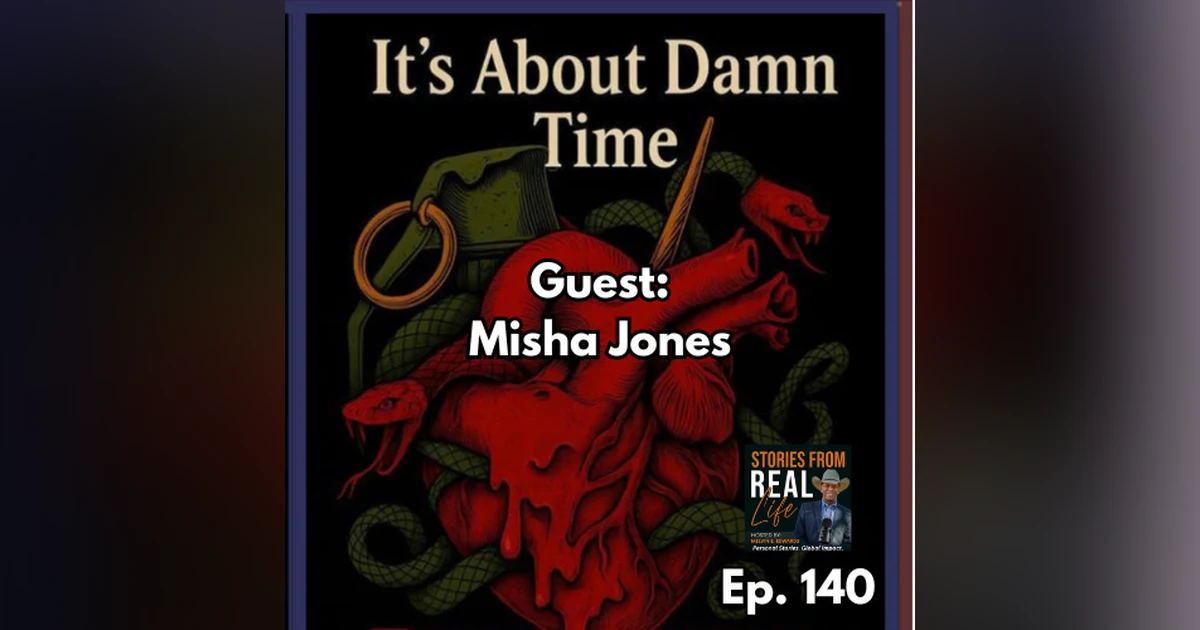

In this episode of 'Stories from Real Life', host Melvin E. Edwards speaks with Misha Jones about her book 'About Damn Time'. Misha shares her journey of overcoming 15 years of silence and pain, motivated by the desire to give a voice to those who feel unheard. The conversation delves into the emotional struggles she faced, the impact of betrayal, and the importance of kindness and understanding in a judgmental society. Misha emphasizes that everyone has their battles and that a little love can go a long way in healing.
Chapters
00:00 Introduction to Misha Jones and Her Journey
04:46 Empowering the Silenced: Who the Book is For
10:11 Struggles of Mental Health and Societal Perception
16:35 The Fight for Justice: Navigating Medical Negligence
27:33 Confronting the Past: Courtroom Revelations
33:05 The Role of Children in Personal Resilience
45:17 Critique of Christianity and Judgment
Get full access to Melvin E. Edwards at storiesfromreallife.substack.com/subscribe
If you would like to support this podcast, please click on the PayPal link to make a donation today. Any amount is the perfect amount!
Thanks!
0:01 In this episode of Stories from Real Life, host Melvin E. Edwards welcomes author Misha Jones, who shares her powerful journey of reclaiming her voice after years of silence. Misha discusses the inspiration behind her book, About Damn Time, and the personal struggles that fueled her writing. So I'm writing, and that's why I specifically chose the word lowlife, because I want to get people's attention and let people know that the word lowlife doesn't always mean you're not about nothing. The lowlifes are people who the world treats like they aren't about nothing. They're good people with good heart. Tune in to hear Misha Jones' story of resilience, the importance of kindness, and the impact of sharing one's truth.
0:45 You are listening to Stories from Real Life, a podcast by engaging storytellers for engaged story listeners. Here's your host, author and journalist, Melvin E. Edwards. Hello again, and welcome to another episode of Stories from Real Life. I'm your host, Melvin E. Edwards. Thanks for joining me for the podcast where personal stories can have a global impact. As you heard in the intro, our guest today is author Misha Jones. Misha, thank you for joining me today. Thank you for having me.
1:26 I really appreciate being here. So let's start with the title of your book. It's called About Damn Time. What does that phrase mean to you and how does it capture the essence of your book? Because it speaks... everything about my life. It's about damn time. Because it really is. It's been about 15 years of silence. And so I said, it's about damn time that it finally comes out, but the truth finally comes out and I finally give myself a voice. So the title of my book speaks directly to my life.
2:09 All right. So Can you share the moment or experience that pushed you to finally write this book? Yes, I can. And you know what? I want to first say that I want to attribute it to the encouragement of a very, very good friend of mine. I don't know if I'm allowed to say their name or not. Yeah, you can say whatever you want. Okay, well, my friend Marquez Round, he's a friend of mine that I've known since the fourth grade. I actually gave him a shout out in my book, but throughout all the pain that I've been through and everything over the past 15 years, I've always wanted to write a book about my life, but I was just not able to write through my pain.
2:56 He told me one day, you have to write through your pain if you want to get this book done. Those words have always resonated inside my head. I guess my story wasn't finished being told, to be honest with you. So between now that I feel like this part of my life, the story, I won't say it's closed, but it's kind of like come to a head. Between that and the encouragement of my friend, I was able to finally sit down and say, you know what? I think I'm ready to write this book. I was ready to finally face my pain or push through that pain and actually write it. I sat down one day and I said, you know what, pen to paper.
3:38 And I actually started writing. And I also felt that there was a story that definitely needed to be told. So there's like three main factors and those are the three main factors of why I wrote this book. All right. So who did you write this book for and what do you hope they take away from it? I wrote this book for one myself. Um, and everybody else in this on this across the planet who have been silenced people who are forced to carry as a matter of fact my preference of my book is dedicated to what i call the low life of the planet and when people say low life the the first thing they think is oh you're a thug or you're you don't you're you're a low life you don't mean anything that's not what i look at the low life as I look at a low life, as I said in my preference, people who have been forced to carry pain that they should not have had to carry and have been silenced about it and have been told, shut up, get over it.
4:40 It's not that serious, being belittled by people and have had to carry that pain for so long. And I understand everybody can have the tendency to be like, oh, well, it's not my fault. It's not my fault. But sometimes it's really not your fault. and those people kind of get thrown into the same category as people who have you know some the the accusers i mean the abusers people who cause the problem and then they're pointing the finger like oh yeah no you're the problem so i'm writing the i and that's why i specifically chose the word low life because i want to catch people's attention and let people know that the word low life doesn't always mean you're not about nothing the low life are people who the world treats like they aren't about nothing they're good people with good hearts who have been forced into situations that you can't, it's so emotional.
5:28 So it's really, really emotional, but it's people who have been forced to deal with situations that they shouldn't have had to carry and having to be silenced about it and having no one to turn to about it. I mean, literally it's, it's a lot, it's a lot to carry. It may not seem like it on the surface, but it's a whole lot to carry when it comes to emotional support, you know, and having that, that, that, that support where you can go actually lean on because things are going to happen in life. We're all going to go through things in life. Nobody's exempt from it. But what you go through, how it happens and having an emotional support system to lean on, it changes how you're able to actually you know, go through it.
6:14 And when you have to face those types of situations by yourself and completely alone, and you continue to just get stacked on stacks on stacks, that things happen to you, it destroys you mentally, emotionally, sometimes even physically. And so I wrote that book for those type of people in the world, people who feel like if you feel like you don't have anyone and you're going through probably what you feel is the worst time in your life, your lowest point in life, and you feel like you've hit rock bottom and you're being stomped through that thing, that's who this book is for. I just want people to know you're not alone. And I don't know if that's, you know, how much weight that carried, but for me, it carried some weight to just know that, hey, there's somebody else out here who's going through the same thing you're going through, or in a way, you know what I'm saying?
7:01 Yeah, I can tell this is still really emotional for you. What was the most difficult? Extremely. I'm sorry you went through that. What was the most difficult part of writing this book? Having to relive it all. having to mentally go back through each of those times, each event in my life that I, to this day, even without the book, still haven't gotten over, probably will never get over. And because of the way that they happened and the way they went down and, you know, being left with that, holding the ball. It's like people come over, they spit on you, they crap on you, they push you down, they step on you.
7:45 And it's like, don't say anything, be quiet, just get over it and move on with your life. And it's like, that type of ridiculousness, I'll call it, that type of thinking comes from what I call a disconnected association. And what a disconnected association is, it simply means that's not my problem. So if you're hurting and I'm not, well, I'm not going to let you bring my joy down with your madness, but nobody's thinking about how you're affected by what's going on. A lot of people is particularly, well, a lot of people think that, you know, if it doesn't directly involve me and depending on how I feel about you and what you're going through, people will discredit what you're feeling.
8:32 I mean, you can literally be sitting there bleeding from the mouth, and I figuratively speaking, of course, bleeding from your heart, Pouring your heart out to people, trying to get anybody to understand what's going on. And people are like, depending on how they look at you, they're like, you'll be all right. You know, shut up. You get over it. You know, it's not that big of a deal. Whereas depending on if I call them, I call them the in crowd. If you're, you know, a person that people, you know, really care about, you can get a paper cut on your finger. And like, oh, my God, are you OK? Like, what's wrong? Everybody wants to tend to you. And again, you got people like me who are like out there and you, like I said, bleeding from the soul. And I'm like, get over it. You'll be all right. Shut up. Like, you're really getting on my nerves.
9:13 Like, you're disturbing my peace with your pain. And so I feel for people like that because people, that type of stuff, I'm really big on, what do you call it? Mental health awareness. Because I've been there myself. I've been on the edge of suicide. I've been lost up on a 5150 hole because I literally darned, darned, snatched. mentally because I couldn't handle all the things that I was going through and I had nobody to turn to. So I got really acquainted with places like the San Francisco talk line, the suicide line. Because when you feel like you're out there like that and you're going through so much, you're going through more than you can mentally handle, emotionally handle, and it keeps going and going and going and going.
10:01 You feel like you're about to lose your mind. And if I could just touch one person out there who may feel like they're going through the worst part of their life, then I feel like that my book has done, besides being able to be my voice, because I just, with my book, I just unsilenced myself. I literally have, I said, hey, Misha's got a voice now. And now I get to tell and say the things that I never really was able to say. Not because I didn't want to, it's because I couldn't. Because everybody was so busy telling me, shut up, get over it. You're making a big deal out of nothing. People need to be careful what they call nothing. Because what looks like a paper cut to you can literally be something that's so rich into somebody else.
10:44 And just because you're not affected by it, it doesn't take anything away from what that person's going through. And some of us out here in the world, we fight that battle every day. And my life, my life, you know, when they say, you know, I've heard people say, you know, the only good thing about hitting rock bottom is the only place you can go from there is up. That's not true. My life hit rock bottom. I got put through rock bottom. And it kept coming. And it kept coming. And everybody was like, oh, just keep going and just keep standing. Yeah, you do have to do that. You absolutely do. But we're human. People can only take so much, but there's only a certain amount of people who are acknowledged for being able to only take so much.
11:30 The rest of us, some of us, the low life, what I call, like me, we're expected to just take it, take it, take it. They're bottomless. And that's not true. It wears on you. And so I want people to just, if nothing else, just know that like, There's somebody else out here who just, I understand that pain. And it's not about, you know, I've been told, you know, stop feeling sorry for yourself. It's not about feeling sorry for yourself. Sometimes people go through things and, you know, everybody's pain, everybody's pain is not the same. And I'm not the type of person to say, oh, well, your pain doesn't matter. Your pain is not worse than mine.
12:11 Your pain is not my pain. It's not about that. It's just about dealing with situations as they are. That's why I put at the beginning of chapter 36, personal feelings, which is the deepest chapter of my entire book, if you ask me. I put, I correlated it to death. I know it's a morbid topic, but it applies. And I put that in the very beginning because I said, it's, I had someone tell me one time, struggle is struggle. So you can't just say one struggle is worse than the other. That's not true at all because death is not the same. You have somebody who dies from a heart attack or cancer. Those are called natural causes. Then you have, on the other side, you have homicide, murder.
12:54 Those are intentionally caused. They hit, yes, the person's still dead, but they hit differently because of the manner of which they happen. So we can't just say, oh yeah, all death is the same. It's not. It is, but it's not. So I fight for, or I'd like to stand up for people who feel like their pain and what they've gone through that definitely, like seriously, directly affected their life has been swept under the rug or pushed to the side because everybody matters. So that's, you know. Yeah, let's get more direct. We haven't really talked about what abuse, what happened to you.
13:37 Are you comfortable sharing what happened to you? Yes. Sure. I will say that because of the way that I've been doing dealt with, I guess you can say, so I'm kind of conditioned into thinking that my story doesn't matter. So I have no problem telling you, I would love to share it. I just have to, you know, I might struggle getting through some of it, but well, the beginning of it started in 2009 when I literally lost my entire career.
14:20 over a question that I asked someone who I thought was the best friend of mine and I was working for Kaiser Permanente and I had been there for 10 years and It was someone who I've been best friend with for 25 years, who I thought was my best friend, but some guy came into her life and there was the dude over me. She started treating me like I had a tail basically. I asked her why and it turned into me losing my job. It literally turned into me losing my job because she decided to show out in front of him. Those are the types of things you can go over, but what really took me was, My son lost his eyesight. She took my son's eyesight, my oldest child.
15:01 He was three years old and now he's legally blind. He's been legally blind in his left eye because of this person since he was three. That's the part that hits me the hardest. I can get over a job, but my son will never get his eyesight back. And he was three years old. And I, you know, you talk about anger or being infuriated, hurt, sad, ticked off, all these emotions just bought up in the one F5 emotional tornado that's going through you. And you have to deal with all this stuff, the loss of a job, the loss of your son's eyesight, not to mention the person that did it, got away with it. I wasn't even able to say anything to the person about it. And all that stuff bonded up inside of you for so long.
15:44 And all the hardships have come along with it. I mean, I have my oldest is 23 now. And then I have my twins who are going to be 21. So if he was three, they were one when this happened. And it just completely crippled my ability to take care of my family. And since then, it has been all kind of stuff jumping off i mean as far as hardships and setbacks i mean life is going to have setbacks but we're talking about extra setbacks we're talking about things that like like robbed of a life that we should have had but but we don't and over what and then the whole thing that i've ever been only thing i've ever been told was get over it let that go leave that girl alone don't bother her no and i'm like is anybody so It's very, very, very hard, especially with, like, you know, taking my son to, taking my kids to doctor's appointments.
16:36 And having to watch my son literally struggle the way that he did and knowing why he's struggling like that. And having to eat that, what you call, I guess you would call it an L, but that's an unnecessary loss. Because my son didn't have anything to do with anything that was happening. He was three years old. And I had no type of support. No type of support. I went through everything. And it kept coming at me left and right. And I literally broke down. That was the first time I ended up in a 51-50 hole. in what they call an insane asylum, a nut house. And I'm not ashamed to tell that story because I was fighting for my life.
17:17 I was fighting for my kids. I was fighting for our right to just be, just be. Because I flipped our life upside down like you would not believe. We'd be on this show for about two days for me to tell you about everything that happened because of this. But the hardest thing is my son his eyesight and i'm like you know it angers me even to this day because i'm like if you wanted to come after somebody you could have came after me you went after my kid and then they got away with they broke up they worked for kaiser too they broke every hipaa violation you could possibly and they got to keep their jobs and they protected these people they protected these people the the kaiser protected these people my family protected these people but they get mad at me because they're like oh no you're looking at it the wrong way that's not what how else am i supposed to look at it they literally literally told my told me that your son's not tripping off of it why are you what kind of madness is that like i'm like like literally they literally acted like my son losing his, like they hand out a new pair of eyes at the corner store.
18:32 That's literally how people made it feel. Like you tripping off of his eye? When are you going to let that go? When are you going to move on with your life? And my question from that, the only question that came from that was, how do you let go of something that's got a hold of you? If I grab you, how am I going to tell you to let me go? This stuff has its claws in my back for the rest of my life. like the rest of my son's life. So when am I going to get over it? When he gets his eyesight back. He's not going to get his eyesight back. But nobody's there at the doctor's office. Nobody was there holding my son in their arms when the doctor told me that he was legally blind. And I know why. And then I just, I literally went on a race.
19:14 But the funny thing about The whole situation was that when I got sent to the 5150 hold, it's an automatic 72-hour hold. I don't know if you know that, but I'm telling you, that's what it is. If you get sent there on a 72-hour hold, it's a 72-hour hold no matter what. You have to stay there for at least three days. I was home in four hours, and that happened to me twice. Because all it took was for me to talk to the psychiatrist and let them know what was going on. And the psychiatrist said, you don't belong here. I remember the first one that said, you're not crazy. You're devastated. And it was even that much more hurtful and also relieving at the same time to say it was total strangers who just took a second to listen to what was going on and to realize that, yeah, she's not crazy, while the rest of the people who were around me, my people, were like, yeah, she's crazy.
20:10 She's losing her mind. She needs some help. Go get her some help. Lock her up and put... But I'm like, do we always have to put ourselves in people's shoes to understand how tight they really fit? But I feel like the way some people are looked at, people like myself, yeah, people do have to be in your shoes. And the only downside to that is people are not going to be in your shoes. So they're listening to you and your pain, all your pain sounds like to them is noise. No matter how deep it's cutting. Like I said, you could be literally bleeding from the soul. And people will look at you like, are you still on this mess? Get over it.
20:51 You're bothering me. And my intent was never to bother anybody, but I'm like, this is a lot for one person to carry. And then they hear some of those same people in other conversations about other people and other things say things like, yeah, well, a person could only change so much. Everybody has limits. But when it comes to me and my situation, it's like, get over it, Misha. Like, shut up. You still talking about that? Is that still on your mind? My son's eyesight will never be off of my mind. Nobody. See, my son has had two surgeries. I remember my son. My son graduated from high school in 2020.
21:32 When he first started high school, all he talked about was football. He just wanted to play football. And he made a team. And he quit. And I remember asking, I didn't really ask him, but I just kind of assumed that, you know, hormones, teenagers, you know, because, you know, because that happened to me in high school. I made the varsity team in basketball in my high school and got in the boys and, you know, basketball went the wayside. But my son, he quit after like three games. And I just never understood why. I didn't find out until two years after he graduated. We were just talking randomly one day, and he said, Mama, I said, I wish you had to quit the football team.
22:15 You were really good, you know? And I figured no, so I said, no, you got in the girls. He said, no, Mama, I quit the football team because I couldn't see the ball coming from the left side. It tore a hole in my soul because he didn't deserve that. So the only person... There was one face that came up in my mind because this girl has robbed me and my family of so much. I'm sorry. I apologize. No, you're fine. But that was just one more thing. But when he said that, I literally, I couldn't hold the tears back.
23:00 He was scared to get his license because you know, I'll have to be a reason to make you take the test. He can't see anything. And it's not that, you know, again, this is where I go back to the whole death. Natural versus homicide. Because if this was just a defect that my son was born with or just something that happened over time, then you know what? You know, it would be hard to deal with. But to know that this was intentionally done to my child. And not just intentionally done, but the people who were responsible for it, you got to just walk away and you were protected. And the only person that people came down on was me.
23:41 How does my anger trump their actions? That's something I'ma never understand. And it does make it harder to get over. It's like being poked and like, huh, I got you. Shut up about it. And everybody else is like, yes, would you please move on? People, nobody, especially when you have, that's trauma. Nobody should ever have their trauma swept under the rug because all it does is make it worse. It makes it a lot worse or to have it downplay it like, yeah, she's just on that BS again.
24:26 To have your life be described as BS, okay. Okay. So how did she affect her son's, take away your son's vision in his left eye? What happened? Good question. She didn't do anything physically, but what she did was they started playing with my son's medical records. Her boyfriend at the time was working in the same, and we all worked for Kaiser. her boyfriend at the time was working in the actual department that my son was being seen at. They started canceling his appointments. They started messing with his medical records. They started changing things.
25:07 Now, how are you getting away with this type of stuff with HIPAA going on? I don't know, but this is what these people did. And then the coup de grace was the thing that completely took his eyesight away because, okay, let me go back a little further. So when we, when this first happened, my son started off, he had an eye ulcer. Okay. And it was right in the middle of his left eye. It wasn't threatening to his vision at all. It was something that just took a little care. Like the doctor, we had this excellent doctor with an excellent plan. Eye drops, eye patching, and eye therapy. And they said, and then it would be gone and you would have no problem at all. No problems.
25:48 Well, after this person started messing with my son's medical records, changing his appointments, canceling his appointments. This is all around a time where my job was starting to be online because of her. She took a situation that happened at home and took it back to the job. It had nothing to do with the job. But she went and reported me talking about I was harassing her because I was texting her after what she did. I was texting her like, you need to come get at me. We need to holler. We need to talk because you just pulled some real, real foul stuff. And you just act like, she was like, the last thing this woman told me was this conversation was over and she hung up the phone.
26:29 But I was like, oh, no, no, no, no, no, no. We're not going to do that after what you did. You need to come holler at me. But that's not what happened. So it was just like she hung up the phone. And after that, it was over. But the part that actually took my son's eyesight, completely ruined his eyesight, was the fact that this one... So... So after we had this plan, the eye patch and eye therapy, the doctor myself was saying was getting married. She was gone. Bless you. She was gone. She was going to be gone for three weeks. While she was gone for these three weeks, this other woman, my ex-best friend, called this doctor and impersonated me and cussed my doctor out, literally.
27:16 So I'm thinking by the time the doctor gets back, like when the doctor left, It was all hugs, and we had a good plan, and this is what she's gonna follow, blah, blah, blah, blah, blah. She gets back, and I'm thinking, now we're gonna make the next appointment. This woman literally cussed my behind out. I could not believe it. This doctor went off, and I'm trying to tell her, ask her, what the heck is, what are you talking about? Well, it turns out that the girl... called and left six messages because her boyfriend who worked in that office told her who my doctor was she called and left the message six messages to be honest with you so the doctor we got dropped after that i lost my job after that no more insurance and my son's eyesight went up from there and it literally got to a point by the time we got back on insurance and got county insurance which was literally like insurance from hell My son's eyesight was already gone.
28:13 And I tried to do everything that I could to possibly, like, you know, it just, it was gone. And so when we finally got the doctor from the county, they were like, oh, well, you know, it's, you know, your son, you know, he's legally blind. And those were devastating words to hear. His eye had become drawn in. It just went to... It went all bad. And I just saw red. I literally saw red. And so much to a point where I couldn't find this girl. I literally went out looking for this girl. And I ended up writing the three-page letter because I didn't know where she was.
28:54 And I'm probably glad I didn't because I'll probably be having this conversation with you from prison. No lie. But I'm just being honest. But I remember where her mom lived at. So I wrote a three-page letter, detailed letter, gruesome letter about what I was going to do to her if I ever saw her again. And I mail it to her mother's house. And next thing you know, I got the sheriff's at my house telling me I'm getting summits to court. She wanted a restraining order. And this is after about a year of just me going through it with my, you know, my child with the doctor's appointments and just trying to, it was just, it was a horrible situation.
29:35 And so, I remember being in the courtroom with this girl. I hadn't seen her for about a year. And I remember being in the courtroom with her, and I'm looking over at her, who's sitting, you know, playing the table on the fitness table, and I'm sitting over there looking at her like, and I'm literally calculating. I remember telling my mother, I said, you know, mama, I need you to come with me to court, because if you don't, I don't know if I'm going to make it back. And I really meant that. But I was looking at her in the courtroom and calculating, how quick I could get to her before the bedding could get to me. And I was literally going to break her neck right there in the courtroom. But nevertheless, the judge read the letter, and he said, Ms. Jones, Did you write this letter?
30:16 And I stood up and I said, I didn't just write it. I meant every word I said it, Your Honor. I really didn't care about the consequences because all I was thinking about was my life, my livelihood, my kid, his eyesight. Everything is just coming down on me. And I said, yeah, I meant everything I said in that letter. And he said, well, thank you for your honesty, but I have no other choice but to grant her the restraining order. And she stood herself up. And she said, thank you, Your Honor, because it's been enough of these little stupid shenanigans. And when she said that, I literally almost snapped. Because what you're looking at is a few text messages. I'm thinking about my life, my son's eyesight, my livelihood, my ability to take care of my kids, everything that you took from me.
31:00 And you over here talking about some stupid shenanigans. I think that was probably the first night I think I ended up in the day. on the 5150 hole. I literally snapped. Because it's nothing like going through bad things in life and then being told, like, you're making a big deal out of nothing. And you're literally watching your entire life fall to pieces over something that you fought. It's like, you know, I have a friend. I have a friend I used to work with at Kaiser. She's a nurse now at General Hospital. And I remember one day she was telling me a story about somebody who came in there who had shot in the back of the head. And she said, this man came in, she said, and Misha, I'm trying to hold his head in my head and keep the back of his head together.
31:44 She said, but it's all falling out in between my fingers. That's how I felt about my life. I'm literally trying to hold my life together As best I can. And it's literally, you know, it's like holding water in your hands. And it's literally falling apart completely. It doesn't matter how much you're trying to hold it together or how hard you're fighting. Nobody cares. Nobody sees that. So what may look like something that's not a big deal to one, you should never discount because you never know what somebody's going through or how deep it's actually cutting in their life. Even to this day, my kids still, I might, you know, well, they're grown now, but, you know, even up to not too long ago, taking my son to the doctor, I can never stand there and watch them, because, you know, they always do the eye test.
32:35 I can't. It's a boulder, just talking about it. Just talking about it. It's a boulder in my neck. So think about having a sore or a gash on you. anywhere on your body. And it's like, oh, my favorite metaphor is think about hitting your head. You got a little bruise on your head. You know, it hurts. You know, it's like no big deal, right? But think about hitting it again and again in the same spot. And it's not because you're trying to hit it, but you just keep getting hit in that head. You keep hitting that same spot. Nobody else knows how it was already hurting before. So somebody sees you you know get hit in the head and you're like oh my god they're like oh my god it's not that serious you just you just bumped your head not realizing that this is already damaged it was already hurting i already got hit here a couple times so what you see is the first time it's not that at all that's why i said people should never just assume when you're looking at somebody's pain or what somebody's going through You should never just assume it's just not that serious unless you know exactly what's going on.
33:42 But you know what? Not even at that point. You know why? Because I've had people that were right there with me when all this stuff happened to me. And still the better life is not that serious. I'm like, I look at what people call crazy. I look at that completely different. I'm not so quick to call people crazy. And it's amazing how what you go through in life will shape how you see life. Because how many times have you ever seen somebody walking down the street with an umbrella over their head on a pretty sunny day? People are just like, what are they doing? They're tripping. You don't know if that person got skin cancer or any type of reaction to the sun.
34:23 Everything that looks crazy may not be so crazy. And you may turn out to be the crazy one for always judging people who you think are crazy. And I have this thing that I live by. Just because you don't understand it. does not take any of the validity away of a person's situation at all. It just means you don't understand it. But you can't sit there and say, oh, well, I don't think you should be tripping off of me because I don't see it as a big deal. What kind of mess is that? But people do that. And it leaves you in a very, very isolated, dark, lonely, angry place. How do you stay grounded through all this? Because I don't like jail.
35:11 That's a good answer. That's a good answer. I don't like Jeff. I don't do Jeff. Been there once and I'm not doing it again. But no, honestly. Honestly, my kids. And it's so weird because I... My kids, even though they are the ones that keep me because they need me and I need them. My kids are my absolute, I am nothing without my kids. And a lot of people are like, oh, you know, your kids are grown. I don't care. Them is my babies. I know they're not babies. You can't hold it anymore.
35:51 But then my kids are my everything. They're my reason why I continue to fight. They're the reason why I have to keep my sanity and stay out of jail because literally, you know, you talk about being pushed to the edge. I live there. I don't choose to live there. I'm forced to live there. But my kids keep me grounded. But at the same time, it's also a catch-22 to that too. Because while my kids are my everything, knowing what me and my kids have been through, it takes me right there to that edge. Because my kids were robbed of a good life. My life, don't get me wrong, I'm thankful.
36:34 and grateful for the little bit that we do have. I really am. I'm completely, you know, we're not on the street. We could be on the street, you know, but people are always like, well, it could always be worse, and that's true, but that's BS because it could also be a lot better. I just don't, I hate having to always compare myself to the lower to make myself feel better about the crap that I'm already in. To me, I'm like, yeah, it could be worse, but it couldn't be better too. I mean, You know, and I just, like I said, so, you know, looking at what, you know, the hardships that we go through, it all takes me, like, it literally flips my mind right back to everything that we've been through.
37:17 So I would say my kids are going to keep me running. You know what? Honestly, I'm already working on my second book. It has nothing to do with my life. It's about Christianity. and yeah my second book is probably gonna really tick a lot of people off because i i you know i'm a former christian i walked away from christianity about seven years ago i will never look back i can't you know and i don't knock people who who are christians i just hate the judgment that they're so judgmental and i hate the the leverage the spiritual leverage that people give themselves you know, anointed by God. That doesn't make you better than anybody else.
37:58 It just means this is what you practice. This is what you love. You don't get to look down on everybody else because they don't see things the way that you see things. And guess what? Your life is on a different path than mine. So your view on things is going to be a lot different than mine. And so on and so on for everybody. I just don't feel like anybody has the right to turn around and just judge anybody. Oh, you don't believe in this and you don't look at it that way. So then you're going straight to hell. You're going to hell. I see you there. I mean, literally, because you can't, who used to say who's living their life perfect enough to say that anybody else is not? Now, naturally, if you're out here molesting kids or robbing and killing people, of course, nobody wants to deal with that.
38:40 But just because you see things differently in the way that you live your everyday life, that doesn't give me the right to look down on other people who see it differently because trust and believe there's a reason why I see it differently. And just because you don't understand it doesn't invalidate it. for me at all. I'm just more open-minded. I'm open to understanding this. And for me, Christians make me sick. I'm not going to lie. And again, I'm not judging them as people, but the practice of Christianity and how hypocritical and how like, how is it okay for you to just be the biggest jerk? But in the minute somebody else says something wrong, I was, oh, you shouldn't be like that. You have to... I'm like, y'all really think that's going to make God happy?
39:22 Like, for you to be that judgmental? It's okay for you to just dance all over everybody, but the minute somebody else skips, now you want to just down the hell. Come on, why? We are human beings. We are all messed up. You may drink, I may smoke, they may be out on the street. Who knows, but who has the right to judge people like that? And then the goal so far is to treat people a certain way or outcast people. That doesn't make any sense. I have a podcast show. I don't have, it's not popular, but I have over 200 podcast shows I've done. And they're not all on Christianity, but I'm just saying it is my focus because I get, you know, people don't understand that the pain that comes with being outcast like that.
40:09 You know, it's like some people, you know, it's like being, it's like you're on a yacht, You're telling people down there in the water with the sharks how to swim. Well, you don't have that problem. So it's pretty easy to tell somebody how to deal with something when you don't have to deal with it yourself. I mean, this doesn't make any sense to me, but these people... On my end of the planet, it's a pretty prominent thing where people actually treat people like that. And then you just listen to the conversations they have. And it's like, wait a minute. So you do this, but you say this. It's not adding up. We got night and day over here.
40:50 But for some reason, because you're a Christian, it's no big deal. But everybody else, you want a daughter in the head. Why? You never know who needs your help. You never know who could use your help or not even help. Just a smile, just a hug. To me, the smaller things in life make a huge difference. People don't believe that, but I do. You don't have to necessarily go and, you know, sometimes just knowing somebody gives a darn can make a big difference in people's day because I know, because I'm one of those people. Just to somebody, are you all right? Don't ask when you're all right just so you can go get something to gossip about. Don't nobody need that. Seriously, don't nobody need that.
41:30 But just to know that somebody actually cares. Listen, I've heard people talk about, okay, so I work for an airline, okay? And I remember when I first started working there, this girl literally fed herself to the engine of the plane. She committed suicide and she left the note. on one of the passengers' luggage. People, I couldn't believe it turned my stomach to hear how cruel people were talking. I said, that girl was reaching out for help. That girl was reaching out. You know what? A little bit of love was a very long way.
42:11 And I don't believe that it's always about turning from over. She was stupid. She was weak. Do you know anything about her story? You know anything about Washington? I'm not saying that I agree with it, but I understand the pressure. I understand the feeling of when you feel like you want to have nobody else, you have nowhere to turn to, it gets to you. That's why I said, that's why I got very, very acquainted with the San Francisco talk line and the 988 suicide help. Everybody who calls those numbers, they're not weak people. There are people who are reaching out. There are people who, you may not have nobody. I literally almost had a nervous breakdown on the darn freeway and ended up in the darn ER.
42:57 And they wanted to put me on a 5150 hole again, but they actually had the psychiatrist coming to talk to me and they were like, you know what? You are really going through it. It's not always about dismissing people. Sometimes you have no idea the impact you can have on somebody's life by just being there. Genuinely being there. I'm not saying you got to take on their problems or you got to be their genie and solve their problems. That's not how life works. But to be downplayed like that to make it feel like everybody's just, oh yeah, you know, come help me. You know, woe is me. Well, that's not what you're calling out for. That's ridiculous.
43:38 And it isolates people even more. And that's a horrible feeling, especially when you are at your lowest point in life, at your lowest point in life, and you feel like you have nobody, and the rain don't stop falling, and the hail don't stop falling, and the thunderstorms keep striking, and the F5.0. It's not easy. You know, I had somebody tell me before, well, for you to say all the stuff that you go through, you look okay. Hey. No, really. And I put that in my book, too.
44:18 I said, you know, if they had an x-ray machine to the soul, there's not a horror movie made yet. I truly mean that. There's not a horror movie made yet that can top what it looks like on the inside. The worst wounds that people carry are the ones you can't see. And even if you try to say ouch or show any amount of your pain, people don't see that in the genuine way that it's meant. They see it as, oh, you're just trying to stop feeling sorry for yourself. Anybody got time for all that BS? All that stuff doesn't push you deeper and deeper down the rabbit hole. When you're trying to claw your way out of it in the first place and you're being pushed back down by all the crap that you're going through, nobody's saying in my life that I'd be a beautiful walk through Golden Gate Park on a Sunday afternoon.
45:04 Nobody says that. But sometimes people, like, literally you have, people can only take so much. Like, my hat goes off to every single psychiatrist, therapist, yeah, psychiatrist and therapist in the world, the psychologists, people, even the volunteers in the world, 988 operators. My hat, I have nothing but the utmost respect for those people because there's a lot of us out here who need help. And that's just not enough manpower to help everybody. So that means what? You're on your own. With all your problems. And don't think that it's just, oh yeah, you had a problem yesterday, but today it's just a different story.
45:46 And then you're just bringing tomorrow's problem with you. No. We talk about one on top of the other. You're just stacking it. And it's not by choice. It's not by choice. This is what your life brings you. And for people to downplay this and make it sound like, oh, you're making it. No, it's not about making it nothing. I'm dealing with the hand of the card, the hand that was dealt to me. Some people have hands that are dealt to them that are tolerable. Everybody goes through crime for their life. Everybody got a perfect life. Nobody has a perfect life. But some of us, it's overkill. And that's what my book is for. People who are going through the overkill in life.
46:27 That unnecessary stuff. That overkill of unnecessary stuff that literally brings you to your knees. and that you fight every single day just to be, just to be, while you getting judged by people who don't have your problem, and their only problem is you, because your pain or your voice is echoing too loud, because you're disturbed when they pee. Well, it must be nice. Good for you. Must be very, very nice. But for people to turn around and act like your problem's not that serious because I don't think it is, that's ridiculous.
47:07 I have one more question that I always ask at the end of my conversation. But before I do that, I just want to say sincerely, I'm sorry for everything that you've gone through. I know I don't know you. I didn't have anything to do with it. But it's clearly real and you're clearly hurting. And I appreciate that you wrote the book. But I'm sorry that you've been treated the way you have nobody should be treated like well i sincerely i appreciate it thank you very very much i i i do appreciate it i do i do but i'm still standing i'm a little i'm a little sharp around you know sharp rough around the edges but i'm but i'm but i'm still standing i'm still and and that's not easy but thank you i do appreciate it though But I do, you know, I hope that my whole thing, like I said, besides having a voice with my book, I want people, anybody on this planet, the low life.
48:10 And I want people to understand what I mean. It's in my preference. I want people to understand what I'm saying when I say low life. I'm not saying you're not. You're good people with good hearts who the world treats like they don't mean anything. Those are what I call low life. So nobody reads any part of my book. The preface will tell you exactly where my heart is with my book. I just want people to know that you're not alone. Yeah. As a final question that I always ask, what piece of advice would you like to leave with the listeners today? Treat people with kindness. Don't assume. Please don't ever assume that what may look crazy to you, don't judge it.
48:54 If you have enough, just leave it alone. kindness a little love goes a long way heal the world with love that's what i think be genuine to yourself love your people most of all love yourself and spread love like literally this world will be a whole different place if people just everybody gets off on i don't care not my problem i mean nothing i said we got to everybody's problems right but a little it literally goes a long way you never know what type of changes you can make in somebody like or how much of a change you can be in somebody's life or positive influence just by showing a little care so that's right that's right that's the advice that i have spread love that's that's a good message be careful who you cross and be care and be careful who you cross yes That's good advice too.
49:47 So our guest today has been Misha Jones. Misha, thank you so much for being here. Thank you very much. Thank you very much. And I hope people read my book, you know. Yes, I will. So please go to my website at Pastor Life for more information about my guest and a link to her book and how you can get it. So that's it for today's episode of Stories from Real Life. Join us again next time for another chance to learn from each other. Until then, don't forget to shine your light wherever you go. Thank you for tuning in to this episode of Stories from Real Life. Don't forget to subscribe and share. Let's meet right here every Tuesday and Friday. See you then.


