

 Spotify

 Apple Podcasts

 Goodpods

 Audacy

 iHeartRadio

 Youtube Music

 Amazon Music

 Audible

 Podchaser

 YouTube

 Castbox
 RSS Feed
Ep. 141 - The Art of Science & The Science of Peace
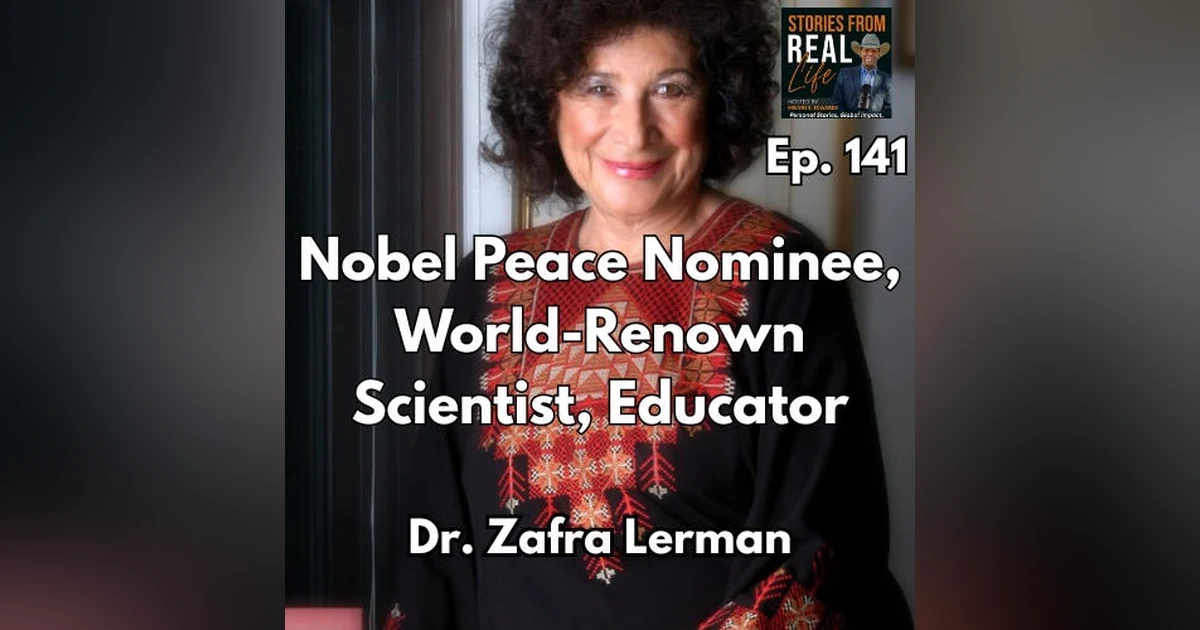

Today’s guest is a world-renown scientist and an educator — and a fearless peacebuilder. Dr. Zafra Lerman has spent her life using science not just to understand the world, but to change it. From creating groundbreaking science education programs that use art to captivate students, to founding the Malta Conferences, where scientists from enemy nations come together in the name of peace, her work proves that science has no borders when it comes to hope.
Her work has been recognized globally, including multiple Nobel Peace Prize nominations, the U.S. Presidential Award for Mentoring Minorities in Science presented by President Bill Clinton, and the prestigious Andrei Sakharov Award for Human Rights from the American Physical Society. She has also been honored by UNESCO, the U.S. State Department, and leading peace and science organizations worldwide.
Pull up a chair. It’s story time—with Dr. Zafra Lerman.
Want to be a guest on Stories from Real Life? Send Melvin Edwards a message on PodMatch, here: https://www.podmatch.com/hostdetailpreview/storiesfromreallife.
www.podcastreallife.com
storiesfromreallife.substack.com
The amazon link to my book, Human Rights and Peace: A Personal Odyssey. All proceeds go to support the Malta Conferences Foundation's next conference.
https://www.zafralerman.com/
Get full access to Melvin E. Edwards at storiesfromreallife.substack.com/subscribe
If you would like to support this podcast, please click on the PayPal link to make a donation today. Any amount is the perfect amount!
Thanks!
0:03 on this episode of Stories from Real Life with Melvin E. Edwards. Today's guest is a scientist, an educator, an artist, and a fearless peacebuilder. Dr. Zafra Lerman has spent her life using science not just to understand the world, but to change it. In this episode, we talk about how science can be a bridge in the most unlikely places, how she's helped free imprisoned scientists around the world, and why she believes education and creativity are the keys to a more peaceful future. Andrei Sakharov was the father of the hydrogen bomb in the Soviet Union that became one of the biggest fighters for human rights and for nuclear disarmament.
0:47 And for that he was exiled to Gorky where he couldn't meet with people and became the most famous dissident. He received the Nobel Peace Prize, but was prevented from going. And I met with him. He told me to take a crash course in Russian to make sure that I don't get a KGB translator. And this is why I could go alone. Pull up a chair. It's story time with Dr. Zafra Lerman. You are listening to Stories from Real Life, a podcast by engaging storytellers for engaged story listeners. Here's your host, author and journalist, Melvin E. Edwards.
1:43 Hello again, and welcome to another episode of Stories from Real Life. I'm your host, Melvin E. Edwards. Thanks for joining me for the podcast where personal stories can have a global impact. As you heard in the intro, our guest today is Dr. Zafar Lerman. Dr. Lerman, thank you for joining me today. Thank you very much for having me. So at what moment in your life, maybe even outside of science, shaped your commitment to peace and human rights? And the way I was brought up shaped me to devote my life for the betterment of others. And probably a typical story will be for my sixth birthday.
2:28 When I turned six and I got up in the morning... I had an envelope with a letter in my shoe. It was for my father. And I opened the letter and the letter said, today is your sixth birthday. I hope you will grow up to be loyal to you. nation, to your country, and to your family in this order. And today I'm giving you this amount of money as a birthday present, and you will divide it to three. One third you will donate Today, orphan children that don't have parents to celebrate their birthday with them, and with that you will make them happy.
3:20 One-third you will donate to plant trees in the country. because it's arid lead. And one said, you can do what you want. And this is six years old already. This was the order of dividing the money. And since then, I always felt that Everybody that comes to this planet has to leave it a better place than they found, not a worse place than they found. And I always used to tell my students at the university, I usually used to start my classes by telling them, Every night before you go to sleep, think about something good that you did for somebody else, not for yourself.
4:15 And if you come up with something good that you did, you had a very good day. So this is my philosophy, and this is what I did all my life. And this led me to risk my life in the Soviet Union for the benefit of people I had never met. Their human rights was abused. They were all in hard labor in Siberia or in prison or fired from their job. And I finished my life going to the Soviet Union, going by myself after midnight in dark at least to me dissidents.
5:02 They were all scientists. to make dissidents to what was illegal. And then at 2 a.m. in the morning, I would give a seminar in some dark attic where 50 of them would gather. illegal. I would distribute scientific material. It was illegal. And I would bring back their resume and their CVs in order to work on their behalf. And many, many people I meet today in an American Chemical Society meeting that thanked me for their freedom.
5:46 They said my action. And in my book that just came out in paperback, I'll show you the book. Here is the book. It's titled Human Rights and Peace, A Personal Odyssey, and it's described in a lot of details, all these activities, and there are funny stories about people coming out, calling me, all that is described in the book. Just let me mention that I did all that because I was for 26 years the chair of the Subcommittee on Scientific Freedom and Human Rights for the American Chemical Society that is the largest, most influential, one subject, scientific society in the world.
6:45 So you talk about, you said your father wanted you to be loyal to your country. Where did you grow up? Where did I grow up? In Israel. Okay, I know you went to... I was born, it was really the British mandate in Palestine. I managed to be born just before Israel was established as a country. So my birth certificate says that my nationality is Palestinian. Not many people have it. but I have it and I grew up in Israel I got my bachelor and master degree at the Technion Israel Institute of Technology and then I moved to the Weizmann Institute of Science is considered one of the 10 best science institutes in the world.
7:50 And I went to do my PhD there. So this is my education and it's all in it. Okay. So you're known for integrating art into science education. How did you first realize that this approach would break down barriers for students? So let me tell you, I did research And after I got my PhD, my field was, and I'm not going to bore your audiences with science, but my field of research was isotope effect.
8:31 And it was called physical organic chemistry. And I did research. When you get a PhD at the Weizmann Institute of Science, you have to go, if you are interested in the academic life, you have to go abroad for a postdoc. And I went to Cornell University to do my postdoc. But after doing research for many years, I decided I believe that science education is a human right that belongs to all.
9:15 And sadly enough, we are forming two class societies. It's one group that has good science and technology education and one group that does not. I was always worried of dividing society, two-class society divided not by royalty, but by knowledge in science and technology. For the half percent of the population or less than that, that will become scientists. It doesn't matter how you are being taught. The teacher, even if the teacher is bad, they cannot spoil it for you.
9:59 But for the rest of the world, you really need to teach it in a way that they will enjoy it and will not think of something up there that they cannot study. So after doing research many, many years, I got an offer from Columbia College Chicago from a president, Mike Alexandrov, that built this college that was a visionary college with open admission, high percentage, minorities, and was a wonderful place. and they didn't have science, they just were accredited as a liberal arts college, but they were very well known as Art and Communication College.
10:52 So he looked for somebody, a magic teacher that is involved in human rights, arms control and disarmament and everything, and my name came up. from different people and made me an author to come and build from scratch a science institute. And I remember my first class that I offered was chemistry in daily life. But when the students registered for that, they went back to their dance department, theater department, television department.
11:37 And their faculty said, chemistry, I never had it. Why do you need to take it? And persuaded them not to take it. So really, and I describe it in my book, To the Way of Teaching, there is a long chapter on that. The way I realized that I will get my audience, I needed the paycheck, So I decided to take a group of students to the bar across the street and practically bribe them to take my class.
12:17 And I said, everybody can order anything they want. And they started ordering... Bloody Mary, Green Grasshopper, God knows Pink Lady, weird names that I never heard in my life. So I was very confused what is going on and then I asked them what are they ordering. So they explained to me this is tomato juice and alcohol and this is orange juice and alcohol. And I said, oh, all of you have one thing in common. What is it?
12:58 Alcohol. What is alcohol? It's something that makes us high. Yeah, but what is it? So I wrote on the napkin the structure of ethanol, what is the alcohol, and everybody wrote it on their napkin, and I gave all the explanation of what it really is. By that stage, the whole bar joined my class, not only the group of students I brought. So being drunk by success, not by alcohol, because I don't drink, I was drunk by success, I decided to continue, and you could order a salad in the bar, I ordered a salad for all of them with oil and vinegar, and then I asked, what is vinegar?
13:49 And I had the chance to explain that it's acetic acid and write the structure of acetic acid. Everybody was writing this structure. We had it on the napkins. And then I explained that if ethanol and acetic acid react with each other, they form a new compound called ester, and this ester even can be used sometimes as a nail polish remover. So they all said, so what do you mean we have now in our stomach nail polish remover? And I said, no, because you need a catalyst. And then I explained the catalyst.
14:30 And the whole bar is already in my class. And then I told to the students, I said, look, the semester is 15 weeks. The ones that are here now already had the first class. So you will have only 14 more classes if you take chemistry in daily life. And this is how I got my first class. Right. After that, I did not have to bribe students anymore to take my classes. Now, how did I come out by teaching science by integrating it with art, music, dance, drama, rap, animation, poetry, with anything you want?
15:23 This, I might say, I was a very good student, and my students were very good teachers, and they taught me how they learned. And like, for example, I explained a reaction on the blackboard and the students did not understand. So a dance student got up and choreographed it as a dance. And they said, this is how it works. I understand it now. So I said, oh, wow. This is a way to teach food dance.
16:06 And then there was something else and an art student came and the students did not understand something that I explained on the development of crystals. So we had a microscope that was a heating microscope. So he took a drop of a solution that was red and put it on the microscope and then you start seeing feathers growing out of it in completely different colors.
16:50 It was like you see a modern art being drawn in view because it was projected. So I said, oh my God, I see how these students, they are very visual. visual in different ways. Few in dance, few in art. So I learned from my students how to teach. I would never come out with that if my students would not teach me. And then it became very, very popular. And because I hated to write tests, and especially multiple choice tests, because I hated that in one hour...
17:36 And maybe I'm not feeling my best. I have to show my knowledge. So I told my students that I never will do to them what I hated to be done to me. It's in the Jewish scripture. It says, don't do to your friends what you hate to be done to you. It was said by Rabbi Lel, that was a very famous rabbi. So I said to them, all of you are my friends because you are in my class and I will not do to my friends what I hated to do to me. So you will show your knowledge in any way you want.
18:19 And this became very popular. with the students and they really, really showed unbelievable knowledge, like a group of theater did a love story between sodium and chlorine to firm table salt, but they wrote it exactly like Romeo and Juliet. They just took Romeo and Juliet. And the science was so accurately, the structure of the atom, how the ionic bond, there are two kinds of bonds that we started, ionic bond, covalent bond. In ionic bond, one element gives the electron to the other, so one becomes negative, one positive, and they attract.
19:07 This is our sodium chloride table salt. And then there is... a covalent bond, when they shared the electron, they wrote it perfectly like Romeo and Juliet about the ionic bond. And then because it's a Shakespearean tragedy, A water molecule came, and in water, sodium chloride breaks the ionic bond because water is polar, and the water molecule came and broke the marriage between sodium and chlorine, and then they stood all of them with plaque.
19:50 Learned to take every tragedy with the grain off, and salt were the two students that formed salt. Another group did a bondfather like the godfather on the covalent bond. I worked with homeless kids that when teaching them chemistry and other faculty of mine came with me on the floor of a dance studio that the teacher was my student teaching them at night and we would bring food and teaching you see pictures the periodic table is on the floor this is how we are learning we are all sitting on the floor learning and many of them went to college and two went to get a PhD in biochemistry.
20:49 I taught prisoners that became very successful and then in order to show that it's real science and not because the school is art and communication. My subcommittee on Scientific Freedom and Human Rights, the members were Professor Tom Spiro from Princeton University that was the chair of the chemistry department and Professor Jack Seiner that was the chair of the chemistry department in Indiana University in Bloomington. So I came to them and I said because we are the human rights committee and science education is a human rights, why don't we develop together a class for non-science major with my method because in Princeton, for example, by that stage, non-science major could satisfy the science requirement with a psychology class.
21:59 It's not really a hard science, and we wanted them to take chemistry, so we developed together. The National Science Foundation gave us the money. We developed the class together. It was titled From Ozone to Oil Spill, Chemistry, the Environment, and You, with my methods, and in order to prove that my students Second to none, we flew every year, and for most of my students, they had never been on a plane. We flew every year for a joint symposium with Princeton University.
22:41 and the students from both sides, and all the media used to come and call it the meeting of the two cultures, because it was really two cultures, but it was a terrific experience. Then they had a meal together, they spent time together. It was beautiful. But then, my calculation was right, that if an Ivy League would like to adapt, they will call Princeton. or any private university. And it was true because when the University of Chicago, a professor there wanted to adopt it, he called Princeton.
23:22 And when a big state university, they called Indiana. And the rest of them called me, and it was adopted all over the world and was proven extremely successful with underprivileged students. What role do you think science can or should play in global diplomacy today? I think science diplomacy can succeed where other diplomacy fails. The reason is science doesn't see borders, doesn't see religion, doesn't see language, it doesn't see culture.
24:04 Science is science. It's an international language. A chemist in Bethlehem, Pennsylvania can communicate easily with a chemist in Bethlehem and the West Bank without knowing each other's language, and they will understand what they do. Therefore, I think science diplomacy is extremely important, and this is the reason that I founded the Malta conferences that bring together scientists from all over the Middle East, Iran, Iraq, Syria, Lebanon, Israel, the Palestinians, everybody there, everybody.
24:50 And for five days under the same roof with several Nobel laureates, to develop collaboration, to have a platform that they can see what unites them and what divides them, to have a platform where they can stop demonizing the unknown other, and they develop friendships that can overcome cosmos of distrust and intolerance, and a platform to develop collaboration on issues that one country cannot solve alone. The nature doesn't know where the British put the lines called borders in the Middle East.
25:35 So the aqueduct for the water goes through countries. And water is a big issue. If we want to solve it, we have to work together. for sure, air pollution, climate change, and we would like to have a science curriculum that will bring everybody to the same level of knowledge of science. This is why I established the Malta Conference that is a bridge to peace, because if we would have a critical mass of scientists that can start a chain reaction for peace, then we would get the peace, and regular diplomacy will never succeed in doing it.
26:25 Okay, so if you had the ear of today's world leaders, What would you tell them about the importance of science collaboration across borders? I would tell them to change the way they think and change the way they operate and to let science diplomacy try to achieve peace that they meanwhile don't succeed to achieve with their way of policy. If I can have scientists from Gaza sitting with a scientist from Israel and then when it ends there are tears in the eyes of people hugging and kissing each other like a family reunion just ended.
27:17 We have to raise the money because we have to pay for everything because equality is very important in the Middle East and we want to make sure that everybody can come. They don't have to beg for money. We have to raise the money and pay for everybody. But if we, you know, there are billions, trillions of dollars to build a weapon of mass destruction. Just a small, small part of it can take peace a very long distance and achieve peace. So can you imagine if we do it with, we have 700 people in the network now, if we could have millions of people in the network, then you're at peace.
28:07 then the mass, the critical mass, is already called well-caused peace. And this is what I would explain to them, but they would never listen because their survival is to do the way they have to do. It's their survival. If everybody can live in peace with each other, their power will be much less. You've helped rescue scientists from prison and persecution. What drives you to take such personal risk for other people? You know, it's a very interesting question that I was asked a lot.
28:54 I just will read to you what one of the people I have, because I used it as a draft. This was a person that was sent, a chemist, to hard labor in Siberia and I worked very hard because I was going into the Soviet Union and then he was released and he came to Chicago the first thing and he gave a talk to the American Chemical Society in Chicago. But I was nominated for, and I received the Andrei Sakharov Peace Prize for Human Rights, the Andrei Sakharov Prize for my work at Human Rights, and he sent the recommendation for that.
29:47 And I want to read to you what he said. I often wondered what could make a person living in freedom, safely, in comfort, to fight for someone deprived of death and languishing on the other side of the globe. That's what you just asked. He was wondering about it too. I realized that both the faraway victim and his American guardian angel had something in common. They had the same ability to go against the tide, and they did for science something which could hardly be rationalized.
30:36 An exhausting, messy job of its very foundation, invisible on the pages of professional journals, they kept science both human and human. And this is from a dissident that I managed to bring out of hard laborers in the Soviet Union and luckily to Chicago. So I could have met him when he came. There were other people, but it's interesting what he said.
31:19 These people have the same values. That's interesting. So what does it mean to you to be a scientist for human rights? Oh, do you know the pleasure it is that you know that somebody that suffers and deprives freedom and all that, and suddenly you see the person being functioning and happy, and it's the greatest pleasure that the person can have. It's a very satisfying feeling.
32:00 You know, I believe that I have to do things to make it good for other people. I have a very interesting life, and I believe that I have to share it so other people will benefit from all my values, all my education, that I should just keep it for myself. So it's a tremendous thing to see, and I have a lot of them. And people from Tiananmen Square in China, I spent a lot of time in China, Cuba.
32:41 So it's a great feeling. Nice. So what can everyday scientists or students do to support global human rights efforts in their own communities? They should all form by themselves a committee or join. All the societies have human rights committees and join the effort. Not everybody... you know, taking risks, but you can join writing campaigns, sending things by people that go, because a lot of them are deprived from knowing what's going on with science and all that, bringing material or sending material with other people that are going.
33:33 There is a lot what you can do. The young generation in the U.S. does not know the name Andrei Sakharov. I don't know how old is your audience, so let me just in two minutes say who he was. Andrei Sakharov was the father of the hydrogen bomb in the Soviet Union that became one of the biggest fighters for human rights and for nuclear disarmament. and for that he was exiled to Gorky, where he could not meet with people and became the most famous dissident. He received the Nobel Peace Prize, but was prevented from going.
34:19 And I met with him. He told me to take a crash course in Russian to make sure that I don't get a KGB translator. And this is why I could go along. And he told me, Pressure, pressure, letter campaigns, pressure on the government is the most important. Never, never lay off of this pressure until the person is out. So there is a lot that people can do, but they have to want to do. I hear from people that really don't volunteer for anything how busy they are.
35:06 You know, retired people that don't volunteer and they are so busy, they cannot do anything. This is out of the question. You know, the more you do, the more you have time to do more. It's the people that are very busy that have the time to do. I don't accept the answer, I don't have time. But you're still very much on the go, I can tell that. So when you don't get immediate results from your peace-building work, how do you measure success to keep yourself going?
35:50 I measure success in different levels. I manage success when I see the interaction between the people. And, you know, when the Iraqis came the first time, it was for them the first time to see an Israeli. And they were in the stage of shock because they told me that all their life, their studies that the Israelis are such monsters that they don't even look like anybody else and how horrible they are. And they said, here we meet the most wonderful people, great scientists that we want to learn from them, we want to collaborate with them.
36:31 Why were we lied? all our life. Why do governments have to make these lies? And this is what we have to fight. And you know scientists that are professors, they have a lot of students. They can share with them their experience. They can teach them. So really the effort is much more than just the people in the network because these people have influence on many, many more people. You know, if we would have more money, we could have involved many more people, have many more Malta conferences, and chief peers, like people from Korea, told me that they would like to do something like that between North and South Korea.
37:28 I was approached if we can do something like that between Russia and Ukraine. Also, Pakistan is not in the Middle East. It's a Muslim country, but they are not in the Middle East. But they asked to participate to learn the models so they can do it between India and Pakistan. So if we could spread it, we can achieve peace. Okay. So looking back over your career, what one moment best captures what you stand for? Wow, wow. I stand for science education for all, human rights and freedom for all, and peace in the world.
38:22 There is no reason for all these walls that we see. And pay attention. They always start by many leaders. Maybe we should think about that. You don't know many women that started war. So how do you hope to be remembered? I hope to be remembered that I devoted my life to education, human rights, and peace. I hope people will read my memoir because I tried to put it all in the book and keep it at 200 pages because I know it's very hard to read more than that.
39:09 So I saw I had a very active life, lived in many countries, traveled in many countries, have a lot of stories. I put it all here. The book shows people how they can be involved, how they can be successful. I came to this country as a single mom. and became very successful. And the book explained how everybody can make the world a better place and be successful by themselves by changing the way they are thinking and looking at things.
39:54 Okay. So as we start to wind down the conversation, can you tell me what's next for you? Are there any new frontiers, new projects you're excited about working on? Next for me is the next Malta conference that will be now tougher than ever, ever before, because so many of my countries are now at once in a conflict. So it was supposed to be last year, but it was impossible because there were not airlines even for most of these countries. So a virtual conference would not get the purpose of this conference.
40:39 It's not just a science conference. But it's better than nothing. So we got all the people together, and with all the wars that were going on, We had participants from all the countries. We had a lecture by a distinguished scientist, and then we broke up for our workshop, because in Malta we have interactive workshops, so we had it on the Zoom by having different rooms, and we ended with something that we have in the last few years by request of the women.
41:25 to have a women's form where the women help each other. In Malta 1, we had four women. In Malta 10, we had close to 40 women. And it's not easy to bring women from the Middle East. Many countries don't allow women to travel alone. You have to travel with a husband if you don't have father, brother. But we have a rule, no accompanying members. So nobody will interfere in the interaction.
42:07 By now, we managed to bring, and the women call each other sister, and they work together, and it's a tremendous support for the women to be scientists. They learn from each other, and everybody... tried to support their sisters. And really the participants called themselves, if you see an email that in New Year's people send, it says, to my Malta family. They gave it the name, the Malta family. Because it's like family at the end, five days together, everybody in the same hotel, the Nobel laureate and the graduate student.
42:53 Everybody eats the meals together. No touring by yourself, touring together, because the social events are as important as the scientific events. It's like the end of a family reunion, no doubts. Really nice. As a last question that I always ask my guests, what one piece of advice would you like to leave with the listeners today on any topic? On any topic, get involved. Make the planet a better place for humankind.
43:35 Don't complain. Make a difference. Everybody can make a difference. And if you are young and in school or university, find a good mentor. because I got all my students involved with me in different projects, but I mentor them to be successful in life. Get a good mentor to help you achieve what you want. And if you are retired, you have time to help. Education needs a lot of help.
44:16 Just talk to the schools. They will get your help. If you want to work with groups for human rights, there are a lot of groups like that. There are a lot of groups that work for peace. You will have a much better retirement life than just playing golf or watching television. That's a good piece of advice to leave with the audience today. So our guest today has been scientist Dr. Zafir Lerman. Dr. Lerman, thank you so much for being here today. I enjoyed this. Thank you very much. Please go to my website at podcastreallife.com for more information about my guest, including a link to her book and also some other things that we discussed today.
44:58 That's it for today's episode of Stories from Real Life. Join us again next time for another chance to learn from each other. Until then, don't forget to shine your light wherever you go. Thank you for tuning in to this episode of Stories from Real Life. Don't forget to subscribe and share. Let's meet right here every Tuesday and Friday. See you then.


