

 Spotify

 Apple Podcasts

 Goodpods

 Audacy

 iHeartRadio

 Youtube Music

 Amazon Music

 Audible

 Podchaser

 YouTube

 Castbox
 RSS Feed
Ep. 143: The College Game Plan: Smart Strategies for Students and Families

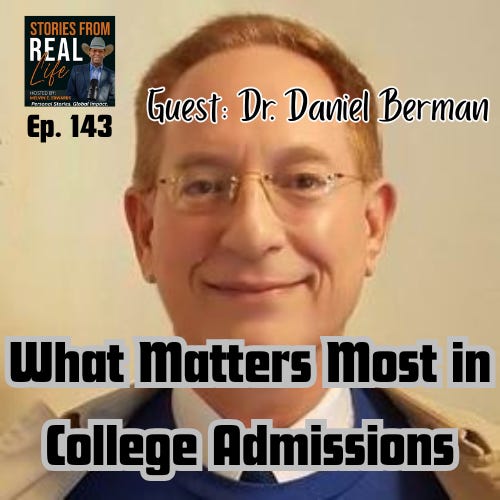
Daniel K. Berman, PhD is the founder of CollegeSolutionsUSA, a college admissions coaching firm dedicated to guiding students through the complexities of higher education applications. A Harvard graduate with more than 30 years of experience in college admissions coaching, he has authored several books and earned hundreds of five‑star client reviews. Formerly a college instructor, Dr. Berman leverages an engaging and encouraging coaching style to empower applicants and their families with the insider knowledge needed for successful college and graduate school admissions. youtube.com+3linkedin.com+3linkedin.com+3.
Website: BestPersonalStatements.comEmail: danielkberman@alumni.harvard.edu (Write: “Matchmaker sites” in the Subject line.)
Kindle eBook: How to Write Winning College Application Essays
Get full access to Melvin E. Edwards at storiesfromreallife.substack.com/subscribe
If you would like to support this podcast, please click on the PayPal link to make a donation today. Any amount is the perfect amount!
Thanks!
0:01 Today's guest on Stories from Real Life with Melvin E. Edwards is Dr. Daniel Berman, founder of College Solutions USA and a trusted voice in college admissions coaching. With over 30 years of experience and a Harvard degree under his belt, Dr. Berman has helped thousands of students and families navigate the often overwhelming college admissions process. So colleges are most interested in students who have the greatest potential to contribute to society by making the world a better place. So many applicants with excellent grades and test scores in addition to impressive extracurriculars are weak in terms of community service and social justice type activities.
0:54 He's known for his straight talk, expert insights, and deep commitment to helping students find the right fit academically, personally, and financially. If you're preparing for college or helping someone who is, you won't want to miss this conversation with Dr. Daniel Berman. You are listening to Stories from Real Life, a podcast by engaging storytellers for engaged story listeners. Here's your host, author and journalist, Melvin E. Edwards.
1:37 Hello again, and welcome to another episode of Stories from Real Life. I'm your host, Melvin E. Edwards. Thanks for joining me for the podcast where personal stories can have a global impact. As you heard in the intro, our guest today is college admissions coach, Dr. Dan Berman. Dr. Berman, thanks for joining me today. My privilege. Thank you, Mel. Looking forward to this conversation, because as we talked about before we started recording, this is very personal for me. I have rising seniors in my household who are going through this process now. It's college admissions. So before we get into the details, can you tell me why you founded College Solutions USA? Well, so years ago, I started by helping my roommate in college who was actually applying to medical school.
2:26 And to our surprise, he got in. It was one of the top medical schools in the country. And I had a lot of friends. I have a lot of friends who are international students who approached me for help. And one thing led to another. One person led to another. And I eventually started doing this full time. And that's how it happened. Okay. So as an educational consultant with decades of experience, what would you say is the appropriate role for a child's parent or guardian in that young person's educational development, including the selection of a college. Yes. You know, there's this wonderful quote by the late great artist Pablo Picasso, who said, the meaning of life is to find your gift.
3:16 The purpose of life is to give it away, unquote. And And I would say that it is our mission to help bring out the best in a student, to help the student fully realize their own potential as a human being, and to protect the best interests of the student. The college selection process should reflect that key value. All right, so what do parents unwittingly do to sabotage a student's application process? Well, you know, it's easy and natural for us as adults to assume that we know what's best for children based on our knowledge and experience.
3:59 What many parents do is steer or even push their children to fulfill the parents' dreams and wishes at the expense of the child's finding their gift. Getting children onto a track that ends up, in effect, depriving them of the full extent of the happiness and fulfillment they could experience is really a tragedy that should be avoided at all costs. So how do parents avoid that? So I would say that pointing to one of the free tools I'd like to point to in this interview is that the first step in a solution is a wonderful website called 16personalities.com, 16personalities.com.
4:56 It's a free website. It's not mine. I have no financial interest in it. It's free anyway. But it has a fun quiz that can be done in about 15 minutes. The quiz, more of a questionnaire, generates a four-letter personality type code that can be matched with college majors and career tracks. Not too long ago, you had to visit a psychologist and pay a fee to take this type of personality inventory, as it's known. But now you can do it for free. And it can also be helpful for adults, by the way, to help guide them along their career path.
5:41 But that's a very good initial step to helping identify, clarify what the student really wants and needs as opposed to what the parent wants. And so if a student isn't sure what they want to major in, let's say a We know, have heard of a lot of freshmen, sometimes even sophomore students who were undeclared. Is that sort of a strong indication that the child is not quite ready for college? Well, I think it may be an indication that the child hasn't explored their interests in the right way.
6:23 For example, through this personality inventory and through career counseling. There's another free action that can be taken, which is what's called shadowing. shadowing people in lines of work that the student thinks they might be interested in. And in a very short time, the student will probably get a strong feeling as to whether they like this or they don't like it. And that's another way of helping the student get in the right direction. All right, what's the single most important thing to know about extracurricular activities?
7:07 So colleges are most interested in students who have the greatest potential to contribute to society by making the world a better place. So many applicants with excellent grades and test scores, in addition to impressive extracurriculars are weak in terms of community service and social justice type activities. Now, without those in a competitive context, you're likely to lose out. If you're listening to this when your child is already applying to colleges, then it's probably too late to do anything about a deficit in this area.
7:52 But if you're listening at an earlier point, I would strongly encourage people to have their child formally participate in community service and or social justice type activities, which will be of value in many ways, not just for purposes of applying to college. Do you have any suggestions for organizations that might be open to accepting a high school age student? Organizations, you mean organizations that... To get that kind of extracurricular experience.
8:34 Yes. Well, what I would do is rather than search by organization, I would search according to the interests of the student. And every interest has multiple organizations that that can be queried about opportunities. And of course, the wonderful thing nowadays about having the internet and email is that you don't have to write a letter, you don't have to put a stamp, you don't even have to make a phone call to talk to anybody. You can just send a message, fill out a form, a web-based form, and send it out.
9:20 If you do that a few times, there's no doubt that you're going to get a positive response eventually. All right. So there are over 5,000 colleges and universities in the United States. What's the best way of going about identifying appropriate colleges for a student to apply without getting overwhelmed? OK, again, thanks to the current age that we live in, there's a category of website that I refer to as college matchmaker sites. You enter basic information about yourself, for example, your GPA, your intended major, if you have one, or subjects you're particularly interested in, geographical preferences, and so on.
10:05 The site then matches you with colleges that are likely to be the best fit based on the criteria you entered. So it will often calculate a percentage for the possibility of getting admitted there. Now, I've compiled a list of 16 free matchmaker websites that I'm happy to send for free to anyone who requests it. What you want to pay special attention to are the colleges that are all mentioned by different platforms. In other words, if several sites agree that the best fit for you would be colleges A, B, and C, then you would want to give serious consideration to those schools.
10:55 You'll probably have my contact email in the show notes. So anyone who emails me with the words matchmaker sites in the subject line will get the list at no cost or obligation. Okay. I will definitely include your email in the show notes to make that accessible for listeners. So I have a question here. If a student has really good grades, but isn't really involved outside of school, doesn't have any specific extracurricular activities. They basically go to school, do everything they're supposed to do at school, and then come home and play video games, for instance. What would you suggest for those types of students?
11:39 Let's say they're ninth or 10th grade, so they're first half of high school. Yeah, okay. Well, so actually by telling me that they play a lot of video games, you've given a clue that they actually do have an extracurricular activity. And I'll tell you a story, just a story from real life. Just during the past application cycle, I helped a student who was very much involved with video games. And we developed a very compelling essay on that basis revolving around his participation in video games.
12:26 True story, he got into his dream school, which happened to be UC Berkeley. And it was thanks, I would say, in large part to that essay about video games. So, you know, very often it's a matter of searching the student's profile with someone who's experienced at interviewing, asking questions and so on. to identify what the student, the parents, and so on may be missing. Because you may not think of it as an extracurricular activity, but it might actually be one.
13:07 Now, that being said, if I may, just for the benefit of your listeners, for those parents, families, students who have the benefit of some time before they apply, I would say really give serious consideration to developing participation in more formal extracurricular activities. Because on the Common App, for example, and the UC platform and all the platforms that I know of, there is an activity section. where you are expected to complete items about your extracurricular activities.
13:52 So if you're in a position where you do have the luxury of some time, then I would say, please do look into that and try to get involved in some of those activities. Okay, good advice. Thank you. So what's the main unwritten rules of the college application game? Well, I would say the first unwritten rule is that you're not always going to get accurate information from the sources you think should be giving you accurate information, including school representatives. So you need to take the time to educate yourself about the process, to help level the playing field, so to speak, because there's a tremendous power imbalance between applicants who are just doing this the first time, and the schools who have been involved in this for countless years.
14:54 A story to illustrate that. So one of the main application platforms in the country, the UC system, which I just mentioned, there's a video on the webpage with all of the prompts. There's a very nice woman in the video who makes what I counted to be no less than five misleading or false statements. An example being, she says, all you have to do, this is speaking about answering the prompts, writing essays. She says, all you have to do is be yourself and proofread.
15:37 Now, that's very misleading, because if you take such a casual attitude, you're almost certainly not going to be competitive at the most competitive campuses. The second main unwritten rule, I would say, is the importance of getting started early and exercising best practices for time management. That's the name of the game, because if you fail to do that, you'll be at a serious disadvantage. These applications are much more time-consuming than most people realize.
16:23 Even after the application season ends, it continues because there will be follow-ups that are needed and there are other steps that need to be taken. It's very time-consuming. You need to get started early and exercise good time management skills. Okay. So how early should an ambitious high schooler ideally start to get college admissions counseling? And what is the best place to seek out that kind of counseling? All right. Well, I would say that really it should begin in the first year of high school.
17:05 And it's not a matter of putting a lot of pressure on the student to say, oh, you have to do so and so many things and you have to have such and such an achievement. But it's a matter of getting a big picture view with the idea in mind of what the student's interests are. You know, as I said at the beginning, finding their gift and And doing some planning, that's really the name of the game. So I would say the first year in high school is really the time to do that. Now, where's the best place to go?
17:45 So usually at high schools, there's some kind of counselor. Sometimes they even call them college counselors, the counselors who help guide the students. They tend to be very decent people. Very often, they don't have all of the experience that would be necessary to really do full justice to the students. So sometimes it can really be very valuable to go outside of the school for some additional assistance. All right. So in the case, like here in my household, when you've got rising seniors, those are students who are going into their senior year of high school and who are applying for colleges in the fall.
18:34 When is the best time to start that application process? So best time to start July and August, which means right now. So even if you're not planning on applying to many schools, it's always better to complete the process earlier rather than later because, as I said, there's more work involved than you probably realize. The sooner you start, the more time you have to submit a high-quality application, which will enhance your chances of admission to your preferred schools. Also, as the process goes on, many students, sometimes parents, make the discovery that, you know what, I think I should be opening up my horizons and applying to more schools than I thought I would apply to.
19:31 So for that reason as well, you really want to get started right now. What's the single most important thing to know about the process of test preparation? Test prep, yes. So as you and your listeners may be aware, there have been a lot of changes with regard to standardized tests in recent years, starting with the COVID pandemic, where for logistical reasons, many schools discontinued the requirement for standardized testing. Many of them have since resumed the requirement or at least made it an option to submit those tests.
20:18 So they can be very important. I think the single most important thing is to recognize that for almost everyone, test performance improves with practice. The more you practice, the better you'll do. So I encourage students to find a program that appeals to you. There are many free ones now online, including the Khan Academy. You may be familiar with it, KHAN Academy. Find a program that appeals to you and stick with it. You have to practice.
20:58 You have to take the practice tests. It is a matter of practice. It's a kind of skill that you improve over time. Now, to the parents of younger children, I would highly recommend that they introduce their children to testing practice as a kind of game as early as possible. In other words, encourage them to have fun with it. Because this kind of relaxed practice over a period of years will help them develop excellent test-taking skills, which will serve them well in many ways. So remove the pressure, make it a relaxed game, fun kind of experience.
21:46 So when college admissions counselors are determining which students to accept, how are they weighing, let's say, application essays compared to GPA or test scores? So, you know, a test score on the low end of the range can be compensated for more easily than a GPA on the low end of the range. for a particular school. So in that sense, the GPA outweighs test scores. But in either case, application essays are often the deciding factor because they can serve not just as tiebreakers, but as equalizers.
22:30 So in that sense, those essays are extremely important. And I could tell you many stories of Students who come to me and tell me basically the following. They say, you know, I'd really like to apply to such and such a school. But my college counselor, meaning the counselor at high school, the guidance counselor, told me, I don't stand a ghost of a chance. But I'd still like to apply. There are more times than I could count. where we have succeeded in getting the student admission to that school by virtue of essays that are very well done.
23:15 So those essays are extremely important. You have to take them seriously and understand the importance that they bring. All right. So what's the main point of the college application essay? that most people don't understand. Yes. So intellectual autobiography, bear with me, that sounds like a big fancy term. It's a written account of your life experience that describes and demonstrates the evolution of your thinking over time. the evolution of your thinking over time.
23:57 In most cases, that's what the core application essay or personal statement, whether it be at the level of applying to college or even graduate school, that's what it's supposed to be, intellectual autobiography. Now, this is critical because a static essay that doesn't show evolution cannot be nearly as compelling as as one that is dynamic. That's the main point about the Common App essay and all other core application essays that most people don't understand.
24:38 They write it in a way that omits this evolution, the development. They have kind of a static snapshot in time. All right. In the context of those application essays, How can flaws in the applicant's part be presented positively? So most applicants commit the mistake of trying to make themselves sound perfect, strenuously avoiding mention of past or present flaws on their part. But the problem with that approach is that, as we all know, no one is really perfect.
25:22 If you try to come across as perfect, you don't sound genuine, which affects your credibility in all regards to the detriment of your application. The key to presenting flaws positively is, first, to honestly acknowledge them, and second, to show how you've learned from them, evolving and developing into a better person as a result. That's the kind of learner that admissions committees are interested in accepting. So what does a student do when they sit down and write their essay and they just can't think of it?
26:04 In my experience, there's almost always an excellent concept for any applicant. It just has to be brought to the surface. So brainstorming with an expert can help the applicant uncover the kind of concept that has the potential for a truly compelling essay. And this is really the key. Don't accept the feeling of defeat at the very beginning that you might have. Oh, I really don't have anything that exciting to write about. Conscientious, serious brainstorming is the key to uncovering that great concept.
26:49 Now, what I often find is that when I'm doing the brainstorming, it helps to have a parent or more than one parent, sibling, especially an older sibling, participate because very often those family members can bring up experiences and events that the student might not be consciously thinking about. So that can be very valuable input. And I do encourage this to be a family affair where parents and siblings, as long as the student feels comfortable with it, where other family members participate in the brainstorming.
27:37 Okay. So we've talked about the application process and we've talked a little bit about test prep What's the most important thing to know about the cost of tuition and financial aid? First, I find that many parents, especially those who are immigrants from other countries, aren't aware that there are two different categories of financial aid, and merit-based. So needs-based, of course, that's according to your financial need. And merit-based is not based on need, but based on the outstanding characteristics that you demonstrate.
28:20 So even children of parents who are relatively affluent and may qualify for merit-based aid. And I've had many experiences where we have received virtually full scholarships from top-notch schools, for example, NYU, USC. on the basis of the merit, which, again, is partly, maybe largely, demonstrated by virtue of those critical essays. Now, relating to that, the sticker price is not necessarily what an accepted applicant would actually need to pay.
29:09 The student might end up getting such a good financial aid offer at a school with a high sticker price that it might actually end up being less expensive to attend that school than a local student. community college. Students I've worked with have had that experience. So that's important to keep in mind. You know, I was listening to a presentation yesterday by a consultant who was telling people, this was on another podcast, who was telling people that they should first determine their financial ability and then only apply to schools that they have the financial ability to afford.
30:00 And my heart sank when I heard that because it's really doing a disservice to the people who will believe it. Because as I just said, there is so much needs-based aid. If you only apply to schools whose sticker price you can afford, you're potentially missing out on on some wonderful experiences that can benefit you your entire life, the student and the family members. Finally, along the lines of answering the question, unless you opt for what's called early decision, remember that you have the option to negotiate financial aid offers, to play one school off against another, The same way they play one applicant off against another, which can end up saving you a lot of money in the long run.
31:03 Now, people are often uncomfortable about negotiating with schools. And the schools very often sort of imply that they're not open to that, that you can't do that. It's sort of take it or leave it. But that's not true. You can negotiate financial aid packages with schools. And if it's at all appropriate, you should, because you could really improve the offer that you're getting. Yes, all that stuff I've experienced also. My older son, who graduated college five years ago, when he was going through the process of he was an athlete and he played baseball, but baseball scholarships in college are very different from football and basketball.
31:52 And you don't get a full scholarship for that, for baseball generally, you get a portion. And we were able to, I was able to help him negotiate his package so that even though it was funny, you talked about the cost of schools, he had a list of schools that he was considering. And the one he really wanted to go to turn out to be the most expensive one. And I thought, we've got to figure out a way to make this all work. So when he was accepted and they gave him his offer, I was able to negotiate because part of that was academic, part was athletic. And I was able to negotiate to make it all academic or all merit-based because my thought was, what happens if he goes to college and then decides he doesn't want to play this sport anymore?
32:38 What happened was he went to college, played the sport, and he got injured. And I didn't even think about that. And he wasn't able to play that sport anymore. But because all of his financial aid, his scholarships were academic, they continued. He was able to continue at that school and graduate with an engineering degree. So that was a very successful story there. Wonderful. Well, kudos to you, Mel. That's a great story. And I hope it serves as an inspiration to people who will take a cue from you and do the same thing. Yeah, thanks. So just a final couple of questions here. So artificial intelligence, we hear about that all the time, especially chat GPT.
33:22 How can AI be legitimately harnessed for purposes of college applications And one of the main pitfalls that parents and students should avoid a very hot and timely topic, yes. To an experienced reader, an AI-written essay is generally easy to spot. You don't need special software. That's because all AI-written essays sort of look the same. They come across as hollow, wooden, and painfully generic. AI is currently good for two things in this regard.
34:05 First, generating content points that deserve consideration. And second, proofreading. But even there, you have to be careful because AI can and does miss things or gets things wrong. So always check and double check when you're using AI. Good suggestions. And today is a final question, one that I ask all of my guests. What's the best piece of advice you would like to leave with the listeners today on any subject? That's a very profound and far-reaching question. Well, I would say, you know, the importance of doing what it is that you really love to do yourself and not what you think someone else might want you to do or what you could do because it will make more money.
35:05 or it will be more prestigious, because as I get older, it becomes increasingly clear that the years go by quickly, time is short, and we really cannot afford to be doing anything other than what we really love to do. We owe it to ourselves to do that. That's a very good way of ending this conversation today. So our guest today has been college admissions coach, Dr. Daniel Berman. Dr. Berman, thank you so much for being here today. My pleasure, Mel. Thank you so much. Thanks. Please go to my website at podcastreallife.com for more information about my guest and the things that we discussed today.
35:49 That's it for today's episode of Stories from Real Life. Join us again next time for another chance to learn from each other. Until then, don't forget to shine your light wherever you go. Thank you for tuning in to this episode of Stories from Real Life. Don't forget to subscribe and share. Let's meet right here every Tuesday and Friday. See you then.


