

 Spotify

 Apple Podcasts

 Goodpods

 Audacy

 iHeartRadio

 Youtube Music

 Amazon Music

 Audible

 Podchaser

 YouTube

 Castbox
 RSS Feed
Ep. 152 - Lt. Colonel to Crime Writer
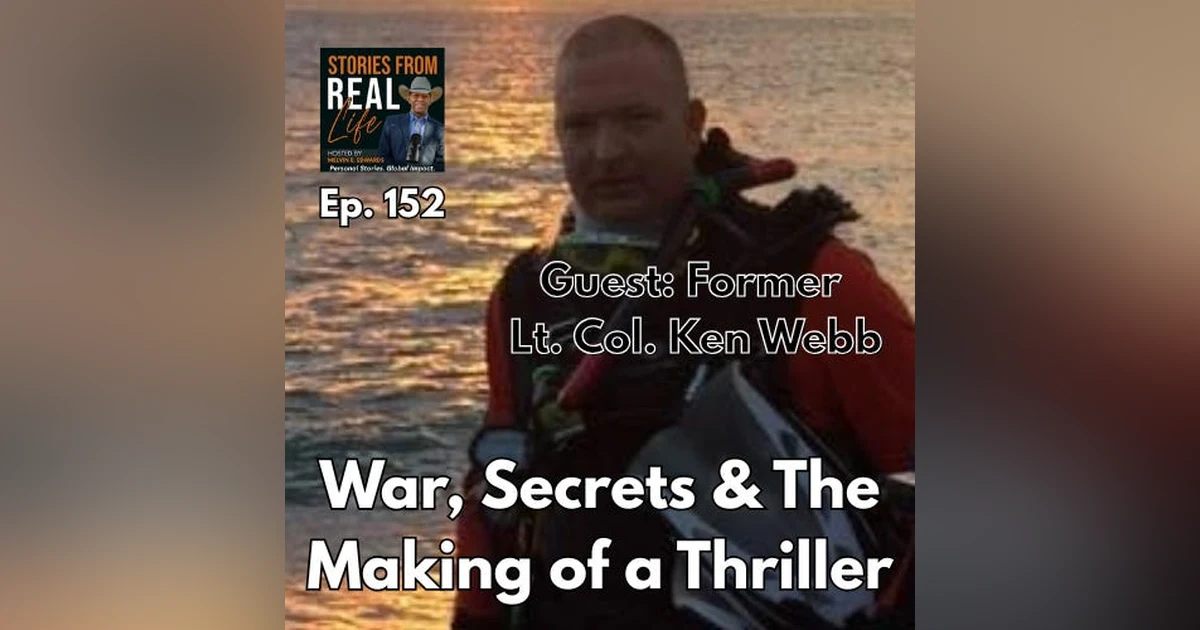

Kenneth Webb has lived a life of constant reinvention—retired U.S. Army Lt. Colonel, former American Airlines employee, defense contractor, and now debut crime-thriller author. In this episode, we dive into his journey from Texas to Lima, Peru, and explore the real-life experiences that shaped his novel Trapped in Deception. Ken opens up about leadership, resilience, and creativity, while also sharing what it’s like to start over in a new country and a new career.
Want to be a guest on Stories from Real Life? Send Melvin Edwards a message on PodMatch, here: https://www.podmatch.com/hostdetailpreview/storiesfromreallife. www.podcastreallife.com
storiesfromreallife.substack.com
Get full access to Melvin E. Edwards at storiesfromreallife.substack.com/subscribe
If you would like to support this podcast, please click on the PayPal link to make a donation today. Any amount is the perfect amount!
Thanks!
0:01 Today on Stories from Real Life with Melvin E. Edwards, our guest is Kenneth Webb, retired Army lieutenant colonel, world traveler, and debut crime thriller author. From commanding troops to crafting deception on the page, his journey takes us from Dallas, Texas to Lima, Peru, and into the dark psychology of his novel Trapped in Deception. I want them to take away from it that to face, you know, face your demons. And in this case, it's a real person. And I don't want to give away the book, but Eddie is facing Sean Larson. And he's given opportunities to just really, you know, take it out on Sean Larson.
0:44 And he doesn't. He chooses the higher route. He does fulfill the mission. And there is catharsis. Pull up a chair. It's story time with today's guest, Kenneth Webb. You are listening to Stories from Real Life, a podcast by engaging storytellers for engaged story listeners. Here's your host, author and journalist, Melvin E. Edwards. Hello again and welcome to another episode of Stories from Real Life.
1:25 I'm your host, Melvin E. Edwards. Thanks for joining me for the podcast where personal stories can have a global impact. As you heard in the intro, our guest today is author Ken Webb. Ken, thanks for joining me today. Thanks for having me today. So what first drew you to a military career and how did your early experiences shape your leadership style? What first drew me to a military career, I was always fascinated by the military ever since a child. I did not grow up in a family that had money. We didn't have money. And what initially got me started in it was the educational benefits. I was at a junior college, saw a colleague, not quite a friend, but a colleague dressed in a military uniform.
2:12 I'd gone to high school with him. And I said, hey, what's going on? What's up? You're changing into a military uniform. He said he was in the ROTC department. We got to talking, and I wound up with a scholarship, which is honestly, in my opinion, the ROTC scholarship is the easiest to get because they want people. You're obligated to serve in the military after that. Okay, that makes sense. So you ended up spending 33 years in Army Reserve. What distinct challenges and rewards did you experience? Well, let me first off, you know, full disclosure, I was commissioned into the Army.
2:53 I was enlisted first. I was commissioned into the Army in 1992, and it was after Desert Storm. There were a lot of cutbacks at that time. The only reason I was able to get commissioned is that I was scholarshiped. And the professor of military science was like one of the assistant professors like, hey, this guy is not going to be able to fulfill the terms of his contract. If you don't let him get commissioned, they had reached their quota. They go on alphabetically. My last name is Webb. I didn't make the cutoff just for that reason. So. And you want to know how how I was influenced. Yeah, what was distinct about it? What was distinct? Well, in full disclosure, I want to say I wanted to be active duty.
3:37 And I just didn't make the cut. And that is because of my lack of academic prowess. I was not an engineering major. I went to the University of Texas at Arlington, which is, it's a good school. They don't have a football team. So a lot of people are like, oh, I never heard of that. But it's a satellite school, the University of Texas, which does have a football team. That's in Austin, Texas. I was in Arlington, the Dallas-Fort Worth. Yep, I recognize the Longhorns. That has different meanings if you go to Spain, by the way, than any of the viewers watching and some of that South America. So I wanted to be active duty. I was depressed.
4:17 I wasn't. And I focused in university on learning. I was first person in my family to go to university. And, you know, you have to learn how to play the game when you're in school. It's okay to learn, but You need to study for the exam for any of those students out there. I mean, go ahead and learn, but make sure you study for the exam. If they say the exams over chapters three to seven, don't be like me and read one through 10. Do what the professor tells you to do. What was distinct about it? Okay. I started out, it was in the nineties and we used to call this the terrible nineties. And I was in Texas in your area and you know, I would go and I'd have to fund my own stuff.
4:59 You know, we use these protractors. I assume they still do. This is before chat GBT and all these things and everybody's phone can do everything. And we'd have to find stuff on a map. I want to buy my own supplies. Okay. There were no, you know, as a reservist, those of you out here who are reservists, whether that's Air Force, Army, Navy, Army has the most of these tours. And I just jumped on them. And when you do those tours, they have to hold your civilian job. And the rule at American Airlines was no more than five years. But after 9-11, because I was first mobilized, I was commissioned in 1992. I was first mobilized in 2001 in April, April the 15th.
5:42 And I went to Kosovo, and I was in Kosovo during 9-11, and then they changed those rules. They said, as long as we have troops deployed, and I don't know when that rule was changed, but I was within the five-year window. What was distinct about it? I learned a whole lot more on the mobilizations than I did just the weekend warrior. What was distinct about it is I would choose a tour, and I'm going to be honest, I'd say, hey, I'd like to try this out, I'd like to see that. And I wound up getting a big diversity. I was able to do things people on active duty couldn't do. I could jump from one tour to another and go to these neat places. It was also very stressful, to be honest, because every time I'd have to renew and I wanted to stay on active duty, you go through this big process.
6:27 Things have to be approved. But I would say in the end, it was well worth it. It was well worth it. Honestly, I retired twice. I retired in 2020. It was when COVID was going on. Because COVID was going on, things were backed up. And three days after my retirement, I got an email. And it said, so much of your retirement, you were extended for another two years. I was given the opportunity. I retired as a lieutenant colonel to make full colonel. I still didn't make it. And, you know, just full disclosure. I mean, you run a race.
7:08 You, you enter a writing contest. Some people write better than others in the race. Somebody wins, you know, okay. Everybody wants to get a trophy. Okay, fine. If they do that, but somebody wins, even if everybody gets a trophy, there's still a winner. And I would just say for the specific things that the army was looking for, uh, We go by evaluations and those evaluations, we try to be subjective. I mean, excuse me, we try to be objective in the evaluations. I'm sure there's some subjectivity, you know, subjective stuff going on. People play favorites. But I mean, if you know, just to be totally honest, I just didn't measure up. It's very hard to make colonel in the Army.
7:49 Now, at the time I joined. When I was commissioned in 1992, people would stress out about making major. And so my goal was to make major. I made one more rank. I went lieutenant colonel. But the dynamics change. I have friends that were in the Air Force on active duty who were majors at a certain booth before me at a certain time. And during the year that they were up for promotion to lieutenant colonel, nobody, zero people were promoted. So it's on the base of the military. So actually, retiring was a blessing for me. So what was unique about me is I got to do many things, single, no children.
8:34 I had to make some sacrifices because I would like to be married at some point. I can't say I ever wanted to have children, but what was unique about it, it was wonderful and yet stressful at the same time. And retiring was a good thing. Having children is a lot the same way. Wonderful yet stressful at the same time. I'm sure it is. They're pricey. You can't take them back. You can't say, you know, I'm moving to Peru. I want to give my child up to this person like you do with a dog. It's not like that. Not like that at all. Not at all. So how did your time at American Airlines and as a defense contractor compare to your military service?
9:15 Okay. First of all, I was only a defense contractor for seven months. At American Airlines, I mean, it was night and day. I was in reservations at American Airlines. I had no authority over anything. I joined American Airlines. My mother is also retired from American Airlines. So did my stepfather. They both passed away now. But I made sure during the interview process, I never mentioned that either one of them worked for American Airlines. I didn't want any Was it nepotism? Is that the word? I didn't want somebody to say you got hired because your mother worked there. Your mother got you the job, you know, kind of like the old thing with a father walking somebody in to the hiring manager and say, this is my son. He'd like to have it. No, there was none of that.
9:56 Just basic reservations. I got to do some special project stuff where I worked in operations and I got on some special projects. But because I was always away on a military tour, because I I started working at American Airlines Reservations in 1998. It was March, March 28th, 1998. And I started mobilizing with the Army in 2001. I was actually physically present working for them less than seven years on the books. I'm 22 years with them because when you return from a military deployment as a reservist, If you're on that deployment for more than 180 days, you have three months to return to work.
10:43 That's the Soldier and Sailor Act. If you're on it less time, you have different amount of times to return. And so I would always take advantage of the Soldier and Sailor Act. Sometimes talking to American Airlines, they'd give me longer. I'm like, look, I have another tour. This is when it starts. And they said, OK, Ken, don't bother coming back to work for three weeks. So it worked well in conjunction, I guess, because I wasn't in management. I got no grief. It wasn't like some people I hear because under the Soldier and Sailor Act, you have to give the person a comparable job when they return. You don't have to give them the same job.
11:24 But, you know, if you're a pilot and if I was a pilot with American Airlines and I return, you know, I think I have to be making the same kind of money. I still have my seniority, but I don't know that I'd have to have the same route. I wasn't a pilot. I went down that route, by the way. I tried out for private pilot, and I did the test. I passed everything, landing, taking off, but I couldn't solo. I was scared. And it was probably, you know, something I shouldn't be doing. So how does it compare? They worked well in conjunction. I identify myself as an Army officer.
12:06 I don't identify myself working in reservations at American Airlines. No. Okay. So you live in Peru now. So how is immersing yourself in Peruvian culture influence your creative journey? How has it? Well, okay. This is my fifth time in Peru. I moved down here to immerse myself in the language. I do not believe that people should retire and not have any goals. How has it influenced me? I believe that I am blessed. I retired at 53 and You know, that's not the normal age for retirement. So I think it's OK to retire if you retire and do something.
12:49 That something doesn't have to be a job. I did DOD contracting for seven months. I didn't like it. I went from being a lieutenant colonel with my own office to, hey, you come here. We need help with this. Uh, and it, I guess it was a strike to my ego, but I also didn't like not being part of the team. You know, if you're, you're part of a sports team, you know, you're on that team. If you're like the, I don't know if you're some kind of an admin person, person selling tickets or something like that, they may still be nice to you, but you're not like, yeah, one of the team, you know, and I, I wanted to be a part of, of, of something like that. So if I go back into government work, it would be as a government civilian.
13:30 Cause then you're, you're like, you're in the click again. Contracting is just about money. I mean, don't get me wrong. Some of these contractors work very hard, extremely patriotic, do a great job. And, you know, we, in the military, we loved our contractors, but it just wasn't the same. So immersion here in Peru, I mean, there, to me, there's no other way to learn the language. If you go to the defense language Institute in Monterey, California with the military, they immerse you in that language. And, uh, How has it influenced my writing? Well, it's in the United States, we're very stressed, you know, even in Texas. And I would call Texas a more laid back place.
14:13 And I love Texas. I'm from Pennsylvania. I prefer Texas. I think it's influenced me. Well, for number one, my novel. has Juan Cayo, Peru in there, which is a place of Peru. I chose specifically to have my novel take place in Dallas, Texas, and the area around there, Grapevine, Texas. I graduated from Grapevine High School, you know, Calivo, Texas, and take place in Miraflores District of Lima, Peru for a short while, which is where I'm at now in Juan Cayo. So it's influenced me, the whole culture. There were no gringos in Juan Cayo.
14:54 I was there for three days. I struggled to find anyone who spoke English. You could only the tourist people, the tourism people. I didn't find any tourists who spoke English. They were, everybody I met was a Spanish speaker. I'm not sure they were all from Peru. I can't distinguish the accent good enough. My Spanish is getting better and it's good for a gringo who didn't grow up speaking it, but it's not fluent. And so it's influenced it because you understand we have a very, And it's not just I'm not beating up the United States. This is everybody. We have an ethnocentric outlook. We think that that, you know, how we do things is the best.
15:35 And to a large extent, this is true, I think, for a whole lot of things. But it's not true for everything. You know, you can't say the United States does everything better. Well, no, we don't. You know, we do a lot of things better. We don't do everything better. It's the same way here in Peru. There are things I don't like. Some of the things I like are the things I hate when I want to get something done and this whole laid back attitude. And, you know, I'm in line and I need to get through the grocery store. I need to buy something and get back to my house, my apartment. And, and like this person in line knows the person who's checking them out and they'll stop and have a short conversation.
16:17 I'm like, well, why can't you just like do that after work? But at the same time, I went on a trip up to Mancura, which is in the north of Peru. And there was a big bus and there was a tourist place. And they said, well, we have a tour starting at one o'clock in the afternoon. And I said, OK, well, do you have this tomorrow? And they said, no, you can come on it today. And I said, okay, it's one o'clock right now. I was looking at the clock on the desk. It was exactly one o'clock. And I said, my credit card is back in my room. And they said, okay, go get it. Okay, so I went and got it, got all the things I need and came back.
16:58 People on the bus all waited for me. Nobody complained. Wow. Okay, if I was on that bus, I would have been irritated, actually. I was like, okay, this guy's going to be here tomorrow. Let him go on the tour tomorrow. Because I... you know, have a date or something with somebody or not, not even meeting up with a friend. And I'm going to be, I'm the guy that's going to be 10 minutes early, you know, here, 10 minutes late, 15 minutes late. That's like on time. Yeah. Wow. So you, you've mentioned you've lived in Texas and now in Lima, Peru. So if you had to choose between Tex-Mex and Peruvian ceviche for the rest of your life, which one would you pick?
17:38 Go with Tex-Mex, Tex-Mex, no doubt. Ceviche is nice. I don't like it as much as sushi or sashimi. Yeah, I can't say I've completely moved over to the food side here in Peru, but stuff that is very similar. to U.S. because this is a touristy area I'm in. But yeah, no, the food, I prefer Texas. Okay, cool. All right, so let's talk about your book. It's called Trapped in Deception. Trapped in Conman's Heist in Dallas to Peru. Is that a product of real-life observation, professional insight, or is it just purely fiction? Well, the book itself, the whole robbery, that's complete fiction.
18:23 Everybody in the book who speaks... who has a speaking role is based on somebody I personally know. The bad person in the book, which actually I think there's more written about him than there is about about the good person in the book who's modeled after me loosely is based on somebody I really know. And it was very therapeutic, the book for me, because I know somebody. I was his friend. I was the best man at his wedding. And I'm not a psychologist. I talk about pathological liars.
19:05 I think a pathological liar would lie even if they don't need to. You ask them something, they're just going to lie, even if just telling the truth benefits them. They're going to lie just because they feel compulsion. I don't feel this person is a pathological liar. I do believe that he lies and takes no responsibility for his own actions. Perhaps that's a sociopath. I don't know. I know that the next day he'll, he'll, he'll try to gaslight me, which is, we know gaslighting is named after a very old movie, which I still need to watch. And he just say, Oh, you must have me confused with somebody else.
19:48 I never said that. And it was this person, you know, I wanted to see the good in him because he was so much fun to be around. We went to university together and he could be fun. But when I, know you're slowly you you get to know people you realize things because you know a salesman when they when they sell something they can they can fool somebody for a short time but you get to know somebody you're around them enough you travel with them and we we had gone on vacations together as friends you get to see their true side and it was therapeutic it was like uh and during the the novel the The good person, whose name is Eddie in the novel, you see him grow and grow and overcome things.
20:32 And the bad person, you see him delve into things. I had one beta reader read my book and say, you know, this person starts out looking very sophisticated, and then they're down in Peru, and then they're acting like the big Lebowski. And, you know, that was actually true. This person is actually, I'm not cutting that out. This person is actually like that. You know, he will be ridiculously silly, but at times he can, he can show great discipline and, you know, drinks too much, recreational drugs. All this is true. Womanizer, all these things. So that this book, you know, and finally, you know, it's just like a relationship, whether it's a friendship or a romance, you know, you see people's negative qualities and you're either going to put up with that or you aren't going to put up with that.
21:24 And there comes, you know, a point where, you know, it's just like, okay, this is too much. So I just cut him off as a friend. He lied to me multiple times. I called him out on it. He even denied he was lying. So yeah, the book, the book was very therapeutic for me. It started out being like around 73,000 words. It's currently with my editor. It's less than 43,000. And that's because you'd see text in their emails, and they were real emails, changing only the names, the dates. And it's like people would read and be like, no, nobody would send a text like that.
22:05 Well, yeah, they would, because they're real texts. Nobody would think that. And I've never... You know, if you met somebody, I guess the problem is with these kind of people, maybe they're not all bad. They have some good qualities. Maybe they feel some guilt. They do some good things. But you're never going to get an even exchange. Maybe it's, think of it kind of like with children to parents. When children are children, they, well, I think it's impossible. They're not going to do as much for their parent as their parent's doing for them. But yet the parent's going to appreciate when a child, you know, if a child does save up the allowance or does some sacrifices, takes much money and buys a present for the parent, parents are going to appreciate that.
22:54 And I guess I was desperate to have a friend and I don't wish any bad on this person, but. But I needed to write the book. I couldn't not write it. I felt a compulsion. When it's all said and done, I will spend somewhere around $7,000 on this book. And that's a lot more than most people spend. I looked for beta readers, editors, and I wanted to see who is the best at this. Who is going to do this? Because this is my first book. Never written fiction before. By the way, it's less than 43,000. 43,000 words is short for a novel. But, you know, I feel I want more than sales.
23:38 I want somebody to read the book and say, man, that was a really good book. If I don't make a penny off it, that is what I want. All right. So how did your background in military intelligence contribute to crafting the psychological and strategic layers in the book? Okay. As an officer, I was first military police for 14 years. The vast majority of my mobilizations at active duty were in intelligence. How did it structure it? Well, 14. I think I leaned, and by the way, I wanted to be military intelligence in the beginning from, I mean, I didn't have the grades for it. They didn't select me. So, but actually being military police actually wound up helping me.
24:21 So it's like this whole thing, you know, I'm a Christian. I believe, you know, God like forced me into these things that I would, if I had been open, through my prayers and stuff, I would have drifted toward these things naturally. I am naturally by nature, a very analytical person. And I'm not, not an action person as much. I would rather play chess than, than play baseball. I would rather, you know, if I do a physical activity, swimming, jogging. It's going to be something like that. I don't want to get in there. And I used to play racquetball, but I mean, I don't want to get in there and play soccer.
25:02 I want to do something good for my body. And then, you know, then relax. So how did it, how did it, uh, contribute to my novel? Uh, the, The novel was written. You'll see that Eddie is actually a very anal person. And I'm that way also, you know, he's, he's going to say it's 643 in the morning. He's not going to say it's quarter to seven. He's not going to say it's 630. Uh, the chapters in the novel. And I had, I had a beta readers cut this out and I put it back in. I put it in the day, the time, the date, the location that that's the way I am.
25:44 Now, in the beginning, I was writing it like an intelligence analyst, and I was giving way too much information up front. The bottom line up front is from the Army, probably all branches, BLUF, bottom line up front, because you want to know, you don't want to have to be told a whole story to get the message. I mean, you can imagine if a police officer was to call into something and to tell all this stuff and description of the suspect and all this kind of stuff, and then at the end, say where they're at. and he's calling in for help. You wanna hear, this is where I'm at, this is what's going on in the beginning. And so how has it structured it? I struggled a lot with showing instead of telling.
26:29 I was telling what happened. Same way like if you and I were walking along the street and I wanna say I got into an argument with my friend or my wife or something and I just tell how it is instead of revealing it. which is not the way to do if you want to get to the point, but you want to reveal that somebody's a narcissist. You don't want to say this person's a narcissist. You want to say, you know, he looked in the mirror and observed himself, you know, much, much longer than was necessary. You know, you want to, or, you know, he's, he didn't have to ask if his was, if his suit was the best, he already knew it.
27:09 You know, you just, So, and intelligence is very structured. It's written much different. I have a more unique style and I want that. You don't want to, I think it's fine to use artificial intelligence to look for spelling and grammar checks, but sometimes making things exactly according to what's the best way to structure this sentence, you lose your own voice. You don't wanna over correct something. Okay, so your protagonist in the book is Sean Larson. So if he suddenly came to life, knocked on your door there in Lima, would you invite him in for a drink or would you run the other way?
27:53 Well, remember, it's based on a real person. So if that person was to come here to Lima, I think I would ask and knock on my door and I would say how, first of all, I'd say, what are you doing here? How did you get this address? I would not invite him in. I'm not sure if I would say what I just said or if I just close the door in my face and his face, close the door in his face. No, I would not invite him in. I don't want to talk to him. I don't want to. I haven't blocked this former friend. And that's not because I want to talk to him again. That's because. He made an attempt for years to reach out to me, and I want to know what he's doing.
28:35 If he says, hey, Ken, I saw your new novel. I'm going to come down to Lehman and talk to you about it. I want to know what he's doing. So, no, I want to distance myself from that person. I don't want to see him again. So, no. Okay. So, Trapped in Deception, which is your book, has been likened to Breaking Bad with a Wall Street twist. Yeah. and Gone Girl from the perspective of a sociopath. How do these comparisons resonate with you? As I watched both of those, I mean, specifically Breaking Bad. You said Breaking Bad. Yeah. Breaking Bad, I mean, we saw, was it Walter? Walter, is that his name?
29:16 I've never seen it, but I'm pretty sure his name is Walter. I'm actually horrible with names. I mean, I'm talking to family members and I like forget their names. While I'm talking to them, it's incredibly embarrassing, but I'm very good with facts. So, I mean, you see him transform and he really just, I don't think he becomes a different person. I think we just, he kind of realizes who he is. You know, that's the person he is. And I think that the good person in the novel, who's Eddie, really was a good person and wanted to get through this, this deception, this psychological damage had been done to him.
30:00 And the other person who was Sean Larson, he that's the name of the novel. He was always a bad person. And you see him slowly, you know, it's not uncommon, if you know, in movies and stuff, the person you slowly realize who they are, as they, they start to become insecure, they start Because things are not going their way, they're used to being in control, and then they're losing control. So I would say in that way, specifically the Breaking Bad, because you see the people come out and people become who they really are.
30:43 When people are faced with trauma, when people are faced with bankruptcy, things like that, then you see who these people really are. So after decades of demanding careers, what does stepping away and settling in Lima teach you about reinvention? Reinvention. And I pride myself on my ability to reinvent. And it's taught me that, you know, instead of looking at this, you know, going through depression, you know, trying to jump back into somehow military or quasi-military to be like on the team or chasing money.
31:24 I now have the opportunity to do the things that I've wanted to do my entire life. I can't say I've always wanted to be bilingual, but I want to become bilingual. I have always wanted to write a book. I've always had that in the back of my mind, and I never thought I was going to be doing it in retirement. I thought I was going to do it sooner. I have always wanted a doctorate, and that's because that's a You know, I don't know what the new term is, but they used to say terminal. But, you know, they're like, that sounds like death saying terminal. But it's you can't go higher. You hear about people doing postdoctoral work.
32:07 You don't hear about, you know, I think there may be, you know, somebody is going to call me out on this, but I don't think there's something after a doctorate. It's not specifically a Ph.D., but, you know, there are other kind of doctorates. I don't think there's like a doctorate square. There's not something after that. So you go as high as you can go. You can still do post-doctorate work. But this has given me the freedom, my pension from the Army, the liberty to do that. So what has it taught me? It taught me that just because somebody else says something, it doesn't mean it's true. I lived with my grandmother. The teachers at the school I was going to told her, you know, we're very sorry, but you're, you know, I was eight years old and I was in second grade.
32:52 Your grandson will never learn how to read. I went to summer school then. She bought a bunch of books. She worked with me. I went back reading at a fifth grade level. This is over a period of months. So I had the aptitude to read. My problem was concentration and You know, I could blame it on the teachers. And I suppose if they were better teachers, maybe they would have worked on that. But, you know, I just say maybe I had some special needs that back in the, I guess, late, mid to late 70s weren't as well known identified as they are now. All right. So what encouragement would you offer aspiring writers, veterans considering creative paths or anyone aiming for a dramatic life transition like you've experienced?
33:42 OK, there's a couple of things. I mean, money is always a factor, but I think you need to have enough money. You don't need to make money the main focus, as long as you have enough. I mean, if you have some kids to support or a wife that's sick or something, yeah, then you need more money, then yeah, that needs to be that. But if you have enough money, do what you want to do. As we said for this interview, I got a mole cut out recently. I was scared to death. There are different kinds of cancer. It was cancerous, but this one, like the cancer is not there now. I just have to go in for checks.
34:23 But it scared me to death. I was like, oh, no, melanoma, melanoma, even though they told me it wasn't. So we don't know how long we have in this life. So don't wait to do something. Don't think you're too old. I've had people tell me I'm too old to get my doctorate. I'm 56 years old. I'm going to start it in September of 2027. I'm going to do it online. You're not too old. I mean, if you die achieving your goals or working for your goals, keep working on them. Don't I mean, I don't think your goal should be, you know, watching how much television you see, how much you can watch. Your goal should be accomplishing something. It doesn't have to be financial.
35:05 It could be, you know, my grandkids are having trouble learning to read. I want to make sure my grandson can read. That's a legitimate goal. It can be I want, you know, my daughter has a flower garden. I want to make it look the best way I can make it look. But it should be goals. But the other side of that is, you know, if you get too much like I used to be, you can stretch yourself out with goals. If your goals stretch you out, that's not if you're all stressed out, that's not a good thing either. Enjoy your life. Understand that, you know, tomorrow is not a given. that, you know, we don't know how long we have.
35:48 And I was specifically from the Army Reserves. One of the reasons I chose to retire, I knew people that were not that much older than me. And there were four of them. And they weren't friends, but I knew them, worked with some of them. Three of them died from cancer, one from a heart attack all in the same year. So, you know, my... My best friend and other people are saying, you know, Ken, what are you doing? I mean, you got the pension. You've saved your money. You've been good with your money most of your life. Do what you want to do now. I still have this wonderful post 9-11 GI Bill, 34 months left on it.
36:29 Only used two months of it. I want to get that doctorate. Good luck on that goal. It's not part of your goal. So with your book, Trapped in Deception, what do you hope readers take away from it? I hope that they take... Well, first of all, I want them to think it's just a great book. And if they say it's the best book they've ever read, you know, great. But I don't want them to lie to me. I want them to take away from it that to face, you know, face your demons. And in this case, it's a real person. And I don't want to give away the book, but Eddie is facing Sean Larson. And...
37:10 he's given opportunities to just really, you know, take it out on Sean Larson and he doesn't, he chooses the higher road. He does fulfill the mission and there is catharsis. And, and the takeaway from it, that it's important. And I also, I would say to take away from it. If you, I told you, these are real people. If you have a story to write, write it. And, You know, don't necessarily believe what one person, don't let somebody else tell you it's not a good book. And if the only thing it does is help you get out your feelings, then it's a good book and it was worth it.
37:52 You know, I've had more than one person tell me when you have an issue with somebody, you know, write it down, write the whole thing and then saying, I forgive you. And then you burn that. And the thing is, why do you burn it instead of bury it? If you bury something, it can be brought back up. You burn something, it's gone. And that's how you'll see me deal with things. If I have a real issue with someone, you know, get an ashtray, you know, burn it. You know, it's gone. And so to take away from it, deal with your problems. Write if you want to write. Already admitted I'm terrible with names that this is not original. Be true to yourself.
38:33 If you want to get that doctorate, if you want to travel the world, do these things. All right. As a final question, I usually ask people to give me one piece of advice on any topic. It sounds like that was your advice, unless you've got some more. It was. Okay. Well, that's your advice and that's it for today. I appreciate that. Our guest today has been author of Trapped in Deception, Kenneth Webb. Ken, thank you so much for being here today. Thank you. So please go to my website at podcastreallife.com for more information about my guests and the things we discussed today, including a link to get his book. That's it for today's episode of Stories from Real Life. Join us again next time for another chance to learn from each other. Until then, don't forget to shine your light wherever you go.
39:18 Thank you for tuning in to this episode of Stories from Real Life. Don't forget to subscribe and share. Let's meet right here every Tuesday and Friday. See you then.


