

 Spotify

 Apple Podcasts

 Goodpods

 Audacy

 iHeartRadio

 Youtube Music

 Amazon Music

 Audible

 Podchaser

 YouTube

 Castbox
 RSS Feed
Ep. 155 - Unlocking Your Side Hustle Potential

I apologize for the distorted audio on my end. It’s still a good episode with plenty of helpful hints.
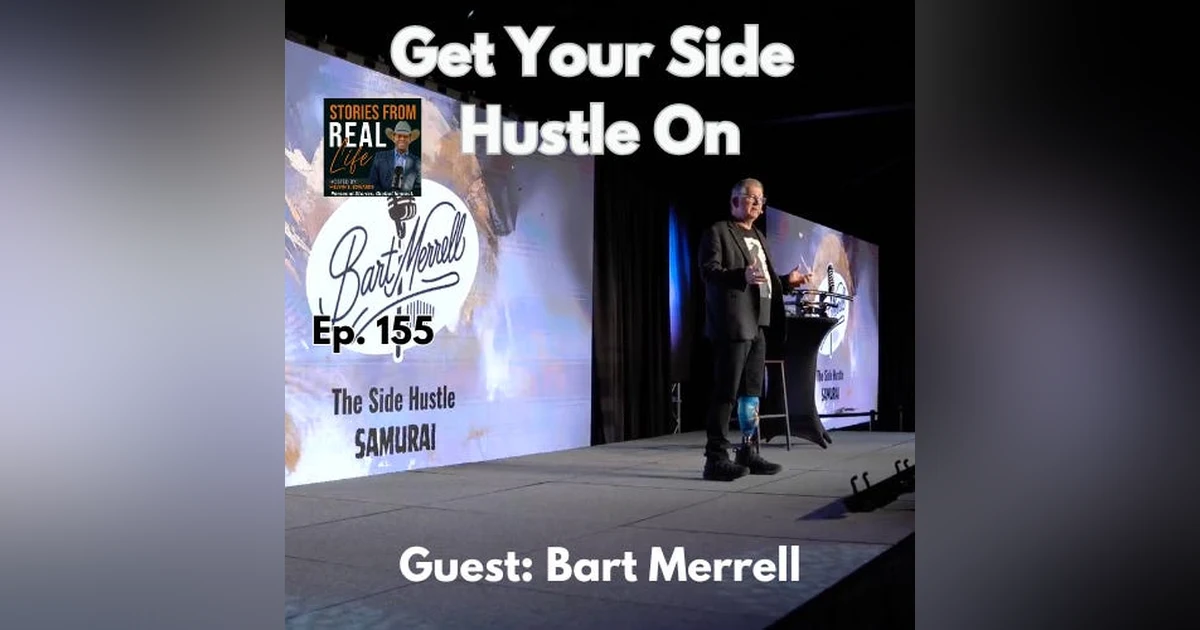
In this episode of Stories from Real Life, host Melvin E. Edwards speaks with Bart Merrill, known as the Side Hustle Samurai. Bart shares his entrepreneurial journey, starting from his childhood experiences on a pig farm to becoming a successful entrepreneur. He discusses the importance of monetizing one's mindset, validating side hustle ideas, and the role of mentorship in achieving success. Bart emphasizes the need for financial resilience and preparedness for opportunities, as well as the significance of embracing new trends, particularly in AI. The conversation concludes with valuable advice for aspiring entrepreneurs, encouraging them to recognize opportunities in their own lives and take action.
Want to be a guest on Stories from Real Life? Send Melvin Edwards a message on PodMatch, here: https://www.podmatch.com/hostdetailpreview/storiesfromreallife.
storiesfromreallife.substack.com
Get full access to Melvin E. Edwards at storiesfromreallife.substack.com/subscribe
If you would like to support this podcast, please click on the PayPal link to make a donation today. Any amount is the perfect amount!
Thanks!
0:00 Today on Stories from Real Life with Melvin E. Edwards, our guest is Bart Merrill, better known as the Side Hustle Samurai. Bart's all about helping people turn what they already know into extra income without waiting for the perfect time or idea. From creative side hustles to his monetize your mindset approach, he's on a mission to show that financial freedom is closer than you think. Monetize Your Mindset just came to me. I thought it was amazing. I thought, oh, it's amazing. The dot-com is still available. Man, this is God-given. It's meant to be. And then I would talk to people. My sister, who grew up with the same dad, she's like, well, what does monetize mean?
0:43 What do you mean by monetize your mindset? And that's where I noticed I had to have something else to it. So the tagline is create financial security by monetizing what you already know and do. Pull up a chair. It's story time with Bart Merrill. You are listening to Stories from Real Life, a podcast by engaging storytellers for engaged story listeners. Here's your host, author and journalist Melvin E. Edwards.
1:25 Hello again and welcome to another episode of Stories from Real Life. I'm your host, Melvin E. Edwards. Thank you for joining me for the podcast where personal stories can have a global impact. Our guest today is Bart Merrill. Bart, thanks for joining me today. Thanks for having me. So you call yourself the Side Hustle Samurai. If you really had a samurai sword, what everyday problem would you use it to solve? Really had a samurai sword. So I do have a samurai sword. It is considered a toy. It won't hold an edge, but you could run someone through with it and do some damage.
2:06 What would I use it to solve? I'm a pretty even keel guy, so I don't get too angry. I don't get too excited. I kind of stay level. So it wouldn't be for aggression or defense. It would be for a barking dog. Especially early in the morning, right? Exactly. All right. You've been a serial entrepreneur since before you could drive. So what was it about that early experience that set you up on your entrepreneurial path? So my dad, he was a pig farmer, but he wasn't just a pig farmer, he was a businessman.
2:46 He had his hands in many different areas of the agricultural industry. He was part owner in a dairy, part owner in a mushroom farm, part owner in a produce warehouse where they would bring produce from Mexico and then distribute it out to the different grocery stores. And so growing up, I watched this. And then when I was 11 years old, I worked on the pig farm and I bought my very first stereo. I loved music, to listen to music. I loved to listen to it. And man, I got that stereo and oh, I was in heaven. It was all in one system. It was a Sanyo. It had a cassette deck over here.
3:27 And what would you think was on the other side? Well, it probably wasn't a CD, I'm guessing. It was not a CD. It was an eight-track player. Okay, I didn't want to go back that far. And it was just, I loved it. But as an 11-year-old kid, it was a liability because every time we'd go to town, I'd have to buy the new tunes. And for an 11-year-old kid, back then we had to buy the whole thing. It wasn't like we do now. We had to buy the whole thing. And so... But when I turned 15 and got my driver's license, I decided I was going to become a DJ, a mobile disco unit, and I would go do dances.
4:12 But for me in my small town, nobody was hiring 15-year-old DJs. And so I had to create my own opportunity. I rented the community center, hired an off-duty cop for security. Mom and dad took money at the door. I spun records. Everybody danced, had a great time. And that's how I got my start. And so watching my dad and then my dad helped and encouraged me as I went along. And so between my dad's example, he never sat me down and taught me the birds and the bees of business. He just showed me by example and I followed it. And that's how I kind of started. That sounds like fun. A lot of fun.
4:53 I monetized fun. I monetized something that I liked to do. Nice. So your concept is called monetize your mindset. So how did that come? What specific moment brought that and sparked that idea for you? So I was volunteering at a drug rehab center. It was a 90 day in-house drug rehab center. I was teaching, speaking, teaching them how to tell their story. And I was listening to Jen tell her story. And she was talking about how as a kid, when she was growing up, the they would go out and about and the family was normal but then when they would go back home is when the abuse and the neglect happened and in her mind everybody else was the same when they're out and about they're no more normal when they go back home they got the same abuse the same neglect that she got it wasn't until she got to college that she realized things were different And so I'm sitting there and I'm listening to this and I'm thinking about me and my life and what I've done.
6:00 And I think it's the same when people think about finances. If they didn't grow up with my dad or someone like my dad, they don't think like I do. And so that's when it all was born. I don't know. Monetize your mindset just came to me. I thought it was amazing. I thought, oh, it's amazing. The dot-com is still available. Man, this is God-given. It's meant to be. And then I would talk to people. My sister, who grew up with the same dad, she's like, well, what does monetize mean? What do you mean by monetize your mindset? And that's where I noticed I had to have something else to it.
6:42 So the tagline is create financial security by monetizing what you already know and do. And so that's how it all came about. I still think it's an amazing title. It's just some people have to need a little push. I get the same thing with side hustle. I think side hustle samurai is amazing. Good alliteration. But people go, what's a side hustle? I'm like, really? And so you just gotta be, you gotta teach people what it is you're doing. And so with my side hustle samurai, one of my things, I teach people how to identify their ideal side hustle.
7:26 And that leads me right into my next question. We're getting close to the end of the year, but your 25 successful side hustles for 2025 program promises real income relief. What are two or three ideas from the list that were especially powerful right now or powerful right now? And so the most powerful one I haven't mastered yet, but I have a mentor that I watch him do this every day. And it's just amazing what he does. And that's the Forex market. And he says, he's not a trader. He just knows how to pull money out of the market.
8:07 And he does it in a very short period of time each day. I mean, he gets a notice that something's looking good. He'll go check it out, put his things in and walk away. And he makes sometimes seven figures in a day. And so it's just crazy if you can master what he does, which I'm in the process of doing. I've made four figures in a day, but I haven't done what he does. But to me, and he has students that have done five figures, even six figures in a day. And so that to me is just the holy grail of side hustles.
8:51 If you're disciplined and you're willing to do the work, So another one that I am in is the pet industry. I'm a dog trainer. I love dogs. I've had a dog all my life, and I've always thought about, man, how can I monetize my mutt? And then I adopted a mutt. He's not a mutt. He's a purebred Rottweiler. He was an eight-month-old, 90-pound puppy that didn't know the word no. And I would call my friend, Sean. I'd say, Sean, he's doing this. What do I do? And he would tell me what to do. And Sean said, you know, I'd call him again, Sean, he's doing this. What do I do? He's doing this. What do I do?
9:31 And finally, Sean just said, Bart, my company's doing a train to trainer program. Why don't you come and take the train to trainer program so you can train your own dog? Once again, as the side hustle samurai, my first thought is, okay, if I'm going to train my dog, I'm going to get paid to train other people's dogs. And that this was right, this was probably about a year before COVID happened. And so I got prepared and I got training dogs and then COVID happened and I, man, it just, it was crazy. I did like 388 days without a day off, training people's dogs.
10:12 And the money was good and it was, I get paid a lot of money to play with other people's dogs. Something I love. And that's just how things work in my brain. So there's two right there. If I'm thinking of another one. So I like to take people down a process to where it's not a, the 25 for 25 is just a memory jogger. It gets you to think about what is out there. Stuff that, I mean, picking up dog poop. I have a friend in Idaho that makes good money with a dog poop picking up company.
10:59 Who would have thought? And so the 25 for 25 is just to get the juices to start flowing so that you start to think about, oh, well, what about, this is a little different than what's on his list, but what about that? It's something I know. It's something I can do. Maybe I could do that. And so the list is just there as a memory jogger to get you thinking. That makes sense. On that list are real legitimate side hustles. Another real quick one. I hopped in an Uber. This is probably four or five years ago. And my driver was Megan.
11:40 And I said, Megan, how's Uber treating you? She's like, oh, I just do this to and from work. She was a nurse at a hospital. She lived about an hour away from the hospital. And she would have to drive often during rush hour traffic. If she was by herself, she couldn't use the HOV lane. So she would pick up a customer, drive to Salt Lake City, drop off the customer, go to her work, pick up a customer for the drive back home. She made an extra $60, $70 a day, plus she got to use the HOV lane and get home quicker. And so just little things like that that people just don't think of.
12:20 They're leaving opportunities on the table. All right. So in a recent podcast, you emphasize that, quote, luck is when opportunity meets preparedness. How do you help people cultivate that preparedness? So, yeah, one of the things that I do is I take people through a process where we look at what do you like to do? What do you need to do? What are you already doing? Then we take it a step further. What would you like to learn? What do you need to learn? What have you already learned? And that gets them thinking, it gets them thinking about things. Now, when I say you gotta be prepared, there's several things you gotta prepare for.
13:01 So as you take that list, those six lists, we refine it down to where you have a handful of opportunities. Now those opportunities are gonna be different. One may take cash to get going. So you gotta be prepared financially to do that opportunity. Another one, getting in business, being an entrepreneur, Things happen. I mean, things happen anyway in life, period. Things happen out of the blue that can cause you stress, cause you grief. And so you have to be prepared mentally. And so I tell people, there's nothing I can tell you today that's going to get you prepared for something happening right now.
13:45 But if you start putting good stuff in your mind, good videos, good books, good... Just stuff that energizes you and lifts you up versus watching the news all day long or seeing the stuff, the bad stuff in the world that gets you thinking about the bad issues. If you get prepared and get prepared mentally and then financially, then you're prepared for when those two meet. I'll give you another example. If you've listened to some of my podcasts, you know that I had to have my leg chopped off about a year and a half ago.
14:26 My lower left leg had to be amputated. Now, obviously, that was a kick in the gut when I got the news. But when all the shock and awe ended, because I was mentally prepared, I said, okay, I don't like this, but it's got to happen. There's nothing I can do about it. It's got to happen. So how can I monetize it? Six months post-op, I've contracted with my prosthetist to help him with people who are going to go through what I had to go through. So I love to talk. You can tell by the way I talk.
15:06 I love to talk. And I love to listen and help people. And so it gave me an opportunity to use and do something that I love to help people and get compensated because I had to learn, I needed to learn how to go through what I was gonna go through. Now, mentally I was prepared and I expected the best. When the news happened, I said, okay, this is gonna go great. And I expected the best and the best has pretty much happened. And when something didn't go as expected, because I was mentally fortified, I was able to handle it and overcome it. And then it gives me something, gives me an arrow in my quiver.
15:50 If someone else experiences that same thing, I can help them with it. And so being prepared, and like I said, there's nothing I can tell you today that'll prepare you for right now or maybe even tomorrow. But it's like, when's the best time to plant a tree? 20 years ago. When's the next best time to plant a tree? Right now. And so if you start preparing right now for whatever's going to happen, for the opportunities, good or bad, then that's going to get you ready for when it does happen. Okay. So what are some of your top tips for validating a side hustle idea? Yeah.
16:32 So the number one pitfall that you could run into with a side hustle is something that you choose the wrong side hustle. So you choose something that's not right for you, whether it's lifestyle, whether it's money, you don't have enough to get it off the ground, or whether you don't like it. If you don't choose the right side hustle, especially if you're doing it with a job, which I haven't done, by the way, I've I kind of fell into this because my dream job got blown up. And so I just fell back on what my dad had showed me as a kid and just through his example.
17:13 And then I just kept going, I kept going and things happen, things happen. Like I say, I sometimes say that I'm lucky, but luck is preparedness, meeting opportunity, and then taking action. If you don't take action, that's probably the number one thing. If you preparedness and opportunity meet and then you don't do anything about it, nothing's gonna happen. But if you do pick the wrong side hustle and it's something that's taken away from your family, taken away from the other things that you love, taking time that you would be doing something else, you better like it at least a little bit, or maybe it's something that you're already doing anyway.
17:55 I don't like having a prosthetic leg, but it's something I'm doing and it's something I'm learning. So I'm doing it anyway, you might as well get paid for it. Oh, sorry, go ahead. So I like to say it like this, when life gives you lemons, They say make lemonade. I say, no, if you're making lemonade, you might as well build a lemonade stand and sell the stuff. And so good, bad or ugly, when life gives you something, build a lemonade stand and sell the stuff. Makes sense. So how do you personally decide whether side hustle is viable?
18:35 What's your process for that? That's a good question that I don't know that I've really ever thought about. So when something comes across my life, like I said, good, bad, or ugly, the process goes something like this, huh, can I monetize that? And then I process it. So let's look at my leg. Now people will say, that's just crazy talk. And you're going to monetize getting your leg chopped off. That's kind of extreme. And I wouldn't advise it to any of your listeners to get their leg. Don't chop off body parts to create a side hustle.
19:16 But the way it happened is I thought about it. So I started thinking about it. And then I'm sitting with my prosthetist. He is doing something with my new leg or whatever we were doing. And I just, it just, it came to me. I said, okay, Scott, you got a competition who has a guy because I talked to him. I saw three different prosthetists before I chose my prosthetist. And one of them had a guy that came and talked to me at my house and told me things to expect and helped talk me through that. Even the day of my surgery, after my surgery, he came to talk to me, even though I had another prosthetist.
19:56 So he had a guy that was there. Their company had a guy that was there and helped trying to get business, probably. I said, Scott, your competition has a guy. You don't have a guy. I'm your guy. And he thought about it a second. He says, okay, then we started our negotiation process. And when I negotiate, I negotiate to where... I want it to be a win-win for everybody, but I'm not gonna go into it if it's a win for them and it's not a win for me. And so I'm upfront. I told Scott, I said, I'm not looking for a job.
20:37 I'm looking to help people. I love to talk to people. I love to work with people. I don't want a job, so I'm contracted as a 1099 contractor and I take calls, I give calls, he calls me and tells me, okay, this guy needs some help, can you go do it? And I'll go run up and do it. And so I'm upfront, but I thought about it for a while before when the opportunity came to present it to Scott, it just felt right. There was a time when I thought I was gonna be a poker player. back in the no limit hold'em boom.
21:19 And you had the, and it's still a boom, but I mean, it was really big. It was just growing. And I was like, I'm gonna be a poker player. And you could play poker online with real money and be in tournaments. And I played poker six, eight, 10 hours a day. And for about six, eight months. And when I looked at my poker account, it was $500 positive. I did the math. And it came out to like 20 cents an hour. I'm like, 20 cents an hour isn't gonna pay the bills. So it immediately went on the back burner. But I mean, I've studied that. I read books that were this thick. I mean, they were two inches thick about poker strategy, poker statistics.
22:04 I studied it harder than I studied what I studied in college. But I just didn't get to the point to where it was viable. Here's one thing that I think was important was I didn't have someone, a mentor, to guide me, to help me through it. I joke that my mentor might have came to the same conclusion I did. Bart, you're not a good enough poker player to be a professional poker player. But at least I would have had someone to guide me and maybe help me be a better poker player. So I think mentorship is huge. But I decided that wasn't for me. Here's another one.
22:47 So I do have connections to Japan. I took the first commercial bungee jump to Japan. And I've been back and forth to Japan many times. And there is a curry restaurant. It's a Japanese curry restaurant called Kokoichi Bomb Curry. And in Japan, these restaurants, they are successful 100% of the time. They're profitable within the first year. And when I land in Japan, it's the first place I go. When I leave Japan, it's the last place I go. And I loved it. I had the money lined up. I had a investor that was willing to front the money. And I got home and I started doing the things here and I'm researching and putting things together and it finally hit me.
23:31 I don't wanna work that hard. Restaurants are hard. I like to eat there. but I don't want to be the person in the restaurant. And so I let it go. And my investor said it like this to me, if you make money, we'll split it up some way. If you don't succeed, don't worry about it. And we're talking hundreds of thousands of dollars to get started. And so I could have took his money and just gave it a shot, but my heart wouldn't have been in it And I would have lost his money. And so I couldn't do it.
24:12 I didn't do it. And I chose not to do it because I didn't want to work that hard. You know, everybody thinks, okay, I want, oh, I wish I was Bezos. I wish I was Musk. I wish I was Mark Cuban. I wish I was, do you really, do you know what they did to get where they are? Slept on other people's sofas, slept in the office, slept, They work nonstop crazy. Is that really what you want to have their life? And I'm not saying their life's bad, who knows? I mean, right now it's probably amazing, but maybe not. Do you want that lifestyle? And so you have to think about those things.
24:53 What am I getting into? Is that really what I want? And that's why I let that restaurant go, even though I bet it would have been successful. It just wasn't what I wanted my life to look like. You talked about helping launch that first commercial bungee jump effort in Japan. Have you ever done any other type of side jobs, side hustles that were high adrenaline like that one? So I got a call from the same company that did the bungee jump. And they said, Bart, we saw this thing on TV. It's in Germany and we want you to go try it.
25:34 And I said, OK, what is it? It's a complete unattached free fall into a net from about 150 feet in the air. And I just paused for a second and I looked at myself. I kind of looked like this, I'm sure, where my head was turned. I'm like, oh, I told him, you know, that's that's got to hurt. Yeah, I know. That's why we want you to go try it. Well, I called Germany, and Germany said, well, it's only four stuntmen right now. We'll call you when it's ready for the public. I didn't think I'd get a call, but two or three months later, I got a call, and it was in February, and I was on a plane to Hamburg, Germany, and Hamburg, Germany is cold in February.
26:16 I did it three times. I flew to Japan. We sold three of them in Japan, and then I built two here in the States, one in Dallas, Texas, and one in Wisconsin, Dells. And it was a rush. I mean, and seriously, it was freezing cold in Hamburg. And I'm hanging at the top of this thing. And they pull this. They say, okay, here we go. Three, two, one. And they pull this release carabiner that releases. And you drop. And you drop butt first. But you're falling. And you're only falling for less than four seconds. But in your head, the net by now i should have hit the net by now before you finally hit the net and and so that's one uh the sky coaster there's a sky coaster is a big swing thing you see in all these parks i took that to japan as well and same company they called me and said hey is there a sky coaster sky coaster close to you i said yeah it's about an hour away They paid me $2,500, $3,000 to go try it.
27:19 So me and my girlfriend hopped in the car, went and tried it. I said, yeah, I liked it. And so we took it to Japan. That sounds pretty fun. I wouldn't do it, but it sounds like it would be fun. I love it. I love the adrenaline rush. And then I got married and I calmed down a little bit. It has a way of happening. My wife said, you don't need to be doing that stuff anymore. Yeah, marriage has a way of taming us. So you've spoken before, being financially self-sufficient regardless of the economy. So what traits make someone resilient in that type of way?
28:00 So it's a lot about what I've been talking about. Being... Understanding the opportunities that are all around you and being aware of them and then being willing to take action. That first step is often the hardest. And getting that momentum, getting started is often the hardest. That's why I have the 25 for 25. It helps you get the juices flowing. But you need to get out there and take action. You know, we talked about the bungee jumping. One of my crazy, stupid claim to fame is I jumped off a bungee tower just hanging on to the bungee cord with my hands. And it was eight stories high.
28:43 And there's a reason. There's a reason for my madness. You're giving me that look. And I don't know if it's a good reason, but there is a reason. Okay, let's hear it. So at the bottom of my bungee tower is a stunt person airbag, the kind that are always blowing up with air and you can jump in them. And it was said that you could jump from the top of this tower without a bungee cord and hit the mat and be okay. And so I'm sitting up at the top of this bungee tower. It's on a slow day. And my mind just says, huh, I wonder if you can do that.
29:24 And I walked over to the edge and I looked down like, no, I ain't that crazy. And so my brilliant mind, and if people are watching this, let me just give this to you. This going forward is brilliant. This going backward is crazy. And so my brilliant mind is going forward and says, okay, If you could jump with a bungee cord attached, wait for the bouncing to stop, and then unhook yourself, you're only falling from six stories instead of eight. That's doable. And so I jumped, waited for the bouncing to stop. When it stopped, I couldn't unhook the cord. There was too much pressure.
30:05 And so once again, my brilliant mind says, okay – Well, when you attach the cord to your customer, you have about a foot-long, one-inch nylon strap with a carabiner on it. You could take two of those, wrap them around like you'd wrap it onto the customer, hook it to itself, and you have two loops. To put it on the end of the bungee cord, what do you have? You have two handles. Now I don't need to unhook the cord. I can just jump, wait for the bouncing to stop, and then all I gotta do is let go. Now that is brilliant. So I did it. I walked to the edge.
30:45 I said, three, two, one, bungee, and I jumped. And obviously I'm okay. I can make it happen. And it worked, but people look at me like you're crazy. Why would you do that? And I say, it is not an uneducated guess that I could hold on. I had jumped many times. I knew what the pressure was. I was 99%, probably 99.9% sure that I could hang on. And so that wasn't the issue.
31:30 And I did, I jumped and I tell people, you need to make an educated guess in business, but you're going to have to jump even if you don't know what the outcome will be. You need to take that first step. And once you step off, you got to see what there is to see. And even if you fail, you're going to pick yourself back up and try again. And so you have to do. All right. So you brought the story back around. So it wasn't just a matter of you being crazy. You actually had a plan. Like I say, you have to make educated guesses and then decide whether you want to jump or not.
32:11 But if you don't jump to see what there is to see, you're not going to make progress. That makes sense. So as a side hustle samurai, what advice do you give for those who are overwhelmed by the just sheer number of ideas and they don't know where to start? Get a mentor. Get someone who's done it before, whether it's me or someone else that can walk them through the process and help them refine their list to where they have the two top three, the top two, top three on the top of the list. and try them one at a time. But the biggest thing I can say is a mentor is going to help you through and hold your hand.
32:57 Even if you really don't need the mentor, just having someone there makes you feel at ease and helps you move forward better. And so mentors are key in so many different areas. I agree. So what are some of the common... mindset traps that you encounter with people who are struggling to start? I can't do this. Or I'm not good enough. Or I don't have enough time. But aren't you supposed to only focus on one thing? That's huge.
33:39 And they throw this at me and people hear it all the time. Well, you know what they say about the jack of all trades, master of none. But have you heard the full quotation? I don't think I have. The full quotation is jack of all trades, master of none, though oftentimes better than the master of one. It is meant to tell you, you need to diversify. It is nothing about focusing on one thing, which people use it for all the time. I don't have time, I need to focus here.
34:19 And if you do, great, you need to focus there. But if you need multiple streams of income, and that's what this is all about, multiple streams of income, diversifying where your things come in, helps you when life happens. When I got my leg chopped off, Even though I had multiple streams of income, having that financial worry, it was right up there at the top. Dog training was one of my biggest sources of income. It's hard to train a dog on one leg, especially when that one leg hurts.
35:01 And so I'm worried, how long until I can get back up on my feet? Well, I guess I'd be getting back up on my foot. You can laugh at that. But it was a worry. It was a legitimate concern. How long is that source of income going to be gone? Now, I had a goal. My goal was four months. I made it in three and a half. And I was back training dogs. But the concern was there, but what made it easier to deal with was the fact that I had my rental income coming in. I had my Japanese export income coming in.
35:42 I had multiple streams coming in that just made the ability to last longer if complications were to happen. Those streams of income would help support me as I went. And so that's just one of the things that people, I hear a lot. Now I need to focus on this. You've heard what they say about the jack of all trades. And I just tell them, have you heard the real, the full quotation? And they're like, no. Okay, you ready for it? And then I tell them it and they look at me like, oh, okay. Okay.
36:24 But it doesn't necessarily convince them. I'm just diffusing their rationale. So how do you balance multiple ventures or side hustles without getting burned out? A lot of my side hustles, a lot of my ventures take very little time. Dog training is a venture that takes a lot of time. And like I told you that I did it for 380 something days straight. Then I decided to cut back. And so I focus on, okay, how much time can I put into this here, this here?
37:05 And how much time do I want to do other things? And so if a side hustle is going to take more time than I'm willing to give, then I won't start it. unless it's just very lucrative and I'm in it for the money side of it, but it's gonna have to outweigh the, what is it taking me from? What am I gonna have to give up to get it? Is it worth that amount of money? I mean, they say money isn't everything, And I say, or is it when you don't have enough?
37:51 Because when life happens, and that's a lot of what I talk about is life happening. A few years ago, my wife called me from Japan. My wife's Japanese. She goes to visit her family all the time. And while she's there, a lot of times she gets her health checks done. She called me and said, the initial test indicate cancer. And everybody's had their life touched by cancer in one way or another. And my brother, he passed away at age 53 of cancer, two sisters at age 62. So my life had already been touched and my mind was racing. I could lose my wife.
38:34 Sadly, my second thought was, we can't afford this. Why do my thoughts go to money so quickly? Because money, it isn't everything, but if you don't have enough, it is. And I'm worried that I didn't have enough to drop everything and be by her side as she goes through whatever it is she's going to have to go through. Now, we were lucky. The biopsy came back negative. And so she just had to have surgery to remove the tumor. And so we were lucky. We got a wake-up call. And that's another thing that started me on multiple streams of income and doing multiple side hustles at the same time.
39:14 You got to be prepared for whatever happens when what happens happens because it's not if it'll happen, it's when. And when it does happen, you got to be financially prepared. And here's the, Steve Jobs had all the money in the world. He still died of cancer. It didn't save his life, but it gave him options to keep him more comfortable as he went through whatever he went through. So money isn't everything, but it gives you options. All right, so looking towards 2026 and beyond, what new firms or industries are you most excited about for side hustling?
39:59 If you get on the AI boom right now and get prepared for when it gets, I mean, it's already huge, but the AI boom is going to be bigger and bigger as it grows. And it's just, I was on the phone with HP support last night and I was on with a bot and the perfection of the conversation, we were trying to diagnose an issue with one of my laptops and I was blown away. Now it is HP, it's a computer company. They better have a good bot. But the conversation was incredible.
40:45 And we're talking technical stuff on my computer. I am speaking as someone who doesn't know. I only know enough about computers to get myself in trouble. And I'm speaking as someone that doesn't know anything about computers. And the bot is understanding my issue diagnosing it in computer gibberish or whatever it is and telling me what to do. AI is gonna be incredible and it is, you can, there's so many people that don't use it right now effectively.
41:25 This is the perfect time to be starting a side hustle because you can use, you can leverage AI to free up your time. Nobody had to talk to me from HP. No person was involved, freed up their time to do other stuff that the bot couldn't do. It is the same with you. I send out emails to marketing, whether they're marketing, I have people sign up for my workshops and I get a text, oh, this guy, this person signed up and it automatically upsells them to the next thing.
42:08 Anything that you can do on your computer can be done by a virtual assistant. By an AI assistant, I should say. And it's just, if you can master that stuff and help businesses get their time back, You can make money just learning that. And it's so fun. So I was in an AI seminar a couple of weeks ago. And the CEO of Lindy, which is an AI assistant company, he was on talking, showing his stuff. And his stuff was amazing, really good stuff. You could speak to it in, like I was telling you about the bot from HP, you could speak to it in normal human language and it can diagnose things and do things.
42:57 But what impressed me more was how excited he was to do what he does. He says, I could have never dreamed as a kid that I get to get up at seven o'clock in the morning and do this every day. So if you enjoy that type of stuff, to me, it's mind-blowing. Speaking of mind-blowing. So I am... I attended this seminar. And after the seminar, I spoke into my phone and I said, Ashley, Ashley's my AI person, my AI.
43:42 I said, Ashley, I've just spent all day in an AI workshop. My mind is mind blown. Can you create me a picture of me with my mind blown? And she says, sure, could you upload a picture? I uploaded a picture. She says, okay, I'll be back in a second. And within 30 seconds, she created this picture of me with my mind blown. Yeah, the audience, you need to go to YouTube to take a look at that picture. It's really funny. I'm talking to my phone. I didn't type anything. I even uploaded the picture from my phone.
44:23 See, and that's fun stuff. My dog clients, I took dog pictures. I sent them to my AI and I had them turn it into a cartoon. I sent those to my clients, my previous clients. Oh, that's so cute. That's so amazing. It took me seconds. Ashley, could you turn this picture into a cartoon? Boom, and I sent it over to my client. And this is stuff that is just my clients love it. So whatever business you're in, there is a use, a purpose for AI. If you get on that right now and you start studying and you're at the front, and I wouldn't even say we're at the front anymore.
45:07 We're kind of just almost to the middle. But it gets better and better week by week. It's so crazy. Wow. So I just have a couple of questions left. What are the next ventures or goals, both from your entrepreneurial journey or from helping your audience succeed? So my big hairy audacious goal is to do as much good so that I'm as well known as or better known than Rich Dad Poor Dad. Rich Dad, Poor Dad is the first book I read about entrepreneurship.
45:50 Now I didn't have a Rich Dad, Poor Dad. I had my dad, the entrepreneur dad. So it was a little different. I never had the money blocks that he had, but it was eye-opening that other people had the money blocks. And so I want to help people in the side hustle realm create a million side hustles for a million different people that gets them financially secure. And I'm not talking about becoming a millionaire. I'm talking about becoming financially secure. So when you have a car expense that you can't afford or your refrigerator breaks down, I mean, that's two grand for a new, well, maybe not two, one grand, at least a grand for a new refrigerator.
46:41 or your house floods or your... God forbid you have to have a health problem like cancer or getting your leg cut off. You have the financial security to deal with whatever happens when life happens. And so that's my big goal there. As far as my next... I am getting really into doing... I shouldn't say really into doing events. I am doing live events now to where I bring people in, I take them through my process. And by the time they walk out of my one day event, they have a handful of ideas and a pathway to start going down to turn it into a stream of income.
47:32 And I wanna, right now my goal is to do those every quarter. once a quarter and just help people and get it on and, and just continue getting bigger and bigger to where I might have to do more than once a quarter. All right. And as a final question, it's one that I ask all of my guests, the general question, what last piece of advice would you like to leave for the listeners on, on any topic? So, I talk about my dad a lot and I appreciate the stuff that he taught me. Even in death, dad taught me a huge lesson.
48:12 Have you heard the story, Acres of Diamonds? I don't think so. So Acres of Diamonds is a story about a Persian farmer. His name was Ali Afed. He sold his farm and he went in search of diamonds. He died broke alone in a foreign land. He never found them. The owner of his farm was watering his camel in the brook that ran through the property, saw a weird rock, picked it up. It was a diamond. He found acres of diamonds in what was Alia Fed's backyard. The Golconda diamond mine was established. My family, we have a similar story. Instead of acres of diamonds, we call it acres of pig poop.
48:57 Like I said, I grew up on a pig farm in a small town in southern New Mexico. There were more pigs than people in this town because of us. At any one time on our farm, we probably had somewhere around 19,000 pigs. We had 2,000 sows. Do you know what a sow is? I do. Mama pig, for if anyone doesn't know. Mama pig can give birth 2.5 times a year. And on our farm, we averaged 9.97 pigs per litter. Now you might ask, how do you get 9.97 pigs? A lot. And it just comes out that way. But anyway, for those mathematicians that are out there, that creates a lot of pig poop.
49:44 We had these three man-made ponds that we called the lagoons. And we would divert the sewage into one, next year the other one, and next year the other one. They'd just rotate it, rotate it, rotate it. We did this for years. Now, when dad hit his mid 60s, he decided it was time to shut down the pig operation and go in search of his acres of diamonds, his next acres of diamonds, looking for his next big opportunity. He died at age 81 and he never found his next big thing. Two and a half years after his death, we sold the property for $235,000, which was a fair price for the property at the time.
50:24 The new owners, that was about six months after they purchased the property, they were leveling those man-made ponds. They'd been dry for years. But as the heavy grater was going across the middle of the pond, it broke through the crust and sunk up to its belly in this black muck. Still wet, still gushy, still yucky. They called in experts to analyze the stuff and right there on the spot, they offered the new owners of our farm $2,000 a ton for the stuff. That's a dollar a pound for old pig poop.
51:05 The farm that we sold for $235,000 is now worth over a million dollars. That's a lot of poop. of old pig poop was acres of diamonds right under my dad's nose. So I want to ask your listeners, what about you? Where are your acres of diamonds? Are you right there on the verge of discovery? Or are you overlooking them like Alia Fed and my dad? They could be right in your own backyard, right there within your grasp, or right there under your nose. They may even look like a pile of pig poop.
51:49 Take a look all around you and notice the opportunities that are there and then take that first step. Take that first leap, that first jump and monetize those things that you already know and do. Well, that's some great advice, and that's a good way to end this episode today. So my guest today has been Bart Merrill, the side hustle samurai, and he actually has a samurai sword. So, Bart, thank you for being here today. I enjoyed the conversation. Thank you. Thanks for having me. Please go to my website at podcastreallife.com for more information about my guests and the things we discussed today, including a link to his website.
52:31 That's up for today's episode of Stories from Real Life. Join us again next time for another chance to learn from each other. Until then, don't forget to shine your light wherever you go. Thank you for tuning in to this episode of Stories from Real Life. Don't forget to subscribe and share. Let's meet right here every Tuesday and Friday. See you then.


