

 Spotify

 Apple Podcasts

 Goodpods

 Audacy

 iHeartRadio

 Youtube Music

 Amazon Music

 Audible

 Podchaser

 YouTube

 Castbox
 RSS Feed
Ep. 156 - Navigating the Sounds of Silence
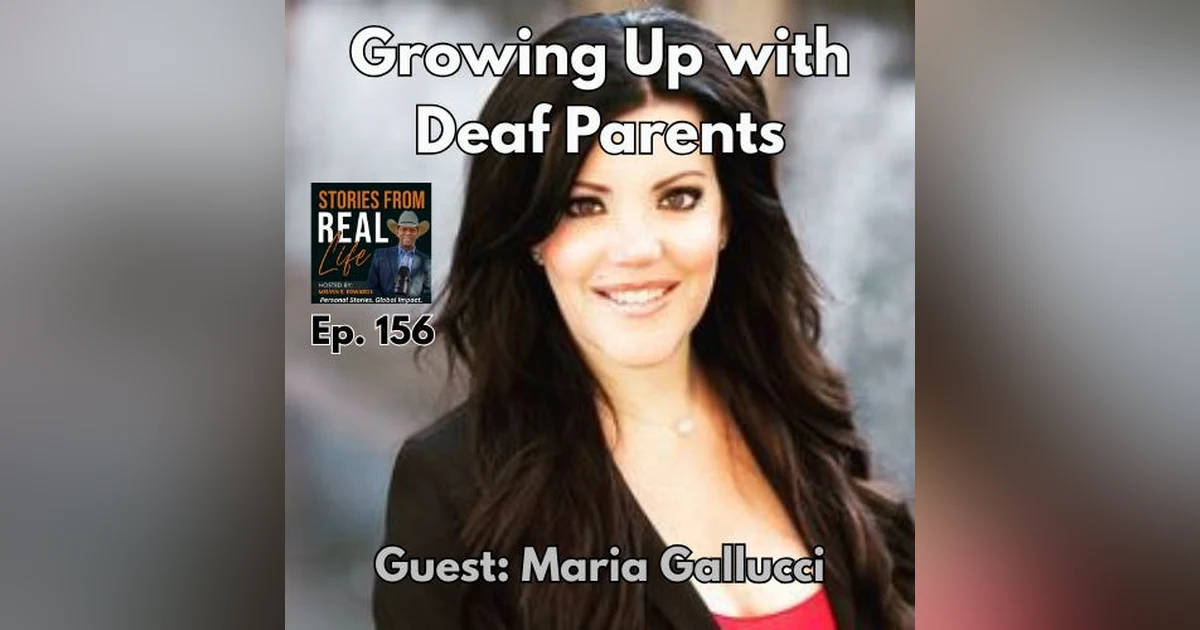

In this episode of Stories from Real Life, host Melvin E. Edwards speaks with Maria Gallucci, a real estate agent and author who grew up in a deaf family. They discuss the unique challenges and experiences of navigating both the hearing and deaf worlds, the importance of communication, and the role of empathy and love in bridging cultural gaps. Maria shares insights from her book, 'Raised in Silence,' highlighting the significance of family dinners, the lessons learned from being a child of deaf adults, and the misconceptions surrounding deaf culture. The conversation emphasizes the need for inclusivity and understanding in communication, regardless of language.
Get full access to Melvin E. Edwards at storiesfromreallife.substack.com/subscribe
If you would like to support this podcast, please click on the PayPal link to make a donation today. Any amount is the perfect amount!
Thanks!
0:00 Today on Stories from Real Life with Melvin E. Edwards. Our guest for this episode is Maria Gallucci. Maria grew up in a world where silence spoke louder than words. As the daughter of deaf parents, she learned early the power of listening, resilience, and love. Lessons that shaped both her memoir, Raised in Silence, and her thriving career in real estate. Today, Maria shares how her story bridges cultures, challenges assumptions, and inspires new ways of thinking about communication, family and business. I think it gave me a perspective of being empathic and to know that some people do suffer communication issues.
0:46 And I think that bridging the gap between the hearing and deaf culture world makes a big difference in a lot of things. And I think that it gives people a big heart and it gives them knowledge of just trying with everyone, with every culture that's out there. Pull up a chair. It's story time with Maria Gallucci. You are listening to Stories from Real Life, a podcast by engaging storytellers for engaged story listeners. Here's your host, author and journalist, Melvin E. Edwards.
1:32 Hello again, and welcome to another episode of Stories from Real Life. I'm your host, Melvin E. Edwards. Thank you for joining me for the podcast where personal stories can have a global impact. As you heard in the intro, our guest today is real estate agent and author, Maria Gallucci. Maria, welcome to the show. Hi, thank you so much for having me. So you grew up in a home with deaf parents and now run a real estate business that caters to deaf clients. How do you balance between being both an advocate and a professional in your life and your business? I feel like I find a way to balance it by like making people feel good about like buying a home or being in the deaf community. So I love like making people happy.
2:13 Okay. So what's the funniest or most unexpected moment you've experienced while showing a home to a deaf client? Something that probably wouldn't happen on a typical real estate tour. So we had turned on a swamp cooler and we turned it on just to see if it was working and then we didn't hear anything. And so we went back the next day and it like leaked through the entire house and the basement was like all soaked, like soaking wet and the ceiling was falling down. Yeah, that was pretty bad. Did you have to buy the house? Yeah, they actually did still buy the house. It was fixed. Wow, that's, I wasn't expecting that.
2:54 So when that situation happened, what did you do? How did you handle that? I called the agent and was like, there's water leaking. And we didn't know where it was coming from at the time. But we figured out it was the swamp cooler going down through the thing. But obviously my clients were downstairs and they couldn't hear the water leaking because I was upstairs. And so I think we could have caught it on time if we'd have known. Wow. Okay. So let's talk about your book a little bit. So it's raised in silence. And the subtitle of your book is Lessons on Listening, Love and Loud Family Dinners. So what role did family dinners play in shaping your understanding of communication?
3:37 Well, there was six of us kids and we're all hearing. So both of our parents were deaf. And so I feel like We always had Sunday spaghetti. And so I feel like it was always like our day to connect. And I'm still very close to my brothers and sisters. So I feel like the spaghetti dinners and we would be loud, obviously, because our parents couldn't hear us. And so we would just be like more of a community type thing. So tell me what those dinners were like. Us yelling at each other across the table, throwing food at each other. Things like that, because obviously if our parents are turned around, they can't hear us. So we would just be like my dad always said little devils.
4:18 Did you think you were getting away with something because they couldn't hear you? Oh, yes, always. Yeah, my dad actually put a little chirper thingy on the door, like a security system. And I was thinking how they're not going to hear it when we open it. But every time we opened it, it would chirp like a bird. So we were we that actually scared us into staying in the house. But even though like they couldn't even hear if we opened it and chirped. OK, so growing up as a CODA, this child of deaf adults, how did you come to realize that your first language wasn't spoken, but signed? I think that we, I think it was in preschool when my sister was whispering to me and I always had to interpret for her.
5:00 And so I feel like that was when I realized, oh, we're a little bit different because we were doing ASL, which was our first language. And my mom always said that we learned to talk through the TV or through school and stuff. So we didn't even know, it was always our normal. So we didn't even know that it was any different until we actually went to preschool. Wow. All right. So what are some of the lessons on listening you feel most people misunderstand unless they've had your kind of experience? Yeah, I think that a lot of people think that sign language is something different because any language is different. And so I feel like when they saw a signing or anything like that, they would always stare at us or like, what are they talking about?
5:45 And so I don't think people actually realize that it's an actual language like Spanish or any other language. language you know something i've learned about sign language recently as a family we've we started a couple weeks ago we started taking sign language classes at our church to communicate with my grandson who he can hear fine but he's autistic and he he doesn't speak so he's learning sign language too so that we can all communicate with him through sign language because he can hear us but can't speak he can't say what he's thinking he can hear what we've said to him but if we have something in common a common language then it'll it'll work for them. Yeah, exactly. We're actually teaching our granddaughter sign language. And when she, cause she's only, I think she's 18 months now, but she always says more or thank you.
6:30 And like she's been signing because it's easier for them. So I feel like to learn that versus speaking. Right. That's, that's pretty cool. So one thing I'm curious about here, deaf people obviously use their, their hands for sign language and you have to be able to see those signs. How do they communicate in the dark? like when you're a parent driving and you've got kids in the backseat misbehaving, how do they communicate to them? That was always scary because they would sign to us while they were driving. I'm like, no, just wait to watch the road. But no, they would sign while they're driving, which is probably not a good thing. So my mom was vocal, but my dad wasn't.
7:12 And so we always knew when we were in trouble because my mom would yell at us, but our dad never would. And so I think that they would just like either like go like this and hit like in the back of you guys or tap them. That's how the driving went. So what did your mom yell at you? Be quiet or like, don't misbehave. So just typical parent stuff. Yes. Yeah, for sure. So can you talk a moment about when love and communication conflicted with your family dynamics and how they were resolved? Or is there any, how do you resolve things like that? I feel like when I would have to interpret for them as a child or things like that, because they wouldn't know what other people were saying.
7:56 So I feel like it, I think a lot of people misunderstand the culture of it and just know that we're just trying to communicate and like just try to communicate with them where a lot of people would just not try. And they would like just ask us as children, like, can you interpret this for a you know, your parents. And I think that makes a difference. How did you balance, again, I used this word in the first question, how did you balance between being a bridge for your parents to the hearing world, while also sort of gaining your own identity and voice as you were growing up? I think it gave me a perspective of being empathic and like being like to know that some people do suffer communication issues.
8:46 And I think that bridging the gap between the hearing and deaf culture world makes a big difference in a lot of things. And I think that it gives people like a big heart and it gives them knowledge of just trying with everyone, with every culture that's out there. Okay, so your last name is Gallucci, as I mentioned. That's an Italian name, I'm guessing. Is that your heritage? Yes, yeah. Okay, so Italians are known for being very expressive with their hands. I know, so it's perfect. Is that like a different expression or a different emphasis when you're doing sign language? Yeah, so you do a lot of body expressions and facial expressions.
9:27 Like when people wear sunglasses, it's very hard for me to communicate because I have to actually see them. Example, yesterday I was at a party and I was – talking with my hands because I always talk with my hands. I was just like, no, don't move your hands. People are going to think that we're talking about that. I'm like, no, I have to communicate with my hands. So how did American slang language or deaf culture in general influence your perception of what language really means? I think it was our normal when we were being raised. So we didn't know any different. So I think that When you communicate with people, I think that you're more expressive and you're more like heartfelt towards them and knowing what struggles they go through with not having the same language in any language, not just ASL.
10:16 So what's the most surprising thing you discovered about your own hearing life as you reflect back on your childhood? That we were different. I would say, because we were like growing up in the deaf culture and the deaf and hard of hearing world. That's like our, our normal. And I actually relate to a lot. I have a lot of deaf friends because I feel more comfortable signing than I do speaking. Hmm. That's interesting. So is that because that was your first language? Yes. Yeah, I think so. Yeah. Okay. How do you see silence, both literal and metaphorical affecting children of deaf adults, especially in a public or social setting? Only statistics show, and I'm not sure the exact percentage, but only 10% of parents know sign language with their kids.
11:03 And so a lot of children aren't exposed to the ASL, like the hearing world. So they just grow up in silence because the parents aren't able to communicate with them. And that's why it's so important to put children into the deaf culture and not the mainstream school. That way they can get the proper education and the proper... exposure to people. Otherwise they feel isolated, I feel like. And so it is silence to them because they can't hear. So you mentioned earlier that you felt like your family was different. How did that impact you as you were growing up? How did that affect your, let's say, the way you made friends or the way you saw yourself?
11:44 I think that we were stared at a lot, like anywhere we went because we were signing. So it was something different to a lot of people. And so I feel like it made me more self-conscious about people staring. And I feel like it made it a little bit harder to make friends because no one really knew what our side was. And I always wondered, I actually always wondered what it would be like to have like somebody actually say, I love you, like your parents, because they can actually hear it where we would sign it. So it was a little bit different in that aspect. So how have the lessons from your experience shape how you parent or interact with your friends or in a community context? I think it made me more aware and more inclusive with people because I know how it feels to be an outsider.
12:30 And I know how my parents felt to be left out or an outsider. So for me, I feel like it made me be more heartfelt towards people and more like inclusive towards anyone. Is that how you operate your business? Yes, absolutely. With the heart. So what are some misconceptions hearing people often have about deaf culture that you try to correct in your book? That they don't, they feel like they're not like as aware as they are or as smart as they are and that's not true like the deaf people and the deaf culture and hard of hearing culture is just as smart as the hearing they and they're more like observant they're more they have they know how to communicate i think more towards people because they are all the other senses have to kick in and so i feel like that's an aspect that people don't really realize So your book, again, is called Raised in Silence.
13:30 So what role does love play in overcoming communication challenges? And are there limits to what love alone can do? I think that you just have to just try with anybody. Like if you see someone struggling or even communication wise or for anything, you just have to try and just try to help them or try to be inclusive with them. I 100% agree with that. And I think that kind of attitude works regardless of what language you're talking about. Because people will overlook a lot of things that you might do wrong if they know it's coming from a good place. They know that you're trying to communicate or you're trying to be a friend.
14:12 And that makes a huge difference. It makes them feel better and it makes them feel good about themselves instead of just ignoring them or just leaving them on the wayside. Right. So how do you hope your story changes the way readers think about silence and communication in their own families? I hope that it will bring them to a position to where they're going to be trying with others and be inclusive. We don't have to let everybody, just because you don't see the way they see doesn't mean they're not human. All right. So if somebody's reading your book and they've never been exposed or never had to navigate the deaf culture, what kind of lessons do you hope or insights you hope they gain from your book?
15:00 I think empathy and just being aware that they're the same as we are and we can communicate with them. You don't have to just ignore them or just like, oh, it's okay. They don't understand because they do. And all anybody wants to do is feel loved. All right. So where can people get your book? It is on all the book platforms. So it's on Amazon, Barnes & Noble, Apple, Google. So it's on all the book platforms right now. Okay. And as a final question is one that I ask all of my guests, a very general question, not specifically about your book, but if you want to make it about your book, that's fine. I asked for one piece of advice you'd like to leave with the listeners on any topic.
15:42 I would say just try with anybody, anyone and everyone and just love is love and just love. So my dog just started barking. So I guess I better get off here. Our guest today has been the author of Raised in Silence, Maria Gallucci. Maria, thank you so much for being here today. I appreciate it. Thank you very much for having me. Please go to my website at podcastreallife.com for more information about my guest and the things we discussed today, including a link to how you can get her book. That's it for today's episode of Stories from Real Life. Join us again next time for another chance to learn from each other. Until then, don't forget to shine your light wherever you go. Thank you for tuning in to this episode of Stories from Real Life.
16:25 Don't forget to subscribe and share. Let's meet right here every Tuesday and Friday. See you then.


