

 Spotify

 Apple Podcasts

 Goodpods

 Audacy

 iHeartRadio

 Youtube Music

 Amazon Music

 Audible

 Podchaser

 YouTube

 Castbox
 RSS Feed
Ep. 157 - Empowering Students Through Proactive Support
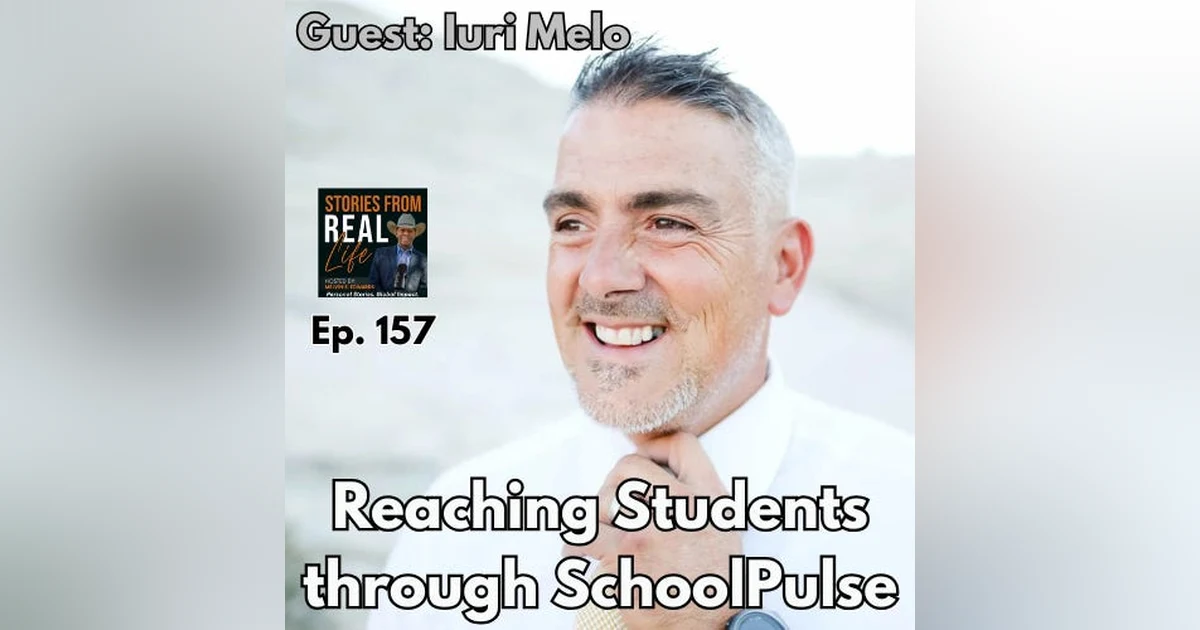

My guest today is Iuri Melo — a licensed therapist, author, and co-founder of SchoolPulse, a program that brings daily encouragement, emotional support, and real-time communication to students across the country. Iuri has spent his career helping people discover resilience, hope, and healing, whether in schools, families, or individual lives.
In our conversation, we’ll dive into his personal journey, the lessons he’s learned from working with thousands of students, and how SchoolPulse is reshaping the way we talk about mental health and well-being in our schools.
This is an episode about courage, connection, and the power of showing up when people need it most.
Here’s a link to SchoolPulse.
988 Suicide and Crisis Lifeline
Get full access to Melvin E. Edwards at storiesfromreallife.substack.com/subscribe
If you would like to support this podcast, please click on the PayPal link to make a donation today. Any amount is the perfect amount!
Thanks!
0:01 On today's episode of Stories from Real Life with Melvin E. Edwards, we're joined by Yuri Mello, therapist, author, and co-founder of School Pulse. He's passionate about supporting students, building resilience, and creating space for honest conversations about mental health. And our first step is always to connect that student to their primary network. And of course, that's a parent or a guardian or whoever is caring for that child. Our next step is let's connect you to the professionals at your school. And of course, next is we provide other ways for students to connect to other resources. School Pulse isn't the final solution.
0:42 That's not who we are. We are just trying to connect these students to the best solutions, which, of course, at the top of that list are the people who are the closest to those kids, which, of course, are their parents. Pull up a chair. It's story time with Yuri Mello. You are listening to Stories from Real Life, a podcast by engaging storytellers for engaged story listeners. Here's your host, author and journalist, Melvin E. Edwards.
1:24 Hello again, and welcome to another episode of Stories from Real Life. I'm your host, Melvin E. Edwards. Thank you for joining me for the podcast where personal stories can have a global impact. As you heard in the intro, our guest today is therapist and founder of School Pulse, Yuri Mello. Yuri, welcome to the show today. It is an honor. I am so happy to be here. I love the background. Everything is looking great. I'm excited to see where we go today. Let's give it a go. Okay, so I'd like to know more about school polls. So let's start there. Tell me about school polls. You know, basically what we do, I'll just give you a really brief summary, and then maybe we can go down into more detail if you feel like that's a good rabbit hole for us to go down.
2:08 Basically what we do is we provide really targeted and specialized solutions for schools, primarily secondary schools, so junior high all the way through high school, for administrators and school counselors who are looking to improve student wellness, student success. And also to prevent student suicide. So that's kind of one of our big focuses. But instead, I think maybe the way that we differ specifically in our efforts is that we have some really unique and innovative ways of proactively engaging students in providing live support to them. instead of just being passive or reactive.
2:51 The way that I always describe it is instead of being a fire extinguisher on the wall, waiting for a crisis to happen, and then we have to break that glass and intervene. My whole goal is for us to proactively reach out to students. And we do that via text. We do that via email. We do that through our incredible student success activities. I'll sometimes tell people that School Pulse is a positive psychology service. Our goal, our objective is less about the identification of risk or helping people figure out what the signs of suicide are. And instead, our goal is really to focus on promoting and strengthening the protective factors of kids.
3:39 And we've kind of noticed that over the years, I mean, as we've, I mean, we've chatted with thousands of schools over the past seven years. And I feel like sometimes, right, we're really just enamored. I feel like enamored with risk. And we provide, you know, crisis intervention services. And I feel like by then, I mean, obviously those services are very effective. They're providing a lot of support to a lot of people and we utilize those services as well. But we're definitely more of an upstream type service where we're providing tools before anything happens we're educating students we're helping them to have a better perspective that hopefully will actually allow us to prevent some of the challenges and some of the struggles that we're seeing and as i mean you were mentioning to me just briefly right how you are you're spending a lot of time with students you're a substitute teacher which is just awesome and i'm excited to maybe even go into that a little bit but Unfortunately for the teens in our country especially, it's unfortunate, but we see that a lot of the metrics right now when it comes to student anxiety, to student depression, to suicidal ideation, to suicidal attempts, like a lot of those metrics seem to be moving and have been moving now for the past little while in the wrong direction.
5:03 And I think there's a tremendous amount of attention there. And I think there should be. I mean, these are our children. And so I think that that's really what we're there to do is we're there to help them to develop the kind of perspective or mindset that will help our kids live extraordinary lives and that can hopefully insulate and protect them. At least that's what the data and the research would suggest is that when kids... develop better perspectives that come from, say, a positive psychology or growth mindset or even other cognitive behavioral strategies. If we can provide students with those, that education works. I mean, we are in the field of education. We believe education works. That's our hope. And so we want to provide those types of things to students in easy ways that they can that they can eat those things in a sense and absorb them into themselves and hopefully have them not just prevent some of these things that we're really concerned about.
6:02 But I think once again, more importantly, what I really want for teens, to be honest, is I just want them to have extraordinary years. I I want it to be memorable years. I want them to go to junior high and to high school and to have a great experience instead of not. So I'm definitely more kind of on that positive psychology mindset type of thing versus that we're just there to stop suicide, which of course we want to do as well. It's just that our way of doing it is definitely more upstream and definitely more proactive. So anyways, probably more than you wanted to know right off the bat, but... That's okay. It's good to have a good foundation here to start off the conversation.
6:42 So tell us a bit more about your personal background and what inspired you to step into this world with young people. I would love that. So I've really been a licensed clinical social worker for the past 20 years. I'm a married man. I've got... Five incredible kids, wonderful wife. And when I started my career as an LCSW, I've really been fortunate. It's just worked out very well for me. I really have been, I started in private practice and have stayed in private practice. About 10 years ago, I wrote a couple of books, Mind Over Gray Matter and Know Thy Selfie. And I'll tell you just how that connects. So about seven years ago, we live in this fabulous community, Melvin.
7:25 I don't even know where you are. I should ask where you are. Where are you, Melvin? I'm in South Texas. Oh, my gosh. Love it. Love it. Love it. What a lovely place that is. So we're actually here in southern Utah, kind of on the western corner of southern Utah, about an hour and 45 minutes away from Las Vegas or so. But it's just absolutely lovely up here, Melvin. I don't know if you've ever been, but St. George, Washington, which is where I'm at. We're just literally kind of in the middle of like the Grand Canyon, Zion National Park, Bryce National Park, Lake Powell. I mean, it's just this beautiful high desert. I've been to Salt Lake City once. Yeah, so you saw the big mountains there, which is awesome.
8:06 Those are lovely, of the Wasatch Front. But we just live in a beautiful community in about seven years, seven years ago, almost eight years ago now. But we had seven students in our community that took their life by suicide. And a good friend of mine, uh, who is just a, an absolutely fabulous administrator, proactive, innovative, uh, open to new ideas. He reached out to me. He had actually lost two students at that point. My two oldest girls were going to that school. He had lost two students to suicide. And then later on that year, he actually lost another student, uh, to just an accidental death. But anyways, hard year, obviously for that school.
8:48 But he reached out to me and that was really his pleas. Like, man, Yuri, like I feel like I'm under all of this pressure from the community, obviously from the district as well. And I feel like all I have at my disposal are reactive tools. And I don't want to do that anymore. Like I want to be proactive. I want to engage students. I want to know where they're at. so that he could intervene earlier, right, instead of later. And so we actually began what I would maybe call, I don't know if I'd call it mastermind. I certainly wouldn't put myself in that category. But we just began to meet. Like, we would meet at his office sometimes. He would meet at my office. And we would just have these discussions, like, what can we provide?
9:29 What can we do? Can we just provide more resources? Yeah. And then I introduced this idea to a good friend of mine. His name is Trent Staley, who's just a brilliant software engineer, very successful, had built other companies and really liked the idea of creating technology for good. So he kind of heard this idea that was kind of budding where we wanted to create something for students. He really loved it and said, hey, why don't we do that? And why don't we start to proactively engage students? And let's do it over text. Like, let's not create an app. Let's actually find a way to engage them proactively via text. And then later on, and I'll kind of skip the story a little bit, we actually began to provide live support to the students.
10:14 Right when we began, Melvin, we were actually just proactively sending a message to students. It was just a little questionnaire like, hey, how you doing today? You know, scale one to four, the kids would respond with the number. And then we had a bunch of little canned messages that I had prepared and we would just respond back. And then a couple of years into it, Trent Staley, who's the software engineer that I was telling you about, said, hey, the kids are engaging back, like over text. And at that point, we were not responding back. It was just kind of a static service. And so we began to consider the idea, you know, what would happen if we started to add real people on the other end and providing life support?
10:55 And so we began to do that. And to be honest, Melvin, it's hard to look back now because – We have just had just, I mean, I feel they're like Nobel Prize winning experiences with these kids, ranging from anything from kids who are actively suicidal to people who have lost loved ones to parents who are divorcing, kids who are self-harming, kids who are homicidal, fights, school shootings, et cetera. And we've just kind of been involved. Yeah. Because we provide this service that isn't just passive. We're not just waiting for crisis, but we proactively text students every Tuesday, every Friday.
11:39 We deliver our student success activities and then we provide other fun and engaging content that's inspirational and positive psychology and growth mindset based. And because of our proactive engagement, kids respond back and they get to meet our proactive team. And we're talking live people. It's not artificial intelligence. We're talking live individuals who are trained and that engage with them in an enthusiastic, fun, grateful, thankful way. And when kids experience, number one, the ease, right, of We're just tapping them on the shoulder and then we're providing this wonderful place that's private, that's easy to access.
12:21 And then kids just open up. 80% of the time, they're opening up to us about the awesome things that are going on in their lives, which is actually so meaningful because we want to amplify the good in their lives. That's exactly what we want to do. You know, and then the other 15 to 20 percent of the times we're dealing with struggles, whether students are just stressed out or they're burned out or they're failing out of school or they're in trouble or or other things. And then we're just providing fabulous resources right over text and providing that ongoing support. Melvin, we have people. whom we have been engaged in and who we've been promoting our awesome content for years.
13:02 Like when students opt into our service, less than 3% opt out. Just imagine that, like we're talking about teens, right? They could be a tough crowd and I absolutely adore, adore teens, but less than 3%. We have kids who have graduated, you know, who have gone beyond middle school, high school, they've graduated, they're in college. And they're asking for us to continue our service to them, which we do, free of charge for them, by the way. So we're trying to do a lot of good. We're having a huge impact and we can measure it, which is really cool because we can show schools that we're really delivering high value, by the way, at a really low effort on their part.
13:48 And as you know, with schools, I feel like, I mean, the overwhelming language that we hear from schools is overwhelm, under-resourced, and please don't give us one more thing to do, right? And that's what we try to do is we try to provide these really targeted solutions that provide high student impact with very low lift solutions. for school staff or administration. And so our text-based campaigns, our email campaigns, all of those are things that they don't even touch, but we're providing maximum values. So it's kind of exciting. It's fun stuff. It is. I mentioned to you that I'm a substitute teacher at a high school and I'm there every day.
14:29 And one of the things I've learned after a career in much different fields as a communicator in public relations, dealing with these students, we have a large high school with about 2,500 students. Wow. That's a great high school. Yeah. I've come to develop some pretty close relationships with a few of the students. And I think it's because I just recognize them. I call them by name when I see them in the hall. I give them a fist bump. I ask them how their day is going. And they don't just say, fine. They tell me how their day is going. And I listen.
15:09 And I try to encourage them. And if they're having a bad day, I, I do whatever I can. I know you're not supposed to touch students. You can't hug them or anything, which is frustrating. I like, I like that. It is. But I think people, I think teenagers just want to know that somebody cares. Yeah. Melvin, I love that. I've done quite a few of these, especially lately. And some of them I've actually done with some educators as well. And sometimes they'll help. I mean, they'll ask me the question, you know, what, you know, Yuri, what would you say is, you know, if you had one piece of advice to give, you know, whether it be to an administrator or a teacher or a school counselor or even a parent, right?
15:51 Right. But I would say specifically to those, and you actually nailed it, Melvin, which is it's just the absolute power of a positive relationship. Like that is the ultimate suicide prevention. Like that is the most... important factor. If we want to insulate our children from suicide, and I realize that I'm knocking on wood here, that in reality, we can't fully stop that problem because there are multiple factors that are involved in that. But if we want to utilize the most important factor, it's a relationship.
16:32 And we're not talking about really these fantastical things. We're talking about what you just described, which is seeing them in the hallway or waiting for them at, you know, at your door, greeting them, calling them by name, fist bumping them, high fiving them and just creating an environment right where they feel liked and, You know, and I know that that sounds very basic. And like I said, I mean, it sounds like you're a professional communicator, which is awesome. But that's it. And in fact, there's a quote that I use all the time that I'm sure you're familiar with, Melvin, which is, well, I've adapted it a little bit, but...
17:14 But relationships multiply joy and divide sorrows, right? And that's a great quote. And better yet, there's actually fabulous research that confirms exactly that, that when we have positive relationships in our lives, our joys multiply, meaning I can go for a run in the morning by myself and You know, and on a scale of zero to 10, that's going to be fabulous for me because I love to do that. So that's going to take me to about a six or a seven. But if when I go, when I happen to go with a couple of friends, you know, for my like, you know, church or for my neighborhood, like that happiness is just maximized.
17:57 Even if it's just 10% more, eight, nine, 10, whatever it is. But it's just true. And one of the crazy things that I've realized, sometimes it actually drives me crazy, is that I will run faster and longer and tireless when I run with people. And I'm not the only person that... recognizes that. But it's just amazing how, I feel like just how social we are and what that actually does to our perspective and what that actually does to our biology. In fact, I was having a conversation. I've got five kids from I want to say 25 to 14, right?
18:40 Two older girls are out of school. I actually have a special educator. She teaches special education at, which is a really overwhelming job. But I was talking to my, My youngest daughter, who's 14, and she does cheer at the high school. She's just an absolute firecracker. She's so, so fun. But we were just having a conversation about friends. I was asking about people that she knows in her cheer squad or at school. And I was kind of just making this suggestion to her while we were talking in the car. And I just said... You know, I hope that you can take some of these school friends or cheer friends, and I hope that you can find a way to transfer them to after school friends as well.
19:22 So people that you come home and then you go hang out and you go and do things with these people. And my daughter said something to me, and I feel like she's pretty... She's pretty social. She's a pretty social person. But she said something to me. She said, you know, Dad, I think sometimes I just like to be alone. And so I don't know if I'm the kind of person that wants to be with people all the time. And I actually didn't challenge there. I really just kind of listened. And I actually even kind of complimented her and say, look, I'm really happy that you can be the kind of person that That's okay with being alone.
20:05 That in itself is a pretty valuable skill because the reality is we're going to be alone a good percentage of our lives. But there's a point that I hope I actually have a continued conversation with her, which I will, which is actually where I could gently challenge a little bit of that perspective where she's saying, I would rather be alone. And maybe that's true. I actually don't need to challenge that. I just need to maybe help her to recognize that simple idea that when you're with people, especially in a positive environment, you'll be happier, less depressed, less anxious, more courageous.
20:46 You'll actually be more successful in the future professionally. So there are just all of these tremendous advantages when it comes to us being I guess, more socially engaged in participating than not. But sometimes, right, we begin to identify with some ideas, right, or what I would maybe call in psychology, like some limiting ideas or limiting beliefs that we feel are like, well, that's just who I am, right? I'm just not a very social person or I'm kind of shy or I'm kind of this or I'm kind of that. And I recognize that we all have some propensities, right? Right. But I also want people to recognize that regardless of what you feel your propensity is, we're beings in the midst of evolution and learning to be with people and around people is an advantage to us physically, emotionally, spiritually.
21:41 And so anyways, interesting little conversation. I'm sure that that's something that as a substitute teacher, you probably hear quite a bit is kids are really quick and you know, to kind of place themselves in these little boxes of I'm this and not that and this, but not this. And this isn't my thing. instead of just realizing that we're really dynamic, we're flexible, we're not these rigid creatures who don't change or transform. That's what we do. I absolutely hate labels. From a personal experience, I've learned through my own experiences that even good labels can have negative consequences.
22:25 For instance, I've told this story before. When I was young, I was a very good student. And then my dad died when I was 13 years old. And I really struggled, as you might expect. But I struggled in school too. And then I started to think, well, everybody's always called me the smart one. So am I not that person anymore? Because I'm having struggles in school when I've never had struggles before. I sort of lost an identity because I was grieving. So even a positive label can have a negative outcome. So I just say, you're not the smart one.
23:07 You are a smart student. You are a smart person. You're this and you're that. You're not this or you're that. And one other topic I want to talk about briefly is about parenting, the parenting role. You mentioned having five children. I have six children. I love it. Four biological children and two stepchildren that I'm raising. And the funny thing was, I was a single parent for a long time, got my kids to adulthood. They are between the ages now of 34 and 26. And I thought I was done with that phase of my life. And then I met a woman who had eight-year-old twin boys when we started dating.
23:51 And I realized, okay, I guess I'm starting a different phase of my life. And they're now 17 years old. They're seniors. And that's created a different challenge, but also a different set of blessings in growing up. So with School Pulse, how are parents integrated into this process with the students and with the the counselors or therapists on the other end who are giving them positive things? How do the parents sort of reinforce the lessons that the students are learning? I love that question. I'm glad that you're asking it. That's actually really key. I mean, and we don't just have to look at...
24:32 I think parents are much more involved in their kids' schooling these days. I think they want to be involved. I think they want to be informed. And of course, I'm being a little bit general, right? Not every parent is this way. Some are pretty trusting. Others are less. Some are pretty confrontational about it, whatever it is. But that's really a key part of one of our specialized services is, number one, we make sure that everything that we are providing for the students. So one of the very first things that we do when we walk into a school is we have an email campaign that once a week delivers our student success, a brand new student success activity.
25:15 to every student and to every parent. And once again, that's a very simple, we walk into a school, they can provide us with the roster and we begin this email campaign that goes out to every parent. We are huge fans, not only of transparency, but of parent development. Like we just recognize that we're all trying to do the best that we can. We're all learning sometimes by, you know, doing really good, sometimes not so good. And so that's actually what we provide to these parents is these fabulous little tools. We have these videos that I've created that address the goal. Once again, is really to help students do several things. Number one, Succeed academically, participate and be engaged in school, learn how to create wonderful relationships with friends and with parents and ultimately be successful.
26:03 Like that's our goal. We're very positive, but we provide all of this fabulous content directly to parents and So that they can utilize it in whatever way they want. Hopefully it'll be a tool for them, but hopefully that's something that they can share with their students as well. Specifically with our text-based support, another one of the first things that we do when we enter that school is we provide every school and district with a template that they can send to the parent. in a sense, kind of letting them know about this initiative. And we offer them the opportunity to opt into the text service themselves. So we have parents who come on, right, who opt into the service, and they're engaging with our team.
26:47 And over the past seven years, I mean, probably over 100,000 users plus, I mean, we've dealt with incredible and extreme circumstances. and not just students. We're talking about parents who themselves are struggling with sadness, depression, who are in and out of a mental health hospital, who are struggling with substance abuse, who are going through a divorce, dealing with custody issues, or even dealing with suicidality or other things. And so we love coming into a school that being totally proactive, providing fabulous tools for parents, and even live support to parents. We have just had tremendous success.
27:29 Number one, we definitely don't want to exclude parents. And for example, I'll share one more quick thing. So one of the things that we do, right, when we're talking to students or we're providing life support, like we talked about, sometimes we are dealing with students who are in crisis, right? Or who report abuse or who report lots of things. And our first step is always to connect that student to their primary network. And of course, that's a parent or a guardian or whoever is caring for that child. Our next step is let's connect you to the professionals at your school. And of course, next is we provide, you know, other ways for students to connect to other resources.
28:11 School Pulse isn't the final solution. Like that's not who we are. We are just trying to connect these students to the best solutions, which, of course, at the top of that list. Are the people who are the closest to those kids, which, of course, are their parents. And so that part is very key. And I would say, I mean, we we have a state contract with the state of Idaho. We do lots of schools. We have lots of schools in Texas and in Florida. And those are really important issues for those specific constituents because they. they really want to be involved in what their student is receiving. And so I've done lots of community gatherings, school board meetings, all addressing parents who are asking that exact same question, Melvin, which is, Can we have access to that content?
29:01 Can we vet every video? And the answer to that is absolutely, 100%. Yes, everything that we have is available to you. In fact, we provide that live support to you as well. So that's what we try to do is there are no locked doors with us. Everything is wide open. Please come. Please use it. More importantly, don't just... Don't come to find fault because I suppose we can find fault in just about anything we want to. But what we try to do, and I think this is what we've done very, very well, is honestly, I think we do a really wonderful job. in providing students with what, the best word that I can think of to describe it is really benign content.
29:48 That means content that can fit into your life or your child's life, whether they're Jewish or Muslim or unaffiliated or Christian or Republican or Democrat or whatever. And we do that by really sticking to, we provide positive psychology, growth mindset, and cognitive strategies that are there to help your child do awesome, awesome. And we stay away from anything that could be perceived as some sort of an indoctrinating type piece. We're just not interested in that at all. And we stick to things that any parent would look at and say, absolutely, like that is exactly what I want my child to do.
30:33 And we do that by really promoting, once again, academic success, school participation and engagement, positive relationships, because those are very diplomatic, right, and benign principles that every parent is looking for. So yeah. But yeah, I think a lot of schools and districts are terrified, right? They're terrified. Like, please, Yuri, don't do or give us anything that's going to create problems between me and my parents because that is just pain and suffering for them. And so we are very cautious to do everything in a sensitive and caring way. I just thought of a question when you were talking about making sure you don't have divisions, dividing lines.
31:19 One thing that I think is true, minority families, individuals have a harder time seeking, in general, seeking therapy, seeking a third party for intimate, personal things to share. Most teenagers are the same in general, but obviously there are some individual things that different communities experience that some others might not. So a black teenager might experience something, a Latino teenager might experience something that a white teenager might not. Are you able to address something that specific?
32:02 We are. And we try to do that very well. In fact, we have a lot of schools, I mean, downtown Phoenix in Texas and California, East Coast, who have, I mean, a very varied population, including, I mean, we even have a couple of communities that we're in. I mean, one even in Boise, Idaho, interestingly enough, that we would think like, oh, that's like probably like majority white, which it probably is, but we have even some refugee pockets throughout kind of the country that we're serving as well. And I think the piece that really allows us to be individual, I mean, our videos, once again, we're really trying to provide content that is I want to say a little bit general, because we're trying to do exactly what you're describing, Melvin, which is we want to provide students with the kinds of skills, psychological, academic skills, professional, even personal skills that we hope can really apply to the entire, you know, matrix of population.
33:11 The part where we can be individual, right, is in the individual support. So we have, you know, kids that we're talking about who are migrants, right, or whose parents have left or been deported, you know, all the way to kids downtown Phoenix, right, who are dealing with gang violence or really challenging families situations that are difficult for them. And so I think that that's where we can go from, we provide some general solutions, and we also all go all the way down to the individual support of that one-to-one interaction that our team, what we call our positive interaction team, has with these individual students. So that's kind of how we try to bridge that gap, right, is we provide a general all the way down to one-to-one type support.
33:58 And the beauty of that once again is zero lift to the school. Like we're doing that seven days a week through the summer, through the holidays, and it does not weigh on their counselors, doesn't add anything to their staff. We're doing it like, so it's great. Nice. So how has technology changed the way students express their mental health struggles? And what does that change? How does that demand? What does that change demand from those supporting those students? You know, I think what I, what I like the very most, and there are lots of different things out there. And that includes, you know, a lot of, I mean, I'll tell you this really quick. I've got an individual that I work with because I still do individual therapy.
34:41 So I kind of do, you know, my school pulse. And even though we've been at this for about seven years, I still feel like we're very much a, I mean, a startup, at least that's how it feels. We're small, we're scrappy, we're working our tails off to just create the most extraordinary service for schools ever. Yeah. But one of the things, you know, that I see more and more, in fact, I even have a good friend of mine, I mean, that I see on and off, you know, in therapy or have, you know, for years. And, I mean, he uses pretty frequently, specifically like ChatGPT, as almost like a little bit of a personal assistant, right?
35:21 And it goes beyond just like helping him with tasks and things to also – Someone that he kind of actually kind of runs ideas from and provides a little bit of support. We know that some teens are doing that. We know that chat GPT has actually responded or even changed and adapted a little bit over this past little while. Um, So that kids or adults really can't do that as much as they want to. I think they realized that a lot of people were actually trying to utilize those kind of AI tools as kind of emotional supports. And they've actually stopped using that because that was creating some problems for them. Yeah. But I think specifically for us, like one of the things that we really like, right, is technology, right, allows these wonderful teens, right, to just, for us, I mean, we put these, you know, stickers throughout the schools with a little QR code and the kids just go up, scan that QR code.
36:21 It's not an app. They don't have to download anything. There's no username. There's no password. They literally just get a text on their phone that just says, hey, welcome to School Pulse. And how you doing? Right. And the kids can go. Is this a real person? Is this AI? And we have a little and we actually we actually love that. That's probably the funnest part of our job is whenever we launch at a school and we have, you know, hundreds of students that opt in sometimes in a matter of minutes. And it's just kind of engaging with them as they're trying to feel out like. Is this real? Is this a real person? Can I say whatever I want in here?
37:01 And kids do. They do say whatever they want. In fact, we have one of our mottos specifically for our team is, is every interaction is a positive interaction. Whether they're just like, man, you guys are so awesome. We love this. Thank you. All the way to like, F you guys or whatever it is. Because teens are teens. I mean, they're going to say ridiculous and sometimes pretty offensive things. And what we're providing for them is really – it's almost like I'm reminded of Carl Rogers, who was kind of a famous humanistic psychologist, of just this constant positive regard. And that's really what they're going to get from our team is even kids who – I mean, we've had kids, I mean, who are not just struggling – But who also have some problems with anger and violence and homicidal tendencies as well.
38:01 And we're happy to say, we're proud to say that we're helping those kids. Yeah. Like we're continuously nudging them with goodness, with gentleness, with hope, with optimism. And we believe that we're making an impact. In fact, we have ways to kind of measure that, and we are. And so we're not only impacting some of those negative emotions, but actually what we're hoping to do, right, is to promote some of these other ones and really to help students learn how to solve problems better, learn to perform better, and develop some emotional and psychological muscles, right, so that they're just not, you know, emotionally weak.
38:54 Like, we got to create a little bit of muscle in kids. Yeah. And so how can schools balance being proactive with mental health interventions while respecting student privacy and autonomy? Yeah, what a great question. So one of the ways that we do that is, I mean, the very first thing, right, is everything that we do other than our email campaigns, right, which we usually begin. Of course, parents and students are always welcome to opt out. We have very low opt out rates, but it's very easy to do. to block, to opt out, to exit. And then all of our texting service is an opt-in service.
39:34 So we're not forcing anybody. Of course, there's zero negative consequence if somebody doesn't want to participate. But our goal is to invite students to participate so that we can deliver that. And one of the very first things that we talk is, you're welcome to be here. We invite you to be here. But if you don't want to be here, I mean, you can... exit out and it will never bother you again. So that's one way, right, is we always give the opportunity for opt-in. We're not mandatorily opting them into the program. And of course, they can opt out. But specifically for schools, and of course, I mean, we have to, we're dealing with minors, which is which makes this portion of our work incredible, but also a little bit challenging.
40:21 And so all of our conversations with adolescents are anonymous. Like we don't know who these students are. Like, you know, when they scan a QR code and opt in, we don't know who that student is. We know the school they go to, right? Because that's what allows us to then hopefully connect them to professionals or to parents and or encourage those connections. But we don't know who those are. So that's how we protect their identity. And that's actually wonderful for them. I think it's wonderful for us as well. And that provides that protection to schools as well. I'll say one more quick thing. I was speaking to a superintendent who I've kind of become friends with over the year.
41:02 And he had lost a couple of students in within his district to suicide and he was kind of in the middle of a civil lawsuit where I think the parents were suing the district because I actually don't really remember the details of the case other than they felt that something had happened or there wasn't enough support that was given or maybe the school knew something and they didn't communicate or whatever it was, right? Anyways, this is certainly not the only example of things happening like this, but I remember talking to that superintendent, you know, post this happening and him saying to me, man, Yuri, I wish I had school pulse in my pocket walking into that courtroom, man, because you guys provide such a comprehensive and proactive solution.
41:54 We're not waiting for crisis. We're constantly promoting the kinds of tools and skills and strategies that could potentially prevent that. And I think he went in there and he didn't have some of those things in place and really was kind of hoping that he did. So we love to come to the rescue of schools and who, number one, tell us, man, we don't have enough resources. We're in a rural place. And we love to come in and to provide real solutions that multiply their current efforts and that provide even some security and some protection for them.
42:41 So we really do love that. That's important for them. Okay. I just have a couple of questions left as we start to wind down the conversation. Send it. All right. And what ways can parents and guardians partner more effectively with schools and the mission of supporting mental health? Here's how I would say, actually. And this I'm going to go back to the to the relationship piece. What I would actually say is is as much as possible. And I realize that the world is. life is incredibly demanding and overwhelming.
43:23 Um, And that there's a variety of parents right there, sometimes single parents, who are just doing everything that they can to provide for their kids. But what I would say, similar to what I told you, what would you tell a teacher or an educator? I would say, man, do everything in your power to create a positive relationship with this person. That's what I would tell a parent. The best way for you to support mental health or student wellness or student success efforts is is to find a way to be involved with your student. And of course that means in your own personal home and creating an environment where your child feels safe and a place where they feel like they can come to.
44:08 But then I would also say on a larger scale, go be part of that school community. Um, And I would actually say this to any parent, for your own sake and your own happiness, take advantage of these little communities that are just filled with energy, like energy. As you know, Melvin, when you walk into a middle school or a high school, man, there is there's like raw energy in there. And I think when I was young, I think that just intimidated me.
44:50 Like I was I was young, I was insecure, whatever, you know, but but now I'm old and probably a little jaded and I don't care anymore. And stuff like that, it honestly just, it lights me up as a person. Like I am truly grateful for teens and their energy. And I would say, do what you can to support your child and do it for yourself too. Like go to the football games, to the soccer games, to the choir concerts, to the orchestra concerts, go to the plays and Because I think that that's how you can contribute in a large way to the improved mental health of that school is just find a way to be involved in those stellar, these stellar little communities.
45:44 So that's one way, but that's how I would say is, is don't just watch from back there and critique it and come up with some pessimistic notion that, that schools are broken. Everything is broken. And we can sometimes very quickly fall into that pessimistic mindset and that problems aren't localized and that there are solutions and that there are things that we can do. We just jump into this like, no, everything is broken. You know, schools are broken. The educational system is broken. Our politics are broken. And it's just those are the kinds of things that keep us from the outside just looking in and complaining and blaming. And when we're in that state, when we're in that victim state, not very many good things happen.
46:29 And so I would say, just get out of there and find small ways to contribute, find a small way to give. And that's how we raise the tide. I mean, that's how we do it. So that's what I would say. And I hope that you do it because honestly, I think you will add some enjoyment and satisfaction to your own lives by just jumping into that wonderful culture that sometimes middle schools and high schools can create. And it's awesome. That's great. And a final question, one that I ask all of my guests. It's very general. What one piece of advice on any topic? It doesn't have to necessarily be what we've been discussing today. What one piece of advice would you like to leave with the listeners today?
47:10 I would say, in fact, I just had a wonderful conversation with a good friend of mine yesterday. And in fact, I would even reference a little bit of – I'm sure that you have and maybe even some of your listeners have read or have heard of the book, The Anxious Generation, where he kind of talks about some of the struggles and the challenges that youth are facing today. And I won't go into the book specifically, but I would say something that I repeatedly tell parents specifically – When they're kind of dealing with their children, what I would say to them or what I would say to anyone is, especially if you have children, is send your kids into the world with confidence, like quit preaching the message of fear.
47:58 Like, I think we as parents, we do that sometimes. from a good place. Please, parents, don't take that as criticism. I absolutely love you. I adore you. I love what you're doing. I love your effort. I love your intentions. I actually believe they're good. But I just feel like sometimes some of our own kids' nervousness and fear and anxieties, man, it's like us. It's our own fear. It's our own insecurities that instead of sending them out into the world confidently to succeed, fail, and everything in between, giving them the confidence that when we make mistakes, we rebound, we repair, and we go again, better, wiser, stronger.
48:46 And so that's what I would say. I think sometimes not only do we end up being very quick to rescue because we're trying to prevent harm, right? And I understand, yes, right? I think part of our fear as parents is like, but yeah, Yuri, but like, you know, do we not intervene? Do we not do this? And of course we do that. But I think like I had a discussion years ago, I remember, you know, a parent who didn't allow their child to go on the bus because there was stuff happening in the bus right to school. Right. Like the kids were being inappropriate and, you know, there was some fighting and stuff. And I understand that parents are concerned.
49:28 But what I would say is, and not only were they concerned about that, but they were concerned that their child would be exposed to some of this behavior and somehow become worse as a result. This is not an uncommon concern. We all feel that. But what I would say is don't just remove that. If you're going to remove it, do it with the intent that we're going to go back into that bus. I'm just going to prepare you to go back into that bus so that you're not just the recipient of maybe some crazy behavior, but so that you're the change you used to see in the world.
50:09 Sometimes when we're trying to get our kids to not hang out with people, we forget that what we really want to preach is... Like, we want you to go and be a positive influence to those kids. Like, and we can't, we can't avoid, we shouldn't exclude ourselves just because something is difficult. But once again, I feel like that's, it's just a little shift from I'm afraid and I have to prevent and I have to, to like, Avoid these circumstances versus let me send you into this world and teach you some some skills and techniques and even just go with optimism and confidence that are awesome.
50:50 Kids can can make an impact and make a difference instead of just it's scary over there. Kids are swearing. Kids are smoking. Kids are vaping in the bus like. I don't know. That's me probably being a little idealistic. But I guess that's what I am. It's the emotional toughness that you mentioned. It is. The resilience. Yeah. We've got to do that. Wind up the conversation today. So our guest today has been therapist and founder of School Pulse, Yuri Melo. Yuri, thank you so much. It's been a great conversation. Melvin, you've been awesome. Thank you so much for letting me be here. Thanks. Please go to my website at podcastreallife.com for more information about my guests and the things we discussed today, including a link to School Pulse.
51:34 That's it for today's episode of Stories from Real Life. Join us again next time for another chance to learn from each other. Until then, don't forget to shine your light wherever you go. Thank you for tuning in to this episode of Stories from Real Life. Don't forget to subscribe and share. Let's meet right here every Tuesday and Friday. See you then.


