

 Spotify

 Apple Podcasts

 Goodpods

 Audacy

 iHeartRadio

 Youtube Music

 Amazon Music

 Audible

 Podchaser

 YouTube

 Castbox
 RSS Feed
Ep. 166 - Patton Dodd: 'Becoming the Father I Needed'
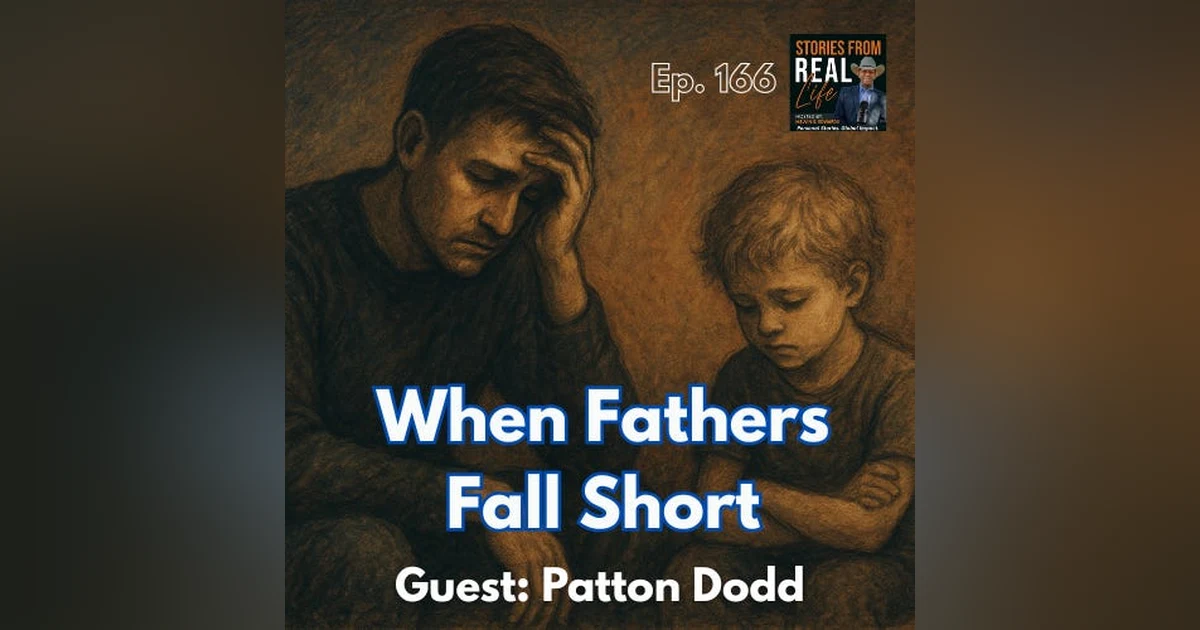

Everyone carries a story about their father — the one we got, the one we needed, and maybe even the one we’ve become.
In this episode of Stories from Real Life, I talk with Patton Dodd, writer, editor, and author of The Father You Get: And the Ones You Make, Believe In, and Become.
Patton’s story explores what it means to inherit pain and still choose purpose, to face the past without being defined by it, and to discover grace in the mess of family life.
Together, we talk about father wounds, forgiveness, and the ways faith and storytelling help us rewrite who we are — and who we can still become.
Stories from Real Life website
The Strength of a Thousand Sons
Get full access to Melvin E. Edwards at storiesfromreallife.substack.com/subscribe
If you would like to support this podcast, please click on the PayPal link to make a donation today. Any amount is the perfect amount!
Thanks!
0:01 Today, on this episode of Stories from Real Life with host Melvin E. Edwards, our guest is Patton Dodd, Ph.D., the Executive Director of Storytelling and Communications for the HEB Foundation. He's also a writer, editor, and author of the book, The Father You Get and The Ones You Make, Believe In, and Become. Together, we talk about father wounds, forgiveness, and the ways faith and storytelling help us rewrite who we are and who we can still become. Fatherhood is pretty simple, and it's really just about presence. It's really just about being very available.
0:43 to your kids and being fully present in front of them and transparent about who you are. It sounds like you had a dad who was present physically and could show up and be with you. And that's at least half, maybe more than half of it. And the other half is being present emotionally, spiritually, psychologically. I think that it's pretty simple at the end, just being around. and being, yeah, transparent before your kids about this is who I am and I'm okay with who you are. And like, let's connect kind of on that level of truth. I think our culture, yeah, misses that more often than not.
1:24 Pull up a chair. It's story time with our guest, Dr. Patton Dodd. You are listening to Stories from Real Life, a podcast by engaging storytellers for engaged story listeners. Here's your host, author and journalist, Melvin E. Edwards. Hello again, and welcome to another episode of Stories from Real Life. I'm your host, Melvin E. Edwards. Thank you for joining me for the podcast where personal stories can have a global impact.
2:04 My guest today is Dr. Patton Dodd, the Executive Director of Storytelling and Communications for the ATB Foundation. He's also the author of the book, The Father You Get, and The Ones You Make, Believe In, and Become. And his new book is Why We're Here Today. Everyone carries a story about their father, the father we got, the one we needed, and maybe even the one we become. Fatherhood is one of my passions. On this episode today, we talk about the father wounds, forgiveness, and the ways faith and storytelling help us rewrite who we are and who we can still become. And on that note, Pat and Dodd, welcome to the show. Thank you, sir. I'm really happy to be here.
2:45 Happy to have you. You've applied story and faith to the deeply personal realm of family and fatherhood. And I'd love to start right there. So when you look back on your own story, what's one early memory of your father that still shapes how you see the world today? Well, you know, for me and my story, I was trying to figure that out. Like, what are the stories that I've been carrying with me my whole life? And early in my book, I talk about how the first time I went to go see a therapist in my early 30s, he asked me this very question, like, tell me a story about your dad. you know so we can figure out like what shapes you and i and i go through kind of a litany of examples of like in my mind i'm thinking through like should i tell him this story or that story my dad was a mess of a man and he was you know abusive in a range of ways and a mess and so i was trying to figure out what anecdote from my childhood what anecdote of like trauma basically can I tell this therapist to kind of crystallize who my dad is and he at some point he I talk about this in the book he kind of paused me because I wasn't really answering his question I was thinking and he said to me like stop overthinking this just when I ask you the question The one you just asked, like, what's the first story that comes to mind?
4:06 And I knew the answer to that question. And it was a story about the time that I broke my father's lawnmower when I was a young teenager. And I poured oil into his gas tank thinking it would solve the problem of this broken lawnmower. And of course, it made it worse. And we had this explosive moment. And my dad did not hit me in that story. He doesn't. I don't even know for sure if he was drunk that morning, although he was drunk so much of the time in my childhood. But that story is one that I had carried with me for a long time because my dad had kind of imprinted upon me that day the idea that I am an idiot, the idea that I cannot figure anything out. And I had been kind of haunted by this.
4:47 my whole life through. And I had always been embarrassed to tell people that story because, I mean, indeed, I did break his lawnmower. I did pour oil into the guy's tank. But also, in that story, it doesn't have a lot of the classic features of an alcoholic dad's story. My dad doesn't hit me in that story. He doesn't curse at me. I mean, he does a little bit, but he doesn't curse at me all that bad in that story. But nonetheless, it was a story that had haunted me. And finally, I came to terms with the fact that... We don't really get to choose which memories, including which memories of our fathers, hang over us. And I think a lot of us have lawnmower stories, have stories that our dads inadvertently, accidentally impressed upon us that just, yeah, kind of told us who we are.
5:35 um and maybe told us the wrong story about who we are and that's what that story with my dad uh was for me and i and i in some ways what my book is is trying to unkind of unwind that story and figure out why did this you know encounter with him have such a hold on me you spent much of your career exploring the intersection of faith story and identity How did that path lead to your book? Well, you know, yeah. So I've always been, I think, a storyteller and a writer. I've always been a curious guy. I was an English major. I've always been interested in writing and reading. When I came out of college, I was a professional writer for a pastor in Colorado for a long time.
6:17 I was kind of a ghost writer, helping him with his work. And then I became a journalist and did my own work as a writer for many years. And yet, I had never really dealt with myself and my own... I had never done the work of investigation of my own story. And I think that I was always destined to get to that work. I mean, for years, my friends and family would tell me, when are you going to write about your dad? Anyone who knew me well would ask me, when are you going to finally write about your father? Yeah. because they knew that I had been profoundly shaped by this man and by the traumatic way that I had been raised. And so I resisted it for a long time.
6:59 I was in my mid-40s before I finally decided that I need to get about this work. I need to finally pay attention to to who this man was. And I think it was something that I felt called to do, frankly, and resisted that call for a long time, like some kind of Jonah. And finally, I stopped resisting. And sometime during COVID, I was like, all right, I'm going to start sitting down every day and working on this story. So yeah, I think the various things I've done in my life intersected to this moment where I finally had the courage and in the space to work on it. It does take courage, having written about my own father and the males and the Edwards line of my family.
7:44 It takes courage to tell your story. And then it takes, well, I guess another level of courage to have people read your story. And then to stand by it, realizing that even people who were close to you, may have been close to you, I'm sure, may have had a different interpretation of some of the things you experienced. That's actually one of the scary things I found about writing about my family, wondering what other relatives might think. Did you experience anything like that? Oh my gosh. Yes, sir. I mean, that's actually a big part of my book is that I, you know, the irony about my dad is that I didn't know much about him. Like he raised my sister and I, well, he was in the home where we were raised mostly by our mother and, But he was, you know, he was a drunk and he was kind of passed out every night and not all that available or present.
8:39 He was like, I say in the book, he was present but absent at the same time. And so, yeah, I didn't know much about my dad and I had only, the only sources I had to get information about him were his family members, but he had... He had long since cut off ties from his family. And so part of my story is trying to track down information about this guy who had raised me, but who I didn't have much information about. I had one distant cousin from my father, and then I had his older sister, I think she was eight or nine years older, But she didn't want to talk to me. And I spent about a year trying to get her. She lived in Jackson, Tennessee, and I'm in San Antonio, Texas. I would reach out through a cousin or two. And my aunt was like, yeah, she would just kind of ghost me and not really respond to my inquiries.
9:26 But finally, persistence paid off and I ended up sitting down with her at dinner in Jackson, Tennessee and then at my cousin's home and she finally opened up and told me stories about their childhood, gave me answers to the questions that I was seeking. And so, I have been for years really wrestling with how will my family respond to this stuff? We didn't know much about this man. I uncovered things about him through, you know, the process of reporting and investigation. And then how will the family, including his sister, who has since passed away, but there are other family members who like, you know, now they have to read this book where I'm like, Yeah, talking about where my dad came from, where we came from as a family and some of the trauma that was there.
10:12 And so, to tell you the truth, my book has only been out for about a month. I don't yet know how they're responding to it. I mean, they've been very supportive. They've been sending me congratulations and that kind of thing. But I don't know how they're feeling yet about the story that I tell and the truths that I tell. about who my dad was and who his parents were. Because yeah, the reality is that my dad was raised in a very abusive home. And he was, you know, he was the troubled man that he was because he was shaped as an early kid, as a troubled little boy. And I'm trying to like tell some truth about that. And so it's uncomfortable and difficult. And I just hope, you know, I guess for Grace on my dad's family side, that they understand that this is the work of truth telling is somewhat sometimes what we have to do.
11:00 I 100% agree. And writing about my dad, I chose to tell his story through his voice. So as if he was giving the story from a first person perspective. And a lot of the stories came directly from him to me when I was a child. He died when I was 13 years old. So those memories are long memories from my childhood. And the thing that the one story about him that I recall that burned into my memory from when he told me when I was like seven or eight years old, and this is how I started my book. And again, it's from my dad's perspective. I said, what's the worst thing that ever happened to you? What's the worst day you ever had?
11:40 My worst day was trying to kill my daddy. It was the worst day because I failed. And his dad was so abusive that he tried to kill him and the gun jammed. Wow. He was 10 years old at the time. And he made a vow at that point that he told me about that if he ever had children, even though he didn't know what a good dad looked like, he just decided he was going to do the opposite thing. everything he had seen. And I was certainly the benefactor of that. My dad was my hero.
12:20 So I'm sorry you had to experience that kind of abuse. I'm sure the lessons you're learning and the stories you wrote about in your book, your children can benefit from your experiences, from the lessons you've learned. And I should hope so. I mean, that's the whole purpose, I think, of of doing this kind of work of investigating yourself and your own story is to try to do a 180 basically from the way that you were raised and to try to extend, I don't know, redemption into the lives of the people who come after you.
13:00 You know, there were many times in this project where I was like, I think I'm done. Like, I don't really want to do this anymore. It was really hard to sit with all these hard stories. And I almost bailed several times. And the only thing that kept me going on the hard days was my own kids and thinking, if you know, If only three people read this book, it will be my three children. And it's worth all these lonely Saturdays working on this book if my three kids have it and can read it and share it with their own children someday. But hopefully it's a testament to them of, I don't know, a life well lived, I don't know, but a life like lived with reflection and honesty, you know, about who I am and where I come from.
13:49 And I think honesty and transparency is like the secret, you know what I mean? It's like the way you... And I can contend with all of your days, good and bad, and try to find some goodness, you know, that you can extend for others. So, yeah, that's the purpose. Okay. So, of the four father types you describe in your book... The one you got, make, believe in, and become. Which was the hardest to write about and why? You know, I kept thinking as I was going through this book that the next section would be easier than the last. So I don't know that I... It's hard for me to rank them. The father you get, obviously, is the one that you're born with. The fathers you make is the process of what I call father figuring, where you are making men right into the image of the dad that you kind of wish you had.
14:36 The father you believe in is, you know, some concept of the universal father, which for me is God the father, the kind of Christian tradition of God. that part of the Trinity, God the Father, for me, figured and represented mostly through my mother, actually, who was the one who carried belief in that father into our home. And then becoming a father, which is me in this book, like trying to figure out who I am as a dad. And honestly, Melvin, like they were all hard to write about. I would say that like the father you believe in section Like I thought what I was going to do was write a kind of intellectual history of the concept of God the Father and throughout the kind of Christian tradition for 2000 years.
15:23 Kind of an overview of that is what I had set out to do. And I wrote some of that. It was very boring. And so, I stopped. I stopped working on that in part because I realized that what I'm really wrestling with here is who my mom is. believed in. She was a woman of very bold and persistent faith. Her faith is the faith that I have. It's the faith that she tried to hand off to me. It's been not the same for me as it was for her. I've struggled to believe in the same God that she believed in, but yet it's been a big gift to me to... to have received her faith and to have it as you know a kind of stance on what the world is and who we are and i lost her in 2018 she died of breast cancer after a really hard life and um i guess i would say that section was the hardest to write to answer your question Because I'm still grieving her.
16:14 I very much was still grieving her. I mean, maybe I would say I hadn't yet started grieving her properly. I had not yet started grieving her properly when I started working on this book. And I knew that I needed to, but I was delaying it. And so, for me, writing about her and her faith in God the Father, her belief in God the Father was a way of entering into my own grief over losing her too soon. Yeah. And over my own, to be frank with you, anger with God about losing her too soon. And so, that section was hard to write just because I had to sit with myself and honestly confront, you know, again, my anger and my grief.
16:55 You know, that work is hard. That emotional work is hard for any of us who has lost someone dear to us. But I'm better for having done it. I feel lighter. I mean, grief never really ends. And so, I'll be carrying that with me the rest of my life. And yet I have a different relationship with her memory now than I did before I wrote that section. Okay. That's good. So how did writing about your father change the way you understand yourself as a son? Oh, man. Yeah. Yeah, that's a great question. I guess I would say, first of all, that I see more clearly now than ever how much I come from my dad. Like I did not like this man and I would love to forget his memory and kind of despise him for what he was.
17:37 And yet he's in me, you know, like I am part of him. There's no escaping that. And so, I think part of what it's done is just helped me, I don't know, settle into the truth that I am Bildad's son, and I always will be. And it's not all bad, but there are some things there that I have to contend with. And so, if we tend to become the thing that we resent, and so, I think it's made me more careful about my own emotional attitude toward my father. If I only live in anger or resentfulness towards him, yeah, I might just end up mirroring him. So, now I think I approach his story with more curiosity and some grace now that I see kind of more where he came from and how he was shaped.
18:21 So, that's one thing. The other answer to your question though is that I hope that I'm more emotionally available for my own kids. My dad was really closed off like a lot of fathers are and I think that was a disaster for him. Not just for us, but also for him. It disformed him to hide the way that he hid from us and the way that he hid from others and ultimately from himself. I don't know, man. I'm trying to be present to my kids. I'm trying to be honest with him about who I am. I don't do it perfectly. I have plenty of issues and challenges, but it changed me in the sense that I just believe in honesty is the best way forward in our relationships with the people that we are closest to.
19:10 And so, I am hoping... that what i can do for the rest of my life is be transparent with my kids as much as i can be about who i am which takes real courage you know it takes like being willing to be hurt but i don't want to be closed off from these people i love them very much and so i just want to like yeah warts and all show up for them as who i am and hope that that's sufficient you talk about being bill dodd being part of who you are What's the best part of your dad that you think you inherited? That's a hard question, man. Like I, gosh, the best part. I have one answer. And this is weird because like, If my sister was listening to this podcast, she would be like, there's nothing maybe.
19:56 I don't know. He was not a good guy, man. He was a mess and there's not a lot there. But I will say this. He said, I love you all the time. And I didn't trust it because it was usually slurred because he was drunk all the time. But he said, I love you. And actually, yeah, it was too loose. So I'm going to hear I am critiquing him. But it was too loose of a use of that phrase. And I didn't trust it. I kind of hated hearing it from him, actually, because he didn't back it up with his actions. But that was a kind of gift. Like, I say I love you. It's pretty easy for me to tell people that I love them. And to tell my kids that I love them is super easy.
20:36 My wife... And I've learned over time that that's not true for a lot of guys. Like a lot of men, love is like a word they just don't use, a word that it feels really hard to use. And that's not true for me. Like I can say it pretty easily. And I try to like back it up in the way that, you know, my dad didn't. But I do think he gave me the gift of familiarity with that word. And it's probably the most important word. And so like, yeah, man, I do appreciate that about my dad. He said it a lot. And even though I didn't trust it, it was not an unfamiliar word to me.
21:17 And it was one that was kind of easy and available. And so it's pretty familiar in my own home today. And I think that my dad has something to do with that. That's really interesting because my dad, I know my dad loved me, but he never once told me that. I just don't think he knew how. He just didn't know how. He never heard it. He just didn't know how. So his way of telling me was to show me by spending time with me, by taking me to baseball games, going fishing with me, telling me stories about his life, those kind of things. That was his way of showing love. But I decided when I had kids, I was going to do that and tell them.
22:02 So there would be no doubt at all. So it's one of the ways I'm different from my own dad. Yeah, that's beautiful. Yeah, I love it. Both and. Like both say the words and do the words. I love it. So what role did your faith and community play in helping you rewrite the story of your family? Well, my faith is pretty, that's a pretty troubled story because I, like I mentioned my mom's faith and how she tried to give it to me. And that's true. I mean, I'm a believer. I'm 50 years old as I'm talking to you. And it took me until about five years ago to even be willing to like, kind of admit i'm a believer because i'm also a skeptic like i i've just reflexively i i've always been that way even when i was a early christian um i just wrestled with doubt and i just always have and i don't think i have a way around it and i you know i went and got a phd as you mentioned earlier and i kind of felt like i would probably be unwinding faith over time because i couldn't figure out a way to be intellectually honest and also be a believer.
23:10 But eventually I have found that's not true. Like I, faith is in me and you know, uh, I can't suppress it. And, um, and my doubts are still with me as well, but they're, um, I don't know, they're less important to me now than they used to be. Um, And so, my faith has shaped, I guess, my willingness to tell this story because, I don't know, man, I just believe in I believe in the love of God and that it ultimately is the center of everything. It's what everything emanates from. You know, the sort of, the hokiness of that and the unprovability of that, yeah, just matters less and less to me as I get older.
23:58 And so, part of what this book is for me is leaning into that hope and leaning into that, yeah, to that faith that somehow our lives are intertwined with with God and with the work that God is trying to do in this world. And I hope that my own effort of truth-telling and being vulnerable in this book is, I hope it's just part of that work. And my community, to answer that part of your question, I mean, a lot of my community is like, I don't know, bound up with these same questions. But I have an interesting community kind of spread across the nation. I've traveled a bunch, I've had a bunch of different jobs, and I've kind of collected friends along the way, many of whom are people who are either, either they are people of faith or they are people who may not have a faith practice, but they're like really invested in these questions of what, you know, what reality is and who God is.
24:54 is or might be what ultimate meaning is and so we've been hosting my wife and i conversations at our dinner table about these issues our whole marriage for 25 plus years now and that is my community my community is people who are seekers you know in a variety of ways and who care about getting to the heart of things and so It's not a typical neighborhood church community or whatever, but it's a community nonetheless, a community of support and of conversation and investigation into the truth of the matter about who we are and where we come from. So they absolutely propelled me into this work and then sustained me through it.
25:35 Okay. So as I mentioned at the beginning, you work for the AT Butt Foundation. ATB is the community, the grocery store part of that organization. It's such a great community part of that. A lot of people around here know it as Texas FEMA because of how much they do during That's right. Especially weather-related emergencies. Has your personal story changed due to the influence you have at your job? Wow. What a question. That's a good one. Has my personal story changed because of my influence at my job? Yeah. 100%. I feel like this organization, I love the H.C. Bud Foundation.
26:23 Um, and I love the family, you know, that I work, that I, that I get to work for. Um, I think that they are really invested in community and then wholeness in community and in being vulnerable. The way that I came into this organization is that I was invited to speak at a retreat center on Laity Lodge. Have you heard of that? Laity Lodge? Is that familiar to you? Yeah. So it's a Christian ecumenical retreat center in the whole country. It's about two hours north of San Antonio. And in 20, I don't know, 13, 2012, I was invited to speak out there. This is way before I knew anything about H-E-B or even Texas, frankly.
27:06 I was like, I came to Austin for South by Southwest for work every year. And that was about all that I knew about sexes. And so I came out here to speak at this retreat center. And it's a, it's a place where you, yeah, you travel two hours north from San Antonio. You lose your cell signal about 30 or 45 minutes before you arrive. You're really cut off from the world. And then you're in this beautiful place. You drive through a river, through the free river to get to the retreat center. And it's just this remarkable place. And, um, yeah, And once you're there, you're in sudden community with people that you've never met before from Thursday to Sunday, you know what I mean, for a few days. And you have nothing but each other and the natural world around you.
27:50 And back then, I was a journalist. When I came here for the first time, my head was spinning all the time with what I was doing in the world. And I was just being cut off from that for a few days. And having the opportunity to really be present to people, you know, in a room over and over again for a few days was just a, I don't know, it was a life-giving gift to me. And it woke me up in a way. And it made me realize like, I don't know. And it made me realize that there is power in deep reflection and in taking a chance on, yeah, being vulnerable with each other, including strangers.
28:31 I don't know. I mean, it really just kind of turned me around. And it's not like I didn't go from that to having a job here. But I left that retreat that weekend thinking, I want to be invested in this place. Like, these are my people in a way. And so, I just stayed in touch. And I kept serving in ways that I could in the next couple of years. And eventually, it led to an opportunity to come work for the organization. And I love these people and what they do. You know, we run camps and retreats in that location. And then in San Antonio, we run a variety of programs that are basically all around engaging the community with regard to some of our deepest divides economically and class-wise and otherwise.
29:18 And it's deep work and I love being able to be a part of it. And so, yeah, my ability to be here and to lead the Within this organization, I don't really, like I keep it separate actually from my writing life, but in some ways I would not have been able to write this book if I hadn't gone through the experience, the 10 year experience now of working with these people and learning from them about, you know, yeah, the practice of reflection, the practice of being really present. in front of other people, the practice of truth-telling. So that is, in some sense, the legacy of this foundation, of Howard Butt Jr., who started the AC Lodge. And I'm just, yeah, I'm privileged to be a part of it.
29:59 Okay, that's great. So back on the subject of fatherhood and fathers in general, what do you think our culture most misunderstands about fatherhood today? Oh, man, so much. Like, we could start this podcast over and just talk about that. You know, I think... I think one thing is that just fathers are just, you know, it's just another form of parenting. It's just like being like my mom was my father in a lot of ways is one thing that I kind of come to in this book because my dad was so unavailable. I think fatherhood can come from just about anywhere. Like it's like, it is like we are made to be nurtured and we are made to be fathered and mothered but we are made to be fathered um i think that you know some in some ways i think we put too much emphasis on the distinctives of fatherhood or motherhood not that they're the same they are not the same but there's a big overlap it's all nurturing.
30:58 It's all training and forming a human and to the person that he or she can be. So, that's one thing that I would say is that like, yeah, we need to support dads as dads and moms as moms. But ultimately, we are all beings that are just wired for and made for nurturing. And so, if you've missed fathering the way that I did, it's not done for you. There's nurturing out there. And it might come from a source that you may not expect, I think is one thing that I believe now and that I'm clear on that I was before I wrote this book. But the main thing, Melvin, is that I think fatherhood It's pretty simple and it's really just about presence.
31:42 It's really just about being very available to your kids and being fully present in front of them and transparent about who you are. It sounds like you had a dad. It was present physically and could show up and be with you. And that's at least half, maybe more than half of it. And the other half is being present emotionally, spiritually, psychologically. And maybe you didn't get that half of it quite as much. But I think that it's pretty simple at the end, just being... Being around and being transparent before your kids about this is who I am and I'm okay with who you are and let's connect on that level of truth.
32:26 I think our culture misses that more often than not. But I think it's pretty simple. Just around and available is what I think that should be. I agree. And one of the biggest lessons I've learned as a being a father is that Kids will cut you some slack. You may not know what you're doing, but just try. Try. Be there and try. Give an effort. Kids will appreciate that. 100%. Yes, they will. So what does the title, The Father You Get, mean to you now that you finished the book? Well, you have to contend with the dad you got no matter what he was or wasn't.
33:09 And he may not even be around. He may not even have been around. But like, you had a dad. You wouldn't exist without one. So like, I liked to pretend for a lot of my adult life that I didn't have a dad. Like, screw that guy. He wasn't there anyway. I would rather pretend he didn't exist. He died when I was pretty young. I was about 30 years old. And I was really glad he was gone. And I think that I was like, huh, I kind of escaped this guy. You know, he was a mess. I'm kind of okay is what I was thinking for a long time. And maybe I don't have to really deal with who he was, but that was false. Like the father you got is in you. He's in your DNA. You share it with him, whether you like it or not.
33:51 And if he was in your home or just in your life, then you share even more of the DNA. You share other kinds of likeness. And so, you can't avoid him. You just have to sit with him and visit him. And that's what I've been doing these last few years is revisiting my father, the one that I got. And I think that's what I mean by that title is like, yeah, there's no escaping it. And I labored under the illusion for a long time that I could escape it, but you just can't. And so that looks different for different people. It may not look like writing a memoir or like you've been spending years or whatever, but like at some level we all have to like sit with the father that we got and get curious about the ways that it left an impression on you.
34:33 Does that make sense? It does make sense. So for listeners who never had the father they needed, what do you want them to know about hope or healing? Just that it's there, man. Like it's available. Like I... i think the trick the lie that we can get tricked into believing is that it's not that it's hard to find hope and healing i mean like i don't mean to overly overly simplify it overly simplify it but i do believe that hope and healing are super available like they might just be right around the corner at least the start might be right around the corner like it can be really It could be a long journey and it has been for me. I've gone through a lot of therapy and pastoral care, spiritual direction.
35:16 But the thing we want to avoid is despair. Despair is believing that hope and healing are not possible. Like it's just over. All you have is pain and suffering. That's the lie that I think is like that we're all tempted to believe in. But hope and healing, yeah, it may be a climb. It may require like scaling a mountain to get there ultimately. But you can start that scaling process now. You can start it tomorrow or even today. It might be as available as the next conversation you're about to have. It might be one person you trust or even halfway trust. It might be a call to a therapist or that church on the street or whatever.
35:59 It might just be one simple move to open up this process for you. And so, yeah, hope and healing, I just think are closer than we sometimes think they are. Again, maybe not ultimately for complete wholeness, but at least beginning the process. And I'm very glad that I stopped putting it off. And then I started trying to invite hope and healing into my own life. So at what point did you realize you had actually started to become the kind of father you once needed? Gosh, man. I... At what point? I don't know. Like, I... I'm kind of nervous. This is the hardest question you've asked me because I'm nervous to make any claims about the father that I am.
36:45 But I will say that I've always known that I wanted to be around. I've always known that I didn't want to run from my kids from the time they were first born. It's like... When they began to tell me, you know, when they were old enough to like reflect back to me the way that I've been in their lives through like, I don't know, birthday cards, Father's Day cards or things that they've said. And to be honest with you, I've been a very insecure father. Like I still am kind of in a way like I wish I wasn't, but I just like I need the affirmation more than I would like to admit. And I've sought that from them sometimes in a way that probably isn't all that great or all that helpful.
37:27 But I don't know. I've accumulated some evidence now. that my kids see me as loving and present and capable. And yeah, I'm a mess in plenty of ways and always will be. But we are in relationship with each other and they're not running from me. I don't think they're just putting up with me the way that I did with my dad. I think they actually... There's more than that going on. I had an interaction with one of my kids just a little while ago before you and I got on. This is an adult child, an 18-year-old child, and it was a real interaction. I never had that with my dad.
38:12 It's almost like the daily or at least weekly interactions with them that if I let it be, is evidence that I'm that the father they got is different than the one that I got. For the listeners who may still be stuck in that stage of resentment or loss, what do you recommend as a small first step towards rewriting their own story? Well, I think the first thing is talking to other people. Before you're alone in a room trying to figure it out in your own head, you have to communicate with someone else about it. Feedback from others is the first step.
38:53 So, I would say community, relationship are like, you know, if you could build that up and like share something of who you are with someone else, especially where your dad or your mom are concerned, that's what I would do first. I would try to seek some kind of like intentional, maybe recurring conversation with someone. One time is not going to be enough. They're like, there's levels to this, you know? And so... um i would say yeah trying to to find um uh a series of conversations where you can like yeah really tell the truth um sometimes that's a friendship or sometimes that's a counselor or a pastor or therapist or whatever a family member that you trust Put yourself in the hands of someone who is skilled at having these conversations.
39:49 And then the next thing I do think is being alone with it. Like, trying to, whether it's journaling or voice memoing to yourself, recording a podcast or whatever, man, like just creating something out of it, I think is also a really helpful part of the process. At least it has been for me. And a lot of the people that I know who are healthiest have had some active creation, not just introspection, but also creating something out of the story that you've been living. So we've been talking about fatherhood in general and your book specifically. So what's one teaser? from your book that would encourage people to go out and pick up a copy of it? Well, what I've been hearing back from readers in the month and a half or so that my book has been out is story yourself is the thing that I've been hearing.
40:37 I talk in this book about... the importance of storying yourself, not just telling your story, but like turning yourself into a story, which means the deep exploration. Who am I as a character? Who are the other characters around me? What is the kind of story arc of my life? And that takes time. That takes like a real reflection to figure that out. But turning yourself into a story is I think really important work because stories bring coherence, they bring themes and ultimately they can bring resolution. So I would say that if you're interested in storying yourself, I think the father you get is at least one example of how to do that. Okay. And similar question may even be the same answer.
41:19 What challenge or invitation would you leave for people about the stories they tell themselves about their own families and fatherhood? Just be brave, man. Just be open to those stories. I ran from this project and from my own family stories and personal stories for a long time. And it took real courage to finally face up to them. And so if you're looking for a challenge, it's courage. Just find courage to face who you are, who your family is, the stuff that has haunted you. that you've not wanted to really sit with like sit with it you know like summon up that courage it'll be okay i had a lot of days where i like wanted to like pull the ripcord and you know and not do this anymore and i'm so glad that i wasn't able to do that because it it you know i feel lighter about all these these issues than i did a few years ago and so yeah find the courage you need the story yourself and um you'll be glad that you did Okay.
42:21 That sounds like the perfect way to wind up this conversation today. So our guest today has been author and storyteller, Dr. Patton Dodd. Patton, thank you so much for being here. I really appreciate this. Thank you. This has been a gift. Appreciate your time. Thank you. So please go to my website at podcastreallife.com for more information about my guests and the things we discussed today, including a link to his website and how you can get his book. That's it for today's episode of Stories from Real Life. Join us again next time for another chance to learn from each other. Until then, don't forget to shine your light wherever you go. Thank you for tuning in to this episode of Stories from Real Life. Don't forget to subscribe and share.
43:03 Let's meet right here every Tuesday and Friday. See you then.


