

 Spotify

 Apple Podcasts

 Goodpods

 Audacy

 iHeartRadio

 Youtube Music

 Amazon Music

 Audible

 Podchaser

 YouTube

 Castbox
 RSS Feed
Ep. 170 - Jim Brown: How A Firefighter’s Guitar Group Helps Men Facing Cancer
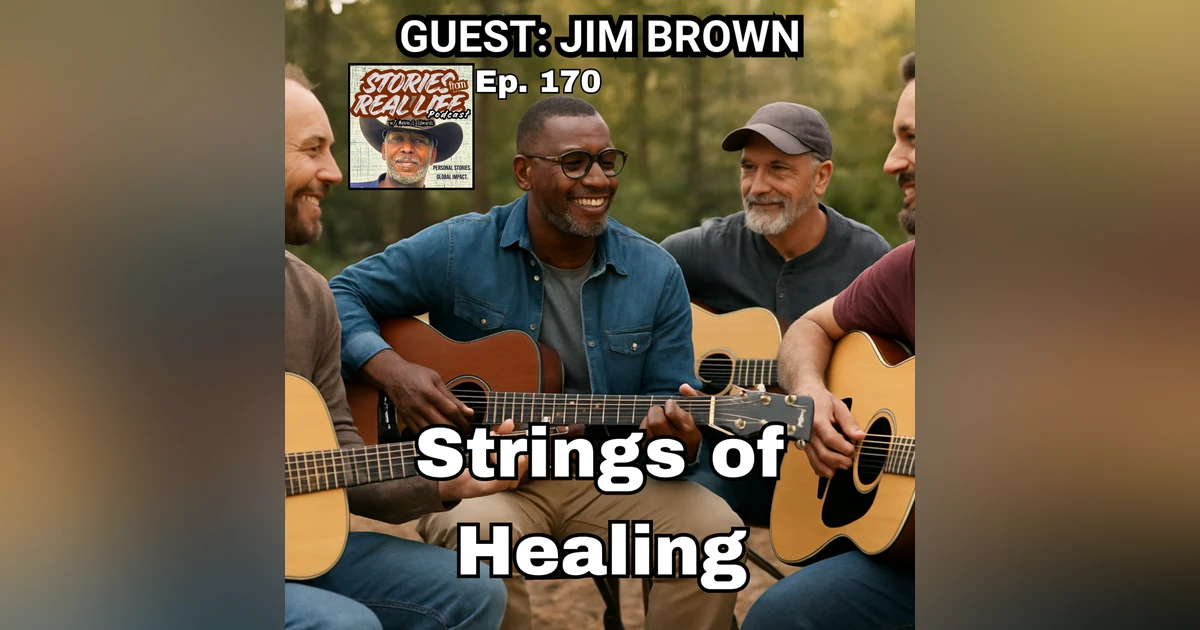

🎧 Episode Intro:When firefighter and paramedic Jim Brown was diagnosed with Stage IV lung cancer, his life took a turn no training could prepare him for. Out of his struggle came something extraordinary — a nationwide guitar group that’s helping men find healing through music, honesty, and connection.
📝 Show Notes:In this heartfelt episode of Stories from Real Life, Melvin E. Edwards sits down with Jim Brown — cancer survivor, former firefighter, and founder of the “Cancer Camp Guitar Club.” They discuss masculinity, vulnerability, and the surprising power of a few chords to bring men back to life after crisis.
Key themes:
* Living with stage four cancer
* Music therapy and emotional healing
* The Man Up to Cancer community
* Redefining strength and vulnerability
* Brotherhood through shared struggle
🎙️ About the Guest
Jim Brown is a retired firefighter and paramedic from Olympia, Washington, and a stage four lung cancer survivor. After decades of serving others in crisis, his own diagnosis led him to a new mission — helping men facing cancer find healing through music and community.
Jim is the founder of a nationwide guitar group that gives men a safe space to connect, express emotion, and rediscover hope through the power of song. He’s also a proud member and contributor to the Man Up to Cancer community, where he advocates for vulnerability, brotherhood, and living fully in the face of illness.
🔗 Connect with Jim
🌐 Learn more: NWPB Feature on Jim Brown📧 Contact: Man Up to Cancer – info@manuptocancer.org📱 Community: Man Up to Cancer on Facebook
Get full access to Melvin E. Edwards at storiesfromreallife.substack.com/subscribe
If you would like to support this podcast, please click on the PayPal link to make a donation today. Any amount is the perfect amount!
Thanks!
0:03 When firefighter and paramedic Jim Brown was diagnosed with stage 4 lung cancer, his life took a turn no training could prepare him for. Out of his struggle came something extraordinary, a nationwide guitar group that's helping men find healing through music, honesty, and connection. In this episode, Jim and host Melvin E. Edwards discuss masculinity, vulnerability, and the surprising power of a few chords to bring men back to life after crisis. This is Stories from Real Life with Melvin E. Edwards. And today's story is Jim Brown's How a Firefighter's Guitar Group Helps Men Facing Cancer.
0:44 I think that people need to understand that they are more resilient than they give themselves credit for and that they just may not have been tested yet. Resilience is, people have an inherent resilience and that resilience can be cultivated, but we're put on this earth, you know, for connection. And so your relationships, you know, that's your legacy. You are listening to Stories from Real Life, a podcast by engaging storytellers for engaged story listeners. Here's your host, author and journalist, Melvin E. Edwards.
1:36 Hello again, and welcome to another episode of Stories from Real Life. I'm your host, Melvin E. Edwards. Thank you for joining me for the podcast where personal stories can have a global impact. My guest today is Jim Brown, a former firefighter and founder of the men's support group, Cancer Camp Guitar Club. We're here today because of our mutual friend, Adam Swinson. So Jim, thank you for being here today. Thank you for having me. So firefighters are first responders. What was the emotional process you went through when you transitioned from being a rescuer as a firefighter paramedic to being the one needing rescue as a patient? Well, it was a pretty jarring circumstance. I mean, I was kind of living the dream at the point, as my voicemail would say.
2:20 If you called me, it said, I'm out living the dream. And I was 47 years old, recently promoted to captain at the fire department. Three beautiful daughters. Great wife. You know, life was great. And, you know, I started to have a little bit of an issue with some breathing when I was riding my bike. And, you know, I won't... I won't... I won't... I'll spare you all the gory details, but long story short, I was a lifelong non-smoker, endurance athlete, and this breathing issue that I had when we got down to the bottom of it, it turned out to be stage 4 metastatic lung cancer, which was just the last thing in the world I would have thought.
3:08 Really, at first, there was a lot of confusion because I just couldn't understand, like... How did I go from zero to stage four without any sort of detection? And the fact is, is that it happens a lot with lung cancer. A lot of times patients are not symptomatic until they're symptomatic. And then it's like, oh, it's stage four. So... You know, at the beginning, there was a lot of confusion and there was a lot of, you know, it was a very jarring thing to me and my family. And to tell my daughters that I had lung cancer was ranks as the hardest thing I ever had to do up until that point.
3:51 And so, you know... I spent my entire career showing up on people's worst days and solving problems and taking control of situations. And this was a situation that I couldn't control, but I knew that I had to... Go to work. I knew that I had to find the best practitioners, the best doctors, seek out, as I would say at the time, I'm looking for the biggest brains. I want the biggest brains working on my case. You know, I was pretty action oriented. And I also had my father had always taught us this mantra growing up that attitude is everything.
4:37 And so the kind of behind that is like we don't have control over what comes at us, but we have control over how we respond to it. And so... That is, you know, I was trying to come at it with that kind of an attitude. But it was pretty scary. You know, they told me at the beginning that if I didn't immediately start aggressive chemotherapy, I had maybe six months to live. And so, you know, we were navigating the system and trying to figure out what might be the best course. And at the time, Keytruda, which is an immunotherapy, was a really big deal.
5:19 And so I was trying to get into a study for that. Long story short, I started a pretty aggressive chemotherapy and it beat me down pretty good, but I was trying really hard to keep my chin up and try and keep things as normal as I could. I was working a desk job at the time at the fire department, so I engineered my days off and used some sick time and got to borrow some time, you know, where my fellow firefighters would contribute sick time to help me do it. And basically, I worked through chemotherapy. Like, I didn't take any time off, any extended time off at all. I just figured out what the plan was going to be.
6:02 And it was going to be chemotherapy every 21 days. And I engineered my work schedule so that I would go get chemo on Wednesday and And then Thursday, I'd be feeling pretty rough and Friday quite rough. And then I'd get through the weekend and then I'd basically come crawling back into the office on Monday. But the thing about that cycle is you really feel crummy at the beginning and then you start to feel almost normal again and then it's time to do it again. And so that was... the cycle that I did for the first year and a half of my journey. But very classically, as the response that many men have when they're diagnosed, they want to keep their chin up.
6:49 They want to keep things normal. I wanted to keep things as normal as I could for my kids. I didn't want them to, if dad's not going to work, then something's really wrong. They were 8, 11, and 15. And so the younger ones, you know, I don't think they had a full comprehension for how serious my diagnosis was. At what point did you realize that the cancer diagnosis wasn't just a temporary setback, but a whole new chapter of your life? When my doctor said, I mean, basically lung cancer is incurable and advanced lung cancer in particular.
7:30 You know, people have cancer journeys and many times they go and they get treatment and then now they're in remission. And my doctor right from the gun said, there's never going to be such thing as remission for you. Like... This is going to be your journey. And at the time, chemotherapy was pretty much the thing, but there were some new treatments coming along. And my doctor had a suspicion that I might be a candidate. And so I had some genetic testing done on my cancer and found out that I have this very rare genetic mutation that 1% to 3% of non-small cell lung cancer patients have.
8:11 And there's a very durable targeted therapy for that. And when I talk about targeted therapy, I basically like killing cancer with chemotherapy is like killing cancer with a shotgun. And killing cancer with targeted therapy is like a sniper rifle shooting the guy driving the bus carrying all the cancer cells on it. Like it just... it eliminates it at that level. And so I did chemotherapy for a year and a half. And that was, you know, this is the new life. And then I had disease progression. And so I started my first targeted therapy. And with the targeted therapy, I was taking pills every day.
8:53 And so I didn't have the cyclic 21 days cycle anymore but i had kind of a more consistent you know there's still plenty of side effects but uh you know so that just you know we started marching through and that this is this is going to be our reality you know the idea that i was never going to like this is going to be my reality like And it's kind of jarring, but at the same time, I was pretty defiant and I was pretty warrior-like. And I was like, you know, basically my mantra, like my diagnosis at the time, 3% chance of living five years. And...
9:34 I always just said, you know, a couple things I used to say was one was statistics don't apply to me. And then the other thing I used to say is somebody has to be the 3%. So, you know, so I just kept, you know, I just... kept rolling and then had disease progression again. Three years into my diagnosis, I had metastasis to my brain and I had metastasis to a rib bone. And so we had to switch it up and try a new treatment. And so I went on an experimental drug that was designed specifically to cross a blood brain barrier and eliminate the cancer in my brain, which it did amazingly.
10:16 But it also made a significant impact on my mental health and eventually dysregulated it enough that I had a pretty big nervous breakdown and ended up having to go to a mental health treatment center for firefighters. So it's not only stage four lung cancer, then it became mental illness that was a side effect of the drug that was saving my life. Like it's the ultimate catch-22. Here's a drug that's going to save your life. You mentioned that I have it. I happen to have that book right here. I've been reading it. That's funny. Yeah, yeah. So, you know, I went and got treatment. And for my mental health, I was diagnosed with drug-induced mania, which...
11:00 You know, people throw the word manic around a lot. And I don't think people really know what that means. But it really did a lot of damage to me and to my relationships. And so I had a lot of work to do after coming out of treatment as far as like rebuilding my life, rebuilding my relationships. But I just, you know, I had a mission and I had a purpose and meaning in my family. So I just kept rolling. And here I am, 10 years in May. And when I had my scans during that period of time, my oncologist said, when you're diagnosed, there's a 3% chance you would live five years.
11:47 The idea that you lived 10 years is you are the 1%. So I've kind of grabbed onto that. I've kind of grabbed onto that and embraced that somebody has to be the 1%. So it may as well be me. So it may as well be me. So you've said that sharing your story publicly has helped others open up about their own fears. So how has that transparency affected your own healing journey? You know, I think a lot of this, you know, in the beginning, I was pretty public about my situation, but there was a different reason for that. And that, that, that was stemmed in, you know, lifelong pursuit of filling a bottomless pit of validation.
12:30 You know, it was like, I kind of became, I was the firefighter that got cancer from his job. And I was like this, the noble victim and, you I just was eating up that attention. And then when I became manic, it just got worse. Like when you're made manic, everything gets turned up to 11 on the amplifier. And so after in my recovery, I really had to like pull back and really assess, you know, when and where I was going to share my story and make sure that my intention, you know, was in the right lane. Group therapy is a really big thing in treatment. And when you sit into it in a room and you're with your peers and this treatment facility I was in was specifically for firefighters.
13:11 So I'm sitting in a room of guys who all have a slideshow of human pain and suffering in their heads. I have a little bit of PTSD as well. That feeling of not being alone, like the first time you hear someone else in the room express something that that you're experiencing, you're just like, oh, I'm not alone, you know? And so that feeling, you know, even for myself, like the first time I reached out to another firefighter that somebody had connected me to who had lung cancer, The intent was, hey, Jim, can you call this guy and provide a little inspiration for him?
13:51 I get on the phone with the guy, and he's got small kids as well. Our stories are a lot of similarities. I came away with that conversation recently. with as much benefit as he got. Like we both mutually had this great experience. And so, you know, I've always known that there is a lot of value in community and in sharing. And so I reengaged through the organization Man Up to Cancer and really kind of dived in again. Okay. So what have you learned about masculinity and vulnerability through leading men who are facing serious illness?
14:34 Yeah. Yeah. Well, there's a lot of patriarchal pressure in our society for men to be, you know, to be strong. You're the wage earner for the family, like all of the societal pressures. And so I think there is a tendency for men in many cases to do that, to keep their chin up and to not express... how scared they are or how much fear they have. And they isolate themselves. And the worst thing a person can do in that kind of situation is isolate. And so through some of the communities I've been involved with, there has been this opportunity for vulnerability.
15:17 And men growing up in many cases, certainly in my case, and I worked in a pretty masculine, hyper-masculine environment, vulnerability was looked at as a weakness. Like, you can't make yourself vulnerable. And what I've come to understand, with a lot of help from a lady named Brene Brown, is that vulnerability is the only pathway to courage and bravery. Like, if you think about it, think about a guy that gets a silver star. in combat, that guy made himself really, really vulnerable to do what he did.
15:57 And he was awarded with awards for courage and bravery. It's the same thing emotionally. That is the path to courage and bravery. And so this organization Man Up to Cancer, that's very much encouraged amongst men and in the community. And it's very, very healing to be in that environment. All right, so let's shift to this incredible project that you started, founding a guitar workshop for men impacted by cancer. And apparently this is through men up to cancer at the Gathering of the Wolves retreat. So why guitars and why music? Well, I started playing guitar February 1st, 2024.
16:37 And it was a lifelong ambition that I had always just told myself – that I wasn't musical and it was too hard and I didn't know how to do it. And I just finally decided I was going to do it. And I was going to adopt a growth mindset and I was going to learn how to play the guitar. And I made a commitment to myself to play every day. And then I got connected with a great learning platform and I got connected with some friends that play. And I just tried to expose myself to as many people as I could. And so about six months after I first started playing guitar was the Gathering of Wolves retreat for Man Up to Cancer.
17:21 And I just had the idea that, hey, you know, I should send a message out to the community and see if I can get some other guys to show up with their guitars. And so I did that and went to the event in September of 2024. And five other guys showed up with guitars. And at that point in my journey with the guitar, I had never played with other people before. I had just been learning on the computer and playing by myself. And so we came together, these six of us, and our song was Wagon Wheel. And we, we, you know, we got, we got to camp and we got together.
18:02 And next thing I know, like we're playing wagon wheel, I'm playing with other people. And it was like, it was such a, it's a feeling that I just can't, I've never felt before. There's a feeling of joy that comes from like playing and connecting and synchronizing. And, and so yeah, We kept playing through the weekend and then we got invited to play at the campfire. We played Wagon Wheel at the campfire and that was a lifelong dream for me to play a guitar at a campfire. It was an impactful thing and a lot of people that saw what happened with the guitar, they were impacted by it. So as planning was coming together this year for the retreat, I reached out to the retreat directors and asked them what they wanted to see from Cancer Camp Guitar Club.
18:51 That's what we called ourselves. And there was some enthusiasm about putting on a workshop. And then the camp director, Jay Abramovich said, oh, hey, wouldn't it be great if like a guy could show up who had no experience, didn't have a guitar, could take the workshop? And I was like, oh, yeah, that'd be great. But we would have to have guitars for that. And so we kind of discussed it. And I've got some experience in fundraising and working with some nonprofits and such. So I just said, hey, give me 48 hours. Let me see what I can come up with. And I just reached out to a few of my friends. And next thing I know, I had some money raised to buy some guitars and reached out to a great music store in Bozeman, Montana called Music Villa.
19:39 And worked out a deal with them where they would sell us a guitar and a gear bag or a gig bag and do the shipping for us for a really reasonable rate. And so then I threw it out to the community and I had a pretty big response. And so next thing I know, I got nine guys who want to come to camp and play guitar. And so... i put it all together and was able to get nine guitars and these guys came to camp thinking this is great i'm going to do this workshop and i'm going to get to borrow a guitar and awesome and what they didn't know was that i was plotting the whole time to give those guitars to them and so the guys showed up we did a workshop i think we had 16 guys in our beginner workshop and And at the end of the workshop, I gave them the guitars and it was just like, it was like sowing seeds of joy.
20:35 I've just found so much joy in playing the guitar. It's brought me so much happiness. I just wanted to spread that. And so like we gave these guys guitars and I had grown men hugging me and crying and crying. It was a pretty cool thing. And it definitely a transcendent experience for me to feel like I was making a contribution to my community. That's pretty awesome. So can you tell me a story of one participant whose life or mindset shifted through the guitar club? Just one story that sticks with you. There's a guy named Boyd who last year was not a member of the club, but was inspired by what he saw.
21:19 So he went home last year and bought a guitar and started taking lessons and came to camp this year and just was like... we just really connected and he was just so motivated and he just wanted to play. And he was, you know, he got the opportunity to play with a whole bunch of different guys. And, and it just really inspired me to see that like, oh, this guy came to camp last year and he saw what we did. And then he made a decision for himself, you know, to choose this. And now here he is and we're playing together. It was, it was a pretty cool full circly kind of moment feeling. All right. So how do you see the Guitar Club contributing to men's healing in body, mind, and spirit?
22:01 And how is that different? Or how is it similar to more traditional support groups? Well, the guitar provides an opportunity for mindfulness. And mindfulness is a cornerstone of mental health. And The ability to focus in on something in the present moment and allow all the other external things just kind of go away, you know, it can be a difficult thing for somebody to idle their minds, you know, and be able to turn those things off. And so... When I sit down for a guitar session, and it's a part of my daily routine, it's part of my mental health, it is a mindful period of time for me where the only thing in the world that exists is me and my guitar.
22:47 And my guitar has become a very close friend of mine. And so... As far as the impact on mental health for men going through a really hard thing who have hard things coming at them all the time, the opportunity to take time for themselves and do this mindful activity is pretty huge. And then secondarily, there's just nothing like the feeling of... You work on something and you work on something and then you play it and it sounds like something. And somebody in the room is like, oh, hey, that's, you know, whatever the song was you play. That's Country Roads or that's, you know, they recognize and it's like you just get this huge dopamine hit.
23:31 And, you know, that that kind of feeling is really, really good for your mental health. And then the whole idea of the community and playing with other people like that's a whole thing. Like I said, I had played by myself all the time. And then I went to camp and I played with other people for the first time. And it was like, holy smokes, this is amazing. And so we're encouraging these guys as they go back into their communities to seek out opportunities to play with other people. And the crazy thing for me is like – I've had people that were in my life for 25, 30 years who played the guitar, but that was not part of our relationship at all.
24:13 And now I'm seeing these guys, like, I got one guy I play guitar with twice a week. Like, I've known him 25 years, and the guitar thing is only one year of our relationship this last year, but it's pretty amazing. And so I'm really excited about... where we're going to continue to go with this. I'm excited to see the guys. We sowed the seeds of joy last year. I'm excited to see the guys come back and see what kind of progress they made. And we stay connected through a message thread. In our mad up to cancer community. So we got a pretty good idea what guys are up to.
24:57 It's solicited the organization to make it a line item in the budget next year. And it's officially going to be a program and it has a budget line item. I'm committed to raising the money to make it happen again. So I don't know. It's pretty amazing. If you had told me five years ago that, oh, hey, you're going to be like leading this guitar thing, I would have just told you you're crazy. Like I don't play guitar. Like that's too hard. I don't do that. But, you know, here I am. 10 years into a cancer journey, finding my authentic self.
25:38 And I'm guitar guy at guitar camp. None of the other, you know, the other things from my life that, you know, the fire department or all those other things, they're not there. Like when I'm at camp, I'm guitar guy. And it just feels like I'm able to really be my authentic self. That's pretty incredible. So do you recall a moment with the guitar group that sort of captured exactly why you started it? A moment that might have given you tools or something? Yes. Yes, I do. This year in the beginner workshop, we had 16 guys in there and Adam Swenson and I were doing the instruction.
26:19 And we were basically just trying to teach these guys very simple versions of standard chords. And we spent two hours with them. And we were coaching them to work through the chords, work through the chords. And at the end, we were able to get these guys to play through a verse of Stand By Me. while Adam sang it. And it was just the most beautiful thing. These guys left that day having played their first song with other people and... You know, and I have a recording of it.
27:02 It's just the most beautiful thing. You can hear Adam singing and the guys are, I'm counting the cadence out, you know, for the guys to do their chord changes. But yeah, that's rocket fuel for me right there. That was amazing. Yeah. It is pretty amazing. So with your cancer journey, beyond survival, what does thriving look like to you now in your relationships and in your health? You know, I've always tried to embrace that term thriving and thriver. I'm not a survivor. I'm a thriver. And so for me, you know, I have a very regimented way that I go about life.
27:43 And I have a lot of integrated things that I do to take care of myself, both my mental, emotional health and my physical health, but like to be able to live life as full as possible and to be able to embrace my most important relationships, which are with my wife and my children. And, you know, I'm, I'm, this year is a really big year, 2025. Um, was 10 years of survivorship for me. And I lived long enough. Next month, my wife and I are going to celebrate our 35th wedding anniversary. And, you know, 10 years ago, yeah, 10 years ago, that was, you know, not a thing.
28:25 And guess what? Now I'm thinking about like, I might even be a grandpa someday. In fact, in fact, my low hanging fruit goal is with playing guitar was that I wanted to be able to play good enough to be cool grandpa that could play and sing for his grandkids. And I've surpassed that. I'm way beyond that. So that's awesome. But thriving just looks like, you know, living life to the fullest. I subscribe to a mortality meditation called memento mori, which basically means remember that you must die. And And I, um, I remember that every day and that, and that drives me and motivates me, you know, like I want to go and put everything out there every day and make sure that when my head hits the pillow at night, that everyone that I care about knows that I love them.
29:16 And then if I don't wake up tomorrow, I put in a solid body of work and, And that's mostly primarily my purpose and meaning starts with taking care of my health and wellness, which, you know, between the side effects from my cancer drug, I've got metabolic issues that I have to manage. And then I've got the mental health thing that is, you know, you don't just like go to treatment and get some pills and you're fixed. Like it's an ongoing, continuous process to always be managing it, you know. There's a lot of days I wake up in the morning and I kind of forget that I have cancer. And that's a really, really great, great thing to feel. But I'm not sure if I completely answered your question, but, you know, spend time with my kids and yeah.
30:05 So when people finish listening to this conversation, what's the one thing you hope they carry with them about courage or connection? Courage or connection? Well, courage. I think that people need to understand that they are more resilient than they give themselves credit for and that they just may not have been tested yet. And so, you know, resilience is... People have an inherent resilience and then resilience can be cultivated, but we're put on this earth, you know, for connection. And so your relationships, you know, that's your legacy. Like people think about like, Oh, you know, like it was, it was kind of a big thing in my head for a long time at the fire department.
30:46 Like what legacy am I going to leave? It's like, Oh man, you walk out the door 20 minutes later, like they forgot who you are. Right. Right. But your legacy is truly, you know, it's in the relationships that you have. It's in my relationships with each one of my daughters, and it's in relationship with my wife. It's relationship with the people in my community that I try to have a positive impact on. So I don't know. Those are a couple things about courage and connection, I guess. Okay. So what role has gratitude played in your journey? Gratitude is my superpower. Gratitude is... You know, I get to do things.
31:27 I don't have to do things. I get to do things. You know, I've lived 10 years with this disease. Everything I do, I get to do. And I have gratitude for that. You know, I just, that's one of my forward facing things in the world is starting with gratitude. You know, just that idea that you get to do things, that you don't have to do things. You get to do things. And I get to live this life. And As much as the journey has been a lot of adversity, I've grown through that and I have gratitude for that. It's a slippery slope because there was a time where I was like, if you ever call cancer a gift, I'm going to throat punch you.
32:18 But, you know, where I'm at right now, it's like I can look back and see the growth, you know, that I've had through the journey and the connections. And so I guess I can say that I have gratitude for the journey that I've traveled. So I'm not technically saying I have gratitude for the cancer, but I'm having gratitude for the journey that I've traveled. Okay, that all makes sense. So you built a community among men who often struggle to open up. What have you learned about listening? And what makes someone feel truly heard? Listening. They call it holding space. It's a skill.
32:59 It's a skill to sit with someone and be an empathetic witness to their pain and to their suffering. And it's a skill to not try to fix their situation. It's a skill to not be thinking about a relatable story in your head while they're talking instead of paying attention to them. so you know that is uh you know also as part of my memento mori uh thing is uh i use it as a verb sometimes if i'm going to spend time with someone i put a lot of value in that time that i'm going to spend with them and i try and be as focused and as present with them as i can humanly be possible and so that If they never spend time with Jim Brown ever again, if they never see me again, they'll look back on that time that we spent together with a positive vibe.
33:54 And part of that is listening. It's engaging. I'm kind of a student of Dale Carnegie, and he's an old-timey guy that wrote this book called How to Win Friends and Influence People. Dale Carnegie has really helped me a lot with my conversations with my friends and, and you always start with family and, and, you know, so I really, really like to engage people and I like to, and it's a skill to hang back and not, you know, want to fix it or want to tell another story like just allowing somebody to express it and you know sometimes that's all they need if it's just if it's a really hard thing you know sometimes all they need is just to be to have an empathetic witness my wife taught me that taught me that term and it's a very powerful thing to do that and i take it i take it very seriously okay So, has your experience with music changed how you define faith, purpose, or creativity?
34:51 Yes. Purpose and creativity, specifically. It has helped shape a new purpose and meaning for me. As I was rebuilding my life after my nervous breakdown and my whole thing, I had to be very, very focused with my purpose and meaning, which was... my health and wellness and to show up as my best self with kindness grace and empathy to each member of my family meeting them exactly where they were that was that is my razor that is my purpose and meaning and i've had to be really focused on that for the last five years and i've gotten to a place of stability in my life where i can start to kind of expand my purpose and meaning a little bit in the world.
35:40 And this music thing has been become a vehicle for that. And so it's, uh, you know, it's, it's about, it's about transcendence, you know, like, um, Isaac Maslow's hierarchy of needs, you know, for the longest time, it was self actualization. But a lot of people don't know that when before he died, he amended that and it's it's transcendence. And so transcendence is something, you know, looking out for something bigger than yourself. And so that's that's something that the music thing has provided for me. And the creativity thing is just like, I just never considered myself a creative person.
36:20 And I wrote my first song last week. Wow. Congratulations. Thanks. Yeah. Yeah. So, uh, yeah. So for me, like purpose, purpose and creativity have been just, you know, the guitars just been a rocket ship for that for me. That's awesome. So when you meet someone newly diagnosed with cancer, what's the first thing you want them to know about what lies ahead? Well, part of my new cancer, there's a phenomenon. It's called friend of a friend with cancer. And like you get a lot of times people are like, my friend got cancer. Can you talk to them? And so it happens pretty frequently. But then, you know, also in the communities, you meet somebody new and man, like...
37:06 Becoming the fiercest self-advocate that you possibly can is paramount. You cannot let anything slide and you have to be willing to challenge your team. You have to be willing to ask hard questions. You have to be willing to go get a second opinion. Sometimes people will start in with a doctor and they'll develop a bit of an emotional attachment and then they're afraid to get a second opinion. The fact of the matter is their doctor should be celebrating them getting a second opinion because it's another set of eyes on the situation. I mean, when I got when I was diagnosed, I was very, very happy with my oncologist.
37:48 He's actually a cancer survivor himself. So. When it's time for scans, he understands the scansiety that you have. And he's an amazing guy. But there's also two other really big brains in this country. One was in Boston and one was in Denver. And I went and saw both of those people. And both of those people said, hey, we like what you're doing and we're on your team now. So if you ever need... a consult or anything like that. So I think that's a big hurdle for people is they're just kind of afraid to do that. And they're, you know, so fear self-advocacy is kind of what I lead with when I'm talking to new people.
38:30 All right. So I just have two questions left as we start to wind down. Okay. Positive is everyone tries to remain. Inevitably, you will lose someone. So how do you learn to handle those losses? I consider what a gift that those people were in my life and the fact that they have helped make me a better person. And I also have to like, there's a certain amount of detachment that I have to do because I have to always remind myself that their story is not my story. You know, and, you know, I got 10 years. Like, this is uncharted territory.
39:10 And I've had friends of mine who were beyond 10 years who died 13 and 17 years. They were that far into their journey and they died. And so I have to remember to stay connected. you know, vigilant about my own health and wellness. But then I also, they motivate me to, like I talked about before, making the most of every day. This is my daily journal. And inside the jacket, those are my friends that I've lost since my diagnosis. And they're in my journal. And I see them every day. And every day, they say to me, Jim Brown, go out there and put it all out on the field today.
39:55 Go live your life the fullest you can possibly live it and make a difference in your community and be kind to people. That's pretty good advice for everybody. So my whole question is also about advice. So what advice would you like to leave with those who are either battling cancer or supporting someone who is? I guess for the people that are battling cancer, you know, the word hope gets thrown around a lot. And I always have to kind of stop and remind people that hope is not a plan. Hope is motivation. And part of the reason that I have chosen at this point in my journey to share a little bit is because there's somebody out there that's newly diagnosed and they're really scared.
40:45 They think they're going to die. And if they can see somebody like me who's 10 years in, I call it a resilient role model. And I've had several resilient role models in my journey who really motivate me. And so if they can see somebody like me, then I can provide a little hope. And that hope is motivation. But hope is not a plan. So you got to have that motivation and then you got to have a plan, work with your team, and then you got to execute and you got to execute every single day. Like this, you know, this success that I've had in my journey is not just me, you know, I'm not just laying back and getting, taking the medication and, you know, going on, you know, putting my feet up.
41:30 I work hard every single day to fortify my body and what I call my inner citadel, which is kind of that inner sanctum that, you know, where your resilience and your strength resides. And yeah, people that are supporting cancer patients, you know, just the kindness and showing up, that all makes so much of a difference. And You may not feel all the time that you're appreciated, but you are. Your efforts make a big difference for folks, and it may get difficult, but just showing up is a really important thing.
42:14 Sometimes people shy away. They don't want to face the hard thing, but just showing up is a big deal. Well, that's an important way to end this episode today. And Jim, I thank you so much for being here today. Our guest is Jim Brown, who started the group Cancer Camp Guitar Club. So again, Jim, thank you so much for being here. Thank you. Please go to my website at podcastreallife.com for more information about my guest and the things we discussed today, including a link to how you can support the group and Man Up to Cancer. So that's it for today's episode of Stories from Real Life. Join us again next time for another chance to learn from each other. Until then, don't forget to shine your light wherever you go.
42:57 Thank you for tuning in to this episode of Stories from Real Life. Don't forget to subscribe and share. Let's meet right here every Tuesday and Friday. See you then.


