

 Spotify

 Apple Podcasts

 Goodpods

 Audacy

 iHeartRadio

 Youtube Music

 Amazon Music

 Audible

 Podchaser

 YouTube

 Castbox
 RSS Feed
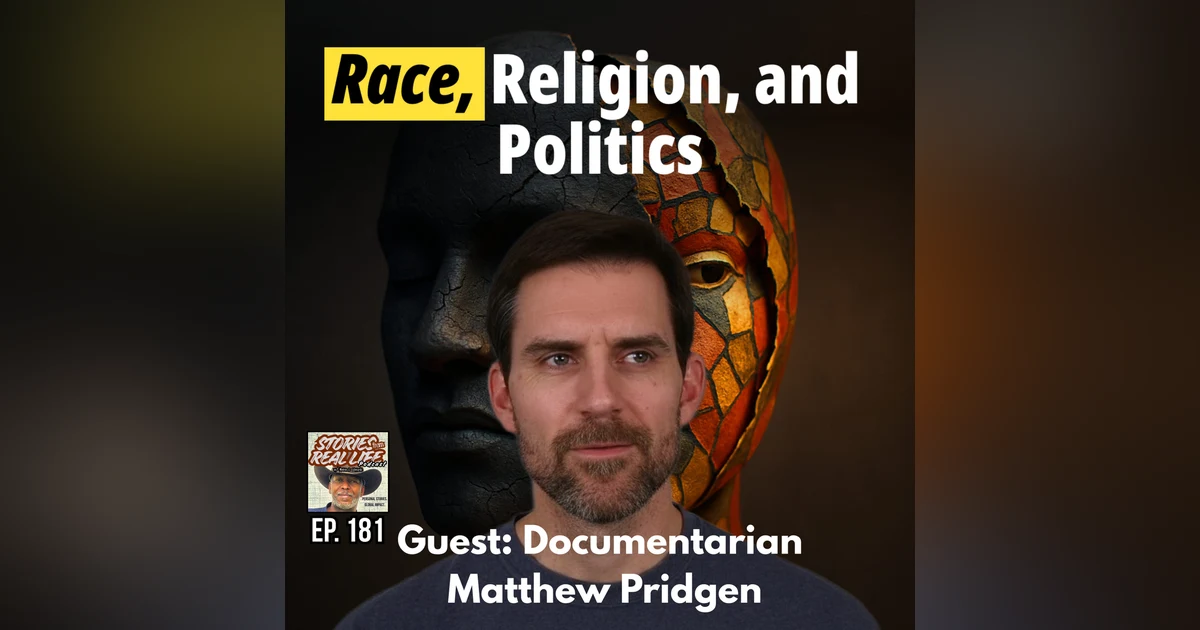
Ep. 181 - Matthew Pridgen: Confronting America’s Hardest Truths

FOREVER Digital Storage - Their mission is to be the complete, permanent, and safe place where millions of families save and enjoy their memories for generations. Please support this sponsor of the podcast.
Episode SummaryIn this episode of Stories from Real Life, host Melvin E. Edwards speaks with filmmaker and author Matthew Pridgen, creator of the documentary The Sins of Our Fathers: Race, Religion, and the Rise of Trump. This powerful conversation explores how Christian nationalism, generational racism, and white evangelical culture helped shape the political rise of Donald Trump—and what that means for America today.
Drawing from his own dramatic life transformation—from addiction and atheism to faith and social awareness — Matthew brings a rare combination of vulnerability, insight, and lived experience to this discussion. Together, we unpack the cultural, historical, and theological forces that continue to influence American politics.
Key Topics Covered• The inspiration behind The Sins of Our Fathers• How race, religion, and politics intersected during the rise of Donald Trump• The role of Christian nationalism and white evangelical culture• Generational belief systems and inherited racial bias• The fear narratives driving modern political movements• Why so many Christians supported Donald Trump• What Matthew hopes viewers will confront about race and faith
Why This Episode MattersThis conversation is essential for anyone interested in:• race relations in America• evangelical Christianity• Christian nationalism• political polarization• the rise of Trump and its cultural roots• documentary filmmaking focused on social justice• reconciling faith with historical truth
About the Guest: Matthew PridgenMatthew Pridgen is a documentarian, author, speaker, and advocate who explores the intersections of race, religion, and justice through film and storytelling. His documentary The Sins of Our Fathers has sparked national conversations around racism, faith, and political identity.
Resources and LinksWebsite: matthewpridgen.comDocumentary: The Sins of Our Fathers
Get full access to Melvin E. Edwards at storiesfromreallife.substack.com/subscribe
If you would like to support this podcast, please click on the PayPal link to make a donation today. Any amount is the perfect amount!
Thanks!
0:00 Stories from Real Life is sponsored by Forever, the digital shareable platform that preserves all of your precious memories forever. This is Melvin E. Edwards, the host of Stories from Real Life. One of the things I'm passionate about when I'm not doing this podcast is genealogy. And if you've ever researched ancestors, you begin to understand how short generations really are. That's why it's important to preserve those memories while you still have the chance. And that's where Forever comes in. Forever is the world's first permanent, shareable, digital home for all your memories. Look, your photos, videos, and family stories deserve more than temporary cloud storage. With a Forever storage account, your files are guaranteed safe and protected for your lifetime plus 100 years.
0:44 Your lifetime plus 100 years. And here's what I love. No endless monthly fees. You can make a one-time payment or break it down to 24 monthly installments and you own your storage. It's all backed by the Forever Guarantee Fund, built to preserve your legacy for generations. Check out my website, podcastreallife.com and click on Sponsors or the link in the show notes. Your memories are the stories from your real life. Forever, make sure they truly last forever. Today's episode takes us deep into the crossroads of race, religion, and political identity in America.
1:30 Documentarian Matthew Pridgen joins me to unpack his film, The Sins of Our Fathers, Race, Religion, and the Rise of Trump, a project shaped by his own dramatic transformation from addiction to faith and from unexamined assumptions to a hard confrontation with truth. Matthew takes us inside the communities, conversations, and uncomfortable truths that define our national moment. This is a story about belief, fear, and the legacy we leave behind. This is Stories from Real Life with Melvin E. Edwards. And today's story is Matthew Pridgens' The Sins of Our Fathers.
2:15 You are listening to Stories from Real Life, a podcast by engaging storytellers for engaged story listeners. Here's your host, author and journalist, Melvin E. Edwards. Hello again, and welcome to another episode of Stories from Real Life. I'm your host, Melvin E. Edwards. Thank you for joining me for the podcast where our personal stories remind us how much we can learn from each other. Today, I'm joined by documentarian Matthew Pridgen, creator of The Sins of Our Fathers, Race, Religion, and the Rise of Trump, which is streaming now on Prime Video.
3:00 His film examines how racism, white evangelical culture, and political fear shaped one of the most divisive moments in American history. Matthew, welcome to the show. Thanks so much for having me. I'm looking forward to this conversation today. So what was the moment or realization that convinced you the sins of our fathers needed to be made? And why did these themes of race, religion, and the rise of Trump feel urgent to you? Yeah, absolutely. So this all actually happened 11 years ago. I started my wife and I started a mentorship group in an inner city in downtown Charleston.
3:40 So this neighborhood is called the East Side neighborhood, downtown Charleston. It's a historically black neighborhood. It's where the majority of the city's housing projects are located. And I grew up two and a half miles from this neighborhood. But, you know, Charleston is a very divided city, like most southern cities. And we never went to the east side. We were always sort of told never to go north of Calhoun Street. And when we did go near the east side, it was always drive around. I remember locking the doors, driving through black parts of town, and it was a very rare occasion. So I spent my entire life sort of avoiding this neighborhood. And even interestingly, as I got... I had a radical conversion to Christianity 20 years ago.
4:23 And in between that time and starting this mentorship group, I went on a mission trip to Africa. So I literally drove past the east side, went to the airport, flew to Africa, flew home, drove past the east side back to my home, never thinking to stop in this community. So we started this mentorship group. It was actually a bunch of girls who were all in this elementary school that was in the community. And as I dug into that group and I was spending time with their families, We would have them for dinner at our house and different events, take them to the beach or, you know, to go get dinner or whatever it was.
5:04 Spending time with these kids, that was really the first time I had experienced what I call like systemic poverty or generational poverty because I did a lot of homeless ministry. And that's actually what got me to the east side. And homeless ministry is sort of what I call situational poverty. So anyone can fall down. into situational poverty. You know, I met a guy one time who was a successful contractor. He got t-boned by a car and broke like four or five of his vertebrae, was never able to work again, ended up losing his business in his home and ended up homeless in his truck. And, you know, those are the people I minister to. Homeless ministry is all about Food, shelter, food, clothing, shelter, right?
5:45 But as I started really digging into this neighborhood, I was like, this isn't situational poverty. This is generational poverty. This is something deeper. And I started studying our history because the East Side was founded as a community after the War of 1812 by enslaved people. There were domestic servants and skilled artisans who were able to go home at night, and that's where they lived. And a lot of those slaves worked in the neighborhood that I lived in, that I grew up in. It was called South Abroad and a very affluent neighborhood where the plantation owners, the Charleston plantation owners would build their city houses. So I'm looking at these patterns and I'm realizing like this is all connected.
6:26 And what it did was it started to challenge the assumptions and the biases and really what I call the mythology that we tell ourselves that, oh, these people are poor because they're lazy. Or they're poor because they're drug dealers or whatever we tell ourselves. But I was like, they're not poor because they're lazy. Because I was looking at these families and they work extremely hard. You know, all of these moms, there was no married parents among any of our kids, but all single moms, working moms. And even sometimes like an older sister would be in the house working. They worked extremely hard. And that was how we met these kids because they were kind of roaming around and didn't have a parent at home, you know.
7:07 And, you know, I realized that these things that I had told myself, that we as a society tell ourselves, they weren't true. And that the reality had a, there was a lot, there was a much deeper thread. So then I started pulling on that thread. And that's what, that was the beginning of making this film. 11 years ago, I was starting to pull on the threads of our history as a nation. our history as a city. And as those threads started to unravel, I was shocked at what I discovered. Okay. And I don't want you to go too deep into that yet because I've got some questions. I want to go step by step to fully flesh out this story. So what kind of feedback have you gotten so far since the release of your film?
7:51 Well, it's been very positive, very overwhelmingly positive. So really essentially what we undertook to do was to tie the racism and not just the racism, but the political and religious ties All the way from slavery to Trump. So one of the things that people don't realize is that slavery wasn't just a social construct. It was a political system and it had religious backing. And so our focus is mostly on religion. the white christian church that essentially theologized slavery so we pulled scriptures out of the bible to justify it not just sort of like like sort of passively tolerating it but we actually justified it we gave the moral justification for slavery and then when The Civil War ended and the Emancipation Proclamation came down.
8:51 We essentially did the same thing in the realm of Jim Crow. We pulled scriptures out of the Bible to justify Jim Crow. Jim Crow was actually justified through the story of the Tower of Babel, that God had separated all races and that he wanted races to be separate. But it's all this cherry picking because we didn't tell the story of Pentecost, how God brought those races back together, right? So it's all about taking Scripture to serve an agenda. And then we go all the way to Trump, how we've theologized Trump. A lot of people call him a type of David, even though he's never actually repented of anything. When I read David in the Bible, I see a sinful man who repented.
9:32 And he didn't just repent later on. As soon as he was confronted with his sin, he repented. That's a man after God's own heart. That Donald Trump has never repented of anything that I am aware of in his entire life. And he's had cameras on him for most of his life. So I'm not judging him, but the Bible does say you can know a tree by its fruit, right? And so I think we're not called to judge people, but we are called to be fruit inspectors. And then there's this other idea that he's some kind of Nebuchadnezzar or King Cyrus. And so essentially, we've theologized him. And it's the same thing we've been doing all the way back. One of the things that we were trying to accomplish with the film is to tie this thread of racism all the way to modern day, because a lot of people, you know, we had this idea that racism ended in the civil rights era and that we sort of, you know, Jim Crow and slavery were in the past and now we're in a new time.
10:28 Essentially what racism did is it didn't go away, it just adapted. So you look at like Reagan is a very famous example that's in the film of using religious dog whistles, racist dog whistles to game, you know, white voters where he couldn't be overtly racist. So he said things like welfare queens and crackheads. And, you know, he he famously talked about young strapping young bucks, eating T-bone steaks on food stamps. You know, he didn't say black or white, but we know who he's talking about. So he connected the welfare system and He connected the social safety net to black people and sort of vilified the whole thing. It's a racial dog whistle. And Trump's racial dog whistles are he's obviously, you know, has demonized Hispanic people for 10 years.
11:13 But some of the other ones he talks about DEI a lot, CRT, woke, Antifa, inner city crime. These are all racial dog whistles. So we're trying to help people to see how we've been manipulated by politicians pulling on racist threads. And again, we're tying it all the way from slavery to Trump. So I think people watching the film are responding and they're, you know, they're thankful in a sense because we're helping them to see that. So, their response has been overwhelmingly positive because we cannot turn from our history if we're not willing to learn from our history. So, I think that uncovering this stuff, that was my heartbeat.
11:57 Because when I was like I said, when I first landed on the east side, all of these lies that I had been told, were were kind of thrown in my face. And I had a real desire to figure it out, I guess. And so once I figured it out, I really wanted to share that not so much with the black community. Of course, I want to share with the black community, but I really want to share it with the white community because we are the ones who suffer from the blinders of racism that prevents us from building real unity and coalitions across race and culture in America. All right. And again, your documentary is called The Sins of Our Fathers. And you just started a podcast with that same name.
12:39 So why did you decide to do the podcast? Well, we wanted people to have a place to go after they watched the documentary. I've always said that the documentary is really the platform for the conversation that we need to have as a nation. It is not the conversation that we need to have. It's just the tee up for that conversation. The problem with America is that the conversation we need to have about race, we cannot have it because we are saturated by disinformation in the media sphere. So there's so much intentional lying and manipulating going on in the media sphere, it's very hard to have cross-cultural dialogue, political dialogue, because the waters have been so muddied.
13:23 And so what we're doing in the film is we're bringing a lot of history and tying it all the way to the present day in one place, so that we can have an informed conversation, not one that's muddied. You know, one of the things I get all the time, I start talking about race and I'm not a Democrat or a Republican. I was a lifelong Republican, you know, and I will vote Democrat until, you know, as long as Donald Trump is in the political scene, I'm voting Democrat because the man is literally The man leading our country is suffering from dementia right now. I mean, it's so painfully obvious, cruel, and will lie every time he opens his mouth. It's just really sad how we have devolved as a nation, not just from our standpoint, but from a global standpoint.
14:05 It's clear that as a nation, we are in a free fall, right? But I'm not tied to any political party. I consider myself a truth teller. I want to call out wickedness for what it is. But as soon as I start talking about race, I have all these people online and they say, oh, did you know that the KKK, the Democrats are the party of the KKK. The Democrats wanted to preserve slavery and on and on and on. And then But at that time, we're not even having a conversation anymore. We're dealing with this red herring. And yes, the Democrats were the party of the KKK. There were no Republicans in the South for 100 years during Jim Crow. Black people couldn't vote.
14:45 And anyone that was against Jim Crow, I mean, in the South, it was a very suppressed political ecosystem, right? So they call it the solid South. It was bright red for 100 years. But in the 70s and 80s, through Nixon and Reagan, starting in 1964 with Barry Goldwater, the Republican Party pulled the racist white Southerners out of the Democratic Party into the Republican Party. But that takes a long time to explain, and then by the time we get there, we're not having the conversation anymore. And so the film is the tee-up to the conversation that we need to have as a nation.
15:25 And this is a conversation we could have had five years ago, around the George Floyd protests, but we're not willing to be honest. We could have had it 65 years ago. We really could have had it 165 years ago. But the problem is we're not willing to be honest with ourselves. We're not willing to be honest with the history. And so the podcast is a way where we can continue this conversation because we really do need a reckoning on race. I believe we're never going to have a political solution until we have a solution on race, until we have an individual solution about race, because race... you know, it has a way of burying itself in our hearts. And I'm a Christian person and Jesus Christ, he said, the greatest command is to love God and to love your neighbor.
16:07 But I can't love my neighbor if I don't see them, you know, as made in the image of God. If they're Hispanic or they're black or they're Asian or whatever, if I can't see them as my equal, and not only is it a biblical principle, it's also written into our constitution that all men are created equal. If I can't see people that way, then I cannot live into that law of love that Jesus has called me to do. So I always say racism is a trap and we have to have that conversation, you know, or we're going to keep voting for regimes that tackle people, you know, in the middle of the street with masks on. It's like, how did we get here? Well, we got here because we were willing to tolerate racism. the overt and covert racism over 10 years and you know rhetoric does eventually you know manifest in action so we want to keep that conversation alive with the sins of our fathers podcast yeah you talked about the confederacy and i find it interesting we'll say when i'm having a discussion online with someone and they talk about the their heritage of the confederacy is not hate is heritage kind of thing but then they get upset about talking about racism I say, well, you think it's meaningful to talk about something that lasted for four years 160 years ago, but it's not meaningful to talk about something that happened 400 years 60 years ago.
17:32 Right. So, yeah, make that make sense. Right. So the title of your film itself suggests some generational responsibility. So what inherited beliefs or cultural sins did you find most deeply embedded in the white evangelical spaces? Well, so again, what we're trying to do is to create a continuous thread all the way from slavery to Trump. There's this interesting verse when Jesus confronts the Pharisees and he says to them that you decorate the tombs of the prophets who died before you. And it says that because you do that, you're recognizing it was your forefathers that killed those prophets.
18:15 So we have this idea. The way we sort of teach American history is really backwards because we have this idea where we ended slavery and we ended Jim Crow. It's like, well, who is the we? It was a bunch of black people with a few white allies against a majority of white people. and white christians specifically now again i'm a christian i'm not trying to turn anybody away from jesus i just think we have to recognize the sins of our past so that we can do better moving forward right you know the question is what i uncovered was how fervently these christians preached slavery you know we have we have a quote in the film that the war is the servants of slavery speaking of the civil war you know we always say the civil war was about states rights it was about it was about states rights but it was about states rights to own slaves period and if you look at the documents of the confederacy they were very very clear about this there was no ambiguity they were breaking away from the union so that they could continue the practice of slavery.
19:19 Where in South Carolina, just think about how crazy this is. The law was you couldn't work a slave more than 14 hours a day in the winter or more than 15 hours a day in the summer. That was the law. So who's trying to work a human being more than 15 hours a day? And they didn't give them adequate food and clothing. So after they worked for 15 hours a day, they had to go find their own food in a lot of cases or grow their own food or kill their own food, prepare their own food. So it was a wicked system. It was an insane system. One more thing about slavery that we talk about that we uncovered is Because if you look at the plantation system, there's no chains and there's no fences. That always surprised me.
20:01 I was like, what kept these slaves on the plantation? The reality was if a slave escaped, what they would do is if they found them, They would bring that individual in front of the whole community and torture them in front of the whole community. It's the same thing they did with lynching. Why not just shoot somebody? Why do you got to hang them up on a tree or burn them or mutilate them, you know, and then leave the tree, the body up in the tree? It was it was terror. Terror is what kept the slaves on the plantation. Terror is what kept proud black men and women, you know, stepping off the sidewalk during Jim Crow, moving to the back of the bus during Jim Crow, tipping their hat to white men and women during Jim Crow.
20:44 All of these humiliating gestures that that, you know, that, that went along with Jim Crow, what, what oil, it was like the grease on the, of the, of the machinery of Jim Crow was terror. Because if you stepped out of line during Jim Crow, they're going to hang you up on a tree, no trial, no jury, you know, just boom, you're, you're dead. And, and so that was really shocking to me. One of the things that we discovered while filming the documentary was that the slave patrols were actually started in South Carolina in the 1700s. And so we have this concept of white authorities literally hunting down black people looking for runaway slaves.
21:25 And a lot of times freed blacks fell into that system as well. There was that famous movie, 11 Years a Slave. where a free black didn't have his papers and was brought into slavery for 11 years. And black people, if you were a free black, you had to have your identification on you at all times. You always had to have papers with you. And you fast forward all the way to today, 2025 ICE raids, where we get the green light from the Supreme Court to racially profile people. And in America, you have to have your identification on you at all times to prove that you're a citizen so that you don't get detained by ICE. And everything that's happening with ICE right now, the legal sort of framework for it was built during the war on drugs, the erosion of the Fourth Amendment rights, the whole idea of the Fourth Amendment.
22:12 is that you cannot be stopped unless the authorities have probable cause. They have to have a warrant. They have to have a reason to stop you beforehand. They can't just stop and frisk like we instituted during the war on drugs or enter into your home or stop your car under the suspicion that you might have drugs because you're black. The whole idea of the Fourth Amendment was eroded during the war on drugs, but most people didn't see it because it was happening in poor black neighborhoods. You know, I had a very bad drug problem in my 20s and was using drugs every single day until, you know, actually the way I became a Christian was I tried to commit suicide when I was 21 on drugs, and I met Jesus in that process, and I've been sober for 20 years since, which is a miracle.
22:57 But I'm 41 years old, and I've only been stopped by the police two times in my entire life for speeding. And, you know, we have a friend who I mentioned in the documentary who was stopped 11 times in one year, a black friend of mine who never did drugs, pulled over by the police 11 times in one year. That's like literally like once a month. And sometimes they would search his car and he said it was completely humiliating. He didn't, he still to this day does not know why they, they stopped him so many times, you know, but The point is that all of this started a long time ago. The way that we police the black community. People don't realize this. During Jim Crow, in most southern states, it was a law to be vagrant, which means if you were black and you didn't have a job, they could arrest you and put you on a chain gang.
23:44 So there's nowhere for these people to go, nowhere for them to work. If you're just not working, then they would literally lock you up and make you work. It's like there was no freedom in that system. So we uncovered a lot of very disturbing things that, again, these threads go all the way into the present. And that's why we're trying to bring this stuff to the light because we can't understand our current situation if we don't know our history. And we certainly can't correct it. if we're not willing to be honest about where we've come from. Absolutely. I agree with that 100%. So you just sort of touched on this, but I'd like for you to go a little bit deeper.
24:25 How did you discover a certain amount of privilege, even at your lowest point, compared to some things that you might have learned later on? Absolutely. And just to be clear, you're talking about white privilege? Yes. Yes. Well, it's interesting. So I was a drug addict through my college years, and I ended up trying to kill myself after taking 27 hits of acid. And during that time, I had some interactions with the police. And it's amazing to me how police deal with white drug problems. versus the way they deal with black drug problems. Black drug problems are usually treated in a criminal sense, whereas white drug problems are treated sort of like with a treatment sort of approach.
25:11 And I do remember that during that time period, there was a lot of leniency. I ended up with no criminal charges, even though I had drugs on my person. And I think it may be in my situation because I had a very radical situation. I tried to drown myself in the ocean on LSD and swam for 18 hours in the ocean and gave my life to Jesus in the middle of that. That's a whole other story, but it was a crazy story. I was in the hospital for four days and lost 20 pounds just from that swim. And like I said, I've been sober for 20 years. And Again, that's really what propelled me into my faith in Christ that led me to start this mentorship group years ago.
25:56 I am definitely a Christian person. Again, I'm not trying to turn anybody away from Jesus in anything I do, but I do feel like it is important to calling us back to the faith. But I mean, even just like sometimes I'll be walking in certain spaces and I think, you know, I wouldn't want to be here if I was black. I mean, it's just the reality. And I hear my friends who talk about being tailed in retail stores or you know, being passed up for job opportunities, promotions, you know, there's so much to it. Just being white in America. I mean, it's like, you know, I don't know how to say it in the South. It's like a good old boy system. It's a strange world.
26:37 But I think it's very much taken for granted. I mean, how we how we relate to each other, the way we exist. I mean, it's just it's it's like swimming in water you know it's like the old the old parable you ask the fish like what is water i don't know what water is it's like well you're swimming in it like you know white supremacy in america is just the assumption i think we've got to become more aware of it and so we have to listen like the main thing that hurts my heart when i look at american history is you see these three major times where there is a heart cry from the black community it happened during the abolition movement It happened during the civil rights movement and it happened during the George Floyd protests.
27:19 And every time the response from the white community was backlash. It wasn't, hey, let's listen. Hey, let's correct. You know, in the Civil War, there's 650,000 people that died trying in an attempt to preserve the institution of slavery when we could have gone a different way as a country. You know, in the civil rights era, we have massive white backlash and that we cover that extensively in the film. It didn't have to be that way. Actually, the whole southern landscape in most southern cities, you have suburbs that were built not because You know, we were we wanted more yard space.
28:00 The reason why we built our suburbs is because we knew segregation was coming and we didn't want to live next door to black people without a rigid social racial control of Jim Crow laws in place. So we fled to the suburbs like we can you can look at, you know, in any southern city and you see that pattern. And then the George Floyd protests, it broke my heart, you know, that you hear this heart cry like, you know, our lives matter. You know, we're dying at the hands of police officers. We're being harassed constantly at the hands of police officers. And we're the white evangelical church. Well, we basically sat that round out. But then as soon as critical race theory came out, which was a political dog whistle to distract us to shift the narrative, we jumped all over that thing.
28:49 You know, hundreds of laws passed in all over the country. In South Carolina, we passed a law banning critical race theory, but critical race theory was never taught in a K-12 school in the history of this state. But we took the time to pin and ink that thing. They took the time to write out the legislation. We could have just as easily written out some legislation that would help our black brothers and sisters, but instead we fell for the political dog whistle. And that's sad to me because I feel like We will do anything as a nation, but except for listen to the lived experiences of black people. As soon as our black brothers and sisters start talking, it's like we pull the race card.
29:30 I'm like, no, this is just their lived experience. I don't know why it's so hard for white people to listen. It blows my mind. That's actually how I discovered you. I saw a short that you had done, I think it was on Facebook, and you talked about The hardest part for black people to talk about, why it's so hard for black people to talk about racism? Well, we get this massive pushback. It's the strangest thing in the world. Like, I've always been taught, you know, someone's story is the most authentic thing they can tell you, right? Like, if you're trying to tell me about history or politics or whatever, you know, I might come up, I might buck against you and say, hey, you know, I disagree with what you shared.
30:15 You know, I don't, I think... you know, I have a different opinion. Right. But somebody is sharing their personal experience with me. I'm going to listen. You know, I'm not going to dispute your personal experience. Right. Like when my friend was like, Hey, I got pulled over by the police 11 times. I didn't grill him. Cause he had, his wife was like, yeah, he would. Cause he used to call his wife every time he got pulled over. She's like, he's like, she was like, yeah, I think it was 12 times. You know, I was like, and then he was telling me all about it. You know, I was like, well, why, what did you do to deserve it? It's like, no, It's not like that. You know, I just think we have to be more careful, you know, listening to people and recognizing. And again, this is a big part of what we do. The film, my reels online with the podcast is that like it's not just the right now.
31:02 We have a long history of racism in this nation. We have a long history of being manipulated by politicians in this nation because of race. We have a long history of oppression and marginalization, not just of the black community, but of the Native American community, now the Hispanic community. And like, we have to reckon with these things. You know, the term I use is, uh, you know, restorative justice. Like we, God gave me sort of a picture as a nation. Like I don't want to take one more step forward as a nation until we link arms with every group of people that the United, the U S empire, that the American empire has marginalized and oppressed.
31:46 And we have, we have got to say, we are going to link arms and we are not taking a single step forward until we all take a step forward. Because we have for too long built wealth and privilege and power on the backs of other human beings. And we have to reject that. Like we as a society have to reject that because it keeps going on and on. Why are we at war with Venezuela of all countries? Maybe it's because they have the second largest oil reserve in the world. But nobody will say that in the media. We talk about drugs. Venezuela... You know, provides almost no drugs to the U.S. Colombia does. Mexico does. But why aren't we at war with them?
32:27 Why Venezuela? You know, it's like no one will ever be honest about this stuff. We cannot have a real conversation as a nation because everything is veiled. And it goes all the way back. The states rights thing. Why do we have the Civil War? Oh, it's states rights. Like, why can't we just be honest? Why can't we allow black people to share their lived experience and their history without so much pushback? And I think it's hindering us as a nation from having the conversations that we need to have in 2025. Let me share something here. I'm generally just interviewing my guests, but I want to share something here that goes along with what you just said.
33:07 I think for a lot of people, a lot of white people, it's just the resistance of allowing black people to have a story, to have anything good or bad. So if a black person accomplishes something, they dismiss it as being DEI. If you talk about chattel slavery, they will quickly say, what about the Irish people? So whether it's good stuff or bad stuff, they don't want to allow black people to have any kind of a story. So they undercut that and replace it with something that makes them the victim. Right. It's almost like victimhood is their empowerment. Right. And touching on that Irish slavery, I mean, that is one of the worst, you know, false flag arguments because there were Irish slaves in the early days of America before, you know, in the colonial days, but they were indentured servants.
34:00 And so at some point, if they worked through their entire tenure, they would come out on the other end, usually with some kind of economic benefits, some kind of land or some kind of wealth. Whereas chattel slavery in the black community was generational slavery, where you were going to be enslaved, your children, your grandchildren, your great grandchildren. And that it's a totally different system. And ultimately, You know, the indentured servitude gave way to black chattel slavery. So it's really a false flag argument. It's not comparable in any way to the 4 million black slaves that were in this country on the eve of the Civil War that were free by the Emancipation Proclamation.
34:47 And this is, again, like... you know, we don't know our history. And so I always tell my kids, it's like, if I live on Main Street, but I don't know that I live on Main Street, you know, and that someone says, hey, you live on hazel street well i don't know know the name of the street i don't know if i maybe i do live on hazel street but if i know that i live on main street you're not going to convince me that i live on hazel street and i know that's a really simple picture but if we know our history we're less likely to be you know lied to by internet trolls or whatever they put this meme up there just because someone makes a meme does not make it true. I just want to, can I tell the whole world that?
35:28 Is that okay? This is a free advice. There's a meme. There were Irish slaves too. I mean, it's not comparable at all. It's a false flag argument to prevent us from confronting this situation. And unfortunately, the reason why we fall for those is because we don't know our history. And that's why we're really trying to educate people and not to do it in a boring, dry way. But my whole heart, is to connect the threads of the past that are still relevant today. Well, you may or may not be surprised at how often trolls are attracted to me when I'm having a reasonable discussion with people online on the issue of race. It's almost like they've got race, racism, races flagged so that whenever anybody discusses it, it pops up on their screen.
36:15 It's Yeah, it's a troll radar, I think. It's instantaneous. It is amazing. I did an experiment recently where I was getting bombarded with racists who claimed they weren't racist, but they were calling me the N-word. So you... Take that for whatever you want. That's what I'm telling you. We got to be fruit inspectors. If you can't figure it out from that, then you're in trouble. Exactly. So I made my post private and it stopped all of that. And then I went back to public within 30 seconds. They were back again. It was crazy. All right. So let's get back to talking about the subject of your film.
36:58 So what... How high on the structure does fear play in all of this system? Oh, fear is everything. I mean, fear is absolutely everything. The only reason why Donald Trump was able to gain the presidency... in 2016 and again in 2024 is because he painted this dystopian picture, right? Of America is this third world country and we're being overrun by Hispanics who put roofs on houses in the middle of the blazing heat. Very scary people, you know? They make wonderful margaritas.
37:39 Very, very scary people. You know, I'm being flippant here, but like if you have ever met Hispanic immigrants, and I know a ton of them because our church that we went to for 10 years was a Spanish English church. man, they are the hardest working, most family oriented, very Christian people. And to demonize them, and actually, you know, one of the things that Trump politicians do is they take a tiny thread of truth, because what did he call them? Rapists and criminals. Well, now there is in the trafficking realm, there are a lot of rapists and criminals. But the people who are coming here are good, hard-working people who are looking for a better life.
38:22 They're coming here for the same reason that our European ancestors came here for. You know, to work hard, maybe to get some land, just to provide a better life for them and their family. But he stoked up all this fear around that. And it's like this, the replacement theory, they're taking your jobs. That's one of the craziest things because I'm an economics man. I actually went to Duke University for economics. So I have an economics degree from a very good school. Economies, it's not like you just, if someone comes and creates a new job, it's not like you steal someone else's jobs. Economies grow through job creation, through entrepreneurship.
39:03 So like The idea that we're stealing jobs. Economies, when you have a lot of hard workers who are innovators and willing to do those kind of jobs, it's going to grow the whole economy, right? But the fear clouds our vision. And if you look at, I just read a report that it was like, 400,000, Trump's deportation efforts are threatening 400,000 jobs in just the healthcare sector alone. The home, like nursing care, like home health, that kind of stuff. Obviously, our economy is majorly contracting. in areas of construction and agriculture because of these deportations, right?
39:44 So instead of doing, you know, he said it was going to do the opposite. We're going to deport all these people and we're going to get all these jobs. Like it doesn't make any sense, but fear clouds our vision. And again, it was the same thing. If you look at all the way back, I like to always go back the advent of the civil war. It was all about fear. Interestingly, too, if you trace throughout history the language that these racists use, you know, they called Martin Luther King Jr. a Marxist and a communist. It's the same thing they do today. It's the same language. But one of the things that I read on the eve of the Civil War, these southern preachers, they call the northerners heathens and infidels, and they want to come and disrupt our godly way of life.
40:27 And it was all of this fear. Like, what are we going to do without the slaves? It reminds me kind of of Pharaoh. You know, when Pharaoh was confronted, let my people go. He's thinking, this is my economic engine. This is how I do everything. What am I going to do? It's the same thing. It's fear. And so fear plays a part in every single decision that we make. You know, the only reason why Trump exists in the political sphere is because he's very, very good. at manipulating people's racial fear, stoking racial fear. And until we realize, like until we can snap out of it, that people are people, that everybody really at the end of the day wants the same thing, like I think that's the most disheartening piece of the whole American story is you have black working class people, black, you know, poverty, On the other side of the political aisle, then you have white working class people and white poverty or Hispanic working class people.
41:29 We all have the same thing in common. It would take you about five minutes. If we had a legislature that actually cared about people, you could pass a law for universal health care and a $20 an hour minimum wage. 80% of Americans would benefit from that. But we will never be able to do that because they've divided us, working class whites over here, working class blacks over here, middle class whites over here, middle class blacks over here. And it's like we can't ever come together. And guess what? Same thing they did after the Civil War. Because in the Reconstruction era, you had white and black fusion politics, people coming together because everybody in the South was poor after the Civil War.
42:13 But if you listen to Martin Luther King Jr., what he said was, it says that for the white people, the politicians, the aristocracy, the wealthy plantation owners, they fed them the crow. And it didn't fill their bellies, but it made them superior to the black man. So they divided us not by class, but by race. And we've been divided ever since. What surprised you the most about conversations you had with Christians who are wrestling with race, nationalism, and their support for Trump? I am surprised every single day. I continue to be surprised. We mentioned this in the podcast. One of the very surprising things to me was when Trump, during the national debate, probably the most eyes on him he's ever had with Kamala Harris before the 2024 election.
43:04 And he gets up on national television and says that the Haitian immigrants are eating the cats and the dogs. And the moderator is like, well, Mr. Trump, they're not actually doing that. And he's like, yes, they are. They're eating the cats and the dogs. And I thought his run for presidency is over. Surely people, rational people, Christian people, you know, who were taught one of the Ten Commandments is don't bear false witness against your neighbor. These are Haitian immigrants who are here legally. They're living, as the Bible says, quiet and peaceable lives.
43:44 They're not making any stir. We always say, well, come into the country. We just want you to come into the country legally. Well, they did that. They came in the right way. They're here legally. And they're being vilified for something so ludicrous, something so cartoonish. And I remember talking to white Christians after that episode, and they're defending Trump. And I'm like, why aren't we defending the Haitian immigrants that just got defamed in front of millions of people? And actually, if you remember, right after that, the Haitian immigrants, they got bomb threats and death threats and all these things. I'm like, they experienced violence because he accused them of a crime that they never committed.
44:30 And this is just one example of so many where I've been like, We are the Christians. We're the Jesus followers in this equation. Like, how does that make any sense? And really, you know, from a big picture perspective, ever since the 2020 election, when Trump stood up there, before the votes had even been counted, said this is the biggest fraud the world has ever seen. He had no proof of that. Five years later, he has still not... provided one single shred of evidence. But that was when my white Christian friends and colleagues and acquaintances really went off the map of truth. And it's never been the same since.
45:11 I have not had a normal moment with my white Christian friends in like five years. And that, to me, is terribly sad. And again, there is a racist root in it. I don't know. I look at dehumanization. It's a fascinating psychological study. You look at the way we dehumanize Native Americans. You look at the way we dehumanized the black community, the way Trump has for 10 years dehumanized the Hispanic community. I don't know why it works or how it works, but it should not work, period. And it definitely should not work on people who are committed to Jesus Christ, who literally says everything, all of the law and the prophets, hang on this, love God.
46:03 and love your neighbor as yourself. It just shouldn't be the case. And that's why I keep talking. I actually had a guy the other day, he reached out to me. He said, what could I do to shut you up, right? You talk about hate. And I was like, if you guys could just stop with all of this madness, and if we could just learn how to love people, love my neighbor as myself, I wouldn't have to talk anymore. If we could love the black community, we could love the Hispanic community as ourselves. I wouldn't have to talk. I wouldn't have to put my mug up here. I wouldn't have to deal with all this abuse, you know, and I just don't understand it. I don't understand it one bit. Okay. I'm going to, for a second, pretend to be a social media troll.
46:44 Cause I could, I could see, I can envision a question they would ask you. Here's a question they would ask you. Why do you hate being white? Listen, I don't hate being white. I just hate the fact that white people can't seem to come to the table honestly when discussing race. That really is my biggest pet peeve. I am not guilty about my forefathers who owned slaves. I do not feel guilty about those who perpetrated the horrendous crimes of Jim Crow. I don't feel guilty, even for my own past.
47:27 I've made mistakes. I've repented. I try to make amends. But I'm going to come to the table honestly. I'm going to come to the table honestly about these things. And that, to me, is the hardest part about being white, is that we feel like we can't be honest. We feel like we have to lie. We feel like we have to skirt around the issues. Like I said, we could have had the conversation about race 165 years ago. We should have. We could have had it five years ago. We could have it today, but we will not come to the table honestly. So listen, I'm very comfortable in my skin. I'm a white dude. I can't change that. It doesn't bother me.
48:07 But I do think it's important to talk about race because race plays into so much of our lived experiences every day. And I think that it's very sad to me, my friends who are black, my friends Even some of my friends who are Hispanic, but mostly my black friends who feel like, hey, I can't talk about my own lived experience as a black American because as soon as I open my mouth, some white person is going to push back on me. And that's hard. And we can't make any progress with that mindset. So when examining race and religion together, what did you learn about how theological beliefs can either mask or expose deeper cultural biases?
48:49 Wow, that's a really good question. I think that I heard this piece of advice one time, basically how your heart desires something and then you... go about justifying what your heart desires, right? So when I look at race in America intersecting with Christianity, I really see people abusing the scriptures. I see people using the scriptures to justify ends that are not biblical. I see people using scripture to justify economic systems that benefit them. I think it was very convenient for the Pope to issue the doctrine of discovery that said, as long as there are no Europeans living on a certain land, if you arrive there, you can take the land and you can enslave those people.
49:45 It's like, well, how is that Christian? What's Christian about that? Well, you're basically justifying what you already wanted to do you're using scripture you know it's slavery it's the same idea this brutal system somehow being justified in jesus's name slave owners beating their slave on a saturday and then going to church on sunday or in jim crow going to church on sunday and then going to a lynching and having a picnic at a lynching on Sunday afternoon. These things, again, I think we're just tacking scripture on to what we want to do. I mean, look at the deportation thing. The Bible says to love the foreigners as your own self, as your native born.
50:25 Treat them as your native born over and over again in the Bible. It even says if you mistreat the foreigner, that there's going to be judgment. And I believe that's what we're seeing right now. But we'll find some way to justify it. And again, it goes back to your question about fear. We're using the Bible to justify what we want to do because we're afraid of these people. We can't embrace them. The Imago Dei is this Christian idea that we're all made in the image of God, but we can't see the Imago Dei in these Hispanic immigrants. who literally are, like I said, are coming here for the same reason that our European ancestors did. They're just coming for a better life.
51:06 And I don't know, I think it's very disheartening to me the way we twist Scripture to justify what I believe is what we already want. It's like just using it as a cover. It's literally the wolf in sheep's clothing kind of thing. The Lord showed me this, like, what is the best sheep's clothing? It's Christianity. So you do slavery, but you do it in Jesus's name. You do Jim Crow, but you do it in Jesus's name. You tackle immigrants in the middle of the street, but you do it in Jesus's name. And people go along with it. And I think that we've got to be more discerning And look at the whole of scripture and not just the verses that we pick and choose to justify certain things.
51:48 Look at the whole of scripture from Exodus, Genesis, Exodus, all the way to Revelation. God always sides with the marginalized and the oppressed. There's never a time where God sides with rich billionaires in the Bible. Look it up. You can fact check me on this. I promise you, right? Jesus came to bring good news to the poor, not good news to wealthy billionaires. Wealthy billionaires, if you look at it from a biblical perspective, are the problem, not the solution. So when you have a cabinet full of billionaires, you can tell something is wrong, right? So again, I just think we have to stop picking and choosing our scriptures. We have to look at the whole biblical record. God has called us to care for the least in our midst, and it's like the literal opposite of what we tend to do.
52:34 So you're saying it's easier for a camera to pass through the eye of a needle? Is that what you're saying? Well, I mean, maybe there's some really famous guy that might have said that. Maybe he meant it. I don't know. And again, like you said earlier, we'll take that scripture and we'll make sure that we don't believe, oh, it's a metaphor. But these other ones are literal. It's like you can't win, right? Right. So after finishing your film, was there anything you felt like was still unresolved? Well, I mean, I think there's a lot still unresolved. I mean, everything is unresolved. I think one of my core convictions is that the future is not written yet. We write the future.
53:15 We don't have to continue supporting Trump. And by we, I am not talking about me and you because I don't think we do, but I'm talking about like white evangelical, my white evangelical brothers and sisters. You know, I love the Bible. I love Jesus. Like I live for Jesus. My conservative mainline Christian brothers and sisters. We don't have to keep going down this road. We can change. That's why we made this film. You know, one of the things that occurred to me, 11 years ago, my wife and I started this mentorship group in this project neighborhood. And we started spending all this time in this neighborhood. My first thought was, I need to go help these kids.
53:58 But very quickly, within the first couple of years, I realized these kids are helping me. They're helping me to see them in a way that I didn't see them before. And I realized very quickly, my ministry is not to them. Although we did do a lot of great things together, my ministry is to my people. And I felt like I was called to go back to the white community and share everything that I've learned. So I hope that people will watch the film. I hope they'll learn from it. I've written a couple books on Amazon as well. We do the podcast. I make reels. Like I said, the future is not written. I mean, we can change.
54:39 I just don't see why we are so committed to a man who embodies the opposite of everything Christian people have been teaching me my whole life. And like I said to this guy, he said, what can I get you to shut up? It's like when we stop worshiping that, you know, I don't believe he is the antichrist, but he's a type of antichrist in the sense that he opposes everything that Jesus taught us. And that to me is. is very hard to stomach. And then we lie about it on top of that. So, you know, for me, the unsettled question is, what is our future going to be?
55:23 You know, I think we have a great opportunity as a nation, as we are seeing, we're already seeing, you know, the cracks of this administration. It's the most unpopular administration, I think, in the history, certainly in recent history. I think we have no reason to stay attached to Donald Trump or to MAGA. And so I'm hopeful. People make fun of me sometimes because I am the forever optimist. But I'm hopeful that we can map a different course as a nation. And one of the things I talk about a lot is restorative justice. The American empire has done so much damage to so many people from the Native American community.
56:08 Remember, we took half of Mexico by force. So when Mexicans cross that imaginary line, part of that is their ancestral homeland. We took Hawaii by force. We took the Philippines by force. We took Central and South America by force. We took Panama, built the canal by force. We take oil from the Middle East by force. So much damage. has been done to create the wealth that we have as a nation. And I believe if we are going to have a future as a nation, again, I'm not sad to be white and I'm not sad to be American, but I just want to look at it openly and honestly.
56:49 Why can't we have an open, honest conversation about the damage that we've done? And let's start talking about what does restorative justice look like in our country, even around the world, to help the people that we've hurt along the way. I feel like that's the only way forward for us as a nation. All right, I just have one last question here for you today. So when your children eventually watch your film, what do you hope they understand about your motivations? My children have already watched my film. And, you know, it was it was unpleasant. There was parts of it where they hated the lynching photos. There's a lot of lynching photos in the film. I've had several YouTube videos taken down because of lynching photos, which really bothers me because it's just historical fact.
57:36 Like I'm not trying to make a political point. I just want to show what happened. So anyway, we put a lot of lynching photos in the film and they were very disturbed by that. But what I would want for them to see is the most simple lesson is that all people are made in the image of God. All people deserve a chance on the earth to flourish as human beings. And if we are going to come together as a society and come up with a political structure, I want to make sure that political structure includes every single person. And, you know, or even if even not on a macro level, if I'm sitting next to someone, I want to make sure I'm treating them as a person who is made in the image of God.
58:20 And I think that at the end of the day, that's really what I want to teach them that. And then also, I think there is something about white privilege that if we have any sort of privilege, any sort of opportunity in this world to do good, don't feel guilty about it. Just use it to help other people. Use it. If you have extra money, use it to help somebody. If you have political influence, use it to make a more just, a more fair, a more equal society. You know, those are the things I would really want them to pass, that I would like to pass on. And one more thing is this. We, again, we cannot change the past, but we can learn from the past.
59:02 And we can change the course of of our nation if we come together and really embrace these values and these principles, which are the principles of Jesus. To me, we can create a more perfect union if we band together across racial lines, across cultural lines, across socioeconomic lines. We can build a better nation, but it all starts with the humanity of seeing the image of God in one another. That is the perfect way to end this episode today. So our guest today has been Matthew Pridgen. Matthew, thank you so much for being here today.
59:42 I really appreciate it. That was my pleasure. Thank you so much for having me. Well, I encourage you, the listeners out there, to go and watch Sins of the Father on Prime Video, and then send me a message to let me know what you thought about. I'm really curious to see what you think. But go and watch it for yourself, and then let's start a conversation. If today's episode challenged you, moved you, or opened you to a new line of thinking, I encourage you to share this episode with somebody who you think needs to hear it. And if you want more conversations like this, make sure you're subscribed and following the show. This is Stories from Real Life. Until next time, don't forget to shine your light wherever you go.
1:00:25 Thank you for tuning in to this episode of Stories from Real Life. Don't forget to subscribe and share. Let's meet right here every Tuesday and Friday. See you then.


