

 Spotify

 Apple Podcasts

 Goodpods

 Audacy

 iHeartRadio

 Youtube Music

 Amazon Music

 Audible

 Podchaser

 YouTube

 Castbox
 RSS Feed
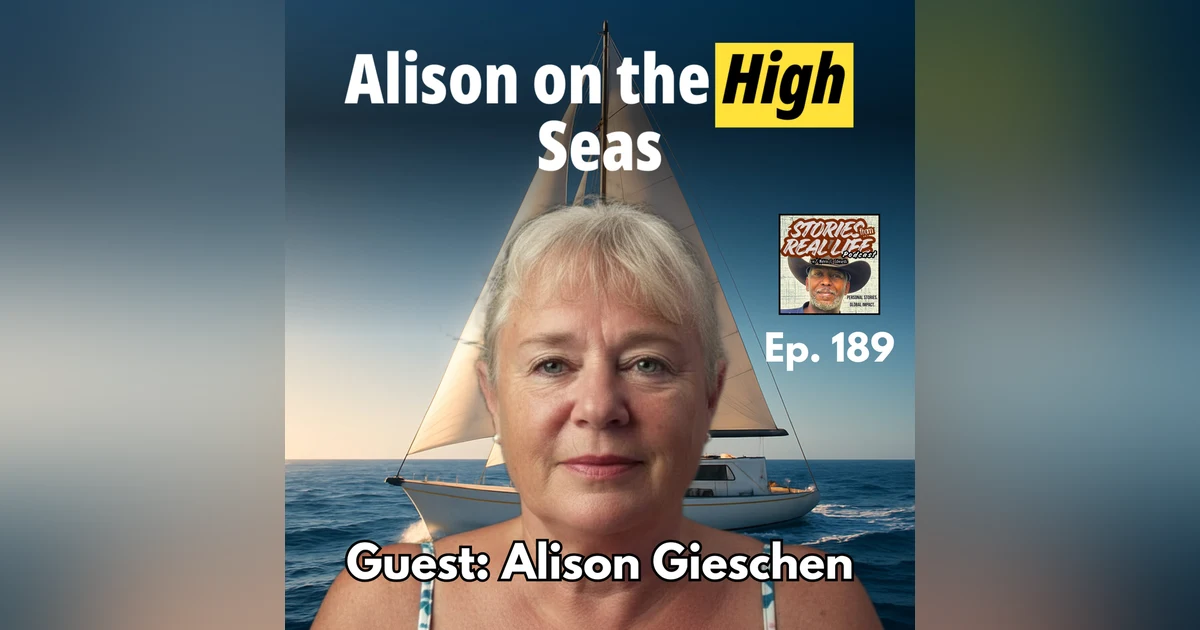
Ep. 189 - Alison Gieschen: Sail On

Show Notes (Bullet Points)
🔸 Key Topics Covered
* Alison’s journey from running a horse farm and teaching to sailing around the world.
* How her early passion for adventure propelled her toward blue-water sailing.
* The creative process of writing while essentially living on the ocean.
* The role of resilience, fear, and personal transformation in challenging environments.
* Storytelling techniques that draw inspiration from real world experiences and mythic imagination.
* Practical tips for listeners dreaming of their own reinvention — whether through travel, writing, or life change.
🔸 Books & Projects Mentioned
* Blue Ridge – Award-winning novel influenced by lifetime experience with people and place.
* The Legend of Altor & Julia’s Vaulting Dream – Children’s and middle-grade fiction inspired by equestrian roots.
* Riding the Waves of Reality: Tales of Turmoil and Triumph – Nonfiction sailing memoir.
* The Seven – A sweeping novel blending fantasy with deep human themes of judgment, connection, and redemption.
* Upcoming title: Seanna – Mermaid Tales (children’s ocean-themed fiction).
Get full access to Melvin E. Edwards at storiesfromreallife.substack.com/subscribe
If you would like to support this podcast, please click on the PayPal link to make a donation today. Any amount is the perfect amount!
Thanks!
0:02 What does it take to sell the life you know and sail directly into the unknown? In this episode of Stories from Real Life, our guest is Alison Gieschen, author and world-circumnavigating sailor, to talk about leaving land behind, writing from lived experience, and what the ocean reveals about who we really are when there's no easy way back. This isn't just a conversation about travel. It's about courage, discipline, and choosing a life that asks more of you. This is Stories from Real Life with Melvin E. Edwards. And today's story is Alison Gieschen's. Sail on. You are listening to Stories from Real Life, a podcast by engaging storytellers for engaged story listeners.
0:49 Here's your host, author and journalist, Melvin E. Edwards. Hello again and welcome to another episode of Stories from Real Life. I'm your host, Melvin E. Edwards. Thank you for joining me for the podcast where our personal stories remind us how much we can learn from each other. My guest today is Allison Gieschen, an author, traveler, and storytelling nomad who circumnavigates the globe by sailboat with her husband. Allison, welcome to the show. Thank you for having me.
1:31 So where are you now and what time is it where you are? I am currently in the Marquesa Islands, which are in the French Polynesians, and it is 1230 here. P.M. or a.m.? 1230 lunchtime, so p.m. Okay, so it's weird because it's like 4.05 p.m. where I am in Texas, so you're not on the full hour. You're also having a half an hour also. Yeah, I don't know where that comes from. That's an oddity. Yeah. That's interesting. I've never heard of that before. All right. So let's talk about your sailing life to start. So before sailing came into your life, what idea did you have for freedom?
2:14 You grew up with horses. That's what a lot of people consider to be freedom riding their horses. But apparently that wasn't enough for you. No, it was wonderful at the time. In that stage of my life, horses were my... Well, actually, I owned them all my life. They were always my freedom. But even when I married my husband, who was not a horse enthusiast, had nothing to do with horses, I brought them into his world. And... He found great joy in them also, not because he loved horses, but because he loved ice hockey. And when he said, what do I do with this horse you gave me for a wedding present? I say, well, you learned to play polo. It's like ice hockey on horses. And he did, and he became obsessed, and it became his new obsession in life.
2:59 That's interesting. That's really interesting. Okay, so you've worked as a teacher, equestrian coach, and a writer. So what's the connection between those three things? The connection between those three things are that they all inspire me. I love children, and I love to teach, and I trained horses, and now I teach people through my books. All right, so what is it about kids that you enjoy? I just enjoy their potential. and I enjoy bringing out that potential and I enjoy connecting with them on their level and trying to inspire them and it's always been my mission when I had my riding program it was unique and that riding has always been for kids with money or kids that can afford it and I took every child that wanted to be around horses whether they had any money or not and that opened up doors and I saw lives changed so I kind of try to use whatever medium I have to inspire kids.
4:09 And when I was an elementary teacher, it was through writing and unlocking the potential of what they could express through writing. Okay. So was the dream of life at sea always specific for you or is that something that you just sort of fell into? Well, it's kind of odd. When I was about nine years old, maybe eight or nine years old, I lived on a farm in upstate New York. We were nowhere near the water. And sailing was something I knew about, but I had never actually been on a sailboat before. But I was walking barefoot through the grass one day and just... heading off to feed the horses or whatever and I had this vision it was just like watching a dream but I was awake and it was about being on a boat and sailing across the water and being driven by the wind and I thought it was the most magnificent feeling and then I thought wow I would love to sail around the world someday I did go in and tell my mom I want to learn how to sail, and she's like, okay, that's nice, honey, just ignoring me as an eight or nine-year-old with a strange thought.
5:11 But when I got to college, I moved down to North Carolina. I took up competitive sailing. and absolutely fell in love with it. And then I was in this really big regatta, and my cousin brought down this eligible bachelor from Philadelphia Naval Shipyard where he worked. He was a preacher's kid. He was a merchant marine. He was a three-time national diggy sailing champion. And we met and spent this entire weekend together. And right before we left, me to go back to Charlotte, him to Philly, he said, you know, my dream is to sail around the world someday. And I said, mine too. Let's get married. So we did. So it was that simple? That simple. How long between the time you first met to the time you got married or engaged?
5:54 Well, he proposed the fourth day we were together after that weekend. He flew me up to the Chesapeake to go on his dad's sailboat, and that weekend he said, I know you're going to marry somebody else if I don't ask you, so will you marry me? And I said yes. So it wasn't official, but it was just something we said and meant. And then his dad is a minister, and he married us on the yacht club lawnmower we met less than a year later. Well, how long have you been married? 39 years. Nice. Congratulations. Thank you. So with horses, did they teach you control, trust or partnership? What are some of the lessons that horses have taught you?
6:36 It may be partnership because you've been married for 39 years. Well, I had a lot of horses. I didn't have just one horse. When I was growing up, I had one or two. But after we had our horse farm, we had up to a dozen horses. So they came and they went. But the really, really special ones was definitely about partnership. And it's really hard to explain to a non-horse person like the bond that you have with horses because horses actually have been, they've proven, science has proven they actually have a physical impact on your body. So they can affect the rhythm of your heartbeat if they're standing less than four feet away from you, which is why horses are used to work with disabled children or people with an anxiety because they actually help them physically And I had horses that were very healing and very strong personalities, but really kind and gentle souls.
7:33 And they were definitely a partnership relationship. There were horses I didn't get along with and they didn't last very long, but the ones that were really good to me and really part of my life were definitely a partnership. So are you on your boat right now? I am. Okay, so I thought I heard the engine and maybe some wind. So how fast are you going? We're at anchor. Okay, you're anchored now. Okay. Yes. All right. All right, so with the horses again, did you learn anything from horses that helps you with sailing? Well, we named our boat Equus, which is Latin for horse, and we have a giant spinnaker that goes out front with a big horse head on the front.
8:19 So when we're out in the ocean and we're crossing oceans and we've got our spinnaker up, I just think of it as my sea pony. You know, she's carrying me like my horse has carried me on land, and it's the same love relationship. Sea biscuit. Same love relationship I have with my boat. I trust my boat to carry me and I trust my horses to carry me. And although my boat is not alive, it is a very close relationship that I had with my horses. Okay. So let's talk about your decision to leave and start a new life. So which was harder, deciding to leave your old life or going out on sea and not seeing any people who you knew?
9:03 The decision to leave was not really hard because we made a five-year plan. We didn't just get up one day and say, okay, we're going. We made a five-year plan, so it was gradual. So I have three children, and my last one actually got married a couple years before we left, so I knew my kids were all secure, and they were safe and good in their own lives, and they could do without us at this point. But it was hard to leave them because we're a very close family and we did everything together. And I don't have a problem missing people out at sea because we meet so many wonderful people. I mean, in this harbor alone, there's probably 10 different countries represented.
9:44 people around this boat and we go out to dinner on shore take hikes together and we're just all one group of people so it really is a unite a uniting factor for humanity the sailing community because it doesn't matter where you come from you know as long as you all speak the same language you get along and you just develop really beautiful friendships and learn a lot of new things and it's really it's really amazing Cool. So do you remember the moment when your someday became, let's do this? Well, I would say buying the boat and securing the boat because we had a lot of trouble with actually getting the loan to buy the boat because the boat was over 20 years old and there was nobody that wanted to give us a loan.
10:30 We could pay for most of the boat, but we still needed like this big chunk of money to pay for the boat. And we almost lost it. There's only 50 of this boat ever made in the world. There's only 50 Tazewell 43s. And every time we found one, we would make a plane ticket to go look at it, and it would sell before we got there. So we missed out on four or five of them and had been looking for three years now. And then we finally found one. We went down, we looked at it, we said, we love it, we want to buy it. And then all of a sudden, our loan fell through. And they go, well, we'd give it to you if it was 19 years old, but it's 20, so we won't give you the loan. So we got an extension, and it was the last day of the extension, and somebody else was ready to buy it, that we tried everything we could think of.
11:13 Finally, USAA, we called them and said, is there any way you'll give us a loan? They're like, sure. So it was like the 12th hour, and they came through, and then we're like, well, this is definitely meant to be. And just knowing that we had the boat of our dreams, we could afford it, we could pay for it, that was a defining moment. Nice. So is there anything that you underestimated about being at sea that you've had to learn to adjust to? A lot of things. Our very first ocean crossing experience, we joined a rally, which is a group of boats that all cross together. And there's organizers and weather routers, and they do instructions before you leave and safety checks.
11:56 So we're all leaving in a group. And unfortunately, we heard a strange engine noise. It was actually coming from the propeller. And my husband said, well, we can't cross an ocean not knowing if there's something wrong with our boat. So we got delayed like 10 days trying to get this problem figured out. So everybody else had gotten, you know, they're on their way. And the weather router said, OK, well, you got 24 hours to get across the Gulf Stream. There is a storm coming. But if you get across, you'll be fine. So we're all good to go. We head out, get across the Gulf Stream. And the next morning, we hit, I don't know if you've seen the movie A Perfect Storm. Mm-hmm. Well, we got trapped in that scenario where two storms were converging and suddenly we were in 35 knot winds and we had 20-foot waves that were compressed together crashing on the deck of our boat.
12:43 It ripped our dinghy right off the deck through the lifelines. We almost got dismasted. My husband had to go up on deck in 20-foot waves and cut it free. We lost our windsurfer, our dinghy, solar panel, titanium whisker, all this stuff overboard. And it was just horrifyingly scary. And we had to turn around and go all the way back to the US. So we did a 500 mile loop and ended up 10 miles from where we started. So right off the bat, I learned that you are never going to be anywhere you think you're going to be when you're never going to be anywhere when you think you're going to be there. Like never in the 10-year group planning that my husband has made for us have we been anywhere when we thought we were going to be there.
13:32 That would drive me nuts. I'm very punctual. I'm very time conscious. That would drive me nuts. It's an adjustment because I'm that way too. I'm never late. I'm one of those people that's like two, three minutes early normally. But it's a different kind of time constraint when your world is this fluid. It's not showing up on time. It's just you cannot follow a plan with any accuracy. So what does time mean when you're out there in the water? It's very different. When you live on land, you're time-driven. From the moment you wake up to the time you go to bed, you are time-driven.
14:12 And here, time is a totally different construct. When we're crossing oceans, we have to get up every three hours and do watches. So day and night, we're sleeping during the day, and we're up during the night. And it took us, I guess, 28 days to cross the Pacific. And we had a horrible failure on that last passage, which talk about another time i guess um but when we finally arrived on the 28th day i couldn't believe it had been 28 days like i just it didn't feel like 28 days you just you just kind of lose track of time i guess so you don't actually have to be awake all the time to steer the boat Somebody does.
14:54 We just have watches. So I'll do three hours on, three hours off during the night. And during the day, we take naps. There's not always somebody awake, but there's always somebody responsible for taking a look. every once in a while and making sure we're on course and that everything is set but you don't see anybody else usually when you're crossing oceans there's very little marine traffic and very few chances of you coming close to anybody so it's mostly when you're near shore that it's you have to stay awake and really be alert what was your biggest fear when you were deciding to do this storms definitely how many of those do you go through a year Not very many because my husband is really good at the weather routing.
15:47 I guess part of his merchant marine, he went to King's Point, and part of his training was learning to read weather patterns and stuff. So he usually, we don't take off unless we know the weather's going to be decent. But things do happen. Like, for instance, when we were going, I guess, from Aruba towards Columbia, That's the lightning capital of the world. And we were on a five-day passage and all of a sudden we were just surrounded by lightning storms. They're on every side of us and there was nothing we could do. And we just had to, you know, survive them and turn the boat and try to head where the fewest cells looked like they were spewing lightning and kind of zigzag through them.
16:30 But it's just, it's part of the sailing life and you get used to it. Is there any particular form or rather storm that you would say permanently changed you? I think the first one, the very first one that we encountered, in fact, I developed PTSD to where when we'd be out sailing and the weather started getting rougher than anticipated and the waves started getting bigger than predicted, I would like have really bad agita. To the point where after we did make it to the Caribbean, I would wake up every morning and say, okay, today's the day I'm going to tell them I can't cross the ocean, the Atlantic to Europe. I can't do it. It's not worth it. I'm terrified when the weather starts getting bad because of that first storm.
17:14 So we pull into St. Martin and we're going to have some work done. And I'm like, yeah, this is where I'm going to tell them you got to get crew because I'll meet you there, but I can't do it. So this harbor had maybe 100 boats in it. And we dropped our anchor. And three boats away was a man named John Kretschmer, who I did a 1,000-mile training passage way back early on when we decided to do this. Because I'm like, I need to be out on the ocean in heavy weather to know that I can do this. So I paid to go on this 1,000-mile training passage with him. And when we got done, he goes, you're going to be fine. You're going to do great. Believe in yourself. You've got this. He was three boats away, the man that I did this training passage with.
17:56 So we call him on our marine radio. We're like, hi, John. We're right next to you because we'll come on over for happy hour. So we go over there and we're all talking and catching up. And he goes, so, Allison, how's it going? And I'm like, oh, my God, John, I'm so scared now. I got this really bad storm. Every time the waves get bad, I can't do it. And I'm like, you know, he's tearing up and everything. And he starts laughing. I went, why are you laughing? He goes, do you know how lucky you are? I said, no. He goes, do you know how many people get in that situation? And the very first thing they do is sell the boat and give up. He says, you're still out here. Your boat did fine. Your husband did fine. You did fine. The chances of that happening ever again are probably zero. And he was the only person in the world, because he was my mentor.
18:41 He's written five books. I've read every one of his books. I listened to his talks at boat shows and stuff. He was the only person in the world that could have looked at me and said, you're going to be fine. And then I believed him. And I'm like, OK, I'm going to be fine. And then from that day on, I learned to deal with it. So do you feel safe out there being on the water? Not just a storm, just being on the water. Yeah. oh my gosh yes and at first it used to kind of make me uncomfortable when we got like really far out in the middle of an ocean like oh my gosh land so far away but now I feel part of that environment and it's like looking out in your backyard if you opened your window and looked out in your yard and just saw this big beautiful grass field the ocean now is like part of me and it's part of my world and I don't think of it as being far away from anything it's just it's just my backyard now So you're also a writer, as I mentioned at the beginning, and you've written several books that we will talk about in just a moment.
19:43 So how does writing from experience differ from writing about experience? Well, once you live it, I think your ability to be expressive and write it down in a way that feels authentic and that people can really relate to definitely increases. Because there's just no way you can describe an experience like we've been through without actually living it. So even in my nonfiction book, I have nonfiction books, children and adults. You definitely feel the things that I'm writing. You're not just reading it. You're feeling it. And that's simply because I've lived it. All right. So tell us about each one of your books.
20:26 Oh, OK. Just a little bit about each one. I'll put the link in the show notes so people can get those two and learn more about them. Okay, so I have two early reader chapter books. One's about a mermaid, but we're avid scuba divers, so I incorporate real sea life in the story and conservation issues. And in the back, there's a glossary and it has photos of the real sea creatures and then facts about them. And since I was a teacher, it's got a teacher's manual. and julia's vaulting dream is the other early reader chapter book and that's the sport of equestrian vaulting which i coached for 25 years and in 2018 my daughter took um eighth in the world in the world equestrian games so we did go all the way up through the ranks and competed on an international level which was really exciting and then i have um The Legend of Altor, which is also a children's book, a later children's book.
21:18 And my son had a really bad bullying experience in school. And so it's all about this girl who has a magic talisman that helps her through a bullying experience. And it's kind of neat. What is a bullying experience? A bullying experience? Bullying. Bullying. Oh, bullying. Okay. I thought you meant like bowling. I thought, well, I don't know what you'd have for that. But okay, bullying. I understand now. Sorry. Yes, yes. He was bullied very badly in school. I followed him up through several grade levels. And... So I just wanted to make this young girl's life be, you know, a really good strong story.
21:59 And she's a preacher's kid also. So there's a lot of really good family values in it and some magical stuff in too, which is fun for the kids to read to put that in there. And then I have my two sailing memoirs, Riding the Waves of Reality 1 and 2. And the first one is the first three years. And the second one is Mediterranean Mayhem and Magic. So that's about our time in the Mediterranean. And I'm starting to work on the third. So there'll be books to talk about every part of our journey thus far. And then my latest book, The Seven, is a very unusual book because it came to me in a dream.
22:41 These horses, normally every night I'm feeding horses or taking care of animals that I had in my past life. And I wish I wasn't doing it, but I have this strong need to still take care of them. And then one night I had this dream that there were these horses I didn't know and I wasn't taking care of them. And then I realized they could see inside my heart and decide if I was a good person or not a good person. And I woke up and it was so poignant. I told my husband about it and I said, you know, this would be a really cool premise for a book to have these horses that could see inside human souls. And so I came up with the premise for the story that horses would be the judge of humans. And if they were deemed worthy, humanity would be saved. If they were deemed not appreciative of the gifts of the earth, humanity would be erased.
23:23 And it's narrated by God and his son. And seven humans are picked from the pool of humanity. And they're from seven different places around the world. And all of their cultures and their... geography and everything, I highly research. So you learn a lot about the history of these people and where they came from and their cultures and where they're from. And each person or place has a direct connection to my life. So I may either know the person or the place. So they're all someplace that have meaning for me. And so anyway, it's a story of seven horses and seven humans and whether humanity is saved or erased. That sounds really cool.
24:04 Is that specifically a children's book? Because it sounds like something I'd be interested in reading. No, that's an adult book. It's called The Seven, An Odyssey of Seven Horses and Seven Souls. That sounds really interesting. And again, like I said, I will have a little blurb about each book and I will have a link to Allison's website so you can get a copy of any and all of those books if you want. So what is it like writing? Oh, go ahead. I just wanted to point out that I have an author website. So, for instance, for the seven, for each character, I have a story behind the story of why I picked that person.
24:46 And I also have the history of every breed of horse that is used in the story because they're all real breeds and they have fascinating stories. histories of how they got where they are so for instance when we came to the Marquesa Islands one of my characters actually got shipwrecked in Fiji and you know the French Polynesians and I knew exactly how the horse ended up on that island so I knew the history of these horses too and they just run wild so the first time I saw these horses I went running up to them and one of them was friendly and I'm holding his face going I know your ancestors I know how you got to this island laughing Yeah, I needed to get that from my wife. She grew up competing in various equestrian competitions.
25:29 Cool. Very cool. What is writing like out there? Do you have no distractions or do you have all distractions? it can be either it depends where we are because i don't do a lot of writing when we're crossing oceans i do do instagram i'm an avid photographer so i take lots of pictures and give little short stories of our journeys but the actual writing usually takes place when we're in harbor or in a marina you know or an anchor somewhere because there's downtime there my husband's always doing maintenance and fixing things And I do a lot of sewing. I have a sewing machine, so I make sail bags and different things for our boat and do repairs.
26:10 But other than that and cooking, I have time to sit down for hours at my computer and, you know, hash out my book. So I write very quickly once I get embroiled in it. But we've been to 49 countries so far, and we have been in five countries for more than three months waiting for boat parks. So sometimes we get stuck somewhere for a long period of time. And for instance, we're waiting for a boat part right now. Our engine is not usable and we're jumping through hoops to get this one little part because our engine is obsolete. It was made back in the 80s to Myanmar and they don't make parts anymore for it. So if we can't get this part fixed, we're in really deep trouble because our engine won't work and there's nowhere here to get a new engine.
26:55 So we're keeping our fingers crossed. But now as we wait, this is a time when I can sit down and make great progress on my writing. Because I also have blogs and everything. So there's a lot of writing to do. So were you stuck at a place for... Up to three months, what do you do? Especially on the land. What do you do on the land? You don't have a car. Well, you can rent cars and you can rent scooters. We love the scooters. You get on the scooters main and they have these hairpin turns. You go all the way up and there's like three mountains between us and the airport on the other side of this island. And it's all hairpin turns all the way up, all the way down. And you go from the palm trees and the mango trees up into the high mountain where you have, you know, big fir trees. And you don't even look like you're on a tropical island.
27:36 You look like you're, you know, somewhere in Sierra Nevadas. So, and there's beautiful overlooks onto the beaches. And you can go drive down to the beaches and go for a swim or grab some coconuts and open a coconut. And it's just... And there's like you'll find limes, coconuts, mangoes, all kinds of food you can just eat along the way, bananas. So it's like a picnic, you know, fill your backpack and you go on. Picnic out in nature. Bring your own food. You just find it along the way. So what's your main motivation for writing? Is it to sort of document all of these journeys or just teach whoever your reader might be?
28:18 It's all of the above. There is no way to contain or encompass what writing means to me. And I was an English major in college. I really wanted to be a journalist when I grew up. But I got out of college and didn't have a way – my parents were already retired and gone. They had six kids. I was the last one. They're like, yeah, you just run off now and go find your own way. Good luck with that. Yeah. I didn't really have any parental support. So I didn't have – you know, a way to pursue my passion. So I just turned to writing. I mean, I love writing. I can just sit there for hours and hours and write and just be totally happy with it. So I forgot your original question now because I start rambling.
29:00 That's okay. The question was about the reasons why you write. Because I love it. There's no other reason. I love writing. All right, so how have you changed since you've been out journeying around the world on a boat? Well, I think you definitely, uh, your priorities change because when you're on land, um, there are so many distractions. You know, you have a job, you have a home to take care of, you have a car, you've got to go places, you've got all these things to do. And it's life is just about hitting the next tick mark. I think when you're on land and when you're on a boat, it's down to survival and your world and what you need to do really shrinks down.
29:46 Um, And you learn how little you need to be happy. Like we don't own anything that's not on these 43 feet of boat. And I find myself throwing away things that I thought I would need. And I'm like, I don't need that. I'm never going to use that. And I keep scaling down more and more to where I can have one suitcase and basically put in one suitcase, everything that I need. And I think when you remove the distractions, of all these worldly possessions and worldly things and tasks and chores and distractions that you're really able to enjoy life more like just getting off our boat bringing our dinghies to shore and taking a walk through this little tiny town with these amazing people and this amazing culture just brings us so much joy in every culture we go to and every place we learn so much so we're gathering knowledge and we're letting go of things that are not a necessity and just learning to really enjoy life and see things and places and people in a way we never saw them before.
30:48 Okay. So along those same lines, how do you define community now? Well, it's definitely those people who anchor next to us. Because even though you don't know them, you're going to get to know them and you're going to find that you have a very strong bond because they're in the same boat figuratively that we are. Literally. If they come over to visit us, yes, we're figuratively and literally in the same boat. But you haven't gotten this far around the world without learning the same lessons. So that immediately gives you a bond.
31:29 and you find people that can help you and that you can help them because I, so I can fix somebody's sale. Somebody else might be a really good mechanic, you know, be able to help my husband with his engine or, or, you know, maybe your dinghy's not inflated. You need to ride to shore. There's going to be somebody that says, Hey, let me pick you up and, you know, bring you, you just, it's a very wonderful tight knit group. And like I said, you're, very rarely find other Americans. I mean, I think there's only one other American boat in this harbor out of the 10 people that we've been hanging out with. But it really doesn't matter. You're all humans and you're all sailors. That's cool. So somebody who might see your life or hear about your life and becomes jealous of that, thinking that's something that I wish I could do.
32:15 What part of what you're living now would surprise that person the most? Either good or bad. I would say the hardships. I would say the hardships. A lot of people are not capable of going through or wanting to continue after going through what we've been through. I mean, we've been through some really, really... We lost our autopilot 650 miles out at sea. And the autopilot is what steers your boat. And hand steering is very difficult because it's a 16-ton boat and... You know, the 10-foot waves, the waves were huge, and I could only do it for 30 minutes at a time before I was physically exhausted, and I kept getting the boat slightly, it wasn't easy to steer anymore either because our whole steering cable got loosened, because we got caught on a Chinese fishing net.
33:05 The Chinese fleets are out there and they're just ravaging our oceans, When we passed one and what they do is if they get a net caught or tangled, they just slice off and they leave the chunks floating in the sea and then they hit our rudders. And so when they hit our rudder, it stopped us dead in the water in the middle of the night. It broke our autopilot and it loosened our steering and we almost had to abandon ship and, you know, be rescued. But my husband got the steering cable tightened so at least we could steer and get out of there. But in those waves, like if I got the boat slightly off kilter, the wave would hit us sideways and our whole boat would like, you know, broach down into the ocean and everything is clashing and banging. It was really scary. And after I did that a couple of times, now I'm terrified. Not I'm only tired, but I'm counting the minutes down, 30, 29.
33:48 So I would do 30 minutes. My husband would do three hours and I would do 30 minutes and we'd go all day and then we'd heave to every night. We'd just turn the boat into the wind and just staying in one place in the water. But we made it. And I think something like that would make a lot of people go, this isn't worth it. But because we've been out here eight years, maybe if that had happened in the beginning, I maybe would have given up. But now I know that we can get through these hardships and every hardship we get through makes you a little bit stronger and a little bit more capable. And so the more that you survive, the tougher your skin gets. So like my mentor said, and he said, do you know how many people that would have happened to and they would have given up the first time?
34:34 And had I not met him, I would have given up the first time. But I met him, so I'm meant to be here. Okay. I just have a couple of questions left as we wind down the conversation. How often do you see your children? So far, we've seen them at least once a year. So in the beginning, when they didn't have all small children, because they've had four babies since we left, they would come see us. So they came to us in the Caribbean. They came to us in Bermuda, the Bahamas. So they did travel. And then since then, every year, we flew home this Thanksgiving and Christmas.
35:14 One year, we met in the Dominican Republic all around the holiday time. So we find ways to see each other once a year. That's pretty good. I live in Texas, my son lives in Virginia, and I usually only see him once a year. So at least you get to see each other on a regular basis, even though it's not frequent, it's still regular. So for the last question of the day, what's your next adventure? What do you think you'll do next? Well, the plan is that we get our engine fixed and all goes well. We will finish exploring the French Polynesians. We'll be Tahiti and Bora Bora.
35:54 and the Cook Islands and some really beautiful, the Tuomatus, which are incredible atolls. And then we will head to New Zealand and then from New Zealand to Australia, Australia up to Thailand. And then after that, we're not really sure what we're going to do. So we just kind of map out a general route and then see what happens when we get there. Well, that all sounds really cool. I don't think I could do it, but it still sounds really cool. So, Allison, thank you so much for being here today. I appreciate you taking the time out to join this conversation.
36:35 Well, it was my pleasure. Do you have anything, any websites or anything you'd like for the listeners to go to? Well, if they want to see my author website, they'd go to alisondesion.com. And if you want to follow our adventures, I have a blog, sailmates.org, O-R-G. And also on Facebook, I have Sailmates. And every day I post pictures and stories, just little stories of things that I'm doing and pictures of the people and the town and stuff like that. So I'm guessing it's spelled S-word. S-A-I-L-M-A-T-E-S?
37:16 Correct. Correct. So not like a gel sale. No. Sometimes it feels that way, but no. Again, I'm so glad we had Allison here today to talk about her adventures out at sea and her books that she's written and the ones that she's writing. So again, Allison, thank you so much for joining us. Well, thank you for having me. It's been a pleasure. Thank you. Yes, it has. I've enjoyed it. So if this episode resonated with you, share it with someone else who might also enjoy it. And if you haven't already, follow me wherever you listen to podcasts. This is Stories from Real Life. Until next time, don't forget to shine your life wherever you go.
38:06 That was Stories from Real Life. Join us again next week for another great storytelling journey. See you next time.


