

 Spotify

 Apple Podcasts

 Goodpods

 Audacy

 iHeartRadio

 Youtube Music

 Amazon Music

 Audible

 Podchaser

 YouTube

 Castbox
 RSS Feed
Ep. 202: Aaron Ryan: The Story of My Life
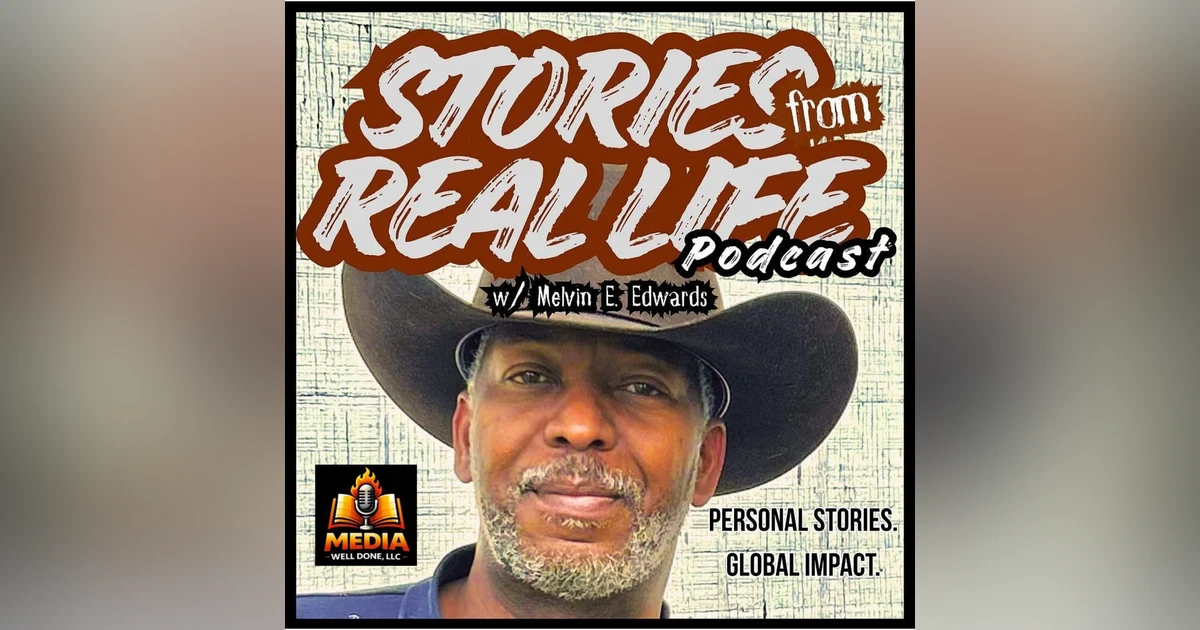

Podcast: Stories from Real Life
Host: Melvin E. Edwards
Guest: Aaron Ryan
Release Date: May 12, 2026
Episode Summary
Award-winning and bestselling author Aaron Ryan joins Stories from Real Life to discuss the discipline, persistence, and creativity required to build a life around storytelling.
With a career spanning science fiction, dystopian fiction, children’s books, nonfiction, and business writing, Aaron has established himself as a prolific voice in independent publishing. His bestselling Dissonance alien invasion saga has reached readers around the world, with one installment adapted for the screen and currently being pitched to streaming networks.
In this episode, Aaron shares lessons from his journey as a writer, entrepreneur, voice actor, and creative professional. He discusses the realities of self-publishing, the habits that sustain productivity, and the mindset required to keep creating across multiple stages of life.
This conversation is especially valuable for writers, entrepreneurs, and creators seeking practical insight into building momentum and maintaining creative discipline.
In This Episode, You’ll Learn
* What separates writers who finish books from those who never do
* The biggest misconceptions about self-publishing
* How discipline drives creative productivity
* Why storytelling skills transfer across careers and industries
* The mindset required to sustain a long-term creative career
* How reinvention can become a competitive advantage
* What it takes to build a career as an independent author
Get full access to Melvin E. Edwards at storiesfromreallife.substack.com/subscribe
If you would like to support this podcast, please click on the PayPal link to make a donation today. Any amount is the perfect amount!
Thanks!
0:01 Stories from Real Life is a production of Media Well Done, LLC. Welcome to another episode of Stories from Real Life with Melvin E. Edwards. Our guest today is award-winning and best-selling author Aaron Ryan, a prolific storyteller whose work spans dystopian, fiction, children's literature, business writing, and faith-based nonfiction. Over the course of his life, Aaron has worn many hats... Voice actor, musician, videographer, worship leader, entrepreneur, and author. That wide range of experience has shaped his perspective on creativity, discipline, faith, and storytelling. This is Stories from Real Life, and today's story is Aaron Ryan's.
0:44 The story of my life. You are listening to Stories from Real Life, a podcast by engaging storytellers for engaged story listeners. Here's your host, author and journalist, Melvin E. Edwards. Hello again, and welcome to episode 202 of Stories from Real Life. I'm your host, Melvin E. Edwards. Thank you for joining us for the podcast where real stories are so much more interesting than fiction. like this one.
1:25 Today's guest is award-winning and best-selling author Aaron Ryan, a prolific storyteller whose work spans science fiction, dystopian fiction, children's literature, nonfiction, and business writing. So Aaron, welcome to Stories from Real Life. Hello. Thanks for having me, Melvin. I appreciate it. Thank you for being here. All right. So the first question I'm going to ask you today is the most important question. It'll just go downhill from here. So I How many times have you been called AA Ron? Yeah, it's a really good question. I actually had a friend. His name is Aaron as well. And I called him double A Ron. So I decided to do that. I don't know that I've, that I've been called that and noticed it.
2:07 I may have been called it and, and it went right over my head. But yeah, I have not kept count of that one. So now it's going to be in your mind all the time. Yeah. It will be on your mind all the time now. We truly are going downhill now. Here we go. Okay. Here we go. All right, so let's talk about your storytelling journey. So where did your love for storytelling begin? Man, so there's a few different origins. They're all roughly around the same age. But I was in second grade and Mrs. Walker – hi, Mrs. Walker – gave everyone an assignment and it was to write a little short novella. So I wrote one. It was called The Electric Boy. It was a blatant ripoff of Alan Dean Foster's novelization of E.T.
2:49 at the time. Seven-year-olds don't understand copyright infringement. And had construction paper surround college rule, three hole punch paper, crude stick figure drawings. And I remember writing it and holding it in my hands and, you know, turning it around and showing people going, look, I made this, you know, look, And I was so excited about that finished product. The next would be reading The Lord of the Rings for the very first time. Absolutely blew my mind. Obviously, it's affected my wardrobe. And I love it. It's just the world building and the stakes and the narratives and how incredible and robust it is. And then I was in a young author's club when I was 10 years old.
3:30 I completely forgot about it. Mom sent me a news clipping, and I was like, wow, the memories came flooding back. but lots of memories right around that age of starting as an author. Nice. Nice. All right. So was that the moment you realized that writing was something that would be a lifelong pursuit or was that not until later on? Uh, no, I think I realized it pretty early on that that's, that's something that, that was one thing that I definitely could do and probably wanted to do. I deviated so many times in my life. I've lost count. Uh, if I was going to count on my fingers, I, I, you know, need to be an octopus, um, cause I need way more arms, but, So for many years, I pursued music and performing and things like that.
4:10 But music incorporates writing lyrics, which is storytelling. So, you know, and then it took it took an iteration in poetry. And I'm a storyteller as a voiceover artist. I tell other people's stories as a voice actor. So it's taken a lot of different representations over the years. But thinking back to those three formative events, that's probably the origin story where I said, I think I could probably do this. Yeah. So other than Tolkien, who are some of the storytellers who shaped your imagination when you were growing up? I feel like I'm crying. All these questions are so personal. There's something in my eye.
4:51 So Tolkien was the most formative by far. I mean, I was never super impacted by The Hobbit or The Silmarillion, but The Lord of the Rings is just fiercely robust. He wrote it over 15 years, and it's incredible, monumental in scope. But I do remember reading Madeline L'Engle. Some Anne McCaffrey, Dave Barry, I mean satire. I even read some Stephen King as a young man and Michael Crichton after Jurassic Park came out. But there's so many different authors. I love John Grisham as a young man.
5:32 I'm very inspired still by Tolkien to this day, but I really love Suzanne Collins, The Hunger Games. I never quite got into Harry Potter, you know, J.K. Rowling. But there's just so many different authors. I love the different styles that they all bring. They're all bringing their true authentic selves to the table and to their books in print. And it's so cool to just partake and go, wow, they write like that and they write like that and look at this story and look at that story. It's just awesome. Well, speaking of different types of writing styles, you've written across genres, different genres, as I mentioned in the beginning. that writers spend a lifetime trying to master. So how do you maintain that level of productivity?
6:15 Yeah, that's – do I maintain it? First of all, I think we need to quantify that. Yeah, you've written 40 books. That's a lot of productivity. Actually, I'm working on number 45 right now. It blows my mind just closing in on 50, and I'm like, wow, what an honor. I have to say that I probably would not have written children's books – you know, were I not a father of two boys? I mean, I've got a 10 and a six year old and I wrote the first one for my 10 year old. And then my six year old saw the one that I wrote for my 10 year old and said, that's great, dad, where's mine? And I don't know why I didn't see that coming, but it turned into a trilogy of children's books.
6:57 Some nonfiction books have basically been off ramps from fiction when I've been stuck in writer's block and You take an off-ramp, you know, and you go write something more personal where your fingers are going to flow more freely. And then it just becomes, you know, a new genre. But, yeah, I've written historical fiction, literary criticism, business guides, prayer guides, kids' books, independent thrillers. I just love stretching myself. I'm writing my first outright horror novel right now. And I've never done that, but I believe an author and a creative should really stretch themselves. Nice. So generally there are two types of writers for authors in particular.
7:42 Generally two types that people discuss. There are plotters and pantsers. So they're generally – the plotters are the people who outline everything before they start to actually write the story. And then pantsers are the ones who just go off the seat of their pants. They just write as the inspiration hits them. So which one – which camp would you fall under? Guilty as charged as a pantser. I am almost – if you're going to put me on a chart, I'm probably in the 90 to 100 percent pantser block. I – There's something so adventurous and so exciting about writing in a pantser approach. There's something so organic about it that's indisputable.
8:24 But there's something super adventurous about being a pantser. Now, that isn't to say that when I write, I don't occasionally. First of all, I have an overarching idea of the story. Always have that. Otherwise, my characters are wandering around aimlessly, bereft of any forward momentum. But I do like to just kind of see where the story goes. I like to let the characters lead. And art imitates life. If you're on the way to a wedding, you're going to get a flat tire and you didn't plan that. So how you deal with that flat tire reveals a lot about your character. So if you write organically, you can let a lot of those oops moments come into play and then see how the characters fare as a result.
9:09 I've always been very fond of being an organic pantser writer, but I'm very in awe of the planners who can see it from start to finish almost every single point in major development all the way. That blows me away that they have that foresight. Yeah, I've written three books. My most recent one was a novel, my first time wading into the fictional realm. And I'm definitely a pantser. And one thing I found that was interesting about the fiction genre is, as you mentioned, I let one character in particular, but generally all the characters has some leeway, but one character...
9:54 I sort of had an idea of what he looked like in my mind, but I had no other thought of like his personality or if he was impulsive, those kinds of things. And so it was, it was just fun following almost like him leading me. Whereas there were two other characters, a married couple who were almost identical to my parents. So they were modeled after my parents. So yeah, The one character, the other character, it was just fun to follow him and see where he went. And then there was one point in the middle. I thought, hmm, I want him to end up this way, but let's see how he gets there.
10:36 And that was just a lot of fun. That was a lot of fun. So I think I might write more fiction. And it'd be better if I could say it, too. Yeah, when I do that, as a voice actor, I'm like, hi, I say things for a living, and apparently I can't even speak. So yeah, I'm right there with you. Man, I have to say, you hit on something that I just deeply resonated with. We do tend to channel what we know and who we know into characters that we create. And it forms a common basis, a common frame of reference for us to look back and hearken back to the original. When I wrote Dissonance, it's now evolved into a six-book saga saga.
11:16 And I had no intention of that. I thought maybe a trilogy at best, but now it's a hexology. But the first prequel, Dissonance Volume Zero, Revelation, there's a family of five, and we are a family of four, but I channeled a lot of me into the protagonist, a lot of my wife into his wife, a lot of my oldest son into his son, who then becomes the protagonist of the main trilogy in the series. And then a lot of my youngest son into their youngest son. So it was a very personal work. And I resonate with those characters more when I do something like that. Yeah. It's pretty fun too. It's a way of honoring people.
11:57 Yeah. Yeah. It's a great way of putting it. Yeah. Yeah. So what do you think separates somebody like you who's written almost 45 books from somebody who starts writing a book, they have an idea, but they never finish it? Insanity. I actually have a t-shirt that says that. It says authoring or writer or something like that. And then it says being a writer is the best way I know how to get paid for being completely insane. And it's so true. I think it's just persistence. Honestly, it's following the path that's been laid out for me.
12:37 I believe this is my calling. That's a huge factor in it. I've always it's so funny because, you know, hindsight's always 2020. I can look back at all of my main vocations, my main careers, memorial videographer, wedding videographer, video conservation engineer or whatever you want to call me. Preservation, you know, engineer preserving audio tapes and video tapes on DVD. And then, of course, being a voice actor, I'm telling someone else's stories. All of those are about preserving legacy and telling story. And what is what is the most? purest raw native form of storytelling, writing a book, you know, writing a story.
13:20 So, um, it's definitely my calling and I can look back and see that. I think what, what, um, I would just go back to that answer. The thing that separates is, is definitely persistence because man, you gotta have, you gotta have really thick skin to survive, uh, in this industry. Um, lack of sales, negative reviews, constantly being beset by scammers over and over again. I'm about to block every single email that originates from gmail.com because I get upwards of 30 of them every single day. Wow. And it's just – It's such a worthy pursuit. I absolutely love going from something that's in here and here and then, again, holding it up.
14:06 This is what I'm holding up for the video viewers who are joining us is the all-in-one hardcover version of the Talisman series. All three books are in this one set. And I made this. Just like The Electric Boy when I was seven years old, I can hold it up. I can go, look, Ma, I made this. And it's such a cool... It's such a surreal feeling to be able to do that. Yeah. One thing I've been posting on social media this week is my book has started to hit the market is seeing people post pictures of themselves holding, holding my book. That's the coolest world. That is the coolest world. Yeah. Yeah. All right. So with you, you've not only written books, but you've also built a publishing career.
14:51 So why did you choose the self-publishing path? Yeah. Well, I am innately an entrepreneur and a freelancer, and I think that's the defining line for which path you choose. I have approached traditional publishers. I've definitely done that. And it's not something that I would – that I prefer. I wanted to more try it and experiment and see what might happen if I did propose my book to – to these literary agents and publishers. But frankly, there's a huge trade-off in going with a traditional publisher. You sacrifice a lot. One of those is, I mean, aside from as a self-publisher, you can command higher royalties, much quicker time to market.
15:32 You retain all rights. You retain all creative control. You can choose your own branding, your own marketing team, your own editing team. There's a lot of things you have to be willing to surrender. in going with a trad pub. I love, as an entrepreneur, the fact that I rise or fall on my own merits. I actually really enjoy marketing and putting my book out there enthusiastically and sharing it with people. So it's a natural fit. It's like a glove for me. It doesn't work for everyone. Regardless of what direction you go, though, self-publishing or traditional publishing, you'll have to market. It's indisputable.
16:13 But the thing is, you'll want to market. If you care about what you've created, I'm so excited about the Talisman series. I can't wait to tell people about this. So why wouldn't I be passionate and enthusiastic and market it, right? But it fits me better, self-publishing, way better. All right. So what are some of the biggest misconceptions people have about self-publishing? Yeah. Boy, that's a tough one. So self-publishing, I think that the biggest, one of the biggest is the thing I mentioned, marketing. I'm going to have to market. Well, you're going to have to market as a traditionally pubbed author as well. I think that there is a common misconception that it's going to take a really long time to get your book to market.
16:59 Yeah. That maybe stems from imposter syndrome or analysis paralysis or things like that. It really doesn't. I mean, if you are writing your book at a decent clip, you're getting it edited, you're getting it published, you can have everything done. You can have multiple books done and published in a year's time. So it's all in your mind. It's all the drive that you have or don't have. Um, I think, I think that for most people, they give up when the going gets tough. And like Billy Ocean saying, you know, when the going gets tough, the tough get going. Um, you have to have thick skin in this industry. And a lot of people think it's going to be easy.
17:41 Um, I think that we're all idealists and optimists anyway, like, oh, it should be okay. I could do this. You know, how hard can it be? Or we're foolishly optimistic like that, but it really is hard. It is a hard pursuit. Um, you could write the best book in the world that you absolutely love and you care about these characters that you gave birth to and it could absolutely fall flat on its face with not a single sale. your idealism and your optimism need to be matched by a dose of reality. And that reality check comes from you simply saying, I don't know if this will succeed. I need to try to make it succeed. And that's through marketing and treating it like a business and really pushing your book out there.
18:25 So... For you, what's been the more likely scenario? Did people come to you to ask for advice about writing their first book or are you encouraging someone to write a book? Well, I think that they can both happen in tandem and they have happened in tandem. I love when – I'm going to say this with a tongue-in-cheek thing. I love when authors come to me, aspiring authors, and I talk to them in the flesh. So I know they're real, but man – Man, do I get plenty of emails every single day. I'm an author. I'm an established and I notice you're doing some big things and I'd love to talk to you and pick your brain. And oh, by the way, I've got a great marketing guy that works for me.
19:07 Wink, wink. And it turns out to be a scammer. So the industry is rife with them. But I do, I put out a lot of Good content. I have a guy that gives me great ideas and creates the videos for me and puts it out. And so I love putting out good content that hopefully will attract and inspire and encourage people that they can do it. And then the door's always open from there if you want to message me. I like to always say that. Comment or let me know how I can help. Okay, cool. And we'll include a link in the show notes so that people can reach out to you. Awesome. Thank you. So you've worked, as you mentioned earlier, in voice acting, music, video production, and obviously writing.
19:48 So what does voice acting influence your writing style in any way? Well, it doesn't really do it too much. I mean, so the only thing that I would say that it actually affects is when I write a book, I'm very cognizant of the fact that if it is going to be a male protagonist, it's most likely myself that's going to narrate that book. As a voice actor, I loathe narrating audiobooks. They take way too long and they pay way too little. It's just the fact of life. I just don't like doing them. But man, when it comes to my own books, no one knows... like me, how that book should sound. No one knows like me, how those characters should sound.
20:30 No one knows how to bring it to life quite like I do. And so, um, and it's so funny when I'm at a vendor market and I'm selling my books and people go, yeah, these all look good, but I just don't read books. You know, I'm more of an audio book guy. And I tell them, well, my books are available in audio and they go, uh, they go, wait, Did you did you narrate it? And I feel like a jack lit deer, you know, like, yes, you know, and they go, okay, all right, then they're relieved because they want the author to narrate the books themselves. So sometimes because I can do several different accents, believably as a voice actor, I will intentionally write characters in my books that are of, you know, a Scottish persuasion or a British persuasion or Australian, because I do want the chance to narrate that character in that accent.
21:20 So yeah, it's, it's, it's kind of a sneaky way of, of giving myself a little bit of like a, of creative freedom there. Okay. So the, To get back to the question, the way your storytelling in the audiobook form influences your writing is you write the way that you want to voice the characters, basically. Yeah. Yeah, that's a very, very succinct way of saying a very good encapsulation. I do want the characters to be heard the way I hear them in my head. That's awesome. So what storytelling principles apply across all types of creative mediums that you've experienced? Yeah.
22:01 I think the number one principle is be yourself. Oscar Wilde said, be yourself. Everyone else has already taken. The world doesn't need J.R.R. Tolkien, number two, Tom Clancy, number two, Suzanne Collins, Marie Lu, Michael Crichton, Stephen King. They don't need that. They need a unique voice that is going to be, hey, check out this new guy or gal. So be true to yourself. Another principle is wave very heavily from the start if you plan on using AI in the construction of your book. It's a polarizing incendiary topic. It pits authors against authors. And one of the best quotes I ever heard was from an editor.
22:45 I think this was on LinkedIn. I wish I would have grabbed the name of who said it. But she said, are you using AI in your books? If so, stop that. I cannot bring out your voice if it wasn't there to begin with. And I absolutely love that quote. It was such a great quote. I wish I would have grabbed it and put it in gold and framed it. AI, assistive AI to come up with ideas, idea generation, things like that. I don't care about that. That's totally fine. But generative AI to fire a few prompts into, you know, Grok or... I don't care, whatever they're using, Claude or ChatGPT or whatever those things are, to use those to generate an entire story for you and then you simply copy and paste it into a format and then go to like mid-journey and have it create a cover for you.
23:40 slap it on there and then you call yourself an author i think that's really morally wrong i think there's something morally bankrupt about that so and you're going to run afoul of a lot of people who are uh we just are not pro ai uh in the creative industry so yeah one thing i've learned i've experienced is in the writing of my fiction of my novel i use ai as and a research assistant My book is set in the 1960s, so I needed to know the names of some streets, for instance, what some of the laws were in this particular state during the time.
24:21 It would save me a lot of time, I can tell you that. Yeah, and you can do that with Google even, I mean, asking simple questions. I wrote a historical fiction novel called Forecast about the thwarting of 9-11. And as I'm riding it, I have my character riding an e-bike. And then, you know, thankfully, I stopped and went, wait, what am I doing? There's no e-bikes back then. Yeah, exactly. I had to Google what phone was popular in 2001. What musician was popular? Was Starbucks around in 2001? Was it in this location, you know, that I have my character at?
25:02 And that research, a lot of it can be done via Google, too. Yeah, it's essentially the same thing, as long as you limit it to that. So what approach or how do you approach fiction differently than nonfiction? Well, fiction involves so much more creation, whereas nonfiction just recalls commemoration or requires commemoration. And here's a fantastic example, at least in my own world. When writing the Talisman series, it's a trilogy, and I'd finished one, it'd been published. Working on volume two and volume three were the hardest books I've ever written.
25:42 I just severe writer's block right here, big, bold writer's block. And I finally pulled away in Talisman Nexus, which is the middle chapter, and said, I'm done for a while. I need to just put this aside. I need to take an off-ramp from the creation side and return to the commemoration side. And that is what gave birth to this book right here, which is You Are My Whole Earth, A Daddy's Love for His Sons. And so my sons are 10 and 6, and I say that to them. You're my whole earth. And it became a beautiful book about observations about how kids don't necessarily need a father. They need a daddy who will be there with them and get down on their level.
26:25 And, uh, you know, and spend life with them. So that off ramp from fiction writing, you are my whole earth, uh, showed me that my fingers still work. My brain still works. My heart still works. And it got my juices flowing again to finish that book. And look, I can publish a book. All right, let's get back to talisman nexus right here. And they're very different processes. Nice. So if for some reason, God forbid you lost your ability to write, How would you keep telling stories? Wow, hopefully I know sign language. Man, well, here's a really personal example.
27:09 The stories that I tell don't need to be for, you know, a vast audience and they don't need to be for profit. One thing that I tell every day is the story of life with my boys. And so I have kept a journal for my son since my oldest son was two months old in May of 2016. And almost every single day, I've written something in that journal commemorating what our life is like, you know, what they're learning, what they've learned, where we've been, what we, you know, what we talked about, lessons learned. And that journal, I'm looking at it right now, it is 300 pages, two columns, font nine, front and back.
27:51 And it is something I cannot wait to give them when they are 18, 21 or whatever. It's called Journal for My Boys. And it is the greatest story I've ever been privileged to tell. So if I can't write, maybe I can dictate and have it translate into the journal. But this is very personal. It's the most personal thing I've ever written. Nice. Very nice. Yeah. So let's talk about some themes of faith and purpose. So how has faith shaped your storytelling? Well, so when I wrote dissonance, dissonance is covertly a Christian saga.
28:33 I mean, it's very filled with faith and hope. It's the last thing you have when an alien invasion is has killed off 85 percent of your of your population. So. But I was very convicted in writing dissonance because I'll never use the F-bomb. I'll never use take God's name in vain with GD or JC. I'll never have graphic sex, bullying, drugs. I don't need that. My readers don't need that. But to achieve verisimilitude, if an alien is coming at you and he's going to eat you, I don't have my character say, oh, shucks. They might say – They might say something else that starts with SH. And so I used that very, very, very sparingly and only during moments of severe intensity.
29:18 Nonetheless, I was really convicted by it. So I have an afterword in Dissonance Volume 1 Reality, the first one I wrote, where I say how much I really struggled with that. When I was finished with all six novels of dissonance, I really felt this is the, well, one of three times. It was the first time I really felt God actually calling me to write something that was clean Christian fiction. I've never felt called to write any of the 45 books other than the end Christian dystopian saga. Uh, you are my whole earth for my boys and God is not Santa, which is about, uh, you know, treating God, not like a prayer list.
29:58 Um, the end is, is so rich with scripture and with redemption and with heart. You will cry. I don't care who you are. Uh, It has turned out so powerfully and I'm so tickled that I got that story. So it very much shaped me. And, you know, in all these novels, I've got a character that is novel hopping. Her name is Pastor Rosie Campione. And she has hopped from dissonance to forecast to the slide to the Phoenix experiment to talisman to the end. And she's my vagrant. You know, she travels between them and she is the epitome and the communicator of hope.
30:39 and faith. Thanks. That's really nice and interesting too. You know, when I was writing my novel, I was, first let me tell you the title of it, then you'll get a better sense of where I'm going with this. So the title is Nuremberg, Mississippi. And I take the principles of the Nuremberg trials after World War II with the Nazis and apply them to the American South at the end, towards the end of the civil rights era. So a character in the book sues the state of Mississippi for crimes against humanity for violating his constitutional rights. Wow. Based on Jim Crow.
31:21 And I thought, if I talk about somebody being hanged or somebody being just blatantly, violently mistreated, everybody would be upset about that. But I decided I'm not going to have any violence in this book. I'm not going to have any profanity in this book. I don't want to use profanity myself. And I didn't want to write any because I want people to, I wanted them to see the system as the antagonist, not individuals. And I wanted them to see themselves in the story. I'll at least give them an opportunity to see themselves. And again, since I'd never written a novel before, that was...
32:05 That was an experience that I, it was much more satisfying than I could have imagined before I started. I bet. Yeah. So that was, it was fun. When they hit home, when they hit home like that, it's just, it's so much more rewarding. Yeah, absolutely. So what responsibility do you think a storyteller has to their audience? Well, I think in the realm of fiction, it's your responsibility and your rich privilege to provide escapism. We're in crazy times right now. I mean, ever since 2020, it's been super, super crazy times. It's been crazy times since 2020. Since September 11th, 2001, the world has changed and it keeps changing and it's going bonkers in some respects.
32:50 So you provide a measure of tangible, palpable escapism and give them an off-ramp. from some of the harsher realities of life, at least for a little while, to put them in a place where maybe there's some more idealistic approaches to life or there is a real measurable level of redemption where they might be denied that in their present reality. So I think that it's your job as an author. It's my job as an author, definitely, to provide some escapism in a positive way makes them think, challenges them, and challenges you in the writing. I believe that.
33:31 So how do you handle criticism? Because as a writer, you know, it's going to come in some form sometime. Yeah. Well, I pull my finger back and I go, how dare you? Yeah. You know, I actually just did a video on this the other day and put it on my – well, I didn't do the video actually. I recorded the content and then my video guy put it together. But it's about reading those reviews where someone – they leave a review that almost has absolutely nothing to do with your book. It's because my name is Aaron and their ex-husband's name is Aaron. And so they gave me a one star for that. I was like, wow. Or they just – they completely threw the baby out with the bathwater.
34:11 um they missed the the absolute uh you know tangible um theme of this book or this saga and they just nitpicked you know uh whatever whatever the thing is about so it's it's a little frustrating sometimes but i barely look at reviews anymore because and you have to just reach that point where you're not you can't steer your life by the rearview mirror right you're gonna do a tree So reviews are your rearview mirror. And one of the best quotes I was ever given was by a former casting agent slash voiceover entrepreneur. And she said this. I had to ask her to repeat it because it was so good.
34:53 She said, someone's endorsement of you or lack thereof has very little to do with your trajectory. Um, and I, it's so impacted me. I had it put on a plaque. I just, I love the quote because you have to develop a fortitude enough to muscle through regardless of what people say or don't say, regardless of, uh, whether or not you're getting sales, uh, regardless of whether or not you're getting reviews. If this is your calling, you follow it. And that is your trajectory despite what's happening around you. Well, we hear a lot these days about imposter syndrome. If you've written a lot over the years, you probably don't have that anymore, I'm guessing, if you ever have.
35:35 Well, I'm assuming that. How do you advise someone who has delayed writing on their own because they say, I'm not a writer? What do you say to them? Oh, wow. Well, that sounds like an identity issue rather than imposter syndrome. You might not be a writer. I mean, find out first if you want to be or if you think you are. I know I am. I know it's my calling. The track record is clear. But like I was just saying, gosh, these last two were excruciating to write. This one and this one were so hard to write. And so I had to take that off ramp and write nonfiction instead.
36:18 But one of the things that people will ask is, what do I have to offer? Who am I in the great scheme of things next to Tolkien and next to Asimov and Collins and L'Engle and Dave Barry even, Stephen King? Who am I? You have a very unique voice. You are the you-est you that you can be. And Oscar Wilde, I may have quoted this already. He said, be yourself. Everyone else is already taken. That quote is something I love because you don't need... A tip of the hat and paying homage to these idols or influences of yours, absolutely fine. But...
36:59 The world doesn't need another Michael Crichton. It doesn't need another Dave Barry or Stephen King or J.K. Rowling or any like that. It just needs you as your authentic self because you do have something to offer. You do have a unique story to tell told uniquely by you. Everybody does. I'm glad you mentioned that again because I had a great line that I was going to use earlier and I forgot. So this gives me a chance to do it again, to do it. You said you don't need to be someone else, another writer, because there's already been one of those. So if you were Tolkien Jr., for instance, you would be J-R-R, Tolkien, J-R.
37:45 So that would really be redundant. It would be. Yeah, it would be. Too many letters there. I would see that and I'd go, I, I, I. All right, so enough of the dad type jokes. All right, so what excites you the most about the future of publishing? Well, the future of publishing, there's two. One is in my own world, I've got some book adaptations to screen and they're being pitched to streaming networks or they're being entered into film festivals and winning awards. That gets me so jazzed. As an author, it's every indie author's dream to see their work up on a screen. So I would love that. In the publishing world, I think that there's a great awakening that's happening right now to the threat of A.I., It is a wild west of unregulated influence and overreach that really, I feel, I am HO, needs to be reined in.
38:43 There are rights being trampled on. There is caution. There's no cost to the environment. There is lack of consideration for creatives. There's the dumbing down of society. There's just plain cheating, you know, by using generative AI. World is really waking up to that. And I think that there is some like the Authors Guild. I'm an active contributing member of the Authors Guild. And I think that there is some great and very necessary involvement. that's happening i know it's happening in the voice acting world right now with with sean astin as the sag after president very vocal about their opposition to ai and and legislating that i think that there are some things in the works uh in authoring that hopefully are going to help help stem the tide of infringement help stem the tide of overuse and um and maybe make it clearer what is and isn't ai that Confusion is what's responsible for the dumbing down of society right now in some ways.
39:47 All right. You just made me think of something. AI has probably hit the writing field the hardest, and certainly first. It's hit that area first. But I saw something today where there's a movie coming out, I think it's probably this summer, that has an AI depiction of Val Kilmer. Yep, yep. So what do you think about that type of a storytelling and that kind of use of AI? I have no problem with that because he gave his consent prior to him dying. He did give his consent, and he's on record having given his consent. The same is true for James Earl Jones who gave his consent and sold the licensing rights to his voice prior to his death.
40:32 So here's Darth Vader's voice. You can have it for a fee. um those guys gave consent where i where i really get troubled is things like uh c dance uh releasing a video of tom cruise and brad pitt having a rooftop fight and it looks absolutely convincingly real neither one of them signed on for it that's neither one of them in there neither neither that's neither one of them on the rooftop it's completely ai and absolutely believable Um, and, and you've got, you know, uh, previews and trailers for the upcoming Avengers Doomsday movie that are being created right and left and released on Twitter and, and, or sorry, X and other places.
41:15 Um, I call it X twit, uh, where, you know, these guys are going to get the pants suit off them because this is an IP of a very large, you know, it's, it's a, it's, um, it's Disney. Um, I wouldn't, I wouldn't toy with that. That's their intellectual property. On the other side of it, too, I don't know that I would necessarily agree that it hit the authoring industry first or hardest. Man, have I seen our income erode as a voice actor. Man, have I seen... Cherished relationships with producers I've worked with for a very long time fall by the wayside because they've been replaced or they've been told we're no longer going to use human voice talent.
42:01 So it's really been hard to see the erosion of something that was once so very lucrative. But hopefully we'll see some change. It's a sea change right now in the opposite direction. Hopefully we'll see a sea change back to where it belongs soon. Okay. So as we start to wind down, I've got some themes I want your quick takes on. We'll call these rapid fire questions. So they're not actually even really questions themselves. They're just themes and then you tell me where you are on these. So what's your favorite book of all time? The Lord of the Rings by Tolkien. All right.
42:41 Favorite author? tolkien definitely tolkien although suzanne collins is really really close but by close that's a relative term here's tolkien here's collins and here's the rest way down here so so tolkien secretariat and and collins is whatever horse finished second 33 exactly exactly yeah all right all right so are you a morning rider or a night rider Ooh, I like the sound of night writer. I thought I should have enunciated it clearer. Night writer, not writer. And not night writer. Yes.
43:21 I think if I was anything, I'd be a night writer, but I'm really an afternoon writer. This is my eight to five or my nine to five is voiceovers and authoring. So I write during the day usually. And then I sign off and I'm there for my wife and my kids after five. Nice. People are stunned when I tell them I'm at my peak writing creativity time of the day between 3 a.m. and 8 a.m. I don't doubt it. Yeah. All right. So coffee or tea? Oh, coffee. It's my crack. I need it. Yep. All right. Fiction or nonfiction? Fiction by far. All right. What's been your biggest writing challenge?
44:04 Yeah. Boy, I wasn't prepared for that one. Knight Rider. No. Coffee. No, I can't use those other answers. Um... My biggest writing challenge is probably impatience, I would say. And that's the whole writing and publishing process. I'm very impatient. And I just – I cannot wait to release this book upon the masses, whatever the WIP is. I cannot – the work in progress, for those who don't know that. I want to get it out there. I can't wait to share it with the world. And so – Man, I'll write it, and I'll do a final read-through, and I'll think I've caught all the typos. And then I go to narrate it, and it's like, holy cow, look at all these typos I still missed.
44:48 And then I'll release it, and it's like I'll find a word that is not necessarily wrong, but it's like it's fore, F-O-R-E, when it should be fore. And that's not a typo. They're both spelled correctly. But little things like that. So I'm very impatient. Yeah, that's definitely the risk of you using spellcheck. Because like you said, those words are spelled correctly, but they're not the right word. Editor. Editor. Absolutely. Absolutely. All right. So what's the most rewarding moment you've had as an author? You know, I would have to say that that's twofold. So the most rewarding moment is every time I get a book done and it's published and I see it published.
45:35 That's so incredibly rewarding. Yeah. I absolutely love that. It's the culmination of a great process of unloading all of what I've been passionate about for these past few months or years into something that looks like this or smaller and to just – I'm holding my hands and go, I love you. You were such a huge part of my life for this time, and I love it. The other thing is when I get an email – we talked earlier about the scammers and what an epidemic it is in the authoring industry. It's a scourge that is not going to go away.
46:16 I liken it to The Terminator. Kyle Reese and the Terminator said, you know, that Terminator is out there. It can't be bargained with. It can't be reasoned with. It doesn't feel pity or remorse or fear, and it absolutely will not stop ever until you are dead. Those are those scammers. I mean it, and I get 30 of those emails a day at least. It's so rewarding when I get one email from, One email from someone who genuinely enjoyed my book or one comment online that says, I read this and I caught this and was this an Easter egg? And I think I caught it. It's like, oh man, or they leave a positive review.
46:57 But that interchange between writer and reader is so precious and so sacred and means so much more in the face of all of this scamming that's going on. That's cool. I left a couple of Easter eggs in my new book, and I'm hoping people find it. Yeah, they're awesome. There's song titles. I relate everything to a song. So I thought I'd put like three or four song titles dispersed throughout the book. Baby Shark, right? Not Baby Shark, no. Not Baby Shark. How could you miss baby shark? I know it. It just didn't seem to, it seemed out of, out of, out of context with Jim Crow and Nuremberg.
47:45 I just couldn't figure out a way to get baby shark in there. Yeah. Put it in the sequel. There you go. Yeah, exactly. All right. So last one, one word that defines your journey, any part of your journey, not just necessarily as a writer. thrilling um it's in a or a rush uh it's it's thrilling um It's so thrilling to see how many I've been able to put out, the response to them, the fact that more than a few have been adapted for the screen and are being pitched and all that.
48:26 It is so thrilling to call myself an author and walk around with shirts like this in the grocery store and have people go, oh, are you an author? Well, yes, I am. And then you get to talk about it. Yeah. No, I mean, it's like, oh my gosh. So I, I, I wish I had the shirt right now I could share with you, but I just had shirts made that say famous author, big letters. But in between those letters, it says like, I dream about someday being perhaps maybe kind of almost famous, but you know, but in the interim, perhaps I'll settle for being an obscure author. So famous and author are huge, but if you really read the fine print, it's like, no, I'm just an obscure author.
49:07 Yeah. On your way. On your way here. On my way. All right. So Aaron Ryan, not Aaron Rodgers, that's somebody completely different. Aaron Ryan has been our guest today. So Aaron, thank you for joining us. I really appreciate it. My pleasure. Thanks for having me so much. I appreciate it too. So Aaron reminds us that creativity isn't about talent alone. It's about perseverance, curiosity, and the courage to keep creating. So if you enjoyed this conversation, share this episode with someone who loves books, storytelling, or creative work. And there's a link in the show notes for reaching out to Aaron or to get one of his books or all of his books if you like.
49:47 I love when they buy all of them. So be sure you follow Stories from Real Life wherever you listen to podcasts. That's it for this week's episode of Stories from Real Life. Until next time, don't forget to shine your light wherever you go. That was stories from real life. Join us again next week for another great storytelling journey. See you next time.


