

 Spotify

 Apple Podcasts

 Goodpods

 Audacy

 iHeartRadio

 Youtube Music

 Amazon Music

 Audible

 Podchaser

 YouTube

 Castbox
 RSS Feed
Ep. 188 - Lisa Rites: Death, Divorce, and the Grief Between Them
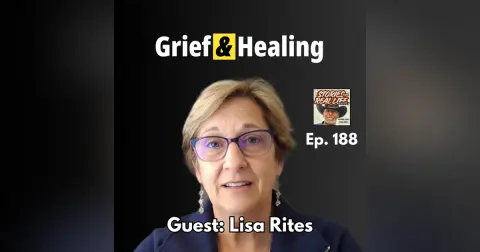
In this episode of Stories from Real Life, grief educator Lisa Rites discusses the multifaceted nature of grief, emphasizing that it extends beyond death to include experiences like divorce and life transitions. She shares her personal journey through grief and how it led her to become a certified grief educator. The conversation explores cultural perceptions of grief, the importance of individualized support, and practical strategies for coping with loss. Lisa highlights the significance of journaling and the need for compassion in supporting those who are grieving. Ultimately, the episode conveys that healing is about learning to carry loss with grace and honesty.
Get full access to Melvin E. Edwards at storiesfromreallife.substack.com/subscribe
If you would like to support this podcast, please click on the PayPal link to make a donation today. Any amount is the perfect amount!
Thanks!
0:02 What if grief isn't something you move on from, but something you learn to move with? In this episode, grief educator Lisa Reitz talks about the losses we don't always name, the damage caused by well-meaning advice, and why so many people feel like they're grieving wrong. We explore divorce as grief, delayed grief, and the quiet ways loss shows up years later, often when we least expect it. If you've ever felt pressure to be strong, to hurry your healing, or to pretend you're fine when you're not, this conversation is for you. This is Stories from Real Life with Melvin E. Edwards, and today's story is Lisa Wright's Death, Divorce, and the Grief Between Them.
0:50 You are listening to Stories from Real Life, a podcast by engaging storytellers for engaged story listeners. Here's your host, author and journalist, Melvin E. Edwards. Hello again, and welcome to another episode of Stories from Real Life. I'm your host, Melvin E. Edwards. Thank you for joining me for the podcast where our personal stories remind us how much we can learn from each other. In this episode, grief educator Lisa Reitz talks about the losses we don't always name, the damage caused by well-meaning advice, and why so many people feel like they're grieving the wrong kind of way.
1:36 We explored divorce as grief, delayed grief, and the quiet ways loss shows up years later, often when we least expect it. So Lisa, welcome to the show today. Thank you for having me. I'm glad to be here. Thank you for being here. So before I start asking you my list of questions, I want to give you a moment to tell the listeners about your book. Sure. So my book is basically my story through grief and divorce. And I actually, going through it, didn't realize how much divorce is grief. And I think a lot of people don't realize that, but it is a loss. And a lot of people always think of grief as death, but grief can be any kind of loss.
2:20 And end of relationship is a huge loss for people. So I decided to write my story down, give a information about grief and each of the stages. And then as they go through those stages, I talk about my story through that stage. And then I give readers a chance to journal some information, answer some questions for themselves, and hopefully at the end, find some inner peace and some answers to the way they're feeling. Okay. And based on the topic of grief and your last name, have you ever been called things like last rights or dead to rights? That's really funny, but no, I always say that when people will say to me, how do you spell your last name?
3:02 I'm like, rights, like last rights. That's the best way I can describe it. So yeah, you, you would think I'd hear more of that though, but. People just aren't creative enough, I guess. No, no, just me. All right. So can you share a story about how your personal experiences with grief and divorce led you to become a certified grief educator? Yeah. So 40 years of my life, I was a registered respiratory therapist. So I dealt with families and grieving families, you know, families that were just going towards near death with their loved ones. Unfortunately, with respiratory disease, a lot of times there's no better outcome.
3:44 So as I was progressing out of my full-time career, I wanted to continue to do something with my life and something that I could help with compassion and empathy. So I looked into this profession and moved myself over to be a certified grief educator and went through the courses in schooling. And now I work with clients that are going through grief and not therapy. It's more education, truly education, walking side by side with somebody that is going through the grief process and trying to help them as they go through each of the stages. So do you work with like hospices, things like that?
4:24 Yes, but I mostly work with clients on my own, all virtual. And I've worked with veterans. I work with obviously end of relationship is one of my niches. And then a lot of times I work with a lot of caregivers that are family members that are living with the elderly or their parents that are near death, that I try to help those caregivers learn about the death process and the grieving process as they're getting ready to grieve their loved ones. All right. So what did you learn from being a respiratory therapist that helps you in your approach now?
5:05 Well, knowing as a respiratory therapist and a lot of patients aren't told, especially when they have a lung disease such as COPD or emphysema, that there is no cure for that. And life can get very difficult towards the end, your breathing process. So I'm working with families and trying to help them through that. I used to run a COPD support group for families to help them through what they were facing, because a lot of times people, again, are just misinformed and don't have all the information and change in diet or just change in activities that patients can do. And family members think they are family, you know, they're person who has a disease is able to do all the things they used to do and they're not.
5:53 And so working with that kind of helped me with this because now, again, I can work with families and work with others that are going through that. Okay. What was the moment you realized you wanted to dedicate your career to grief education and support? Right. I think because I'm a very compassionate person. I get a lot of that from my mother. I just love to help people. I was the person, I always tell people I'm the person that always brought the stray dogs home when I was growing up. I've always had that in me. I believe in people. I want the best for people. Once I moved out of respiratory, I just really wanted to find something that I could be able to help people in and um just watch them grow and it's just such a great feeling um when you're helping somebody in grief be able to move into another step even even if it's just being able to wake up in the morning and put your feet on the floor that's a huge step for some people and um when they when i'm meeting with them and they're telling me that and they're just like oh i was able to do this and you know i went to a book club by myself because maybe their partner's gone now or they were out to dinner or lunch by themselves Just to see that makes me feel so good that I'm able to help somebody be able to just move on to another step.
7:17 Move forward, I should say. Okay. Sorry to interrupt. Was there any particular loss or turning point that shifted your perspective on grief? There really wasn't. It really just came from my heart, and it was just something that I wanted to do. I did lose my mom back in March, which – I think what I know now was able to help me through more of that versus when my dad passed and learning in the grief education course about all the different losses, because I didn't realize myself how many different types of losses there are and learning about that whole relationship and divorce and going aha that's that's crazy like i went through all that you know and and um yeah so i just feel like i learned a lot more about about grief myself not knowing about all the different losses okay does your definition of grief differ from like the culture the common cultural understanding I believe it does.
8:16 I think culturally we are not educated. I feel like grief is one of those taboo subjects that people just don't talk about. We don't learn about it. People are just told, you know, somebody, a family member passed, this is the process we're going to do. And then, okay, now you got to go back to work or school or, you know, whatever you're, wherever you're at at the time. And basically that's it. We talk about our loved one here and there, but people just don't realize that there is a whole process to go through. And for some people, it can last a lifetime. For some people, it might just be through the process and they're good.
8:56 But I just feel society does not know how to deal or work. talk to people that might be in grief. I think a lot of times, one of the things that I do when I'm working with clients that are facing a grief that's coming towards them, such as the death of a family member, a loved one, one of the things I tell them is about how that person's going to change and maybe how Maybe that person doesn't want to die, you know, and they just don't know how to tell you that. And a lot of times people get frustrated with the elderly because, you know, they're not behaving the same way. And maybe inside they're really the person is really frustrated because they're watching their their loved one pass, you know, and that can be very difficult.
9:44 And that is all. process of grief. And I think people don't realize that. Another thing is friends helping friends. I deal a lot with this. People don't know what to say to people who are grieving other than I'm sorry, because that's what we say, right? That's what we're taught. You say you're sorry and you move on. But things not to say are things like, you know, you should be over it by now, or wow, you talk about this person too much, or, you know, You should be you should be past that. And those are definitely not things to say. I always try to tell people maybe an idea is if somebody is grieving, you don't know what to say.
10:24 Call them up and maybe have them over and have a cup of coffee and just sit there and let them talk. And if they're still grieving, it's OK. They're allowed to. Try not to stop them, tell them that they shouldn't be talking about their loved one because it's perfectly fine to do that. But I feel in society, we don't have the patience for people that are in grief. And that's just sad. It is sad. And one thing I've learned, having lost both of my parents when I was pretty young, especially my dad when I was 13 years old, is over the christmas break my now adult son who lives in virginia and i live in texas he's been married about a year and a half and he and his wife came down for the holidays and i we drove to houston to to the cemetery where my where my parents are buried and it was sort of an opportunity in my mind to sort of introduce my parents to my daughter-in-law and my now adult son and it was way more emotional than I anticipated it being.
11:27 And I think part of it was because my son is so much like my dad. And we think about how much they would have enjoyed each other's company. And yeah, when we do, we think about the things that our parents are missing or our loved ones are missing. You know, I have the same thing. I've had some children get married since my dad passed and, you know, he didn't get to see that. And I know he would have loved it. And I know he would love all my son-in-laws and, you know, daughter-in-law and all that. But, you know, he didn't get that opportunity. So, yeah, that's that. And again, that is still part of grief because it does come back up at you when you least expect it.
12:11 Even after 45 years. Right. But tug at the heartstrings because you went there and it was a whole different experience for you, where maybe if you visit him, you just go, you talk to him. And now here's where you wanted him to meet some people in your life that are important to you and you know he would have loved. So your whole attitude changes and it's a whole different outlook. Yeah. I used to go to the cemetery sometimes like to see aunts or uncles and, you know, just do the thing that I was told I was supposed to do. And then I would see people, I would see like a young family sitting on father's day at the grave in beach chairs.
12:52 And I'm like, what are those people doing? Like, that's crazy. You know, I just couldn't understand it, but you know what, since I've been doing this now and I'm, I'm getting that, like I said, my mom passed in, um, In March and Christmas Eve, my husband and I drove out to the cemetery. I'm sorry, on Thanksgiving, we drove out to the cemetery and we brought some coffee because my mom loved to have morning coffee. So we went and we had a cup of coffee with my mom and I talked to her and my dad and I took some pictures and sent them to my kids. Things I never thought I would do, but it stirred up a whole different... feeling inside and I realized that's okay.
13:33 You're allowed to do this. You know, that person was a part of your life for a really long time. We don't have to forget them. And a lot of people feel they have to move on in grief. You just need to move forward. That's a great distinction. So you talked about, we talked about death and you mentioned divorce as, as reasons to grief, but also life transitions. How are these experiences similar and how are they different? So life experiences is a great form of grief. And I think people don't realize, again, that they're in grief when major things happen, such as loss of a job, loss of a family home.
14:14 Maybe you're moving to another place and you're going to lose all your friends. People don't understand what that feeling is. And that is a feeling of grief. because it's a loss. For some of the veterans that I work with, it's a loss of a limb. It could be loss of themselves being in the service. So really, any type of loss, people can grieve. Grief doesn't just have to be a death. So we're trying to educate more on the word grieve. Because that that word does pertain to a lot of things in life. And for a lot of people, it's a new it's going to be your new normal.
14:55 You know, if you're moving, let's just say, like you said, I moved from New Jersey to Delaware. I remember the day I moved out of my house and everybody left. We had unpacked and I stood in my kitchen that I had raised my family. And this was after my divorce. And I just cried. Didn't understand why I was sad. I was just so sad. But that's grief. It is. It's grief I'm losing. I lost my house, my family home where I was raising my children. I moved to another place and I'm remarried. And I'm not saying life isn't good on this side. It is. But for that moment, I needed to grieve and I needed to let go of what that was for me. And now I needed to move on to what my new normal was going to look like.
15:38 You know, I always tell people, too, you can hold joy in one hand and grief in the other. And that's what I try to when I'm working with my clients, I try to get them to that part where they're still holding that grief, which is fine because you still want to remember some of the things you had. But you can have joy and you can move on and you can still have life. Your life is just going to look a little different. All right. So in your view, why is an individualized support so important for the grief journey? I do believe to have someone who understands the grief journey, like we were just talking about with education and trying to maybe talk to your friends or people who just don't understand.
16:24 And I'm not saying you have to be in therapy or you have to, you know, go to see doctors or whatever. But I think just having somebody to support you and help educate you along the way and let you know that your feelings are valid, what you're feeling is fine. And how do we move to that next step? How do you want to move to that next step? It's not about me telling them, oh, you know, this is what you have to do next, or this is what you have to do. It's not because you need to make your own decisions. And as you move forward, you need to figure out what you want your next steps to be. Like I said, whether it be getting out of bed in the morning, because you haven't been able to do that for a really long time, or maybe it's learning how to Make some new friends.
17:13 Maybe it's learning how to rediscover yourself. That was huge for me after my divorce was finding myself again because I didn't become a bad person. I became a different person because I was raising four children. I became a mom, you know, all those things that were Lisa when she was single, you know, not with family. had gone away. So when I went through my divorce, and I was moving on through my grief process, and I moved into that acceptance stage and trying to find myself again, I brought back some of the old me, you know, so it's real important to dig down deep and find some of that and just be able to walk with somebody and have somebody that will listen to you More as a, I always like to say as a friend than as a medical personnel.
18:06 Okay, so what are some of the early signs that someone might benefit from some professional grief support? So, usually right away after a death, I usually won't take on a new client because people are in early grief and I think it's too early to move into some of those stages. And I usually like to tell people when I meet with them, you know, reach out to me in about six months. Let's see where you're at. So that they have some time to have that personal grief and get all of that off of them. And then kind of start to look into, especially if you find you're not moving on.
18:47 You know, I've had clients call me and they're just like, I cry every day. I can't stop crying. I just cry every day. And it's been a year. Okay. You know, and then you start from right there. Why, you know, what are you crying about? And then moving on and trying to help them through so that they're not crying every day. And, you know, trying to realize things we can do and worksheets and journaling and, you know, things like that, that kind of help you get through those phases. So, you know, again, I don't work with early grief, but I will tell people to just try to process a little bit and then reach out to me. Yeah. And a lot of people will wait. And then once they wait and a lot of people will call me right before that first anniversary is coming up because they have to get through that part.
19:33 And that's a tough part. And that's when I think sometimes people start to need help. So what is a first session with you? So I offer a free session first where we talk. I like to hear who their loss was or what their loss was, talk about it a little bit, see where they are in the grief process. Some people could be 10 years in, some people could be a year in. And then just try to see if we're both a good fit. And then I usually tell people, think about it, decide if this is something that you want, and then they can go back and book sessions if they want to. And then I usually start with that client wherever they are in their grief process.
20:15 It could be anger, it could be trying to learn acceptance. So everybody's in different places of, of the grief process. And then we kind of go from there. So I, you know, never tell people just sign on. I always like to, you know, make sure that they're thinking about it. And if this is something that they want to do or talk about. So if somebody is in the midst of grief, what are the first thing you encourage them to prioritize? Usually the first thing we talk about is journaling. Journaling is a big relief process. And if they haven't been journaling, I usually always have my clients start. That's the first week. We'll always start with journaling and writing things down, whether it's anger.
20:57 It depends, again, where they are and what kind of journaling we'd be doing. And then always providing worksheets and moving on and, you know, just talking through whatever stages that they're at. But journaling is huge. And when you look at my website or you look at my monthly newsletters, they're always talking about journaling because it's just such a good way for people to get and release whatever it is they're thinking or feeling. All right. So how can somebody best support someone they know and who's in the grieving process without overstepping their boundaries or saying the wrong things? Right. So, like I said, some of the wrong things that you could say, don't say those.
21:37 But I always tell people supporting a friend or a loved one, first off, maybe have them over for coffee. Maybe bring them lunch. Maybe ask if they want to go for a walk and let them say whatever they want to say. Just listen. Don't answer back saying, oh, I had that with my father and then start rambling about yours. There'll be a chance for you to say yours too, but try to just let that conversation roll and let that person speak to you and just say whatever it is they're feeling. And if they want to talk about their loved one for 20 minutes, That's OK. Let them, you know, just shake your head and say, yeah, oh, no.
22:18 Or I remember that. Or that was so funny about that person, you know. But saying, you know, well, you'll get better or you're going to get over this or, you know, they will, but they might not right away. And it's not what they want to hear because they're going to walk away saying, OK, great, you know. that didn't help me. So just kind of being empathetic and really listening to what the person's saying and just support whatever it is that, that they're telling you. Yeah. Obviously different people express grief in different kinds of ways, but there's also different stages of grief within that one person too. So you can have like moments of sorrow and moments of joy.
22:59 So how do you help people understand that kind of complexity? Yeah. So I will talk about the different stages in the beginning. And I always tell people it's like a ladder. And as you move through the stages, because the stages don't have to happen in order, but as you're moving through, I always talk about anger because anger is probably the biggest and the hardest stage to get past because whatever your loss is, there is usually anger that comes with it. So I always tell people, you know, you may start... feeling better and you're working your way up that ladder and you're getting towards, you know, feeling a little bit better. And then you're going to have a really bad day and you're going to fall back down and you're going to get really angry and you're going to get really mad, you know, and again, it's okay, you know, but what are you going to do if that happens or try to find out what their triggers are that upset them?
23:52 And how are we going to deal with those triggers? And the next time the trigger comes, what are we going to do to get past that trigger so that you don't fall back into a a stage and stay there because you never want to get stuck. I always tell people try not to get stuck in grief. Moving forward is really the goal that we work with is to just get you forward and get you past wherever you're at. We don't want you to stay stuck. What are some coping mechanisms that people can use to help them get past a stuck stage? past the stuck stage. So, yeah, I mean, you really have to you have to think about what your trigger might be that is making you stay there.
24:37 So let me just take like for my divorce when I was stuck in that anger stage for a really, really long time because my husband left me. So I was really angry. And the trigger was the person he was with. Anytime I saw her or my kids came home and spoke of her, I got really angry, you know, so I, I would journal and then I would crumple it all up and throw it across the room because that would make me feel better. Um, sometimes I would grab a game and play with my kids or I would say, Hey, let's go for a walk. Let's go for a bike ride, just something to move and get me past the Um, that thing I always tell people, you know, a lot of people will say, well, I'm going to have a bottle or I'm going to take this or, but, you know, we try to push away from, cause alcohol is not the answer.
25:28 Medication is not always the answer, you know? Um, and for that, you don't need me. Um, and I would push you towards who you would need, but yeah, we, I try to, um, whatever it is or wherever they are, if they have children or if it's, um, you know, um, If they're by themselves, you know, or they have a dog, take your dog, go for a walk, you know, hug your dog, grab your dog, go. What is it you like to eat? Make yourself something special, you know, just something to get away from that trigger, you know, so you don't keep staying stuck and falling back. And and if you're stuck, I can't go out. I don't want to do anything alone.
26:08 Then we'll talk about, you know, OK, so maybe a friend or how do you think you can get? How about go to the library and get a book? That's like you'll be out by yourself or they'll make that step and they're excited. Or, you know, I had a client that was going through a divorce and didn't want to do anything by herself. And she went to a museum that was having like a poetry talk. And she reached out to me the next week when we were in session and she was like, oh, my God, it was wonderful. And I did it by myself. And, you know, I actually went up to somebody and said hello, you know, like it was huge, you know. So just again, just giving them ideas, but depending where they are is going to depend on the thoughts or processes that I would go over with them to do.
26:54 Okay, getting back to your book, just for a couple of questions. So your book emphasizes grace, faith, and hope. So how do these elements play a role in healing from loss? Always giving yourself grace. People need to be a little bit easier on themselves. Um, so when I do talk about grace and, you know, I talk about giving yourself some grace and when you're having a rough day, it's okay. The next day, wake up, let yourself get past that. It's okay. You're allowed to do that. Um, my faith was a big, a big part for me. Um, You know, I believe in God. So a lot of my prayers and talking to God and helping having him help me through and going to church, because I did after my divorce, after I separated, I jumped out of the church for a long time.
27:41 And then when I met my now husband, him and I started going back to church weekly and I found my faith again. And I realized that I really needed that. So so those are some of the things that, you know, help me through. So how do you support somebody who has lost their faith because of what they're dealing with with grief? Um, that's, that's very difficult to, um, deal with. I usually try to find out what, if they, what they believe in or what they no longer are believing in. And I really just try to talk to them about why they lost what they lost and, um, try to promote that there is a higher power.
28:22 Um, but you know, I have clients that just don't believe in that won't go anywhere. So, um, it just depends on, on the person that I'm talking to. All right. So can grief ever be anything that just painful? Can it be transformative or causes somebody to have a kind of growth experience? Absolutely. I think, um, I think you can move forward from grief. Um, again, I think that grief, there will be times when that grief is there, maybe on an anniversary date or maybe on that person's birthday, if we're dealing with death. Um, With divorce, it depends how it ends. My divorce ended very friendly. I was at my husband's wedding, my ex-husband's wedding last year.
29:05 So we ended very friendly. But that was the path I chose because I decided at one point. which is in my book, I no longer wanted to be angry because why was I going to spend the rest of my time angry? He had moved on. He was doing his thing. My kids were doing their thing. And why am I going to be angry? That's crazy. You know? Um, so. learning how to move forward. Are there times I still grieve? Yes. Do I still grieve the loss of my marriage? I certainly do. You know, even though I've moved on because I sit some days and I wonder like when my kids got married and we were both at the wedding, I'm like, how would this have been if we were married? You know, would this have looked any different?
29:46 You know, so I think that grief, some forms of it will never go away, but you can move on and be happy and still hold that that loss, if you need to, it's perfectly fine. If you don't need to, you don't have to, you can let it go. But for those that are out there that need to hold onto it, it's perfectly fine and don't let people tell you you don't have to because you can hold onto it as long as you want to. Okay. So I just have a couple of questions left to start to wind down the conversation. So let's talk about your book some more. It's called Grief and Divorce, A Journey Through Healing. So what kind of impact do you hope the readers get from it? I hope at the end, I do talk about the end.
30:29 I hope they can get some inner peace. My goal with writing the book was because I feel like my family dynamic is not typical anymore, but I was able to move past all those stages and come to acceptance and accept, in all honesty, I needed to accept for myself that part of that divorce was my fault. There is a reason he strayed. I'm sure I had something to do with that. So I had to accept that, which is a really difficult thing, but I always still try to accept all the good things I liked about him, all the things that made me happy when we were in the marriage.
31:13 We have four children together, and I can't imagine... being angry with him now in front of my children and not speaking. I feel like every family function would have looked horrific if it was that way. And I know there are a lot of people out there that have that. So I'm hoping if you read my story, you might get a little hope that if you do something, even one little thing in there, maybe something will trigger and you do it a little differently. Maybe you can be a little happier too and move on. And if you can't have that dynamic, which not everybody can, I hope that somebody will find some inner peace and at least for themselves feel a little bit better that, okay, I struggled like she did throughout all those stages.
32:04 I did all this, but when it came to that keeping the strong bonds together, I can't do that. But there was a lot of stuff that I had to come to realization for. Because my first thoughts when my husband was leaving was, I'm never, ever going to let you see my children again. We had this family, you're leaving it, you're never seeing them. And he knew that. But as I started to realize, and I mentioned this in the book that I did come to realize he was not leaving his family. He was leaving me. So I had to accept that. It was me. It wasn't his children.
32:44 And by him having them or having time with them, it gave me free time. oh, duh, gave me time to go do some things for myself. Again, why make that strain on yourself? Whether you're the male in the situation or the female, being selfish is not gonna help anybody in this situation. So if at any part you can start to look forward and move on. Even if you're just at the end of a relationship, maybe there are no children, maybe it's not even a divorce, but I know people who are in relationships that can't even date anymore. You know, there, there, there is a way and you can do this.
33:27 You just, you have to just learn and be educated on the ways to get through it and you can get through it. I do believe that. All right. So as a final question today, what's next for you? What do you have planned to do? Do you plan to write another book? Yeah. So my next book, I am working on it now. I am calling on veterans that have stories of grief, be it any kind of grief story. I'm listening to them and I'm going to be putting stories together. So I'm going to make a story of veterans' stories and So that's what I'm working on now. And I just finished recording two classes, two courses, one on loss of your mother, one on loss of your father.
34:16 And they relate to... Whether you had a good relationship with your mother or father or a complicated one. So be it your mom died and she was loving. Or if you had a relationship with your mom where maybe she was not the loving mom and you're grieving that part because there's that also. So these two courses are aligned together. And that's that's in the works that will be coming out within the next month. And then I'll be working on I'm going to be working on courses for grief and divorce, and I'm going to be working on some for grief in the workplace. So I have a lot coming up this this this year. So can you tell the listeners how they can get in touch with you or how they can find out more about your work?
34:59 Yeah, so I'm on all social media, LisaWritesGrief. And my website is LisaWritesGrief.com. And you can go on there and there's connections to all my social media. I have a monthly blog. You can sign up for my newsletter. And you can book a free session there. You can book sessions. There's information about my book, my e-books. Everything is on there that you could need. So I always say support there. Okay, I will include those links in the show notes. So our guest today has been grief educator Lisa Reitz. Lisa, thank you so much for being here today. I appreciate it. Thank you. It was great. So as Lisa reminds us, grief doesn't come with a finish line.
35:41 Healing isn't about erasing your laws, but learning how to carry it with honesty and with grace. So please like and share this episode with someone who may be grieving now. That's it for today's episode of Stories from Real Life. Until next time, don't forget to shine your light wherever you go. That was Stories from Real Life. Join us again next week for another great storytelling journey. See you next time.


