
 Spotify

 Apple Podcasts

 Goodpods

 Audacy

 iHeartRadio

 Youtube Music

 Amazon Music

 Audible

 Podchaser

 YouTube

 Castbox
 RSS Feed
Ep. 200 - Melvin E. Edwards: Announcing the Release of 'Nuremberg, Mississippi'
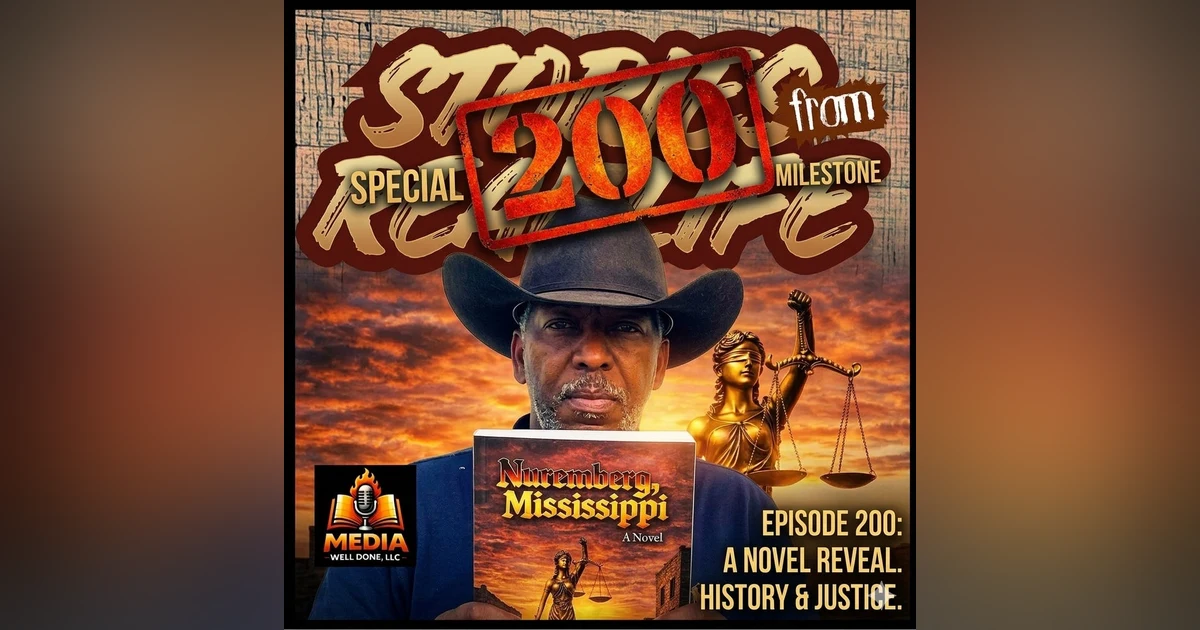
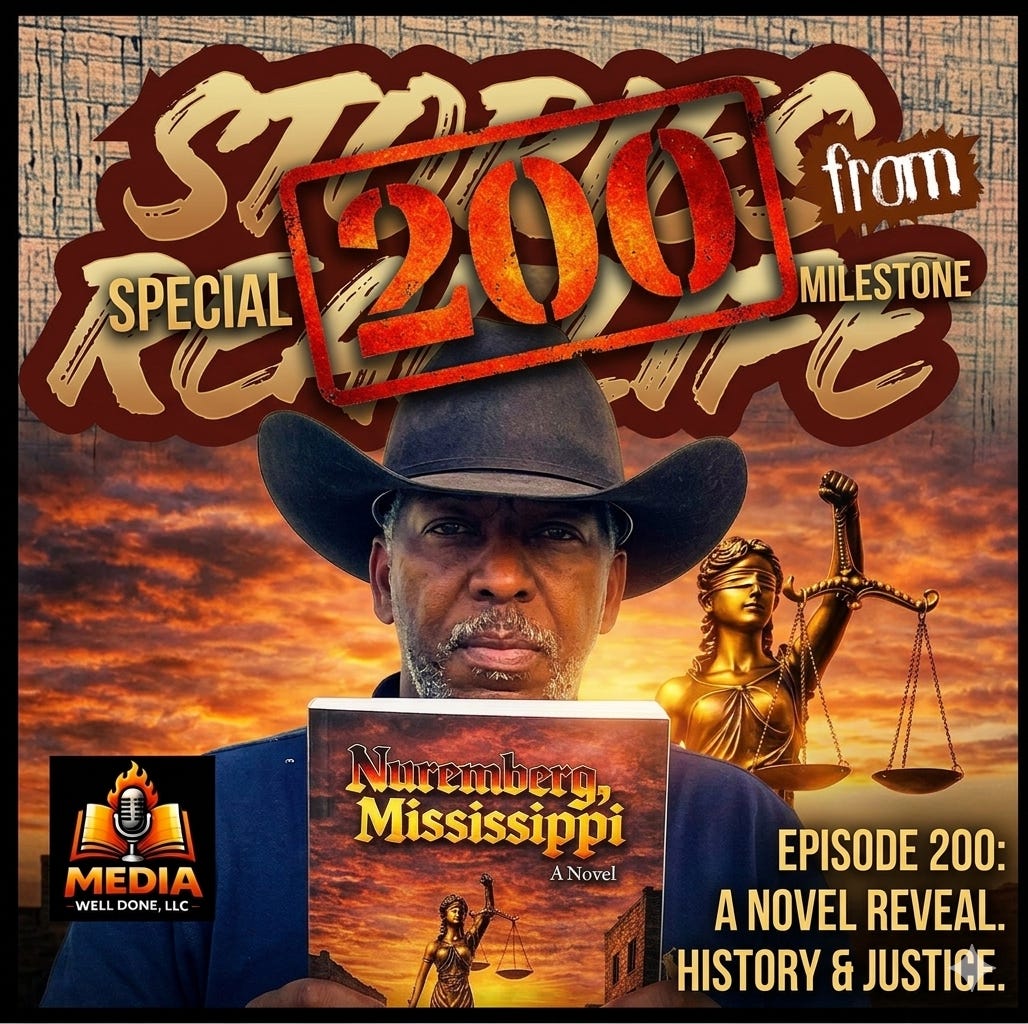
Episode 200: A Milestone and a Premiere
To celebrate this double-milestone, this episode reflects on the journey to 200 episodes of Stories from Real Life and announces the global launch of the debut novel, Nuremberg, Mississippi.
Episode Summary
In this special edition, we mark the 200th episode of the podcast by diving deep into the intersection of historical justice and narrative storytelling. We explore the process of bringing Nuremberg, Mississippi to life — a story that interrogates institutional design and moral responsibility through a lens of literary fiction.
Key Highlights
* The Genesis of Nuremberg, Mississippi: How narrative journalism and a fascination with legal procedure shaped the world of Henry Logan and his wife, Helen.
* From Research to Reality: Bridging the gap between historical institutional structures and the fictional landscape of the novel.
Release Information
Nuremberg, Mississippi officially launches on May 1, 2026. You can order on the website MediaWellDoneLLC.com or on Amazon or Barnes and Noble.
The novel is available through all major retailers and is the flagship release from Media Well Done, LLC. For those in the Texas area, keep an eye out for details regarding the upcoming local bookstore signings.
The first two events will be in the San Antonio area:
May 3: The Twig Bookshop, 11 a.m.-1 p.m. (San Antonio’s Pearl District)
May 9: Book Haus, 1 p.m.-3 p.m. (New Braunfels)
Get full access to Melvin E. Edwards at storiesfromreallife.substack.com/subscribe
If you would like to support this podcast, please click on the PayPal link to make a donation today. Any amount is the perfect amount!
Thanks!
0:01 Stories from Real Life is a production of Media Well Done, LLC. History rarely announces itself. It arrives quietly, in laws written on paper, in rules everyone follows, in systems few people question. In 1945, the world gathered in a German courtroom. The city was Nuremberg. And the question before the tribunal was simple. When injustice becomes law, who is responsible? The defendants answered, we were just following the rules.
0:44 But the tribunal rejected that defense. And in doing so, it established a principle that would change history. The law itself can be guilty. Twenty years later, an ocean away Another system of laws was still standing. Not in Germany, but in the American South. In Mississippi, justice had rules. Some people could vote. Others could not. Some people could walk freely. Others had to leave town before sunset. And the system worked exactly as it was designed. For generations, these stories lived in silence. Until one writer decided to ask a dangerous question. What if the principles of Nuremberg were applied to America?
1:27 What if the courts were forced to confront not just individual crimes, but systemic injustice? What if the rules themselves were the evidence? That question became a novel, written by Melvin E. Edwards, host of the podcast Stories from Real Life, and the descendant of a family whose history carries the weight of that question. His great-great-great-grandfather, Isaac Bladen, could vote in 1867 during Reconstruction. But his father, born in 1927, was denied that right until 1965. Nearly 40 years of silence.
2:07 Not because the law failed, because the law worked. Now, that history becomes fiction to reveal a deeper truth. A story about a lawyer named Silas Thorne, a man named Henry Logan, and a courtroom that dares to ask whether an entire system can stand trial. The novel is called Nuremberg, Mississippi. And today, for the 200th episode of Stories from Real Life, the author tells the story behind the story. how the book was written, why the question matters, and what justice really means when history is on trial.
2:50 You are listening to Stories from Real Life, a podcast by engaging storytellers for engaged story listeners. Here's your host, author and journalist, Melvin E. Edwards. Hello, and welcome to another episode of Stories from Real Life. I'm your host, Melvin E. Edwards, and this is episode number 200. I'm pretty excited about it, and it's a special episode that I'm glad to share with you. I'm actually going to be the guest today, and I have recorded some questions, and I will be answering the questions to kick off the launch of my brand new novel, which releases today.
3:40 May 1st. That's why you have a special episode today. It's not Tuesday, but I think you'll appreciate it. May 1st, launch. Newenburg, Mississippi is my brand new novel and it's available everywhere. I hope you'll pick up a copy and I hope you enjoyed this conversation about the book. We're sitting down today with the author of Nuremberg, Mississippi, Melvin E. Edwards. But before we dive in, I just have to say congratulations on your 200th podcast episode. That is an incredible milestone and it's an honor to have you here for this one. Thank you. 200 episodes is a big deal and I'm excited to be here today. Let's get into the book, That concept is the entire premise of the book.
4:21 There are about 330 pages of the book, and there's not a single episode of physical violence against anyone or even... Peter Robinson, Ph.D.: A profane word. Everything, all the violence, all the misdeeds done against individuals are done administratively, professionally, and just absentmindedly. As Hannah Arendt called it, it's the banality of evil. Nobody came and lynched anyone. Nobody burned any crosses in anyone's yard.
5:03 They just did their jobs without thinking about what they were doing, and it caused great harm to our protagonist, Henry Logan. And he hired Silas Thorne to be his attorney, and we will get into the details of that as we go along in this conversation. I noticed some familiar surnames in the text. Logan, Thorne, Blayden. These are from your own family history. Why was it so important for you to ground this fictional narrative in your actual real-life ancestral landscape? That was important to me because those ancestors are the ones who actually endured these types of evils that we discuss in the book over generations. I've written a couple of books about my family's history, and it's important to me personally, it's important to me to remember my ancestors and to keep a record so that the world remembers their names.
5:55 I feel like I've been blessed to have such an enduring, supportive family, and I wanted to honor them in this way by using their names with each character in the book. So by reading the book, you will see last names. that are familiar if you've read my other two books, and it's just a way of honoring them. It's not in any way a one-to-one equivalent, but it is a comparative, and they did endure some of these same types of trials that Henry Logan and some of the other people in this fictional town of Greenville, Mississippi, endured. Now, as the host of Stories from Real Life, you've spent years interviewing people about history and justice. I'm curious, how did your podcaster brain influence the way you wrote the dialogue and the pacing of this novel?
6:42 The pacing of this novel is one of the more unique aspects of my writing process. Readers will notice that chapters are intentionally brief, quarter chapters, half chapters, and I did that because I intended the form to Matthew Feeney, Ph.D.: The banality of evil, the evil of segregation, evil of Jim Crow can come to people in increments. It's not necessarily somebody who wakes up every day and they're just hammered with the oppression that is very real in their lives, but some of the more dramatic aspects of it come in increments. So they may have something that happens one day, and then it may compile the next couple of days, and then they may have a time So I wanted the structure of my book to give people an idea of the incremental pacing of Henry Logan's world in the way they read the book.
7:39 So the form mirrors the structure, if that makes sense. It will make sense if they're looking at the book and reading the book. Let's talk characters. Silas is a man of measured restraint. He believes the law is a shield for order. What's the moment where he finally realizes that this order is actually just a form of controlled injustice? Well, I don't want to give away the specific moment because that'll ruin someone's reading of the book. I don't want to give away spoilers. But Silas Thorne is someone who is generationally entrenched in the Greenville, Mississippi culture. He's a third-generation person lawyer in his town named Silas Thorne, his grandfather, his father, and himself, all lawyers.
8:23 His grandfather and father were One was a judge, one was an elected official. And Silas is an attorney in town with a private practice and he's doing very well. And in his mind, restraint is a form of self-control and self-control is a form of confidence and security. He keeps things running in the town in a predictable manner and he doesn't realize that what he's doing by maintaining what he would consider order is really a form of control, as James Baldwin would say. So at some point in the book, Silas starts to come to that realization.
9:06 And it takes a while, but he starts to change. And I think one of the things about the characters in this book is There are no real definitive enemies. There's no what you would see in a movie where there's somebody who was just the bad guy from the start. You know right away who you're supposed to root against. In this book, there's nobody like that. Even the good people have certain poorly formed qualities about themselves. And all the characters are very complicated, including the best of the characters, the ones who are supposedly the protagonists. Everybody has certain flaws, just like in real life. Nobody's all good or all bad all the time.
9:48 So even the people who you like the most, even yourself, you may think of yourself as a good person, but you make mistakes because everybody does. And I wanted to be realistic about the personality quirks that I included in my characters. And so someone like Silas has a blind spot, we'll call it. And it takes several situations where he's taught and others where he learns through personal experience that things just are not the way he thought they were when he looks at things from other people's perspectives. Then there's Henry. You describe him as having competence without assertion. To me, his quiet dignity feels like a direct challenge to the entire system in Greenville.
10:30 Is that how you see him? Absolutely. That's 100% how I see him. Henry Logan is a tradesman. He works with his hands. He's very skilled. He's very intelligent. He never had the opportunity for a college education, but he was very smart in high school. He finished at the top. of his class and even graduated a year early, but never had the opportunity to go to college. But that doesn't mean he's not an educated man. He's more self-educated. He likes philosophy and he reads Dietrich Bonhoeffer and James Baldwin and some others. And he likes to talk about those things. And he finds in Silas, who had his undergraduate degree in philosophy, someone sort of a kindred spirit.
11:12 While their experiences were very different, their day-to-day experiences were very different, their mindsets were So they had the opportunity to have some conversations about some very deep things. And that's another opportunity. There was another opportunity for Silas to learn some things that he never even thought. That somebody who fixed things, built things, tore things down and rebuilt something new for a living could be as smart as he is. It just never occurred to him. And so that is the beginning of a very... a turning point conversation that I think readers will be intrigued by. And I can't wait for them to have the opportunity to just go through the pages of the book.
11:58 You'll probably want to read this book more than once. And I'm not just saying that because I'm the writer. I'm saying it because there's so many layers of characters and situations that reading it the first time, you will... have a general sense of the book but reading it again will feel different because you will have more of an idea of what you're getting yourself into especially if you're not someone who is old enough to have gone through Jim Crow or had parents who went through that era and told you about it whether they were on the receiving end or they were observational or they were on the giving side I'm not going to demonize those people at this point obviously what they if they were on the giving side, they were wrong.
12:43 There's no question about that. But I'm not going to demonize them. The process here is to learn. And I want to give people an opportunity to learn different perspectives and things that they may not have thought about. If someone reads this book and they come out of it thinking, wow, I never thought of that before. That'll be a much bigger compliment to me than saying, this is a great book. Obviously, I want them to think it's a great book, but I want them to have a reason for why they would think it's a great book. And I want that reason to be that I engage their mind in something that they just never had thought about before. And it makes them realize that they may be duplicitous in their own lives.
13:25 And then they may have to examine themselves, look themselves in the mirror and ask them very tough questions. And they may have to change their behavior. That's a part of growing, not just growing up, but growing. And if we don't have a certain amount of awareness or if we don't have a certain amount of interaction, we'll never have the awareness because we just don't know what we don't know. And hopefully this book will give people an opportunity to learn some things they didn't know. And then they will take those situations and they will examine their lives and they'll make some changes if changes are necessary. The title alone, Nuremberg, Mississippi, it's provocative. It draws this very deliberate parallel between the Nazi war crimes trials and the American South.
14:09 How did you arrive at that specific comparison? Why was that the right lens for this story? Yeah, I would say the title is probably provocative, but it's not intentionally controversial. I thought of the title after watching, I don't remember the title of the movie now, was it something at Neuenberg, Trial at Neuenberg, I think it was called, a 1961 movie. I've seen it several times. And I started thinking, if the Nazi criminals could be charged with crimes against humanity by a worldwide body, judicial body, How could America stand up to those same kind of principles, same kind of scrutiny? And I thought, well, Jim Crow was certainly absolutely a crime against humanity.
14:52 Why weren't those crimes ever prosecuted? Why weren't they even considered crimes? Why were they just considered now, in retrospect, a dark time in our history? I consider them crimes. And so I thought, well, let's see what would happen. I'm a writer. I've never written fiction before, but I'm a writer. So I thought, I'm going to figure out a way to put Jim Crow on trial. And this book was the fulfillment of that. It just happened to be in Mississippi because I liked the way the title sounded, Nuremberg, Mississippi. I thought about Nuremberg, Texas, but for some reason I just didn't have the same kind of melody or ring to it. So I wasn't picking on my Mississippi friends. It just happened that with the number of syllables, I just thought it worked out better.
15:35 But I wasn't trying to be unnecessarily provocative, but I'm sure the title will provoke some people, at least generate some interest. And that's the purpose. I want people to be interested enough to read it. The book starts by looking at unwritten rules, things that are simply observed. Why did you choose to focus on the power of silence and expectation, rather than starting with the explicit laws on the books? Yeah, that's a great question. It's kind of funny. My answer is going to be kind of funny to some listeners. I'm a lifelong baseball fan, and other baseball fans will tell you every baseball player knows the unwritten rules of baseball. They may not know the baseball rulebook, but they know the unwritten rules, and those rules are enforced, sometimes with injury.
16:21 And that's essentially what happened in small towns in the south of America. It wasn't necessarily the codified laws on the books, who they were essentially facially neutral. It was the discretionary enforcement of those laws that created the real danger for the people living there, African Americans especially. And the unwritten rules allowed people to and force them in different circumstances and in different measures. So something as simple as looking at somebody, quote unquote, disrespectfully, that would never have been a codified law, but it was certainly an unwritten rule. And we know from history that being accused, a black man being accused of even looking at a white woman, the punishment for that could be death by hanging.
17:09 There was nothing on the books that said if a black man looked at a white woman, he had to be killed. But the people within that system knew or enforced the rules in that harsh of a way because they wanted to send a signal. They wanted to. It was a threat. It was under disguise of the guise of order. It was absolute control. One character argues that the town mistakes order for morality. In your research, did you find that this was a common defense for Jim Crow-era policies? This goes back to the last answer I gave.
17:56 It was ordered to an extreme degree. It was essentially legalistic terrorism. And people who were caught up in that system knew what the penalty could be, but they didn't always know what the crime could be. That was the really That's a really tricky part to try to balance in your day-to-day life. You didn't know if you were doing something routine that somebody might describe you as being uppity because that word had no real boundaries of a definition. They were whatever somehow somebody chose But the loose application of those definitions had very, very dire consequences. And so having to balance that in a daily routine life was what told me that order in those days and those circumstances was certainly not moral.
18:43 And anyone who said they were just following the law either was not thinking about what the law said, didn't care about what the law said, or supported what the law said. I don't think there's any other option. Those people would not have wanted to live their own lives under those types of harsh conditions, but they had no problem being the enforcers because they were the ones who were on top of the social totem pole, as it were. I want to get into the hot seat questions now because this book doesn't pull any punches. By using the name Nuremberg, are you suggesting the average citizen of 1960s Mississippi was morally equivalent to a Nazi war criminal?
19:26 I'm going to be careful how I answer this question because the Nazi war criminals who were prosecuted under the Nuremberg Convention principles were not the people who turned on the gas in the gas chambers or who who whatever, who en masse murdered Jewish people. They were the judges. They were the lawyers. They were administrators. And so in this book, there is an equivalent. They weren't the people who flipped the lever in the gas chamber. They were the people who drove the train to deliver the people to the gas chamber. So they weren't directly responsible But without their input, without their involvement, there would not have been an end result that there was.
20:10 So I would say, yeah, there is an equivalent for those who were prosecuted at Neuenberg to an average citizen in Jim Crow, not just Mississippi, but anywhere in the Jim Crow South, including here in Texas. Well, I'm certainly not comparing the scale of the Holocaust. I'm comparing the aftermath, the judicial and administrative parts of determining how to hold accountable those who perpetrated the Holocaust. So I think that type of a comparison is important. pretty close to a one-to-one and in no way tries to diminish or diminish the terrible outcome of the Holocaust or prop up the results of Jim Crow.
21:01 They were crimes against humanity, but they weren't equal crimes. So murder is not the same as stripping away someone's constitutional right, but they were both crimes that could be enforced by a judge and could be prosecuted under standard laws and procedures. So I don't really have a problem if somebody is upset because it's a very hot button word, the Holocaust, and to use Nuremberg as it relates to it. But I don't think it's a direct comparison per se. And what about Silas? He's a decent man who works within a corrupt system for years before he acts.
21:43 At what point does a good man just become a high-functioning cog in an evil machine? Yeah, that one's interesting, and it's very tough to answer. I would say Silas essentially was a good man. He was certainly competent in his legal profession, but he was so competent that he became, or people like him, became the cogs that allowed the system to continue to function as long as it did. But he was not doing it intentionally. But as he came, as he comes to realize, it would not function. It would not So I would say essentially Silas was on the wrong side, even though he didn't know he was on the wrong side, but that didn't diminish the damage that he caused, either directly or indirectly.
22:30 But I would also say that once he or somebody like him becomes aware of what the system requires to continue to function, and they don't change their own behavior, then they are 100% duplicitous in the management and sustainability of that system. So once they know, they don't have an excuse anymore. I would be willing to give just about anybody just some leeway, some mercy if they do something without knowing it. And that's what I want this book to bring about in conversations. I want people to read it in groups like book clubs.
23:10 And I want them to have a discussion. And as I mentioned earlier, if they say this is something I never thought about before, that's a very good start. But what do you do next? If you don't do anything next, then you are a part of the problem. And we want to fix the problem. Is he a hero or is he just trying to clean his conscience before it's too late? Well, I would say you just have to read the book to find out.
23:51 I'll just leave it at that. Readers can determine for themselves if he is a hero or if he's just trying to clear things up before it's too late. Sort of his way of getting in. I would compare by the framing of your question, I would say the second half of it would be someone like Lee Atwater in the 1988 campaign for the elder George Bush, who was clearly trying to clean up his life, his reputation before he died after he was diagnosed with brain cancer. But I'll let the readers determine whether or not Silas Thorne is a Lee Atwater or somebody entirely different.
24:32 This has been an incredible conversation. You know, looking at the themes we've discussed, the thin line between order and morality, the weight of ancestral history, and that haunting comparison to Nuremberg, it's clear that this isn't just another historical novel. It's a mirror. For anyone listening who's ever wondered where they would stand when the unwritten rules of society finally break, you have to read this book. It's uncomfortable, it's urgent, and it is masterfully told. Nuremberg, Mississippi is available right now wherever books are sold. Whether you prefer your local independent bookstore or you're grabbing it online, don't wait. Pick up a copy today. This is the conversation everyone is going to be having at the dinner table this week, and you're going to want to be part of it.
25:19 Again, congratulations on the book, and a huge congrats on 200 episodes of stories from real life. Here's to the next 200. Thanks for being with us. Thank you, and I look forward to the conversation that begins after people start to read the book. I'm looking forward to that. I think there'll be some tough questions, some really eye-opening discussions that will be had, and I can't wait to hear how those turn out. I can't wait to be a part of it. If you read the book and you have some questions or you want me to be a part of your discussion, reach out to me. Go on my website and send me an email or if you know me personally, send me a text message and I'd be glad to join you over Zoom and be a part of your book club discussion.
26:00 That would be incredible. Well, that's it for this week's episode of Stories from Real Life. Until next time, don't forget to shine your light wherever you go. That was Stories from Real Life. Join us again next week for another great storytelling journey. See you next time.


